Wednesday, December 20, 2023

THE WATER WARS COME TO INDIANA


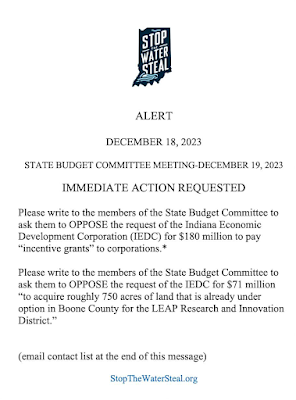
State Budget Committee OKs nearly $300M in IEDC incentives, LEAP enhancements

 |


TO STUDENTS: “BRING YOUR OWN WATER!” (a spoof)

Wanda Ferd

United Press International

September 29, 2023

New Senior Vice President for Policy Planning, Sydney Glick, has come up with an answer to the impending water shortage in Tippecanoe County brought on by the new Silicon Valley manufacturing corridor Purdue is developing between Indianapolis, through Lebanon, and to Lafayette, Indiana. In a policy meeting held August 17, 2023, Vice President Glick proposed that from now on the 50,000 plus Purdue students be required bring their own water supply for the academic year.

Glick declared that without the burden of supplying water for so many students, the high-tech project would make Purdue University the center of semiconductor production in the world. Staff aides pointed out that the student water requirement would give a boost to the production of plastic water bottles. Purdue has placed an order with the Plastics division of General Foods for three trillion plastic water bottles. General Foods spokesperson, Ralph Shallow exuberantly pointed out that each student would owe $500 per semester for their supply of water bottles. The demand for more water bottles would lift General Foods out of a deep decline in sales over the last year.

Former Purdue President, Ed Norton, said about the idea and the corporate connection: “Once again Purdue know how, scientific expertise, and reliance on the free market have led to a reasonable solution to a complex problem. Hail Purdue!”

 ******************************************************************


****************************************************************

And as to the threat to water access nationally see the following:

https://www.nytimes.com/series/uncharted-waters#:~:text=The%20Times%20asked%20all%2050,damaging%20its%20aquifers%20so%20rapidly.&text=When%20Maine%20lawmakers%20tried%20to,out%20to%20rewrite%20the%20rules.

************************************************************************

And how the Indiana economy has hurt workers for over a decade.

https://heartlandradical.blogspot.com/2023/10/hoosier-politicians-and.html


Friday, December 15, 2023

Here Come Raytheon and Rolls-Royce to Purdue University

Harry Targ

The Raytheon Technologies Corporation reported that “Raytheon Technologies is working with the University of Arizona, Texas A&M University, Purdue University, the U.S. Air Force Academy and other academic institutions on hypersonic research and testing, to include the use of wind tunnels to emulate flight conditions and accelerate development.”

Raytheon, one of the five largest defense contractors in the world, sold more than $64 billion in military hardware in 2021. Raytheon profits will be higher in 2022 because of the war in Eastern Europe. Recently, Gregory Hayes, the CEO of Raytheon and a Purdue University graduate who was given an honorary doctorate by Purdue’s Krannert School of Management, predicted that the war in Ukraine will be good for his company’s business.


[Source: twitter.com]

As researchers William Hartung and Julia Gledhill put it: “The war in Ukraine will indeed be a bonanza for the likes of Raytheon and Lockheed Martin. First of all, there will be the contracts to resupply weapons like Raytheon’s Stinger anti-aircraft missile and the Raytheon/Lockheed Martin–produced Javelin anti-tank missile that Washington has already provided to Ukraine by the thousands. The bigger stream of profits, however, will come from assured post-conflict increases in national-security spending here and in Europe justified, at least in part, by the Russian invasion and the disaster that’s followed.”

Another military contractor with ties to Purdue University is the Rolls-Royce Corporation which, according to “Purdue Partnerships at Purdue,” signed a research and development program in 2016 “to create the next generation aircraft agreement with Purdue University.” The partnership resulted in a $33 million jet-engine research and development program to create next-generation aircraft propulsion systems.”


Unraveling an electronic engine controller for the Rolls-Royce AE 3007H jet engine during an announcement of a new engine controls facility in Discovery Park District are, from left, Brian Edelman, president of Purdue Research Foundation; Tom Bell, president of Defense and CEO of Rolls-Royce North America; Mitch Daniels, Purdue University president, and Candice Bineyard, director of defense programs for Rolls-Royce North America. [Source: purdue.edu]

In addition, on April 20, 2022, the company announced a $204 million project to expand one building and two test facilities in the Purdue Discovery Park. Shortly thereafter the West Lafayette government granted the Rolls-Royce Corporation a five-year tax abatement for the construction of facilities in Purdue’s Discovery Park.

·                 


[Source: purdue.edu]


Tuesday, December 12, 2023

ANTISEMITISM CHARGES: THE NEW MCCARTHYISM

 Harry Targ


(The New York Times is trying to link criticism of Israel's policy with antisemitism. The corporate media continues to create pro-US/Israeli narratives. 
https://www.nytimes.com/2023/12/16/us/jews-harvard-antisemitism-israel-war.html)

In early December three university presidents, all women, were called before a House of Representative Committee on Education to explain their defense of academic freedom and the first amendment on their campuses. President Claudine Gay, Harvard, when asked about whether claims of the calling for “the genocide of Jews” on her campus violated Harvard’s rules, she said “it depends on the context.” Of course, the claims about the calls on campus were never verified, and the politicians ignored the fact that President Gay was merely defending academic freedom and the first amendment’s right to freedom of speech.  

While President Gay correctly was defending the hallowed right of free speech and the university as a haven for the “marketplace of ideas.” she correctly implied about the campus and free speech in general that there were limits (the “context”).

As Justice Oliver Wendell Holmes suggested about the question of the first amendment to the constitution, freedom of speech is not absolute. As he wrote in the famous Schenck versus the United States case in 1919, speech may be restricted when “shouting fire in a crowded theater,” where there was a “clear and present danger" that such speech could cause harm. In short, if words are contentious and stimulate debate on campuses they should be protected. If, however, they have the potential to incitement to action endangering people they can be restricted.

In the current case, the corporate media and lobby groups like the American Israel Public Affairs Committee (AIPAC) and the Anti-Defamation League (ADL) are seeking to squash debate concerning Israel’s war on Gaza and the US three billion dollar a year perpetual military aid to Israel. Criticism of Israel’s brutal bombing of Gaza is defined as threatening to Jewish students on campuses and more generally is defined as antisemitism.

These lobby groups refer to a much-criticized definition of antisemitism prepared by the International Holocaust Remembrance Alliance which said about antisemitism in part that manifestations might include “the targeting of the state of Israel, conceived as a Jewish collectivity.” Over one hundred Palestinian and Arab scholars and journalists later responded to the IHRA statement on antisemitism by saying that “In recent years, the fight against antisemitism has been increasingly instrumentalised by the Israeli government and its supporters in an effort to delegitimise the Palestinian cause and silence defenders of Palestinian rights.” . The signatories claimed that linking criticism of Israel to antisemitism “threatens to debase this struggle" against it.

Of course, thousands of Jews and peace groups such as Jewish Voice for Peace, have reflected on Middle East history, the displacement of Palestinians from their homeland in 1948 and the perpetual wars of Israel on the West Bank and Gaza and neighboring countries, and have raised criticisms of both Israeli policy and United States Middle East policy.

Older peace activists remember in the 1950s and beyond, when criticism of United States foreign policy was labeled “communist.” “pro-Soviet” and/or “subversive.” Educators were fearful of raising contentious political issues in classes. Some of those that did lost jobs. Entertainers were purged from television and Hollywood. And, with dissent stifled, the United States found itself in ugly, brutal, and unwinnable wars in such places as Vietnam, Iraq, and Afghanistan. Debate and dissent remain critical for our society. In short, debate about Israel and United States foreign policy toward the Middle East is essential and criticism of either or both is not antisemitism.


Thursday, December 7, 2023

THE MIDDLE EAST TODAY: THE SPIRIT OF CHANUKAH AND CHRISTMAS (a sermon and two interviews)

Harry Targ


Jewish families assemble at dusk on December 7, to light the candles for the first of eight days of celebration of Chanukah. While elements of the Chanukah story remain relevant today this time the resistance against attacks from an armed enemy bent on destroying a people is reversed. While Jewish people were the targets on October 7, since then the victims of brutal violence are Palestinians. Unfortunately, the state of Israel (not the Jewish people) is the enemy. 

The point of Chanukah is for families, young and old, to assemble, admire the candles, share presents and sweets, and enjoy the time that they can be together. But today’s Chanukah requires reflections on the murderous destruction of Palestinian families in Gaza and the West Bank.

Therefore, in the spirit of the eight nights of Chanukah celebrants should reflect and act on the violence being perpetuated in Gaza and around the Middle East.

First, continue to demand, through words and actions, a complete ceasefire in Gaza. Even the corporate media, usually beholden to Israeli lobbyists cannot bear to be neutral in the face of the bombings and destruction (particularly the killing of children) they have to report day after day.

Second, assess the enormous role the United States is playing in fueling this violence: sending arms, finding ways to avoid the transparency of such actions, and advocating for increasing military aid to Israel beyond the yearly $3 billion.

Third, reflect on the extent to which the United States economy is driven by military spending, a permanent wat economy. Huge profits have been recorded for the five leading defense contractors since the Ukraine war began (the Raytheon CEO in fact spoke in celebratory tones in early 2022 about how the Ukraine war was good for its business). The war on Gaza has been an extra benefit for the militarists.

Fourth, think about how the wars in Ukraine and Gaza have rekindled the long historical narrative of American exceptionalism. From Theodore Roosevelt’s praise of the special role of the white race in building civilization to the Clinton/Obama/Biden claim that the United States is “the indispensable nation,” the old ideology has been dusted off to rationalize a new drive for global hegemony. This time the US faces a changing world order in which the Global South is rising up angry and large and powerful nations such as China are asserting their influence.

Fifth, mobilize against a “new McCarthyism,” that is being spread across the land, particularly in educational institutions, claiming that criticisms of Israeli policy are in fact manifestations of antisemitism. In fact, thousands of self-described Jewish activists have been hitting the streets and organizing lobbying campaigns demanding a cease fire in Gaza and registering support for a free Palestine. They see the historic role of the Jewish people as bound, as the Maccabees in the Chanukah story, to resistance against repression.

Sixth, for those who are appropriately concerned about the possible impacts the war on Gaza supported by the United States might have on the 2024 elections it is clear that opposing what is commonly called fascism at home requires opposing fascism overseas. In this Chanukah season Jewish activists need to support politicians who have been calling for a ceasefire, a reduction of military aid to Israel, and the defense of the rights of Palestinian people. Liberals and progressives should be aware of President Biden’s loss of support among the young, people of color, and Muslims, and as well as peace activists generally.

Seventh, revisit “root causes” of Middle East violence over the last 75 years. Unfortunately, the horrific violence against the Jewish people for centuries and particularly the Holocaust was followed by what Illan Pappe has called “ethnic cleansing” of Palestinians resulting from the creation of the state of Israel in 1948 and the 1967 war and Israeli policies ever since. There are many issues to reflect upon and debate but it is clear that the violence in the Middle East did not begin with the founding of Hamas or their terrible violence on October 7, 2023.

Eighth, finally as we celebrate with families while lighting the candles, peace activists should revisit peace alternatives. A two-state solution is not enough; one secular state is needed.  Expropriating Palestinian property and land must be addressed while protecting the rights of Israeli citizens as well. The two peoples who have so much in common historically and culturally must find a way to live together much like the diverse families who assemble for the Chanukah season.


**********


Jewish Voice for Peace: An interview with Rabbi Brant Rosen:  https://www.youtube.com/watch?v=vWgx2OMxZcE

**********

Interview with Harry Targ 

2023 - 12 - 12 - 2000 - Grass Is Greener - Targ And Rice OnHoliday And Resistance by WXRW riverwestradio.com 104.1fm


Saturday, December 2, 2023

MITCH DANIELS CRITICIZES THOSE WHO ARE OUTRAGED BY BOMBING HOSPITALS, KILLING CHILDREN, AND STARVING A MILLION PEOPLE

-He condemns those who are raising historical questions about the creation and perpetuation of the state of Israel at the expense of the Palestinian people.

Harry Targ

Former Purdue University President and Republican Governor of Indiana, Mitch Daniels, published an opinion piece in the Washington Post on November 24 entitled “How Oct. 7 revealed the moral vacuity of U.S. higher education.” https://www.washingtonpost.com/opinions/2023/11/20/campus-antisemitism-jewish-israel/


In it Daniels suggests that institutions of higher education are “wallowing in moral confusion and hypocrisy.” He suggests that “Higher ed has operated for too long in a homogenous, non-diverse bubble of groupthink. America would benefit if that bubble were burst by the sudden discovery of a larger world of people who see things very differently.” And he charges critics of United States support of Israeli militarism in Gaza and the Israeli’s brutal bombing campaign as being “supposedly educated Americans” who “cheer on those who gleefully slaughtered Jewish people, even infants.” (Virtually every peace activist has rightfully condemned the violence and hostage-taking of Israelis on October 7 by Hamas).

Daniels foregrounds his positive experience with Jewish people by recalling fellow children who were Jewish participating in trick and treating during Halloween to raise money for UNICEF. He also referred to Jewish resisters against German fascism during World War II and to the courageous work and tragic deaths of Andrew Goodman and Michael Schwerner in Mississippi in 1964.

For him university administrators and college professors should recall these moments of Jewish heroism and the practice of humane values when many students are protesting Israeli policies.

However, it is Daniels who speaks for those who want to recreate “a homogeneous, non-diverse bubble of groupthink.” While he, to his credit (see the essay linked below on academic freedom), opposes the banning of speech and protest around US and Israeli policy he is speaking for those that do. He invokes what amounts to the old “some of my best friends” are Jewish and/or “aren’t Jewish people virtuous,” and by doing so ignores the history of the creation and perpetuation of the state of Israel and the plight of the Palestinian people.

And ironically, he speaks for those who are revamping higher education to eliminate diversity of thought. Humanities programs that would address the troubling history, ethics, politics, and literature of the current crisis in the Middle East are being dismantled at Purdue and other places. In addition, rich alumni and politicians are, in the spirit of Daniels, seeking to prohibit the discourse on the issue of the Middle East on college campuses. The bottom line is that while most of the world looks on with horror at Israeli slaughter of thousands of Palestinians in Gaza and the West Bank, every effort is being made in the political process and in educational institutions to censor discussion of this grievous and inhumane period in our history. And to Daniels’ initial point, many of those who are outraged and are protesting US policy are Jewish people.


On threats to academic freedom.

https://heartlandradical.blogspot.com/2021/12/red-scares-in-higher-education.html?fbclid=IwAR12TI_SP3uNC9s7AYTol38c_ZPUbwGiwyLPWFOnGleenIN3nmNg0QNQhU8

Criticizing the Israeli war on Gaza is not anti-semitism.

https://heartlandradical.blogspot.com/2020/01/challenging-united-states-foreign.html?fbclid=IwAR27xx6_idca10ETqkHe6L91iX_D4K5PY5u2eWEoSABbQTv8iBhU8D4qm4g

Some of the historic role of the United States in the Middle East.

https://heartlandradical.blogspot.com/2023/11/some-of-historical-context-of-us-policy_9.html

Some of the history of living in Gaza

https://heartlandradical.blogspot.com/2014/08/the-middle-east-militarism-growing_18.html

https://heartlandradical.blogspot.com/2023/10/some-resources-on-history-of-palestine.html


Thursday, November 30, 2023

The United States Overthrows Allende: The Kissinger Role

Harry Targ

                                            National Security Archive


The United States government always interfered in the politics of Chile. That began to increase in 1970 when the Chilean people elected Marxist Salvador Allende as its president. The United States had supported the Christian Democrats in Chile with official assistance and CIA financing since the 1950s. Eduardo Frei, Chile's president from 1964 to 1970, was the favorite Chilean politician of the United States. He had been opposed in presidential elections by the Marxist Allende, who, leading a left coalition, finally won a plurality of votes in 1970, despite much CIA money funneled into the coffers of the Christian Democratic candidate.


From the time of the election in October, 1970, until September, 1973, when a bloody military coup toppled Allende, the United States did everything it could to destabilize the elected government. First, from October to November, 1970, the United States pressured members of the Chilean parliament to vote against certification of the election victory, traditionally a routine exercise. After Allende had been confirmed as president, energy and resources were used to damage the economy and make contact with rightwing members of the Chilean military to plan a coup.


Allende carried out many policies designed to improve the material conditions of the lives of the workers and peasants in Chile. Land was redistributed, major industries were nationalized (copper had been partially nationalized under Frei), and  diplomatic relations were established with the Soviet Union, China, and Cuba. All these moves exacerbated tensions with the United States, since investments in copper, iron, nitrates, iodine, and salt were large.


The Nixon administration formed a secret committee, The 40 Committee,* headed by Henry Kissinger and enthusiastically endorsed by the International Telephone and Telegraph Company (ITT) a major economic power in Chile, whose purpose was the overthrow of Allende. The Kissinger Committee's preference was for an Allende defeat resulting from public rejection, but, if all else failed, a military coup was preferable to a continuation of his government. Among the policies utilized by Washington were an informal economic blockade of Chile, termination of aid and loans, IMF pressure on the government to carry out antiworker policies, fomenting dissent in the military, and funding opposition groups and newspapers, like the influential newspaper El Mercurio.


*https://www.nytimes.com/1975/01/19/archives/the-secret-committee-called-40-at-least-in-theory-it-controls-the.html


Allende's economic policies were effective and generated much support from workers and peasants during 1970 and 1971; but, after the economic squeeze on the government increased, Allende had to grapple with inflation, balance-of-payments problems, and the inability to get spare parts and capital goods that had traditionally come from the United States.


In trying to forestall military intervention in the political process, Allende allowed the "constitutionalist" officers to be replaced by avowed fascist generals. U.S. contacts with these generals provided the organizational basis for the impending coup. Excessive demands by more well-paid workers and more secure peasants, coupled with a truckers' strike and demonstrations of middle-class housewives organized by the rightwing, added to the problems of the Allende government in 1972 and 1973.


But despite the increasing economic and political problems being faced by Allende and the systematic efforts by the U.S. government to create discord within Chile, the Allende-led left coalition scored electoral victories in municipal elections throughout the country in March, 1973.


Since "making the economy scream" had not led to the rejection of Allende at the ballot box, the Kissinger committee and the right-wing generals decided to act. On September 11, 1973, the military carried out a coup that ousted the Allende government, and Allende himself was assassinated in the presidential palace. A junta headed by General Pinochet began a policy of extermination, torture, and imprisonment on a massive scale. A year after the coup, Amnesty International reported that some 6,000 to 10,000 prisoners had been taken. The new regime also banned all political parties, abolished trade unions, and continued its political repression both at home and abroad. In reference to the latter, Orlando Letelier, foreign minister in the Allende government, was blown up in a car in Washington, D.C., by Pinochet agents.

                                            Peoples World


The spirit of the brutal U.S. policy in Chile was expressed by Kissinger in 1970: "I don't see why we need to stand by and watch a country go communist due to the irresponsibility of its own people" (Nathan and Oliver 496) and by President Ford in his first press conference, defending the coup as being in the "best interests of the people of Chile and certainly in the best interests of the United States" (Nathan and Oliver 497).


A more accurate assessment was made by historian Alexander De Conde, who writes that the United States  “had a hand in the destruction of a moderate left-wing government that allowed democratic freedoms to its people and to its replacement by a friendly right-wing government that crushed such freedoms with torture and other police-state repressions" (De Conde 388—89).


The Chilean affair suggests that, despite rhetoric about  the Nixon Administration’s, “a structure of peace" and theory derived from the tradition of Henry Kissinger’s brand of political realism, not much had changed in terms of U.S. foreign policy. Détente was a policy designed to use the Sino-Soviet split in ways that would mitigate the declining hegemonial power of the United States in the world. Kissinger tried to play China off against the Soviet Union, and when that did not work in regions like the Middle East, nuclear alert and threats of holocaust were resumed. Vietnamization and U.S. withdrawal really meant a murderous policy of bombing all of Indochina, giving sympathy if not outright support to the destruction of Kampuchean society, and in the postwar period reneging on promises made at Paris to aid in the reconstruction of Vietnam. Interventionism the old ways—continued unabated in Angola and Chile. Imperial strategies abroad were supported by an institutionalized pattern of harassment, subversion, and murder at home, of which the Watergate scandal was only the tip of the iceberg. And Henry Kissinger, National Security Advisor and Secretary of State, played a major role in these policies.


Alexander de Conde, A History of American Foreign Policy, 1978.

James A. Nathan and James K. Oliver, United States Foreign Policy and World Order, 1976.
The Bookshelf

CHALLENGING LATE CAPITALISM by Harry R. Targ

Challenging Late Capitalism