This is an old story. As Professor John Mearsheimer has pointed out, governments, often democracies, lie to convince their citizens that war is justified. As many have pointed out, lies have been perpetrated on all sides about the Ukraine war.
Harry Targ
Many of us in the peace movement have had useful conversations (and debates) stimulated by the war on Ukraine. We are discussing the causes of the invasion of Ukraine by Russia, both immediate and historical, and how the peace movement should respond to this important crisis.
I commend the Oliver Stone documentary to all as one detailed and informed narrative of a very complicated Ukrainian history. An important element of Stone’s narrative is the role of Ukrainian neo-fascists who were prominently active in the 2014 coup against the elected Ukraine government. These descendants of World War II neo-Nazis, Stone claims, now serve in the Ukraine army.
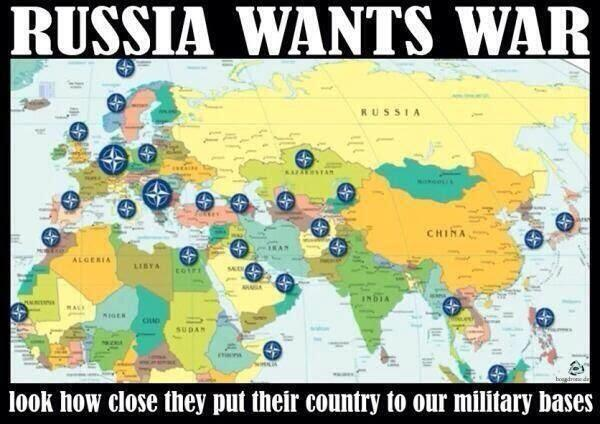
Also, most accounts of the Ukraine crisis today ignore the extraordinary expansion of NATO in the 1990s and the 2014 coup against the elected government of Ukraine carried out with the covert support of the United States. Including this in the accounts today adds important context, not for determining good guys and bad guys, but for figuring out what should be done and where peace forces should stand. And to be clear reflection on this context DOES NOT DENY THE IMMORAL AND INHUMANE RUSSIAN INVASION OF UKRAINE.
My takeaways so far are the following:
1.Russia has fallen into a trap that will significantly and negatively impact on its economy. It also reduces Russian influence around the world and undermines Russia’s renewed economic ties with countries in the Western Hemisphere.
2.The invasion gives fuel to the emerging anti-China Cold War rhetoric for politicians of both parties and the corporate media who suggest that Taiwan will be next, presumably after a Chinese invasion.
3.The Ukraine war is an enormous plus for military/industrial complexes in the US and in Russia as well.
4.The Ukraine story transforms the global narrative from the critical discussion of exploitation by the Global North of the Global South to the Biden narrative of “authoritarians” vs. “democracies.” For example, see the powerful presentation by V J Prashad of the essential nature of the North/South struggle. https://youtu.be/Lg9c0jv6wTA
5.The impacts of the debate on progressive forces in the US and elsewhere are potentially devastating. In the US, our discourse is shifting from a progressive agenda including President Biden’s Build Back Better program for example to stories about the relationships between Putin and former President Trump and so-called “national security.”
Biden’s State of the Union address reflects his “shift to the center.” Now we have a cause all Americans can get behind: opposing the Russians. (I am reminded how the Soviet menace in the 1940s was used to defang CIO militancy, the drive for free health care, Henry Wallace’s call for US/Soviet dialogue and, of course, civil rights for all).
I think the Russian invasion and the incomplete and war-oriented narrative of the Ukraine crisis dominating the news from such sources as the Washington Post, the New York Times, National Public Radio, and CNN/MSNBC constitute a real setback for us. Media news is a commodity. War and portraits of American exceptionalism are profitable commodities for the increasingly concentrated corporate media.
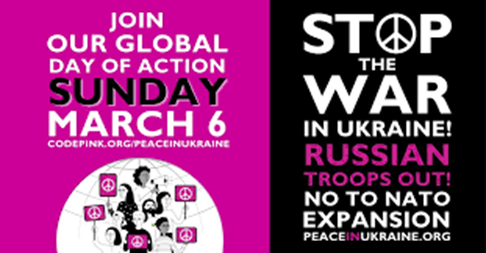
For these reasons and more, I endorse the Code Pink demands that Russia withdraw its troops from Ukraine and the United States and its allies pull back NATO forces from its presence in Eastern Europe. In addition, diplomatic efforts should ensue to replace NATO with an organization that can provide security for Europe and the Global South. The Code Pink frame gives appropriate recognition to both the immorality of the Russian action and the context, including NATO expansion and the events in Ukraine since 2014.
Finally, I want to reintroduce the concept of “historical memory.” These memories are important for people and they are legitimate ways to think about what needs to change. The historical memory for many Russians probably includes the 27 million of their ancestors killed during World War II largely from invading German armies crossing through Ukraine. I assume that if I were a Russian such a memory would affect how I think about the world. I know from experience how deeply the Holocaust still affects Jewish people even today.
So peace activists will continue to debate root causes of this senseless war and what to do about it. But for now as Cold Pink and others demand: Stop the War, Withdraw Russian Troops From Ukraine, Reverse the Extension of NATO.
Harry Targ
I cannot get out of my mind the question: What do people who are descendants of those who experienced 27 million dead from a fascist invasion through Eastern Europe of German armies think about the world today? Do they/can they regard NATO and its expansion as merely a “security” organization? These questions do not “excuse” the Russian invasion but help explain it.
Harry Targ
Original essay on NATO
posted on May 12, 2012
(To
quote a tired but true slogan, “war is not the answer.” The Russian invasion of
Ukraine threatens the lives and property of Ukraine’s, the lives of Russian
soldiers and protesters, raises fears of an escalation of war throughout Europe,
and raises the danger of nuclear war.
“We” need to demand “back-channel negotiations” as occurred during the Cuban missile crisis, diplomacy at the
United Nations, and summit meetings of diplomats from Russia, Ukraine, and
Europe. And conversations on the agenda should include forbidding Ukraine from
joining NATO, establishing regional autonomy for Ukraine citizens who want it, pulling
back NATO bases from Eastern European states, and/or abolishing NATO itself
because the reason for its creation in the first place, defending against an
attacking Soviet Union, no longer an issue.
The "we” at this moment could be a
resurgent international peace movement, taking inspiration from peace activists
in Russia and around the world. As horrible as this moment is, it is potentially
a “teachable moment,” a moment when peace becomes part of the global
progressive agenda again and people all around the world can begin to examine existing
international institutions such as NATO.
The essay below about NATO remains an
important part of the story. And while we react with shock and condemnation of
the Russian invasion of Ukraine, whatever the complicated and understandable
motivations, we need to be familiar with the historic context of the very
dangerous warfare that we are living through now.
As James Goldgeier wrote over twenty years ago on a Brookings Institute web page: “The dean of America’s Russia experts, George F. Kennan, had called the expansion of NATO into Central Europe ‘the most fateful error of American policy in the entire post-Cold War era.’ Kennan, the architect of America’s post-World War II strategy of containment of the Soviet Union, believed, as did most other Russia experts in the United States, that expanding NATO would damage beyond repair U.S. efforts to transform Russia from enemy to partner.” James Goldgeier, Brookings Institute, “The U.S. Decision to Enlarge NATO: How, When, Why, and What Next?“, June 1, 1999).
During World War II an “unnatural alliance” was created between the United States, Great Britain, and the former Soviet Union. What brought the three countries together, the emerging imperial giant, the declining capitalist power, and the first socialist state, was the shared need to defeat fascism in Europe. Rhetorically, the high point of collaboration was reflected in the agreements made at the Yalta Conference, in February, 1945 three months before the German armies were defeated.
At Yalta, the great powers made decisions to facilitate
democratization of former Nazi regimes in Eastern Europe, a “temporary”
division of Germany for occupation purposes, and a schedule of future Soviet
participation in the ongoing war against Japan. Leaders of the three states
returned to their respective countries celebrating the “spirit of Yalta,” what
would be a post-war world order in which they would work through the new United
Nations system to modulate conflict in the world.
Within two years, after conflicts over Iran with the
Soviet Union, the Greek Civil War, the replacement of wartime President
Franklin Roosevelt with Harry Truman, and growing challenges to corporate rule
in the United States by militant labor, Truman declared in March, 1947 that the
United States and its allies were going to be engaged in a long-term struggle
against the forces of “International Communism.” The post-war vision of
cooperation was reframed as a struggle of the “free world” against “tyranny.”
In addition to Truman’s ideological crusade, his
administration launched an economic program to rebuild parts of Europe,
particularly what would become West Germany, as capitalist bastions against the
ongoing popularity of Communist parties throughout the region. Along with the
significant program of reconstructing capitalism in Europe and linking it by
trade, investment, finance, and debt to the United States, the U.S. with its
new allies constructed a military alliance that would be ready to fight the
Cold War against International Communism.
Representatives of Western European countries met in
Brussels in 1948 to establish a program of common defense and one year later
with the addition of the United States and Canada, the North Atlantic Treaty
Organization (NATO) was formed. The new NATO charter, inspired largely by a prior
Western Hemisphere alliance, the Rio Pact (1947), proclaimed that “an armed
attack against one or more of them…shall be considered an attack against them
all…” which would lead to an appropriate response. The Charter called for
cooperation and military preparedness among the 12 signatories. After the
Soviet Union detonated its first atomic bomb and the Korean War started, NATO
pushed ahead with the development of a common military command structure with
General Eisenhower as the first “Supreme Allied Commander.”
After the founding of NATO and its establishment as a
military arm of the West, the Truman administration adopted the policy
recommendations in National Security Council Document 68 (NSC 68) in 1950 which
declared that military spending for the indefinite future would be the number
one priority of every presidential administration. As Western European
economies reconstructed, Marshall Plan aid programs were shut down and military
assistance to Europe was launched. Greece and Turkey joined NATO in 1952, and
fueling the flames of Cold War, West Germany was admitted to NATO in 1955.
(This stimulated the Soviet Union to construct its own alliance system, the
Warsaw Pact, with countries from Eastern Europe).
During the Cold War NATO continued as the only unified
Western military command structure against the “Soviet threat.” While forces
and funds only represented a portion of the U.S. global military presence, the
alliance constituted a “trip wire” signifying to the Soviets that any attack on
targets in Western Europe would set off World War III. NATO thus provided the
deterrent threat of “massive retaliation” in the face of first-strike attack.
With the collapse of the former Warsaw Pact regimes
between 1989 and 1991, the tearing down of the symbolic Berlin Wall in 1989,
and finally the collapse of the Soviet Union itself in 1991, the purpose for
maintaining a NATO alliance presumably had passed. However, this was not to be.
In the next twenty years after the Soviet collapse,
membership in the alliance doubled. New members included most of the former
Warsaw Pact countries. The functions and activities of NATO were redefined.
NATO programs included air surveillance during the crises accompanying the Gulf
War and the disintegration of the former Yugoslavia. In 1995, NATO sent 60,000
troops to Bosnia and in 1999 it carried out brutal bombing campaigns in Serbia
with 38,000 sorties. NATO forces became part of the U.S. led military coalition
that launched the war on Afghanistan in 2001. In 2011 a massive NATO air war on
Libya played a critical role in the overthrow of the Gaddafi regime.
An official history of NATO described the changes in
its mission: “In 1991 as in 1949, NATO was to be the foundation stone for a
larger, pan-European security architecture.” The post-Cold War mission of NATO
combines “military might, diplomacy, and post-conflict stabilization.”
The NATO history boldly concludes that the alliance
was founded on defense in the 1950s and détente with the Soviet Union in the
1960s. With the collapse of Communism in the 1990s it became a “tool for the
stabilization of Eastern Europe and Central Asia through incorporation of new
Partners and Allies.” The 21st century vision of NATO has expanded further:
“extending peace through the strategic projection of security.” This new
mission, the history said, was forced upon NATO because of the failure of
nation-states and extremism.
Reviewing this brief history of NATO, observers can
reasonably draw different conclusions about NATO’s role in the world than from
those who celebrate its world role. First, NATO’s mission to defend Europe from
aggression against “International Communism” was completed with the “fall of
Communism.” Second, the alliance was regional, that is pertaining to Europe and
North America, and now it is global. Third, NATO was about security and
defense. Now it is about global transformation. Fourth, as its biggest
supporter in terms of troops, supplies and budget (22-25%), NATO is an
instrument of United States foreign policy. Fifth, as a creation of Europe and
North America, it has become an enforcer of the interests of member countries
against, what Vijay Prashad calls, the “darker nations” of Asia, Africa, and
the Middle East. Sixth, NATO has become the 21st century military
instrumentality of global imperialism. And finally, there is growing evidence
that larger and larger portions of the world’s people have begun to stand up
against NATO.
See below an array of articles, past and current, on Ukraine. The most interesting for me are the statements by the Kenyan Ambassador to the UN on empires and FAIR’s critique of corporate media coverage.
In my opinion while the Russian attack on Ukraine should be condemned, we need to recognize it as part of an ongoing war that has its roots, perhaps, in the era of formal empires of past centuries, or the Western reaction to the Russian Revolution, or the rise of fascism and World War 2, or the construction of NATO and the US drive for global hegemony from World War 2 to the present, or the promises made by George Herbert Walker Bush not to expand NATO and its subsequent expansion eastward in the Clinton era, or NATOs taking on a worldwide role in imposing western dominance (Bosnia, Serbia, Libya, Afghanistan for example), or the 2014 coup supported by the US against a flawed but elected government in Kiev, or full incorporation of the neo-fascist elements of that coup in the Ukraine military, or the possibilities of a Nord Stream 2 pipeline, and/or the refusal of the US to make a modest but significant promise not to expand NATO to include Ukraine.
The list goes on but a “theory of the new war” needs to incorporate most or all of these elements, even while we condemn the Russian assault on Ukraine today.
I think our peace and justice movements, including those who are doing important election work, have to reflect on how the global agenda, imperialism, war, and militarism relate to all of our work.
An important speech by the Kenyan Ambassador at the UN, Martin Kimani, that condemns all countries who have engaged in or aspire to empire.
FAIR on media coverage of Ukraine:
https://fair.org/home/western-media-fall-in-lockstep-for-neo-nazi-publicity-stunt-in-ukraine/
Jack Matlock former US diplomat:
https://usrussiaaccord.org/acura-viewpoint-jack-f-matlock-jr-todays-crisis-over-ukraine/
Thomas Friedman:
https://www.nytimes.com/2022/02/21/opinion/putin-ukraine-nato.html
Reuters: On the incorporation of neo-Nazis into Ukraine
military
On Stephen Cohen who spoke with sensitivity about Russia and the former Soviet Union (it may be difficult to access Stephen Cohen's articles in The Nation but there are a number of You Tube interviews available with this now deceased distinguished scholar of the former Soviet Union and Russia)
https://www.thenation.com/article/world/stephen-cohen-ukraine/
https://www.thenation.com/article/archive/why-are-we-in-ukraine/
Harry Targ
Revisiting
the Cuban Missile Crisis might provide some lessons and warnings for 21st
century peace activists as we reflect on the current drama in Ukraine. The
essay attached below includes descriptions of two competing evaluations of
Kennedy Administration policies during the 1962 crisis. Whatever the
assessment, it was clear that United States policies contributed to a
heightened risk of nuclear war.
The most
popular view which has been advanced by historians and journalists is that the
careful modulation of US policies during the crisis demonstrated the wisdom and
skill of the Kennedy Administration. These included, the narrative suggests,
the careful and appropriate use of American power, including boarding Soviet
naval vessels, flying US aircraft over Soviet territory, and implicitly
threatening nuclear retaliation against the Soviet Union if they did not remove
their missiles from the island of Cuba.
A second
less popular view is that the United States and the Soviet Union acted recklessly
such that the possibility of nuclear war was dramatically increased. This view
suggests that issues of “security,” “spheres of influence,” “appearing strong
and tough,” and “challenging the spread of communism” were used to justify the President’s
willingness to go to the brink of war. Some, for example the journalist I. F.
Stone, suggested that while the Soviets were reckless in placing their missiles
on Cuban soil, it was they who ended the crisis by withdrawing their missiles
and thus avoiding a nuclear war.
Baring in mind
the competing views, the Cuban Missile Crisis may provide lessons for assessing
the Ukraine crisis today. First, former Soviet, now Russian behavior, played a
major role in stimulating in the short run heightened danger of a war, possibly
including nuclear weapons.
Second, the
Cuban Missile Crisis was part of a long-standing dispute between the United
States, the unquestioned global hegemonic power, and a perceived challenger,
the then Soviet Union. In 1962, as today, the United States sought/seeks to
rekindle or maintain its global dominance in a complicated world, one in which
the pursuit of great power dominance is dangerous and wasteful to all.
Third,
crises, such as those involving Cuba and Ukraine, give justification for
military/industrial complexes in both countries to lobby for more and more of
societal resources.
Fourth,
crises give legitimacy to cultures of “great power chauvinism:” in the US case
“American exceptionalism,” defender of “democracy,” the voice of the “free
world,” “the last remaining super-power,” and/or “the indispensable nation.”
Finally, as
to domestic politics, international crises are used to “bail-out” politicians
whose power and legitimacy are being threatened. President Kennedy had been
judged weak after his Vienna meeting with Nikita Khrushchev in Vienna in 1961,
the German/Soviet construction of the Berlin Wall, Soviet support for
anti-colonial movements, and the continuation of the Cuban Revolution.
At home in
the fall of 1962 Democrats feared that they would lose control of the House of
Representatives in upcoming elections. Pundits speculated that JFK’s image at
home was of youth, inexperience, and lack of resolve. The handling and
resolution of the Cuban Missile Crisis changed all that.
And today,
President Biden’s approval ratings are low. His legislative victories are
overshadowed by the image of his failure to achieve his Bring Back Better
program, and the much-publicized conflicts within his own party.
And, it
should be noted, his major bipartisan legislative achievement is the passage of
a $778 billion military budget which is of particular benefit to the sectors of
the military/industrial complex which feed off crises like Ukraine. (After the
Cuban Missile Crisis, the US and the Soviet Union did begin to dialogue about
tension reduction but US military budgets continued their significant increase,
justified by the Vietnam adventure. The US/Soviet competition would be fought
out by an arms race and battles in independent nations-places like Vietnam then
and Ukraine now).
And as I
wrote in the essay below, citing I.F. Stone, the Cuban Missile Crisis was ended
with the Soviet withdrawal of missiles. One hopes that the current leadership
in Russia will take the initiative and reduce tensions that it initiated
because the US record historically has been to exacerbate tensions not reduce
them.
“As I.F.
Stone suggested shortly after the crisis, nuclear war was avoided because the
Soviet Union chose to withdraw from the tense conflict rather than to engage in
it further.”
**********************************************************
Harry Targ wrote
In October 8, 2012 about the Cuban Missile Crisis:
THE CUBA STORY: THE BAY
OF PIGS TO THE MISSILE CRISIS
https://heartlandradical.blogspot.com/2012/10/the-cuba-story-bay-of-pits-to-missile.html
https://theragblog.blogspot.com/2012/10/harry-targ-from-bay-of-pigs-to-missile_17.html?m=0
“In the
missile crisis the Kennedys played their dangerous game skillfully….But all
their skill would have been to no avail if in the end Khrushchev had preferred
his prestige, as they preferred theirs, to the danger of a world war. In this
respect we are all indebted to Khrushchev. (I.F. Stone, “What If
Khrushchev Hadn’t Backed Down?” in In a Time of Torment, Vintage,
1967).
The
Kennedy Administration Goes to the Brink of Nuclear War
The period
between the failed Bay of Pigs invasion, the announcement of the Alliance of
Progress economic assistance program, and the Cuban Missile Crisis was one of
escalating hostilities. Fidel Castro declared Cuba a Socialist state. The
United States pressured members of the Organization of American States (OAS) to
expel Cuba. The CIA began campaigns to assassinate the Cuban leader and
President Kennedy initiated the complete economic blockade that exists until
today. In addition, Castro warned that the U.S. was continuing to plan for
another invasion. The Soviet Union began providing more economic and military
support to the Cubans, including anti-aircraft missiles and jet aircraft.
In October,
1962, U.S. spy planes sighted the construction of Soviet surface-to-air missile
installations and the presence of Soviet medium-range bombers on Cuban soil.
These sightings were made after Republican leaders had begun to attack Kennedy
for allowing a Soviet military presence on the island. Kennedy had warned the
Soviets in September not to install “offensive” military capabilities in Cuba. However,
photos indicated that the Soviets had also begun to build ground-to-ground
missile installations on the island, which Kennedy defined as “offensive” and a
threat to national security.
After
securing the photographs Kennedy assembled a special team of advisors, known as
EXCOM, to discuss various responses the United States might make. He excluded
any strategy that prioritized taking the issue to the United Nations for
resolution.
After much
deliberation EXCOM focused on two policy responses: a strategic air strike
against Soviet targets in Cuba or a blockade of incoming Soviet ships coupled
with threats of further action if the Soviet missiles were not withdrawn. Both
options had a high probability of escalating to nuclear war if the Soviet Union
refused to back down.
High drama,
much of it televised, followed the initiation of a naval blockade of Soviet
ships heading across the Atlantic to Cuba. Fortunately, the leader of the
Soviet Union, Nikita Khrushchev, sent notes to the President that led to a
tacit agreement between the two leaders whereby Soviet missiles would be
withdrawn from Cuba and the United States would promise not to invade Cuba to
overthrow the Castro government. In addition, the President indicated that
obsolete U.S. missiles in Turkey would be disassembled over time.
Most
scholars argue that the missile crisis constituted Kennedy’s finest hour as statesman
and diplomat. They agree with the administration view that the missiles
constituted a threat to U.S. security, despite Secretary of Defense Robert
McNamara’s claim in EXCOM meetings that the missiles did not change the
strategic balance between the United States and the Soviet Union. Most of these
scholars have agreed that the symbolic value of the installation of Soviet
missiles could have had grave consequences for U.S. “credibility.”
Given the
importance of the missiles, leading social scientists have written that the
Kennedy team carefully considered a multitude of policy responses. EXCOM did
not ignore competing analyses, as had been done in the decisional process prior
to the Bay of Pigs. The blockade policy that was adopted, experts believe, constituted
a rational application of force that it was hoped would lead to de-escalation
of tensions. All observers agreed that the United States and the Soviet Union
had gone to the brink of nuclear war. Even the President estimated that there
was a fifty percent probability of full-scale nuclear war.
In the end
the Soviets withdrew their missiles. Analysts said the Soviet Union suffered a
propaganda defeat for putting the missiles on Cuban soil in the first place and
then withdrawing them after U.S. threats. Khrushchev was criticized by the
Chinese government and within a year he was ousted from leadership in the
Soviet Union.
In the light
of this U.S. “victory,” Kennedy has been defined as courageous and rational.
The real meaning of the Cuban Missile Crisis, however, is different, even
fifty years after the event. The crisis actually suggests that the United
States quest to maintain and enhance its empire would lead it to go to any
extreme, even nuclear war, to defend the interests of capitalism. To avoid
serious losses, whether symbolic or material, for capitalism, any policy was
justified.
Further, in
terms of U.S. politics, Kennedy was calculating the effects of the missiles on
the chances for his party to retain control of Congress in 1962. A second “defeat”
over Cuba (the Bay of Pigs was the first) would have heightened the
opposition’s criticisms of his foreign policy.
Finally, in
personal terms, Kennedy was driven by the need to establish a public image as
courageous and powerful in confronting the Soviets. Khrushchev had spoken
harshly to him at a summit meeting in Vienna in 1961 and Castro had been
victorious at the Bay of Pigs. The President’s own “credibility” had been
damaged and a show of force in October, 1962, was necessary for his career.
Because of
imperialism, politics, and personal political fortunes, the world almost went
to nuclear war fifty years ago. As I.F. Stone suggested
shortly after the crisis, nuclear war was avoided because the Soviet Union
chose to withdraw from the tense conflict rather than to engage in it further.
National
Security Archives files referred to in an earlier blog suggest, “the historical
record shows that the decisions leading to the crisis which almost brought
nuclear war have been repeated over and over again since the early
1960s” ( www.gwu.edu/~nsarchiv/). The danger of the unabashed and
irresponsible use of force and the legitimation of the idea that diplomacy can
be conducted using nuclear weapons and other devastating weapons systems still
represents a threat to human survival.
These
comments were adapted from Harry Targ, Strategy of an Empire in Decline:
Cold War II, 1986. It is the third essay in a series on “The Cuba Story”
available at www.heartlandradical.blogspot.com.”