Monday, October 28, 2019

On United States Foreign Policy:MR Online, Popular Resistance, and Portside

United States Foreign Policy: Yesterday, Today, and Tomorrow

The contradictory character of Trump foreign policy has left the peace movement befuddled. Perhaps the task is to include in the project of building a progressive majority ideas about challenging the US as an imperial power.

printer friendly  


,
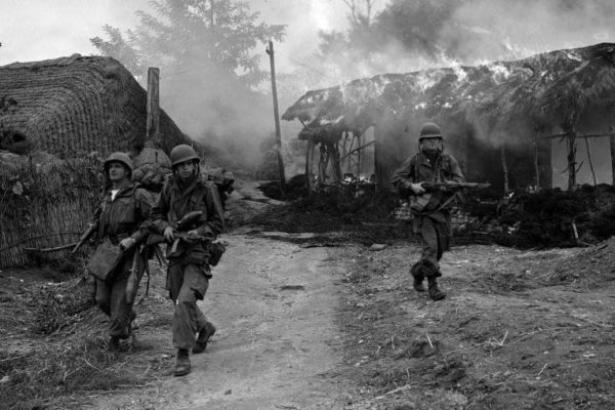
Just before the Korean War started in 1950, post-World War key foreign policy advisers to President Truman threw their support behind recommendations made in a classified document, National Security Council Document 68, which recommended a dramatic increase in military spending. NSC-68 also recommended that military spending from that point on should be the number one priority of the national government. When presidents sit down to construct a federal budget, the document recommended, they should first allocate all the money requested by military and corporate elites and lobbyists concerned with military spending. Only after that the military advocates receive all they request should government programs address education, health care, roads, transportation, housing and other critical domestic issues. When the United States entered the Korean War, in June, 1950, Truman endorsed the recommendations of NSC 68 and used the war on the Korean peninsula as justification. In Andrew Bacevich’s words the United States fully committed to a “permanent war economy.” As political scientist, Hans Morgenthau wrote about that time; there was no turning back from the new war economy and a “Cold War” against the former Soviet Union. Each subsequent president expanded on the war economy and the narrative of a dangerous world that justified trillions of dollars of spending. According to Chalmers Johnson (BlowbackSorrows of Empire), between 1947 and 1990, the permanent war economy cost the American people close to $9 trillion. Ruth Sivard (World Military Expenditures) presented data to indicate that over 100,000 U.S. military personnel died in wars and military interventions during this period. And, in other countries, nearly 10 million people died directly or indirectly in wars in which the United States was a participant.
Seventy years later, Trump era military budgets have reached record highs, $738 billion dollars in the 2020 fiscal year and a projected $740 billion in 2021. As William Hartung wrote: “The agreement sets the table for two of the highest budgets for the Pentagon and related work on nuclear warheads at the Department of Energy since World War II (in Jake Johnson, ‘Unprecedented, Wasteful, and Obscene’: House Approves $1.48 Trillion Pentagon Budget,” Common Dreams, Friday, July 26, 2019). Including past and present military-related spending the War Resisters League estimates that the 2020 federal budget will consist of 48 percent of all spending, exceeding non-military spending by six percent. Just one weapon, the notorious F-35 latest generation fighter plane is costing, by conservative estimates, $1.5 trillion. (Manufacturing facilities for the plane are found in 433 of 435 Congressional districts).

Rationalizing the Permanent War Economy

A factional dispute among foreign policy elites began to emerge in the 1970s about the best strategies and tactics which should be pursued to maximize the continued global economic, political, and military dominance of the United States in the international system. The dispute was not over whether the United States should continue to pursue empire but rather how to continue to achieve it. The debates were occasioned by the rise of the countries of the Global South, the societally wrenching experience of the Vietnam War, the growth of power and influence of the former Soviet Union, and since its collapse, the emergence of China as a new global economic, political and military power. In addition, the new international economy was becoming more global, that is to say more interconnected. Debates about strategy, tactics, surfaced between the neoliberal globalists who emphasized so-called free trade, financial speculation, and the promotion of a neoliberal agenda that advocated for the privatization of all public activities by states and the development of austerity policies that would shift wealth from the many to the few. The international debt system would be the vehicle for pressuring poor and rich countries to transform their own economic agendas. This faction dominated United States foreign policy making for generations, particularly from Reagan to Clinton to Obama. In political/military terms, they have sought to push back challengers to neoliberal capitalism: Russia, China, populist Latin American countries, and they have advocated advancing US economic interests in Asia and Africa. Many of the institutions of the neoliberal globalists, sometimes called the “deep state” include the CIA, NSA, and other security agencies.
The other faction represented by President Trump and some of his key aides prefer economic nationalism, restricted trade, building walls, avoiding diplomacy, and they are driven by a deeply held white supremacist ideology. They believe, as political scientist Samuel Huntington argued, that we are engaged in a civilizational conflict with Islam, a fourth world war. The neoliberal globalists undermined Ukraine, put more NATO troops in Eastern Europe and want to depose Putin and weaken Russia. This is not on the Trump agenda.
The forbearers of the current generation of Trumpian economic nationalists, came from the so-called “neo-conservatives,” historically organized around the 1990s lobby group, The Project for a New American Century (PNAC) and in the 1950s and 1970s of The Committee for the Present Danger (CPD). Both the neoliberals and the neoconservatives share a common vision of a global political economy controlled by the United States but the former prefer selective use of military force and greater use of economic and diplomatic pressure and covert interventionism while justifying policy on humanitarian grounds, including expanding democracy. Since, they say, the United States represents the hope of democracy in the world, it is as Madeleine Albright called it. “the indispensable nation.” The neoconservatives, in a sense more frank, argued that with the collapse of the former Soviet Union, the United States was the hegemonic power. With that power PNAC argued, the United States should have imposed a world order and state regimes that comported with US interests and ideology. Over the years, the policies of the two factions converged; hence economic penetration, covert interventions, occasional wars, and support for expanding military spending. But, often for reasons of domestic rather than international politics, conflicts between the two factions resurface. That is the case in 2019.

The Ruling Class Agenda for the United States Role in the World: Before the 2016 election

From a Washington Post editorial, May 21, 2016:
HARDLY A day goes by without evidence that the liberal international order of the past seven decades is being eroded.China and Russia are attempting to fashion a world in their own illiberal image…This poses an enormous trial for the next U.S. president. We say trial because no matter who takes the Oval Office, it will demand courage and difficult decisions to save the liberal international order. As a new report from the Center for a New American Security points out, this order is worth saving, and it is worth reminding ourselves why: It generated unprecedented global prosperity, lifting billions of people out of poverty; democratic government, once rare, spread to more than 100 nations; and for seven decades there has been no cataclysmic war among the great powers. No wonder U.S. engagement with the world enjoyed a bipartisan consensus.
The Washington  Post editorial quoted above clearly articulates the dominant view envisioned by US foreign policy elites for the years ahead: about global political economy, militarism, and ideology. It in effect constitutes a synthesis of the “neocon” and the “liberal interventionist” wings of the ruling class. First, it is inspired by the necessity of 21st century capitalism to defend neoliberal globalization: government for the rich, austerity for the many, and deregulation of trade, investment, and speculation. (Neoliberal globalization, the latest phase in the development of international capitalism is described in an important recent book, Jerry Harris, Global Capitalism and the Crisis of Democracy, Clarity Press, 2016).
Second, the Post vision of a New World Order is built upon a reconstituted United States military and economic hegemony that has been a central feature of policymaking at least since the end of World War II even though time after time it has suffered setbacks: from defeat in Vietnam, to radical decolonization across the Global South, and to the rise of competing poles of power in Asia, the Middle East, Latin America, and even Europe. In addition, despite recent setbacks, grassroots mass mobilizations against neoliberal globalization and austerity policies have risen everywhere, even in the United States. The Washington Post speaks to efforts to reassemble the same constellation of political forces, military resources, and concentrated wealth, that, if anything, is greater than at any time since the establishment of the US “permanent war economy” after the last World War.
Historian, Michael Stanley, in an essay entitled “‘We are Not Denmark’: Hillary Clinton and Liberal American Exceptionalism,” (Common Dreams, February 26, 2016) points to the ideological glue that is used by foreign policy elites, liberal and conservative, to justify the pursuit of neoliberal globalization and militarism; that is the reintroduction of the old idea of American Exceptionalism, which in various forms has been used by elites since the foundation of the Republic.
The modern version, borne in the context of continental and global expansion, serves to justify an imperial US role in the world. Along with posturing that the United States is somehow special and has much to offer the world, American Exceptionalism presumes the world has little to offer the United States. The only difference between Democrats and Republicans on foreign policy is whether the exceptionalism still exists and must be maintained or has dissipated requiring the need to “make America great again.” Leaders of both parties, however, support the national security state, high military expenditures, and a global presence—military, economic, political, and cultural.

“Innovation and National Security: Keeping Our Edge:” Council on Foreign Relations 2019

The influential Council on Foreign Relations issued a Task Force report in September, 2019, on national security. Task force members included representatives of prestigious universities, large corporations, and staff from the CFR. In the forward, the report pointed out that the United States had led the world in technological innovation and development since the end of World War Two. But, it said, “…the United States risks falling behind its competitors, principally China.” It goes on to propose that the United States “…needs to respond urgently and comprehensively over the next five years and put forward a national security innovation strategy to ensure it is the predominant power in a range of emerging technologies such as AI and data science, advanced battery storage, advanced semiconductor technologies, genomics and synthetic biology, fifth-generation cellular networks (5G), quantum information systems, and robotics.” The report calls for increases in federal support for basic research and development. This would include investments in higher education, selective immigration of skilled scientists, and reform of military institutions to more effectively incorporate new technologies into military capabilities.
Major findings of the Task Force included the following:
  • Technological innovation leads to economic and military advantage.
  • US leadership in science and innovation is at risk.
  • US federal funding for research and development has stagnated for years.
  • US leadership in STEM education is declining
  • The Defense Department and the intelligence community risk falling behind “potential adversaries” if they do not employ more technologies from the private sector.
  • The defense community “faces deteriorating manufacturing capabilities,” and “insecure” supply chains, while depending on other nations for technologies.
  • There is a ”cultural divide” surfacing between technology and policymaking communities weakening connections between the defense and intelligence communities and the private sector.
    And, as to our major competitor China:
  • China is investing significantly in new technologies and will be the world’s biggest investor by 2030.
  • China is closing “the technological gap” with the United States, and it and other countries are approaching the US as to artificial intelligence (AI).
  • China is “exploiting” the openness of the US to secure valuable innovation by violating intellectual property rights.
While praising President Trump for some of his efforts the report says that increased budgets have been too “incremental and narrow in scale.” The Administration has inadequately moved to develop new communications technologies, and to respond to the challenge of Huawei’s global expansion.
Therefore the United States must:
  • restore federal funding for research and development.
  • attract and educate a science and technology workforce.
  • support technology adoption in the defense sector.
  • bolster and scale technology alliances and ecosystems.
In short, “during the early years of the Cold War, confronted by serious technological and military competition from the Soviet Union, the United States invested heavily in its scientific base. Those investments ensured U.S. technological leadership for fity years. Faced with the rise of China and a new wave of disruptive technological innovation, the country needs a similar vision and an agenda for realizing it.” (9)

Where Does the Foreign Policy of Donald Trump Fit?

Taking “the long view” of United States foreign policy, it is clear that from NSC-68; to the response to the Soviet challenges in space such as during the Sputnik era; to global wars in Korea, Vietnam, Afghanistan, and Iraq; to covert interventions in the Middle East, Latin America, Asia, and Africa, the United States has pursued global hegemony (and is suggested in the CFR statement). It is also clear that the pursuit of empire has of necessity involved the creation of a permanent war economy, an economy that overcomes economic stagnation by the infusion of enormous military expenditures.
It is also clear that justification for empire and military spending has necessitated the construction of an enemy, first the Soviet Union and international communism; then terrorism; and now China. The obverse of a demonic enemy requires a conception of self to justify the imperial project. That self historically has been various iterations of American exceptionalism, the indispensable nation, US humanitarianism, and implicitly or explicitly the superiority of the white race and western civilization.
In this light, while specific policies vary, the trajectory of US foreign policy in the twenty-first century is a continuation of the policies and programs that were institutionalized in the twentieth century. Three seem primary. First, military spending, particularly in new technologies continues unabated. And the CFR report raises the danger of the United States “falling behind,” the same metaphor that was used by the writers of the NSC-68 document, or the Gaither and Rockefeller Reports composed in the late 1950s to challenge President Eisenhower’s worry about a military/industrial complex, the response to Sputnik, Secretary of Defense McNamara’s transformation of the Pentagon to scientific management in the 1960s, or President Reagan’s huge increase of armaments in the 1980s to overcome the “window of vulnerability.”
Second, the United States continues to engage in policies recently referred to as “hybrid wars.” The concept of hybrid wars suggests that while traditional warfare between nations has declined, warfare within countries has increased. Internal wars, the hybrid wars theorists suggest, are encouraged and supported by covert interventions, employing private armies, spies, and other operatives financed by outside nations like the United States. Also the hybrid wars concept also refers to the use of economic warfare, embargoes and blockades, to bring down adversarial states and movements. The blockades of Cuba, Venezuela, and Iran are examples. So the hybrid war concept suggests the carrying out of wars by other, less visible, means.
Third, much of the discourse on the US role in the world replicates the bipolar, super power narrative of the Cold War. Only now the enemy is China. As Alfred McCoy has pointed out (In the Shadows of the American Empire, 2017), the United States in the twenty first century sees its economic hegemony being undermined by Chinese economic development and global reach. To challenge this, McCoy argues, the United States has taken on a project to recreate its military hegemony: AI, a space force, biometrics, new high tech aircraft etc. If the US cannot maintain its hegemony economically, it will have to do so militarily. This position is the centerpiece of the recent CFR Task Force Report.
Recognizing these continuities in United States foreign policy, commentators appropriately recognize the idiosyncrasies of foreign policy in the Trump era. He has reached out to North Korea and Russia (which has had the potential of reducing tensions in Asia and Central Europe). He has rhetorically claimed that the United States must withdraw military forces from trouble spots around the world, including the Middle East. He has declared that the United States cannot be “the policeman of the world,” a declaration made by former President Nixon as he escalated bombing of Vietnam and initiated plans to overthrow the Allende regime in Chile. For some of these measures, Trump has been inappropriately criticized by Democrats and others. Tension-reduction on the Korean Peninsula, for example, should have been encouraged.
However, while Trump moves in one direction he almost immediately undermines the policies he has ordered. His announced withdrawal from Syria, while in the abstract a sign of a more realistic assessment of US military presence in the Middle East was coupled with a direct or implied invitation to the Turkish military to invade Northeast Syria to defeat the Kurds. Also, at the same time he was withdrawing troops from Syria, the Defense Department announced the United States was sending support troops to Saudi Arabia. He withdrew from the accord with Iran on nuclear weapons and the Paris Climate Change agreement. Time after time, one foreign policy decision is contradicted by another. These contradictions occur over and over with allies as well as traditional adversaries. Sometimes policies seem to be made with little historical awareness and without sufficient consultation with professional diplomats. (One is reminded of the old Nixon idea, the so-called “madman theory.” Nixon allegedly wanted to appear mad so that adversaries would be deterred from acting in ways contrary to US interests out of fear of random responses).
The contradictory character of Trump foreign policy has left the peace movement befuddled. How does it respond to Trump’s occasional acts that go against the traditional imperial grain at the same time that he acts impetuously increasing the dangers of war? How does the peace movement participate in the construction of a progressive majority that justifiably seeks to overturn the Trump era and all that it stands for: climate disaster, growing economic inequality, racism, sexism, homophobia, and hybrid war? Perhaps the task for the peace movement is to include in the project of building a progressive majority ideas about challenging the US as an imperial power, proclaiming that a progressive agenda requires the dismantling of the permanent war economy. These are truly troubled times, with to a substantial degree the survival of humanity and nature at stake. The war system is a significant part of what the struggle is about.
Harry Targ is a retired Professor of Political Science, Purdue University. He has written books and articles on US foreign policy, international political economy, and issues of labor and class struggle. He blogs at Diary of a Heartland Radical.

Wednesday, October 23, 2019

ESSAYS ON THE CRISIS OF PUBLIC EDUCATION


NEOLIBERALISM, PRIVATIZATION, AND THE CRISIS OF EDUCATION (posted on November 14, 2015)
Harry Targ

Introduction

In August, 2015 12 parents in the Bronzeville neighborhood of Chicago launched a 34 day hunger strike to protest the closing of a neighborhood high school. Their demands, along with its reopening, included the establishment of a green jobs oriented curriculum that would train young people for the needs of the 21st century.

In Seattle, Washington in September, 2015 teachers went on strike to demand fair wages and working conditions in their new contract.

In the summer, 2014 again in Chicago, the teachers union went on strike to push back against school closings, stagnant teacher wages, and closed-door policymaking to consciously limit the influence of parents in the community. This strike had the support of teachers, parents, and children.

During the spring, 2015, parents all around the state of Indiana were keeping their children home during school days as a mark of their resistance to painful, frustrating, ill-conceived, and misused batteries of tests that state/federal policymakers were imposing on young people.

These are just a few examples of rising anger at the threat to the tradition of public schooling, big corporate efforts to privatize schools for profit, the denial of communities of parents any influence over educational policy, and campaigns to destroy teachers unions. A key component of the struggle to save our schools has been to defend the rights of all children to quality education not limited by race, class, gender, or ethnicity.

The neoliberal design

In the 1970s powerful economic and political elites began a sustained campaign to shift more of the wealth of society from the many to the few. A new policy agenda, sometimes called neoliberalism or austerity, was initiated that called for a variety of attacks on government policies that had been instituted over the prior thirty years.

In general, the neoliberal policies called for downsizing government (except for the military), cutting public services and programs to provide for the human needs of the population, deregulating banks and corporations, and privatizing public institutions. Roads, libraries, parks, prisons, and particularly schools were being shifted from public ownership and control to private corporations, mostly to make a profit. While these policies have encountered public opposition and have not been fully implemented, they have dramatically affected the quality of our public life and our communities.

The Threat to Public Schools

Since the dawn of the twentieth century the anchor of most communities in the United States, has been its public schools. Schools help raise, nourish, mentor, and educate the youth of America. Parents, as best they can, participate in supporting school systems and provide input on school policy. Teachers and school administrators sacrifice time and energy to stimulate the talents of young people. And teachers through educational associations and trade unions organize to protect their rights in the workplace, always mindful of the number one priority; serving the children and the community.

Beginning in the 1970s, various special interest groups, many well-funded, began to advocate for the privatization of education. Looking at aggregate data showing some failing school performance, they argued that private corporations, charter schools, could educate children better. They blamed the lack of marketplace competition for waste of taxpayer dollars for poor performance. The arguments ignored the fact that failing schools were schools underfunded by state legislatures and were often in communities where resources were scarce because of inequalities of wealth and income. Most often under-performing schools were underfunded schools: underfunded because of racism and patterns of segregation.

The neoliberal answer was to shift public funds, formerly from public schools, to private corporate charter schools. Along with the creation of charter schools, voucher systems were established by state legislatures and school districts allowing parents to place their children in any school they could find; often difficult to access and sometimes far from the child’s neighborhood. The introduction of charter schools and vouchers began the process of shifting resources from public education to private schools. 

Shifting resources from the public to the private sector served to destroy adequately performing public schools and weakened nearby communities.

The data on the shift from public schools to charters is shocking. For example in Detroit between 2005 and 2013 public school enrollment declined by 63% and charter school enrollments rose by 53%; in Gary the decline in public schools was 47% and the rise in charter school enrollment rose by 197%;  and in Indianapolis the decline in public school enrollments totaled 27% and the rise in charter schools was 287%. 

This historic transfer of public funds for education to privatization would often be sped up by local crises. The biggest crisis in an American community in decades occurred in New Orleans when Hurricane Katrina struck that city in August, 2005. In its aftermath 100,000 citizens were forced to leave the city because their homes were demolished. Over 100 public schools were destroyed in the disaster. Subsequently virtually all those schools were replaced with charter schools, run by private corporations for a profit, devoid of teachers’ organizations and parental participation in the revitalization of educational institutions. Commenting on the New Orleans experience Secretary of Education Arne Duncan suggested that Hurricane Katrina was the best thing to happen to the educational system of New Orleans. 

The human tragedy of Katrina was also a metaphor for what was to follow all across the nation: powerful forces swept away vibrant publicly controlled and accountable educational institutions, replacing them with new profit-driven, non-transparent, non-union, corporate schools that did not serve the needs and desires of the remaining members of the community. Public education is being uprooted, transformed, and destroyed all across the United States.  

To facilitate the privatization of schools cities everywhere have begun to close public schools. Detroit, New York, and Chicago have closed over 100 schools per city in recent years. Several cities have closed at least 25 schools in recent years. In Philadelphia, municipal funds for a prison came from the closure of 50 schools. The impacts of school closings is reflected in the essay “Death by a Thousand Cuts,” produced by the Journey for Justice Alliance: “Closing a school is one of the most traumatic things that can happen to a community; it strikes at the very core of community culture, history, and identity and…produces far-reaching repercussions that negatively affect every aspect of community life.” www.empowerdc.org/uploads/J4JReport-Death_by_a_Thousand_Cuts

********************************************************************************************************************************************************************

IMPACTS OF THE PRIVATIZATION OF PUBLIC EDUCATION (posted on January 11, 2016)
Harry Targ

The political economy of public sector failure is wholly ignored when schools are declared failing and threatened with closure. Further, parents, guardians, community members, educators, and youth are systematically excluded from decisions to close schools and plans to redesign their replacements. The cover story about saving communities from educational crisis grows a bit suspect when the very communities presumably being saved are kept out of the process--and their children are often denied admission to the replacement schools. (Michael Fabricant and Michelle Fine, Charter Schools and the Corporate Makeover of Public Education, Teachers College, Columbia University, 2012, p. 98. These comments were made about New York but are relevant almost everywhere. ht).

In a prior essay, I discussed the connections between the neoliberal agenda characteristic of the changing political economy since the 1980s, the move toward privatization of public institutions, and the threat to public schools. www.heartlandradical.blogspot.com/2015/11/neoliberalism-privatization-and-crisis.html

In this essay I discuss some impacts of these policy changes in the United States and proposals for mobilizing for policy change in Indiana. 

First, the shift of scarce state budget funds from public to charter schools has meant a significant decline in resources to maintain and improve public schools. If funds for new charter schools and increased money for vouchers are transferred from adequately performing public schools to under-performing charter or religious schools the changes in educational policy would lead to a decline in the quality of education provided to all students. For example, in the 2014-2015 Indiana budget, $115 million was diverted by the state legislature from public education to the growing voucher program.

Therefore, as money is withdrawn from K-12 public education the traditional schools have reduced resources with which to do their job. This leads to declining performance. Then privatization advocates call for further reduction as well as school closings, rather than increasing resource allocation to public schools. 

Second, a high percentage of school closings occur in poor and Black communities. These closings create what the Journey for Justice Alliance calls “education deserts.” Parents have to find adequate, affordable schools elsewhere in the cities in which they live. Oftentimes charter schools refuse to admit particular students because of biased estimates of their probability of success, disabilities they may have, insufficient English language proficiency or other reasons. “Charter schools use a variety of selective admissions techniques, such as targeted marketing strategies, burdensome application processes, imposing academic prerequisites, and the active discouragement of less-desirable candidates.” (Journey for Justice Alliance, Death By a Thousand Cuts, May, 2014, pp.11-12). In some cases parents cannot find adequate schools for their children anywhere near their community. 

The closing of schools, the struggle for admission to new schools, the increased class sizes of new schools, the adjustment to a new school culture, along with the inexperience of new teachers, all impact in negative ways on the educational experience of children. Education writer, Scott Elliott reported that of the 18 charter schools operating in Indianapolis in 2015, half of them had test scores in 2014 that registered a “fail” in state examination of their children. The failing charter schools served children from poorer backgrounds and/or were children with special needs such as language training. Several of these failing charter schools had been operating for several years and some had been part of national charter networks.

The Center for Tax and Budget Accountability summed up studies of the impacts of voucher programs on educational performance: ‘None of the independent studies performed of the most lauded and long standing voucher programs extant in the U.S.--Milwaukee, Wisconsin; Cleveland, Ohio, and Washington, D.C.--found any statistical evidence that children who utilized vouchers performed better than children who did not and remained in public schools.”

Third, as parent and student protests in Chicago, in various cities and towns in Indiana, and elsewhere suggest, there is an inverse relationship between the spread of charter schools and voucher systems and citizen input into educational policy-making. Historically, while many parents chose not to participate in school board decision- making, the prerogative existed for parents, and even students, to provide input into educational policy. It was assumed that members of communities had the right and the responsibility to communicate their concerns to school administrators, elected school boards, and teachers. Most school districts have active parent organizations. 

The documentary Education Inc. demonstrated cases in which the frequency of public school board hearings was reduced and meetings were summarily adjourned to avoid debate on controversial issues. And legislatures, such as in Indiana, have prohibited state executive or legislative bodies from regulating the “curriculum content” of private schools that accept vouchers.

Fourth, the neoliberal design referred to in the prior essay is based upon the proposition that institutional and policy success is best measured by the profit accrued to the corporate bodies involved. In the field of education, neoliberal policies seek to shift accountability from the public to the private sector; from professional skills to market skills; and from participation by the professional and union organizations of teachers, parent groups, and engaged students to corporate executives of private corporations. The neoliberal design regards educational professionalism and training and teachers advocacy associations as impediments. 

Therefore the full force of state educational policy includes transferring status, respect, adequate remuneration from long time public school teachers to marginalized, under-trained new workers in charter schools. Also the charter school movement is avowedly an anti-teachers union movement. 

Documentaries on education such as Rise Above the Mark and Education Inc. illustrate that career teachers find demoralizing the repeated and dysfunctional testing of children, declining resources for their schools, and repeated public statements devaluing and demeaning teachers. Educational spokespersons in these films speak in the most glowing terms about the passion to teach, commitment to children, and talent of staffs under their leadership. School superintendents in these documentaries also speak about the contributions which teachers unions make to the enhancement of school performance.   

The sum total of the thirty year effort to transform the educational system under the guise of “reform” are the following: the tradition of public education is being destroyed; access to quality education is becoming more difficult and more unequal; transparency and parent input into policy making is becoming more difficult; and the attack on professionalism and teachers unions is making it more difficult to teach.

How to respond?

The November 14, 2015 essay and this one only begin to tell the story about the attacks on the educational process and quality education. Other issues need to be discussed including testing, evaluations based on dubious metrics, charging parents for text books, inequitable access to school supplies by district and by public versus private schools, inadequate funding, the development of curricula appropriate for a twenty-first century educational agenda, and the need to combat the “school to prison pipeline” that seems to undergird much of urban education. Responses to protect and enhance the quality of educational life for children require the following:

Creating an educational movement in the state of Indiana that says “enough is enough” to those advocates of so-called education “reform.” That means developing inside strategies that include running and electing legislators and executives who believe in public education. It means lobbying at the State House during the legislative season. It means launching litigation when politicians and educational privateers violate the Indiana constitution’s guarantee that all children have a right to a quality education.

The educational movement must also embrace an outside strategy, building a social movement. It should include education, agitation, and organization. Pamphlets, speakers, videos, and other public fora need to be organized all around the state. Educators and their supporters need to rally and protest so that the issue of quality education is discussed in communities and the media.

And organizationally, an educational movement should draw upon the militancy, passion, and expertise of educational organizations around the state that are already engaged in this work. Strengthening the movement for quality education is more about bringing existing groups together than creating new ones. That is the vision of Indiana Moral Mondays and the idea of “fusion politics.” Assemble those who share common values and a vision and build a mass movement such that as the old slogan says: “The People United Shall Never Be Defeated.” 

What Specific Policies and Programs to Support?

1.Increasing, not decreasing, federal, state, and local funding of public education.

2.Prioritizing the funding of traditionally under-funded schools in economically disadvantaged communities. Resources should include salaries to encourage experienced teachers to remain in disadvantaged communities. Funds should provide equal technologies, including libraries, computers, and other tools, for schools in lower income communities equal to those provided for wealthier communities. Resources should provide for language training, math education, and programs in the arts.

3.Policy-making bodies in all branches of government should be open and transparent so that parents, teachers, and students can observe and participate in decision-making.

4.In school districts where teachers choose to form unions or other professional associations these organizations should be recognized partners in the policy-making process.

5.Assessments of school performance should be determined by teachers, school administrators, and parents, not politicians or educational corporations. Teachers should not be forced to “teach to the tests.”

6.The goal of the educational process should be the full development of the potential of each and every student irrespective of race, gender, class or other forms of discrimination.


Sunday, October 20, 2019

UNITED STATES FOREIGN POLICY:YESTERDAY, TODAY, AND TOMORROW

Harry Targ


Just before the Korean War started in 1950, key foreign policy advisers to President Truman threw their support behind recommendations made in a classified document, National Security Council Document 68. The document recommended a dramatic increase in military spending and it also proposed that military spending from that point on should be the number one priority of the national government. When presidents sit down to construct a federal budget, the document said, they should first allocate all the money requested by military and corporate elites and lobbyists concerned with military spending. Only after the military advocates receive all they request should government programs address education, health care, roads, transportation, housing and other critical domestic issues.When the United States entered the Korean War, in June, 1950, Truman endorsed the recommendations of NSC 68 and used the war on the Korean peninsula as justification. In Andrew Bacevich’s words the United States fully committed to a “permanent war economy.” As political scientist, Hans Morgenthau wrote about that time; there was no turning back from the new war economy and a “Cold War” against the former Soviet Union.

Each subsequent president expanded on the war economy and the narrative of a dangerous world that justified trillions of dollars of spending. According to Chalmers Johnson (Blowback, Sorrows of Empire), between 1947 and 1990, the permanent war economy cost the American people close to $9 trillion. Ruth Sivard (World Military Expenditures) presented data to indicate that over 100,000 U.S. military personnel died in wars and military interventions during this period. And, in other countries, nearly 10 million people died directly or indirectly in wars in which the United States was a participant.

Seventy years later, Trump era military budgets have reached record highs, $738 billion dollars in the 2020 fiscal year and a projected $740 billion in 2021. As William Hartung wrote: “The agreement sets the table for two of the highest budgets for the Pentagon and related work on nuclear warheads at the Department of Energy since World War II (in Jake Johnson, ‘Unprecedented, Wasteful, and Obscene’: House Approves $1.48 Trillion Pentagon Budget,”  Common Dreams, Friday, July 26, 2019). Including past and present military-related spending the War Resisters League estimates that the 2020 federal budget will consist of 48 percent of all spending, exceeding non-military spending by six percent. Just one weapon, the notorious F-35 latest generation fighter plane, is costing, by conservative estimates, $1.5 trillion. (Manufacturing facilities for the plane are found in 433 of 435 Congressional districts).

Rationalizing the Permanent War Economy 

A factional dispute among foreign policy elites began to emerge in the 1970s about the best strategies and tactics which should be pursued to maximize the continued global economic, political, and military dominance of the United States in the international system. The dispute was not over whether the United States should continue to pursue empire but rather how to continue to achieve it. The debates were occasioned by the rise of the countries of the Global South, the societally wrenching experience of the Vietnam War, the growth of power and influence of the former Soviet Union, and since its collapse, the emergence of China as a new global economic, political and military power. In addition, the new international economy was becoming more global, that is to say more interconnected. Debates about strategy and tactics surfaced.

Neoliberal globalists emphasized  so-called free trade, financial speculation,  and the promotion of a neoliberal agenda that advocated for the privatization of all public activities by states and the development of austerity policies that would shift wealth from the many to the few. The international debt system would be the vehicle for pressuring poor and rich countries to transform their own economic agendas. This faction dominated United States foreign policy making for generations, particularly from Reagan to Clinton to Obama. In political/military terms, they have sought to push back challengers to neoliberal capitalism: Russia, China, populist Latin American countries, and they have advocated advancing US economic interests in Asia and Africa. Many of the institutions of the neoliberal globalists, sometimes called the “deep state” include the CIA, NSA, and other security agencies.

The other faction represented by President Trump and some of his key aides today prefer economic nationalism, restricted trade, building walls, and avoiding diplomacy. They are driven by a deeply held white supremacist ideology. They believe, as political scientist Samuel Huntington argued, that we are engaged in a civilizational conflict with Islam, a fourth world war. The neoliberal globalists undermined Ukraine, put more NATO troops in Eastern Europe and want to depose Putin and weaken Russia. This is not  a priority of the Trump agenda.

The forbearers of the current generation of Trumpian economic nationalists, came from the so-called “neo-conservatives,” historically organized around the 1990s lobby group, The Project for a New American Century (PNAC) and in the 1950s and 1970s of The Committee for the Present Danger (CPD). Both the neoliberals and the neoconservatives share a common vision of a global political economy controlled by the United States but the former prefer selective use of military force and greater use of economic and diplomatic pressure and covert interventionism while justifying policy on humanitarian grounds, including expanding democracy. Since, they say, the United States represents the hope of democracy in the world, it is as Madeleine Albright called it. “the indispensable nation.” The neoconservatives, in a sense more frank, argue that with the collapse of the former Soviet Union, the United States was the hegemonic power. With that power PNAC argued, the United States should have imposed a world order and state regimes that comported with US interests and ideology. Over the years, the policies of the two factions converged; hence economic penetration, covert interventions, occasional wars, and support for expanding military spending. But, often for reasons of domestic rather than international politics, conflicts between the two factions resurface. That is the case in 2019.

The Ruling Class Agenda for the United States Role in the World: Before the 2016 election

From a Washington Post editorial, May 21, 2016:

Hardly a day goes by without evidence that the liberal international order of the past seven decades is being eroded. China and Russia are attempting to fashion a world in their own illiberal image…This poses an enormous trial for the next U.S. president. We say trial because no matter who takes the Oval Office, it will demand courage and difficult decisions to save the liberal international order. As a new report from the Center for a New American Security points out, this order is worth saving, and it is worth reminding ourselves why: It generated unprecedented global prosperity, lifting billions of people out of poverty; democratic government, once rare, spread to more than 100 nations; and for seven decades there has been no cataclysmic war among the great powers. No wonder U.S. engagement with the world enjoyed a bipartisan consensus. 

The Washington Post editorial quoted above clearly articulates the dominant view envisioned by US foreign policy elites for the years ahead: about global political economy, militarism, and ideology. It in effect constitutes a synthesis of the “neocon” and the “liberal interventionist” wings of the ruling class. First, it is inspired by the necessity of 21st century capitalism to defend neoliberal globalization: government for the rich, austerity for the many, and deregulation of trade, investment, and speculation. (Neoliberal globalization, the latest phase in the development of international capitalism is described in an important new book, Jerry Harris, Global Capitalism and the Crisis of Democracy, Clarity Press, 2016). 

Second, the Post vision of a New World Order is built upon a reconstituted United States military and economic hegemony that has been a central feature of policymaking at least since the end of World War II even though time after time it has suffered setbacks: from defeat in Vietnam, to radical decolonization across the Global South, and the rise of competing poles of power in Asia, the Middle East, Latin America, and even Europe. In addition, despite recent setbacks, grassroots mass mobilizations against neoliberal globalization and austerity policies have risen everywhere, even in the United States. The Washington Post speaks to efforts to reassemble the same constellation of political forces, military resources, and concentrated wealth, that, if anything, is greater than at any time since the establishment of the US “permanent war economy” after the last World War.

Historian, Michael Stanley, in an essay entitled “‘We are Not Denmark’: Hillary Clinton and Liberal American Exceptionalism,” (Common Dreams, February 26, 2016) points to the ideological glue that is used by foreign policy elites, liberal and conservative, to justify the pursuit of neoliberal globalization and militarism; that is the reintroduction of the old idea of American Exceptionalism, which in various forms has been used by elites since the foundation of the Republic.

The modern version, borne in the context of continental and global expansion, serves to justify an imperial US role in the world. Along with posturing that the United States is somehow special and has much to offer the world, American Exceptionalism presumes the world has little to offer the United States. The only difference between Democrats and Republicans on foreign policy is whether the exceptionalism still exists and must be maintained or has dissipated requiring the need to “make America great again.” Leaders of both parties, however, support the national security state, high military expenditures, and a global presence—military, economic, political, and cultural.

“Innovation and National Security: Keeping Our Edge:” Council on Foreign Relations 2019 

The influential Council on Foreign Relations issued a Task Force report in September, 2019, on national security. Task force members included representatives of prestigious universities, large corporations, and staff from the CFR. In the forward, the report pointed out that the United States had led the world in technological innovation and development since the end of World War Two. But, it said, “…the United States risks falling behind its competitors, principally China.” It goes on to propose that the United States “…needs to respond urgently and comprehensively over the next five years and put forward a national security innovation strategy to ensure it is the predominant power in a range of emerging technologies such as AI and data science, advanced battery storage, advanced semiconductor technologies, genomics and synthetic biology, fifth-generation cellular networks (5G), quantum information systems, and robotics.” The report calls for increases in federal support for basic research and development. This would include investments in higher education, selective immigration of skilled scientists, and reform of military institutions to more effectively incorporate new technologies into military capabilities.

Major findings of the Task Force included the following:

-Technological innovation leads to economic and military advantage.
-US leadership in science and innovation is at risk.
-US federal funding for research and development has stagnated for years.
-US leadership in STEM education is declining
-The Defense Department and the intelligence community risk falling behind “potential adversaries” if they do not employ more technologies from the private sector.
-The defense community “faces deteriorating manufacturing capabilities,” and “insecure” supply chains, while depending on other nations for technologies.
-There is a ”cultural divide” surfacing between technology and policymaking communities weakening connections between the defense and intelligence communities and the private sector.

And, as to our major competitor China:

-China is investing significantly in new technologies and will be the world’s biggest investor by 2030.
-China is closing “the technological gap” with the United States, and it and other countries are approaching the US as to artificial intelligence (AI).
-China is “exploiting” the openness of the US to secure valuable innovation by violating intellectual property rights.

While praising President Trump for some of his efforts the report says that increased budgets have been too “incremental and narrow in scale.” The Administration has inadequately moved to develop new communications technologies, and to respond to the challenge of Huawei’s global expansion.

Therefore the United States must:

-restore federal funding for research and development.
-attract and educate a science and technology workforce.
-support technology adoption in the defense sector.
-bolster and scale technology alliances and ecosystems.

In short, “during the early years of the Cold War, confronted by serious technological and military competition from the Soviet Union, the United States invested heavily in its scientific base. Those investments ensured U.S. technological leadership for fity years. Faced with the rise of China and a new wave of disruptive technological innovation, the country needs a similar vision and an agenda for realizing it.” (9)

Where Does the Foreign Policy of Donald Trump Fit? 

Taking “the long view” of United States foreign policy, it is clear that from NSC-68; to the response to the Soviet challenges in space such as during the Sputnik era; to global wars in Korea, Vietnam, Afghanistan, and Iraq; to covert interventions in the Middle East, Latin America, Asia, and Africa, the United States has pursued global hegemony (and is suggested in the CFR statement). It is also clear that the pursuit of empire has of necessity involved the creation of a permanent war economy, an economy that overcomes economic stagnation by the infusion of enormous military expenditures.

It is also clear that justification for empire and military spending has necessitated the construction of an enemy, first the Soviet Union and  international communism; then terrorism; and now China. The obverse of a demonic enemy requires a conception of self to justify the imperial project. That self historically has been various iterations of American exceptionalism, the indispensable nation, US humanitarianism, and implicitly or explicitly the superiority of the white race and western civilization.

In this light, while specific policies vary, the trajectory of US foreign policy in the twenty-first century is a continuation of the policies and programs that were institutionalized in the twentieth century. Three seem primary. First, military spending, particularly in new technologies continues unabated. And the CFR report raises the danger of the United States “falling behind,” the same metaphor that was used by the writers of the NSC-68 document, or the Gaither and Rockefeller Reports composed in the late 1950s to challenge President Eisenhower’s worry about a military/industrial complex, the response to Sputnik, Secretary of Defense McNamara’s transformation of the Pentagon to scientific management in the 1960s, or President Reagan’s huge increase of armaments in the 1980s to overcome the “window of vulnerability.”  

Second, the United States continues to  engage in policies recently referred to as “hybrid wars.” The concept of hybrid wars suggests that while traditional warfare between nations has declined, warfare within countries has increased. Internal wars, the hybrid wars theorists suggest, are encouraged and supported by covert interventions, employing private armies, spies, and other operatives financed by outside nations like the United States. Also the hybrid wars concept refers to the use of economic warfare, embargoes and blockades, to bring down adversarial states and movements. The blockades of Cuba, Venezuela, and Iran are examples. So the hybrid war concept suggests the carrying out of wars by other, less visible, means.

Third, much of the discourse on the US role in the world replicates the bipolar, superpower narrative of the Cold War. Only now the enemy is China. As Alfred McCoy has pointed out (In the Shadows of the American Empire, 2017), the United States in the twenty first century sees its economic hegemony being undermined by Chinese economic development and global reach. To challenge this, McCoy argues, the United States has taken on a project to recreate its military hegemony: AI, a space force, biometrics, new high tech aircraft etc. If the US cannot maintain its hegemony economically, it will have to do so militarily. This position is the centerpiece of the recent CFR Task Force Report.

Recognizing these continuities in United States foreign policy, commentators appropriately recognize the idiosyncrasies of foreign policy in the Trump era. He has reached out to North Korea and Russia (which has had the potential of reducing tensions in Asia and Central Europe). He has rhetorically claimed that the United States must withdraw military forces from trouble spots around the world, including the Middle East. He has declared that the United States cannot be “the policeman of the world,” a declaration made by former President Nixon as he escalated bombing of Vietnam and initiated plans to overthrow the Allende regime in Chile. For some of these measures, Trump has been inappropriately criticized by Democrats and others. Tension-reduction on the Korean Peninsula, for example, should have been encouraged.

However, while Trump moves in one direction he almost immediately undermines the policies he has ordered. His announced withdrawal from Syria, while in the abstract a sign of a more realistic assessment of US military presence in the Middle East, was coupled with a direct or implied invitation to the Turkish military to invade Northeast Syria to defeat the Kurds. Also, at the same time he was withdrawing troops from Syria, the Defense Department announced the United States was sending support troops to Saudi Arabia. He withdrew from the accord with Iran on nuclear weapons and the Paris Climate Change agreement. Time after time, one foreign policy decision is contradicted by another. These contradictions occur over and over with allies as well as traditional adversaries. Sometimes policies seem to be made with little historical awareness and without sufficient consultation with professional diplomats. (One is reminded of the old Nixon idea, the so-called “madman theory.” Nixon allegedly wanted to appear mad so that adversaries would be deterred from acting in ways contrary to US interests out of fear of random responses).

The contradictory character of Trump foreign policy has left the peace movement befuddled. How does it respond to Trump’s occasional acts that go against the traditional imperial grain at the same time that he acts impetuously increasing the dangers of war? How does the peace movement participate in the construction of a progressive majority that justifiably seeks to overturn the Trump era and all that it stands for: climate disaster, growing economic inequality, racism, sexism, homophobia, and hybrid war?

Perhaps the task for the peace movement is to include in the project of building a progressive majority ideas about challenging the US as an imperial power, proclaiming that a progressive agenda requires the dismantling of the permanent war economy. These are truly troubled times, with to a substantial degree the survival of humanity and nature at stake. The war system is a significant part of what the struggle is about.

Tuesday, October 15, 2019

On Higher Education Today: a repost

Higher Education Today: Theory and Practice

In the Beginning
I am a child of the cold war.  I was born in 1940, was an adolescent in the 1950s, and devoid of political consciousness when President Eisenhower warned of the “unwarranted influence, whether sought or unsought, by the military-industrial complex” in 1960.   I was modestly inspired by the young President Kennedy’s admonition to “ask not what your country can do for you but what you can do for your country.”  In fact I have thought a lot about that exhortation recently as I compare the enthusiasm with which young people embraced the Kennedy campaign in 1960 and the way young people today are energized by Barak Obama.  While most of us did not realize then that JFK spoke for American empire, he helped mobilize young people who throughout the 1960s fought against it.
I was not just an empty vessel, ready for cooptation, however.  I read and heard about the courageous people organizing and participating in the Montgomery bus boycott, the lunch counter sit-ins, and the freedom rides in the south.  And I slowly but significantly drifted into the cognitive orbit of the melodies and messages of Pete Seeger and the Weavers, but the politics of social change only marginally entered course work in high school and college.  As a student of foreign policy and diplomacy and international relations I gravitated toward the most “radical’ paradigm reflected in curricula at the time, “the realist” perspective.  This view suggested that all nations, even our own, were driven by the pursuit of power.  Defending freedom, fighting totalitarianism, standing up to communism, the realists said, was the discursive “cover” for the drive to power for which all nations were driven.
I attended a graduate program in political science that was in the forefront of the new “behavioral science” revolution.  We were told we were scientists in the academy and citizens when we returned home.  As scientists we were engaged in the pursuit of the construction of empirical theory about human behavior.  Our task was to better describe, explain, and predict — not change — political behavior.  The unverifiable “laws” of human nature, embedded in the realist logic, were to be replaced by rigorously acquired data and verifiable knowledge claims.
When I came to Purdue University in 1967, assigned to teach courses on international relations, I was troubled by the fact that neither the realists nor the behaviorists helped me understand the escalating war in Vietnam.  I was also increasingly troubled by the assumption that it was not my place as a professor to do anything about the war, as teacher or citizen, presumably armed with a body of knowledge that might have value to the debate about the war.
I started teaching a course with the ambiguous title “Contemporary Political Problems,” and through it my students and I explored the writings of the day that we thought bore upon our place in the world.  These ranged from The Autobiography of Malcolm X  (1965), to the Port Huron Statement (1995), to Camus’ The Rebel (1992), to C. Wright Mills’ The Power Elite (1959), to William Appleman Williams’ The Tragedy of American Diplomacy (1972).  Later on I organized courses around anarchist and utopian thought.  My exposure to the Marxist tradition came later.
Almost invariably, our discussions ended up exploring what the various theorists and activists we read thought about education.  We added to our readings in these courses essays on education by Paul Goodman (1964), Ivan Illich (1999), Jonathan Kozol (1968), Herbert Kohl (1988), Robert Paul Wolff (1970), and such eclectic writers as Lewis Mumford (1963).  And this was before the availability of the works of Paulo Freire in the 1970s, and followers such as Henry Giroux (2007), Peter McLaren (2000), and other radical educational theorists.  Out of all this, I began to develop an analysis of the political and economic contexts of higher education; a sense of the contradictory character of education, particularly higher education; a conception of how my education had been shaped by the cold war and U.S. empire; how the modern university was “contested terrain,” as to ideas and behavior; how “theory and practice” were connected; and, for me, what the obligations of the educator were in the modern world.
The Political Economy of Higher Education
In his presidential address to the Society for the Study of Social Problems in 2000, Robert Perrucci refers to “Galileo’s crime.”  He argues that while most claim that Galileo was punished for proposing that the planets moved around the sun, others have pointed out that he was condemned because “he chose to communicate his findings about the earth and the sun, not in Latin, the medium of the educated elite, but in Italian, the public vernacular, parola del popolo” (Perrucci, 2001).
This thought, for me, constitutes a parable for the history of higher education as we know it.  In my view it is not unfair to suggest that institutions of higher education have always been created and shaped by the interests of the ruling classes and elites in the societies in which they exist.  This means they serve to reinforce the economic, political, ideological, and cultural interests of those who create them, fund them, and populate them.
Robert Paul Wolff years ago wrote a book entitled The Ideal of the University (1970). In it he identifies the historical university as the training ground for theology, literature, and law.  In each case, sacred or secular canonical texts were studied with a microscope.  Their study was designed to reify and transmit the core knowledge claims, ethics, and laws across generations.  Wolff’s description, written forty years ago, about a reality hundreds of years earlier might still resonate with us today.
Thus the activity of scholarship is in the first instance a religious and literary activity, directed toward a given corpus of texts, either divine or secular, around which a literature of commentary has accumulated.  The corpus is finite, clearly defined, growing slowly as each stage in the progress of Western civilization deposits its masterpieces in the Great Tradition.  Though the tradition may contain pregnant, emotionally powerful commentaries upon life and men’s affairs, the scholar’s concern is with the textual world, not with the world about which the text speaks.  (Wolff, 5)
Wolff (1970), Berlin (1996), Smith (1974) and others add to this discussion an analysis of how the university changed in the late nineteenth century to serve the needs of rising industrial capitalism in Europe and North America.  The university shifted in the direction of serving new masters: from the clerics and judges to the capitalists.  Plans were instituted in elite universities to develop “departments,” compartmentalizing knowledge so it can be fashioned for use in research and development, human relations, making the modern corporation more efficient, developing communications and accounting skills, and developing good citizens.  Elite universities initiated the changes that made higher education more compatible with and an instrumentality to modern capitalism.  The model then “trickled down” to less prestigious universities, which in the end become even more effective developers and purveyors of knowledge for use in capitalist societies.
Wolff quoted Clark Kerr, the former president of the University of California system and the target of the student movement in that state in the 1960s, who hinted at this theme of connectedness between certain societal needs, power, and education, and a parallelism between the era of the industrial revolution and the quarter century after World War II.
The American University is currently undergoing its second great transformation.  The first occurred during roughly the last quarter of the nineteenth century, when the land grant movement and German intellectualism were together bringing extraordinary change.  The current transformation will cover roughly the quarter century after World War II.  The university is being called upon to educate previously un-imagined numbers of students; to respond to the expanding claims of national service; to merge its activities with industry as never before; to adapt to and rechannel new intellectual currents.  By the end of this period, there will be a truly American university; an institution unique in world history, an institution not looking to other models but serving, itself, as a model for universities in other parts of the globe.  (Wolff, 33-34)
For Kerr, the modern “multiversity,” responding to the needs of society as reflected in federal and corporate research funding, is obliged to produce scientists, engineers, and doctors.  This university, he said, was “a model” for higher education around the world.
During World War II and the cold war, the modern university began to serve powerful new masters.  As Charles Wilson, president of General Motors, advocated in 1946, there was a need to maintain the coalition of forces that defeated fascism in Europe and Japanese imperialism in Asia to stave off new threats to U.S. and global capitalism and to forestall a return to the grim Depression economy of the 1930s.  To do that, Wilson said, we needed to justify the need for government (particularly the defense department)/corporate/and university collaboration, a collaboration that did so much to secure victory during the war.  He once referred to his vision as “a permanent war economy” (Jezer, 31).  As the post-war years unfolded, that justification was created, the threat of international communism.  The military, defense-related corporations, and research institutions had a reason to work together: to lobby for dollars, do the research, produce the technologies, train future scientists and engineers for the cold war, and educate the broader non-technically trained population in and out of the university to accept the basic parameters of the cold war struggle.
Henry Giroux paraphrased President Eisenhower’s warning, referred to above: “. . . the conditions for production of violence, the amassing of huge profits by defense industries, and the corruption of government officials in the interest of making war the organizing principle of society had created a set of conditions in which the very idea of democracy, if not the possibility of politics itself, was at stake” (Giroux, 14-15).
Giroux claims that in Eisenhower’s first draft of his famous farewell address he refers to a “military-industrial-academic complex.”  In it Eisenhower recalls that in prior days scientists tinkered in their laboratories with experiments that intrigued them.  Now, because of huge costs, of course, scholarship and research required federal and corporate dollars.  But, and here is the warning, “. . . the prospect of domination of the nation’s scholars by Federal employment, project allocations, and the power of money is ever present and is gravely to be regarded.”  Later in the 1960s, J. William Fulbright, former senator from Arkansas, warning about the influences of defense spending and the arms industry, wrote that “In lending itself too much to the purposes of government, a university fails its higher purpose” (Giroux, 14-15).
What kind of claims can be derived from these formative statements; the variety of literatures of more recent vintage, such as those by theorists such as Giroux; and our observations of universities, curricula, and academic professions?
First, higher education remains subject to, influenced by, and financially beholden to governments and corporations.  These influences profoundly shape what professors and graduate students teach and research.
Second, as history shows, conceptions of disciplines, fields, bodies of knowledge, appropriate methods, fundamental truths pervasive in disciplines (rational choice in economics and the pursuit of power in political science) and the academic organization of universities are shaped by economic interest and political power.
Third, the sociology of professions — professional associations, journals, peer review, the validation of professional work, definitions of the substance of courses, dominant paradigms governing disciplines — is largely shaped by economic and political interest.
Fourth, in the main, the university as an institution is, and has always been, designed to serve the interests of the status quo, a status quo, again governed by economic and political interest.
Discourse and Contradiction in Higher Education
It would be a mistake to leave the impression that all that the university does is diabolical, even as it is shaped by and serves the dominant economic and political interests in society.  Within the confines of what Thomas Kuhn called “normal science,” researchers and educators have made enormous contributions to social advancement in scholarship and human development.  However, the argument here is that the university as we should see it does serve some more centrally than others.  But even this is not the whole story.
There emerged over the centuries and decades a view that this institution, the university, should have a special place in society.  It should be, as Lasch referred to the family, “a haven in a heartless world.”  Through its seclusion, professors could reflect critically on their society and develop knowledge that could be productively used by society to solve human puzzles and problems.  In other words, the doctrine of higher education diametrically conflicts with the reality described above.
The Galileo case suggests he was punished for his theoretical and communications transgressions by the academic hierarchy of his day.  More recently, scholars such as Scott Nearing were fired for opposing World War I, and over the years hundreds more for being communists, eccentrics, radicals of one sort or another, or for challenging accepted professional paradigms.  Of particular virulence have been periods of “red scares,” when faculty who taught and/or engaged in activism outside some mainstream were labeled “communists,” which by definition meant they were traitors to the United States.
In response to the ideal of the free-thinking scholar who must have the freedom to pursue her/his work, professional organizations and unions embraced and defended the idea of “academic freedom.”  Academic freedom proclaimed that researchers and teachers had the right to pursue and disseminate knowledge in their field unencumbered by political constraints and various efforts to silence them and their work.  To encourage young scholars to embrace occupations in higher education and to encourage diversity of views, most universities in the United States gave lip service to academic freedom and in the main have sought to protect the principle in the face of attacks on the university in general and controversial scholars in particular.
During periods of controversy and conflict in society at large, universities become “contested terrain.”  That is external pressures on universities lead administrators to act in ways to stifle controversy and dissent.  The targets of that dissent and their supporters, and students and colleagues at large, raise their voices in protest of efforts to squelch it.  Interestingly enough, the university, which on the one hand serves outside interests, on the other hand, prizes independence from outside interests.
Red Scares in Higher Education
Ellen Schrecker documents the enormous impact that the red scare of the 1940s and 1950s had on higher education in her book, No Ivory Tower: McCarthyism and the Universities (1988).  She interviewed academic victims of McCarthyite attacks on faculty at prestigious universities.  They were subpoenaed to testify before state legislative or Congressional committees about their former political affiliations and associations.  As was the requirements of the times, those ordered to testify could not just admit to their own political activities but were required to give witness against others who they may have known.
Some victims were former members of the Communist Party, others were signatories to petitions supporting the Spanish loyalists during their civil war, and still others had supported banning atomic weapons.  The most troubling element of the red scare story was the fact that university administrations refused to defend those of their faculty attacked and in fact, as she reports, some university officials demanded that their faculty cooperate with the investigatory committees.  Her subjects reported that they received little or no support from administrators because officials wished to protect their universities from funding reductions.
Since the collapse of the cold war international system, some scholars have begun to examine other aspects of the anti-communist hysteria as it related to the academy.  Fones-Wolf (1995) and others have addressed the multiplicity of ways in which funding priorities, rightwing assaults, official pronouncements from government officials, lobbying efforts by big business groups, and shifting electoral political currents affected and shaped the content of academic programs.  For example, disciplines can be seen as reflecting dominant “paradigms” which include assumptions about what the subject entails, what aspects of the subject deserve study, what theories are most appropriate for understanding the subject of the field, and what methods should be used to study subjects in the field.  All the social sciences and humanities privilege paradigms that did not challenge ongoing U.S. cold war assumptions about the world.
In each case, dominant paradigms of the 1950s and beyond constituted a rejection of 1930s and 1940s thinking, which was shaped by the labor and other struggles of the Depression era.  Literature shifted from privileging proletarian novels to the “new criticism,” separating “the text” from historical contexts.  History shifted from a model of historical change that highlighted conflict to one that emphasized consensus-building.  Sociology shifted from class struggle/stratification models of society to “structural functional” approaches.  Political science shifted from “elitism” and institutional approaches to emphasizing “pluralism,” in political processes.  For political science, every citizen in a “democracy” can somehow participate in political decision-making.
In other words, the military-industrial-academic complex shaped personnel recruitment and retention and the substance of research and teaching.  Some new disciplines, such as Soviet studies, were funded and rewarded at selected universities and the scholars trained at these institutions then secured jobs elsewhere.  Thus an anti-communist lens on the world was propagated.  Disciplines with more ready access to research dollars — from engineering to psychology — defined their research agendas to comport with government and corporate need.
In response to the university in the “permanent military economy,” students in the 1960s began to demand new scholarship and education.  Opposition to the Vietnam War particularly stimulated demands on professors to rethink the historical character and motivation of United States foreign policy.  William Appleman Williams and his students, the so-called revisionists, articulated a view that the United States practiced imperialism ever since it became an industrial power.  Classrooms where international relations and foreign policy were taught became “contested terrain” for argumentation and debate between the older and more benign view of the U.S. role in the world and the view of the U.S. as imperial power.  Dependency and world system theories gained prominence.
The contestations spread.  Students demanded more diverse and complicated analyses of race and racism in America, patriarchy and sexism in gender relations, and working-class history.  Every discipline and every dominant paradigm was subjected to challenge.  The challenges were also reflected in radical caucuses in professional associations and even in some of the more upright (and “uptight”) signature professional journals.  As a result there was a diminution of red scares in higher education, for a time.
The spirit of ideological struggle in the academy diminished after the Vietnam War and especially after Ronald Reagan became president.  Reagan brought back militant cold war policies, radically increased military expenditures, declared Vietnam a “noble cause,” and developed a sustained campaign to crush dissent and reduce the strength of the labor movement.  The climate on campus to some degree returned to the 1950s.
However, a whole generation of 60s-trained academics were now tenured faculty at universities around the country.  They had institutionalized programs in African American Studies, Women’s Studies, Peace Studies, and Middle East Studies.  Critical theorists populated education schools, American Studies programs, and other pockets of the university.  These faculty continued the debate with keepers of dominant paradigms, created interdisciplinary programs, and developed programs shaped by key social issues such as racism, class exploitation, gender discrimination, and war.
But by the 1990s, a new red scare was surfacing.  Some conservative academics and their constituencies talked about declining standards brought by the new programs.  Others criticized what they regarded as an insufficiently rosy view of United States history.  They claimed that the United States was being unfairly condemned for being complicit, for example, in a holocaust against Native Americans or because slavery and racism were central to the history of the country.  They formed academic associations and interest groups to defend against critical scholarship.
Then David Horowitz came along.  Overseeing a multi-million-dollar foundation funded by rightwing groups, Horowitz launched a campaign to purify academia of those who have records of teaching, research, and publication that he saw as unduly critical of the United States, ruling political or economic elites, or the global political economy.  He opposes those scholar-activists who participate in political movements or in any way connect their professional life with their political lives.  And he opposes those academics who participate in academic programs that are interdisciplinary, problem-focused, and not tied to traditional fields of study.  He published a book in 2006, The Professors: The 101 Most Dangerous Academics in America (2006), in which he presents distorted profiles of illustrative faculty whom he believes have violated academic standards because of a variety of transgressions.  Most of those identified either engage in political activity and/or participate in interdisciplinary scholarly programs that he finds offensive: Middle East Studies, Women’s Studies, African-American Studies, American Studies, and Peace Studies.
In conjunction with the book and similar assaults on those he disagrees with on his electronic news magazine, Horowitz has encouraged right-wing students to challenge the legitimacy of these professors on college campuses and has tried to get conservative student groups to get state legislatures to endorse so-called “student bill-of-rights legislation.”  Such legislation would establish oversight by state legislatures over colleges and universities, especially their hiring practices.
In conjunction with campaigns led by Lynn Cheney, the former vice-president’s wife, and Senator Joe Lieberman, senator from Connecticut, an organization called the American Council of Trustees and Alumni was created.  As Giroux summarizes it, “. . . ACTA actively supports policing classroom knowledge, monitoring curricula, and limiting the autonomy of teachers and students as part of its larger assault on academic freedom” Giroux, 162).
Horowitz, ACTA, and others who attack the university have targeted visible academics for scrutiny and persecution.  Ward Churchill, a provocative professor of  Ethnic Studies, at the University of Colorado, was fired after a university committee was created to review his scholarship because of  controversial remarks he made off campus.  Norman Finkelstein, a DePaul University political scientist who had written several books critical of interpreters of Israeli history and foreign policy, was denied tenure after a coordinated attack from outside his university led by Harvard Law Professor Alan Dershowitz.  Distinguished political scientists John Mearsheimer and Stephen Walt have been the subject of vitriol and false charges of anti-semitism because they published a long essay and book analyzing the “Israeli lobby.”
This latest red scare against higher education has had failures and successes.  Horowitz has had a visible presence on national cable television and radio.  He used it to attack some of the 101 dangerous professors.  However, his supporters have not been able to get any of their legislative proposals accepted.  Also, most university administrators have defended their faculty from the crude assaults from Horowitz and his followers.  In addition, many of the 101 and others like them have stepped up their public defenses of their scholarship and teaching.  It is unusual for any students to level attacks against targeted professors.  If anything, they defend the right of professors to be critical analysts in their subject areas in the classroom.
But, the new red scare has reinforced and legitimized the dominant paradigms in various academic disciples and created an environment of intellectual caution in the academy.  While the impacts are immeasurable, younger faculty cannot help but be intimidated by the public attacks on their senior colleagues.  The system of tenure and promotion in most institutions is vulnerable to public pressures, individual reviewer bias, and honest disagreements among faculty about whether published work and teaching is worthy of promotion and tenure.  Therefore, just as the administrators and faculty of the 1950s felt vulnerable to outside assault on their institutions, those passing judgment on today’s faculty might see the necessity of caution in hiring and retaining faculty whose perspectives are new, different, radical, and engaged.
Intellectuals, the Critical Organic Discourse Model, and Higher Education
The latest red scare has rekindled debate concerning the role of higher education and faculty as to research, teaching, and activism.  Those propagating the red scare insist that education should focus on celebrating American society, history, and institutions.  Anything less, to them, constitutes bias and a violation of the principles of academic freedom.  In addition, educators should not engage in political activism.  Being an academic and being a citizen must remain separate.
While ACTA and others complain about the negativity of those reflecting on United States history, more sophisticated red scare spokespersons, including Horowitz himself, emphasize one or another of two different approaches to the academy.  Some argue that the professorate must be “fair and balanced” in their academic work.  That is, they should in the classroom present all points of view, indicating favoritism to none.  Presumably their research and writing should strive for this balance as well.
Parallel to the fair and balanced position is the argument that teachers and researchers should be objective, that is, apolitical, and indifferent to the merits of competing sides to a conflict being studied.  The objectivity standard requires that the professor abstain, in his/her public role from participation in society.  It should be noted that some targets of the red scare attacks have responded by claiming they are fair and balanced and objective, and occasionally their students have defended them on these grounds as well.  In fact, when Horowitz has been asked on national television if he has proof that his victims have not been fair and balanced and objective in the classroom, he has been forced to admit that he has no way of knowing since he and his researchers had not had occasion to observe the professors in question.
While being fair, balanced, and objective are worthy goals, they stand in contradiction to the history of the university alluded to throughout this paper.  What I call the critical and organic discourse model is a more appropriate standard of scholarship, teaching, and engagement for these critical times.  It has several dimensions: speaking truth to power; critically reflecting on all institutions and processes in society, privileging unpopular ideas, and applying those ideas in social settings where they may be helpful to bring about change.
The last point, inspired by Gramsci’s idea of the “organic intellectual” and the discussion by Jacoby and others about the role of the “public intellectual,” suggest that knowledge in the end comes from and should be used in support of those in society who have been disenfranchised politically, economically, and culturally.  As Gramsci put it, “The mode of being of the new intellectual can no longer consist in eloquence, which is an exterior and momentary mover of feelings and passions, but in active participation in practical life, as constructor, organizer, ‘permanent persuader,’ and not just a simple orator. . .” (Gramsci, 10).  Gramsci’s “organic intellectual” is the intellectual who is connected to various social groups or movements and acts in concert with and stimulates the activities of such groups.  The organic intellectual in class society is linked to the project for historical change of the working class.  Historically the university has not served their needs, and those who embrace this model of teaching, research, and engagement should stand with the disenfranchised, such as the working class.
In sum, the most important elements of the critical and organic discourse model involve giving voice to the voiceless and engaging in education, research, and activity to pursue peace, social, and economic justice.
Conclusion
We have seen that the university historically has reflected and represented whatever ruling classes were prevalent at a given point in time.  We have also seen that the university is a site of contestation defined by a public ideology of academic freedom that justifies critical thought, pedagogy, and practice.  In this latter regard, Giroux points out, the university is an uncommon institution in modern life where full democratic participation in dialogue and critical reflection can take place.  Being fair, balanced, and objective is not enough to meet the needs of building a democratic space.  The university (its educators) must use this democratic space to engage students in reflection about the pursuit of peace in this violent world, and the striving for social and economic justice and against racism, sexism, and economic inequality.  (Some peace researchers have defended their practice by using a medical education metaphor.  Medical education is based on the study of creating health out of illness.  Fields like Peace Studies are based on the creation of a healthy body politic out of violence, discrimination, and inequality.)
Each approach to teaching in the university is evaluated on the basis of different “validation principles,” that is, the standards of judgment of success or failure.  For the crude celebration-of-America approach, teaching and writing is judged on the basis of how positive it has been about the American experience.  For the fairness and balance and objectivity approaches, validation comes from colleagues who judge the quotients of different points of view and/or the distance of the research and teaching from a point of view.  For the critical and organic discourse model, validation comes from the extent to which the ideas developed resonate with and reflect the voiceless and the extent to which the total product of the professors activities — teaching, research, and activism — have facilitated peace and justice or not.  This is indeed a very high standard but, given the world we live in, the only realistic standard that should be applied both to the university and those of us who work in it.
References
Berlin, James. A., Rhetorics, Poetics, and Cultures, Refiguring College English Studies, National Council of Teachers of Education, 1996.
Camus, Albert, The Rebel: An Essay on Man in Revolt, Vintage, 1992.
Fones-Wolf, Elizabeth, Selling Free Enterprise: The Business Assault on Labor and Liberalism, 1945-60, University of Illinois, 1995.
Friere, Paulo, Pedagogy of the Oppressed, Continuum International Publishing Group, 2000.
Giroux, Henry, The University in Chains, Paradigm, 2007.
Gramsci, Antonio, Selections From the Prison Notebooks, International Publishers, 1971, 10.
Illich, Ivan, Deschooling Society: Social Questions, Marion Boyais Publishers, 1999.
Jezer, Marty, The Dark Ages: Life in the United States, 1945-1960, South End Press, 1982.
Kohl, Herbert, 36 Children, Plume, 1988.
Kozol, Jonathan, Death at an Early Age, Bantam, 1968.
Malcolm X, The Autobiography of Malcolm X, Grove Press, 1965.
McLaren, Peter, Che Guevara, Paulo Friere, and the Pedagogy of Revolution, Rowman and Littlefield, 2000.
Mills, C. Wright, The Power Elite, Oxford, 1959.
Mumford, Lewis, Technics and Civilization, Harvest, 1963.
Perrucci, Robert, “Inventing Social Justice: SSSP and the Twenty-First Century,” Social Problems, May, 2001, 159-167.
Schrecker, Ellen, No Ivory Tower: McCarthyism and the Universities, Oxford, 1988.
Smith, David N., Who Rules the Universities? An Essay on Class Analysis, Monthly Review, 1974.
Students for a Democratic Society, “The Port Huron Statement,” in Alexander Bloom and Win Breines, ‘Takin It to the Streets,’ Oxford, 1995.
Williams, William Appleman, The Tragedy of American Diplomacy, Delta, 1972.
Wolff, Robert Paul, The Idea of the University, Beacon, 1970.

Harry Targ is Professor at the Department of Political Science of Purdue University.  This article is the text of his public lecture, presented at the Departments of Philosophy and Political Science, University of Tennessee at Chattanooga, 1 April 2008.

The Bookshelf

CHALLENGING LATE CAPITALISM by Harry R. Targ

Challenging Late Capitalism