Tuesday, May 2, 2017

THE CRISIS OF HIGHER EDUCATION IN THE 21ST CENTURY


Harry Targ

From comments prepared for the statewide meeting of the Indiana American Association of University Professors, April 28, 2017, University of Indianapolis


Prelude to an Historical Analysis

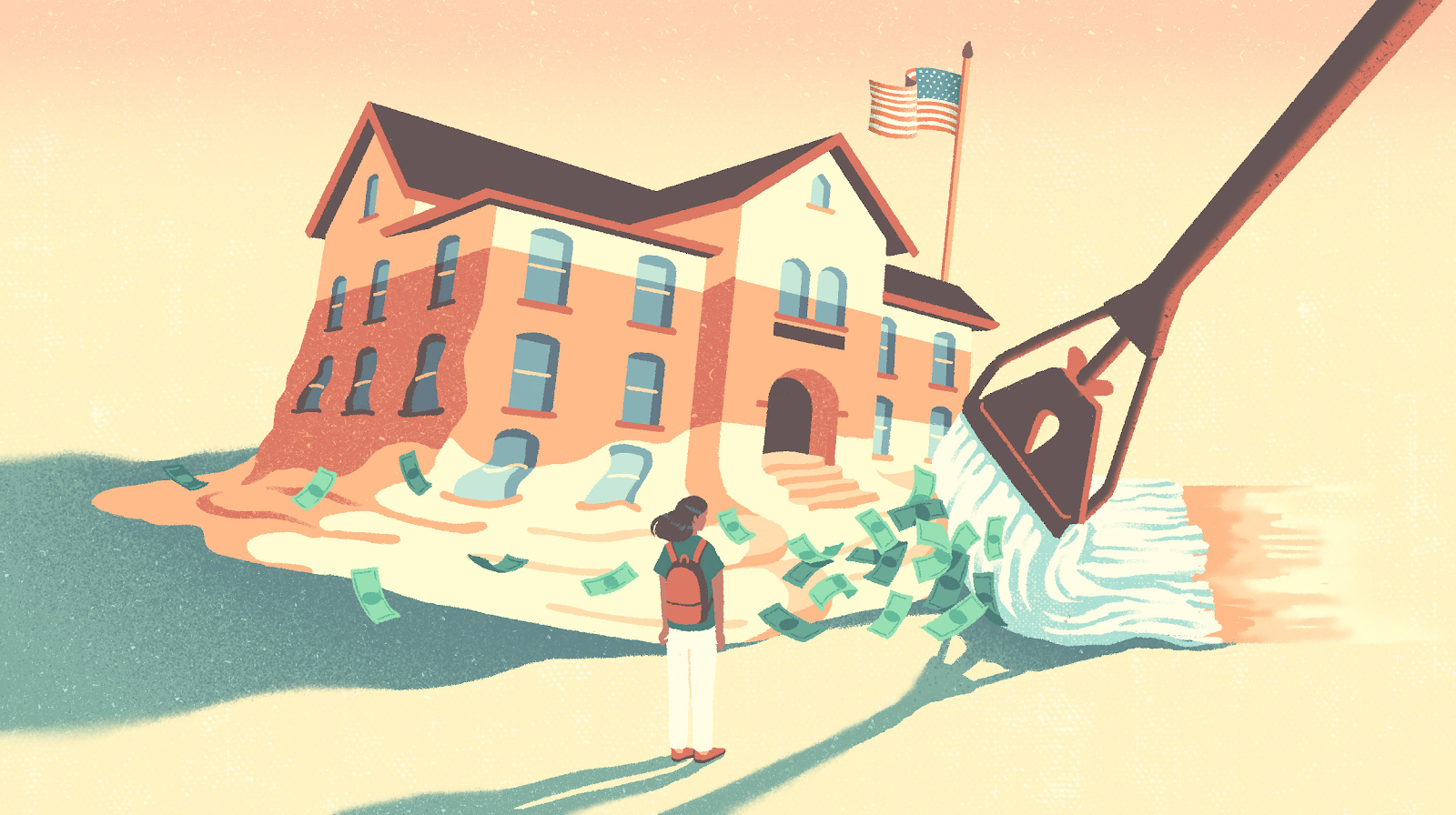
On Thursday, April 27, 2017, President Daniels, Purdue University, announced to the university community a dramatic new program that he and the Board of Trustees had been fashioning in secret for months. Purdue University, a self-proclaimed world class university, would be acquiring Kaplan University, one of several controversial for-profit on-line universities that have emerged over the last twenty years. According to an article in the Lafayette Journal and Courier:

Daniels said the agreement with Kaplan-an affiliate of Graham Holdings Company-both allows Purdue to fully break into the growing online education sector, which the university wasn’t prepared to do on its own, and to serve more nontraditional students who are unlikely to attend a residential campus (Meghan Holden, “Purdue to Acquire Kaplan University,” Journal and Courier, April 28, 2017).

The campus community was stunned by the announcement which it learned about through a hastily called special meeting Daniels assembled with selected faculty and an e-mail announcement to the faculty. Some of us, including members of the Purdue chapter of AAUP were asked to respond to this dramatic new development in The Chronicle of Higher Education. I was quoted as follows:

Faculty should have input on educational policy matters ….Issues to be addressed should particularly include the academic integrity of whole degrees offered on-line...   One would assume, since issues of staffing, developing credit, connecting with the traditional Purdue campuses are all issues of relevance to  faculty who should have been consulted and informed.
Another Purdue colleague, David Sanders referred to the “Walmartization” of higher education, the provisioning of quick cheap degrees. “When speed and cost become more important than quality, faculty are going to object.” (Eric Kelderman,”Purdue Faculty and Students React Warily to Kaplan Deal,” The Chronicle of Higher Education, April 28, 2017).

The dramatic developments at Purdue University highlight a number of issues that bear upon the mission and purpose of AAUP as a protector and advocate of faculty and the integrity of higher education in general. Among the questions that should concern us are the following:

1.Who makes decisions involving higher education?
2.What is and should be the standards and vision of higher education?

3.What role do and should faculty play in higher education?

4.Are there changes occurring in the realm of economics and politics that are threatening our vision of quality education and the long-standing principle of “shared-governance” in matters of educational policy-making?

 An Historical Analyses

According to Clyde Barrow,  (Universities and the Capitalist State: Corporate Liberalism and the Reconstruction  of American Higher Education. 1894-1928, The University of Wisconsin Press, 1990) the modern university had its roots in the period of rising capitalism after the Great Depression of the 1870s to the 1890s when mergers created an economic system in which a few hundred corporations and banks came to dominate the entire U.S. economy. Interlocking directorates of corporations and banks created a system of financial speculation, concentrated wealth, and a capitalist state. The capitalist state through pro-corporate and banking regulations, the allocation of tax and other benefits for the wealthy and powerful,  and military mobilizations, such as President Cleveland’s use of the United States army to crush workers during the Pullman strike of 1894, helped create twentieth century monopoly capitalism. 

Higher education, once dominated by theological pursuits, was refashioned to serve the needs of modern capitalist society. The need for scientific and technical skills coupled with a trained work force stimulated the establishment of educational institutions that could produce credentialed graduates who would serve the capitalist system. Also theoretical work and classroom education was required to educate the young to celebrate the blessings of the economic system and the conduct of the government. Young people learned about the desirability of market economies, the country’s long tradition of democratic institutions, and the manifest destiny of the United States as it conquered the North American continent and established a global empire from the Philippine Islands, to Cuba, to Central and South America.

Barrow provides data to show that members of university Boards of Trustees, the key decision makers in these institutions, came largely from big corporations, huge banks, and law firms which served big business. Some universities from the Midwest and South were led by trustees who represented regional manufacturing and finance capital, but their outlook and interests paralleled those from the major universities of the Northeast and the major state universities. There were never representatives of broader citizens groups such as labor unions on these boards.

During the early twentieth century, Trustees worked to establish an administrative class that could carry out the day-to-day operations of the university and manage the faculty who were the producers of the mental products the university was assigned to produce. Managerial procedures were adopted to control mental labor in the classroom and the laboratory. Metrics were institutionalized to evaluate the rates of productivity of the faculty; from measuring enrollments, publications, and the rankings of the university.

Federal and state governments and foundations funded the construction of a national university system that would serve the interests of twentieth century capitalism. Major foundations generated studies, did surveys, and made recommendations that found their way into institutions and policies of both public and private universities. During periods when domestic crises, such as depressions, and international ones, such as World War I, stimulated critical analyses from universities, faculty were disciplined or fired for challenging the economic system or state policy. The educational mission was to serve the interests of the capitalist elites and the state, not to provide a venue for critical thinking and debate about issues important to society.

Barrow summarized his findings about higher education:

Individual institutions were developing into centralized corporate bureaucracies administered according to nationally standardized measurements of productivity and rates of return on investment. The entire educational enterprise was being restructured within these standards as a production process that was increasingly integrated into local or regional markets for labor, information, research and professional expertise. The process was more and more a planned undertaking directed by the federal government. The construction of a national ideological state apparatus oriented toward solving the problems of capitalist infrastructure, capital accumulation, and political leadership within a capitalist democracy was well under way. (123)

This description of the emergence of the modern university system about one hundred years ago bears resemblance to the wrenching changes that are occurring in higher education in the twenty-first century. First, the further consolidation of capitalist class power in higher education in the current century comes in the aftermath of the Great Recession that began in 2008. United States capitalism continued its transformation from manufacturing to finance as rates of profit from the latter declined. Financial speculation led to banking failures and the collapse of the housing market. Consumer demand shrunk due to rising structural unemployment and falling real wages. And the cost of state support for the provision of education and various social safety nets programs rose. Economic crisis was used to justify austerity policies that included significant reductions in support for higher education.
Second, the economic shocks were used by Boards of Trustees, and their advisers in think tanks and political organizations, to demand increasing efficiencies in the production and teaching of knowledge. Programs that could not be justified as good “investments” became vulnerable. The humanities disciplines had to be justified by their use value to the so-called STEM (science, technology, engineering, and mathematics) disciplines.

Third, metrics have become omnipresent. Colleges and universities are using quantitative instruments to measure “creativity,” “critical thinking,” “personal satisfaction,” “teacher effectiveness,” and faculty “productivity.” University administrators strongly imply that if the activities at their institutions are not measurable in the narrow numerical sense, they should not be supported.
Finally, as the experience of academic critics one hundred years ago of child labor, anti-union policies, World War I, and financial speculation suggests, the nature of debate in the university is circumscribed. University policies, in response to organizations of professors and students, have expanded rights to “academic freedom” and have provided some job security through tenure. But attacks on tenure (which is a right to job security that all workers should enjoy if they perform their duties) are spreading as the twenty-first century “reconstruction of American higher education” proceeds. 

To forestall these trends, faculty and students, as Barrows suggests, need to understand that “education has been and remains a contested terrain.”  Most educators believe that the primary purpose of the university is or should be to stimulate a “marketplace of ideas.” However, the history of higher education, he says, is really about how the university can serve the preservation and enhancement of the capitalist state.

The Crisis of Higher Education
The crisis of higher education involves the efforts of economic elites and politicians to transform education to serve the twenty-first century needs of the larger economy and polity, and not necessarily, the citizenry at large. Barrow provides us with a useful paradigm from which to assess developments in all public institutions including colleges and universities. Power and control resides in Boards of Trustees and political elites and to a lesser extent university administrators. Their lens on educational policy is shaped by unfolding economic and political interests.

If we continue the narrative from the time period Barrow studies, we can identify the growth in higher education with the post-war United States economy, sometimes referred to as the “golden age.” After World War II economic priorities shifted to stimulating manufacturing, mass production and consumption, creating consumer and military demand, the expansion of education, and the provisioning of opportunities for higher education. Higher education became affordable for middle class Americans. War veterans had access to education via the GI Bill. Whole educational systems were constructed in big states like New York and California. Systems of community colleges were established to provide opportunities for poorer and part-time students. The size of faculties increased dramatically. Professional associations and journals increased to facilitate credentialing of new generations of faculty. And in response to uprisings in the 1960s over war, racism, and student rights universities expanded educational programs to overcome traditional “canons” of scholarship and education that left out the examination of the experiences of masses of people (particularly people of color, women, workers, immigrants). The post-war economy boomed and so did higher education.
However, economic stagnation (nationally and globally) began  in the 1970s. Rates of profit declined. Consumption could not match production. Governments no longer could allocate sufficient resources to fund public programs (a political problem) and those who were critics of the modern social democracies marshalled their wealth and political muscle to challenge the vary premises of public policy.

By the late 1970s, Democrats as well as Republicans began to endorse government policies (internationally and domestically) that called for declining government support for social programs; deregulating finance, manufacturing, and markets; and the privatization of public institutions and programs. The policy agenda and this latest phase of capitalism was called neoliberalism. Some commentators refer to the economic policies adopted in the era of neoliberalism as “austerity.”

Below the political radar the billionaire Koch Brothers established The American Legislative Exchange Council (ALEC) in the early 1970s to support client state legislators, create “expert” think tanks on various policy issues, write model legislation on subjects as varied as health care, labor issues, creating charter schools, and transforming higher education. The neoliberal agenda, as was said, was endorsed to varying degrees by both political parties, and was most effectively institutionalized in state governments. Indiana in the era of Governors Daniels and Mike Pence was a model for applied neoliberalism.

Sometime in the late 1980s I heard Rush Limbaugh celebrate on his radio show the neoliberal victories that had been achieved but he declared that the one institution “we” had not been able to shape and control was the university. And that has been the project of endorsed by ALEC, state legislators, rightwing advocacy groups, and university administrators all across the nation.

As an essay by Anthony Paul Farley in a recent issue Academe suggests:

Recent struggles over higher education have taken place on the terrain of austerity, where a new ‘business’ model of higher education has called for the dramatic reduction of labor costs through such means as the elimination of tenure and the replacement of full-time academics with adjuncts. The idea of higher education as a public good has, it seems, very little purchase in the discourse of austerity.  

Everything that can be measured is measured. Money becomes the measure of all things. This metaphysics of austerity has consequences for things not measurable in monetary terms. If the value of an academic discipline cannot be measured in such terms, then it does not exist.

Starving the Beast: Cutting Support for Higher Education

Purdue University President Mitch Daniels testified March 17, 2015 before a subcommittee of the House of Representatives Committee on Education and Workforce on what he calls higher education reform. He also spoke during that week to the American Council on Education and the Brookings Institute. A centerpiece of his recommendations was “income share agreements” whereby students partner with investors, particularly alumni, who would provide funds for their education in exchange “for a small share of the student’s future income.” 

Daniels was touting this idea in addition to new cost-saving policies at Purdue University, such as offering three-year degree programs, using different metrics rather than course hours to measure student preparation, and tuition freezes. He has also urged a reduction in costly federal regulations.

Although some of Daniels’ proposals and programs at his home university have merit, the conversation he and other administrators around the country are having about rising tuition and the accumulation of years of debt ignore the major reason why costs and tuition are rising. In addition to the cost of higher education attributable to increased faculty salaries; layers of new administrators; the creation of new luxury amenities to attract students (housing, food, and recreational facilities), tuition has risen because state government financing of higher education has not kept pace with expenditures.

The Center for Budget and Policy Priorities issued a report on May 1, 2014 (“States Are Still Funding Higher Education Below Pre-Recession Levels”) which provides data to show that higher education funding remains below 2007-2008 pre-recession levels in 48 of 50 states. This means, according to CBPP: “the large funding cuts have led to both steep tuition increases and spending cuts that may diminish the quality of education available to students at a time when a highly educated workforce is more crucial than ever to the nation’s economic future.”

CBPP reports that since 2007-2008 state spending on higher education is down 23 percent, or $2,026 per student. Tuition increases have been substantial in public colleges and universities from fiscal year 2008 to 2014 ranging from $253 in Montana to $4,493 in Arizona.  In Indiana tuition increased by $1,191 during this period. CBPP notes that in 1988 colleges and universities received 3.2 times more of their revenue from state and local governments than from students. That ratio declined to about 1.1 times more from government supports than tuition in 2013. Put another way the report states:

“Nearly every state has shifted costs to students over the last 25 years--with the most drastic shift occurring since the onset of the recession…Today, tuition revenue now outweighs government funding for higher education in 23 states…”

Not surprisingly Daniels’ idea that students find a rich supporter in exchange for future student earnings came from proposals made by free market advocate Milton Friedman in the 1980s. Friedman, the University of Chicago economist, was the most significant descendent of so-called “free market” economists who believe as did President Reagan that “government was not the solution; government was the problem.” From the vantage point of 2015, the privatization of all education, including higher education, is on the agenda of wealthy conservatives such as the Koch Brothers and the powerful state legislative lobbying organization, the American Legislative Exchange Council (ALEC). ALEC funds state politicians who support the elimination of public institutions, such as education.

Naomi Klein, author of The Shock Doctrine: The Rise of Disaster Capitalism, argued that during periods of economic or political crisis, changes have been introduced to weaken government and the maintenance of public services. The CBPP data suggests that the deep recession of 2008-2011 was an occasion for ALEC and the politicians and educators they support to reduce resources available for higher education. Despite the long history of government support for higher education, public schools from kindergarten through high school, libraries, roads, and police and fire-fighting services, the recession offered the occasion for influential and wealthy elites to pressure for policies that reduced state financial support for public services and a shift toward their privatization. In addition universities became even more dependent on big corporations, banks, and the military.  Finally, tuition increased and students had to pay a higher share of the cost of their education.

Throughout much of U.S. history public education, including higher education, has been seen as a public good. The land grant system of public higher education was instituted in 1862. From then until the recent recession, public colleges and universities educated large percentages of the young and generated much of the scientific and technical knowledge that stimulated the U.S. economy, based on substantial public support and low student tuition. 

After World War II, returning veterans became eligible for free higher education under the GI Bill. The program led to the training and credentialing of a whole generation of young people who went on to become educators and researchers, and also consumers of products manufactured after the war. The so-called economic “golden age,” from 1945 until the 1970s, was driven by research and development initiated by GI Bill recipients. These college graduates became members of the largest middle class in American history. 

As Bob Samuels author of Why Public Higher Education Should Be Free put it:

“I actually believe that we should and could make all public higher education completely free. We’re currently spending around $185 billion on higher education annually—which includes spending on for-profit schools, which have very low graduation rates and high debt rates, as well as on merit aid for wealthy students. Given current enrollment, I estimate that it would cost about $155 billion to fund public colleges and four-year institutions completely. My argument is instead of funding the individuals, we should just fund the institutions directly” (quoted in Rebecca Burns, “Why Can’t College Be Free?” In These Times, June 13, 2014, http://www.inthesetimes.com).

However, advocates of “higher education reform” at least those collaborating with economic and political elites who advocate policies depriving government of financial resources, sometimes called “starving the beast,” envision a day when all public institutions are privatized. There is much evidence that the privatization of education will increase gaps between rich and poor and may leave the latter with inferior educations. The Daniels plan will rely on wealthy benefactors to support students while tuition costs continue to rise and those who still seek a college education will continue to accumulate a lifetime of debt. 

Without a return to affordable publicly supported higher education, large proportions of young, intellectually curious, and talented students may be deterred from pursuing higher education which will have negative consequences for the entire society.

Additional Negative Consequences to Higher Education of the Neoliberal Paradigm
STEM

In a 2015 article Lindsey Russell, an ALEC Director of its Education Task Force, wrote an essay entitled “STEM-Will It Replace Liberal Arts?” In it he reports Bureau of Labor Statistics projections that from 2012-2022 there will be a growth of 13 percent in the STEM related workforce. As a result he poses the question reflected in the title of his article. His answer, although he does not say so directly is a qualified “yes.” He does quote a Forbes magazine article that suggests that STEM graduates need “critical thinking skills” to pursue their careers. These skills, the article asserts, along with those in communication, are what a Liberal Arts education can provide. In an interesting statement he says about STEM and Liberal Arts:

“STEM is the present and the future, and STEM related fields are projected to grow by more than 1 million by the year 2022….Liberal arts education may seem irrelevant today, but it is necessary if America’s youth are to become successful members of today’s STEM-dominated workforce.”
However, some empirical studies challenge the claims about preparing for a “STEM-dominated workforce.” Such analyses, and claims about shortcomings in the American educational system, go back as far as the Soviet Union’s launch of “Sputnik.” In a 2014 volume,  Michael Teitelbaum (Falling Behind? Boom, Bust and the Global Race for Scientific Talent, Princeton Press) challenges the periodically claimed view that the United States is somehow “falling behind” in the production of scientists and engineers and in his words, “advocates of these shortage claims have had a nearly open field in politics and the media.”

In addition, in a Bureau of Labor Statistics Monthly Labor Review, May 2015 article entitled, “STEM Crisis or STEM Surplus? Yes and Yes,” the following conclusions are reached based upon extensive research:

*Since the STEM labor market is heterogeneous there are both shortages and surpluses depending on the particular job market segment.”
*In the academic market there are noticeable oversupplies of Ph. D’s.

*In some sectors of government jobs there are shortages of STEM-trained personnel.

*In the private sector, there are some areas were STEM demand is great, in others
where oversupply exists.

*Levels of oversupply or demand vary by geographic region.
Perhaps the most damning statement on STEM training and jobs comes from an article by Hal Salzman, “STEM Grads Are at a Loss,” US News, Sept. 15, 2014 declaring that: “All credible research finds the same evidence about the STEM workforce: ample supply, stagnant wages and, by industry accounts, thousands of applicants for any advertised job.”

While debates continue about the need to prioritize STEM in the educational process, a more important discussion should involve the substance and role of what usually is called “the Liberal Arts.” Should Liberal Arts be seen as only a training ground for honing critical thinking and communications skills or does the Liberal Arts project go much deeper?

Henry Giroux, Professor of English and Cultural Studies, McMasters University, Hamilton, Ontario, posted an essay he called “Neoliberal Savagery and the Assault on Higher Education as a Democratic Public Space,” on September 15, 2016 in which he claimed that political pressures to change and marginalize Liberal Arts had its roots in the theory and practice of neoliberal ideology, an ideology based on a crude vision of markets, privatization of public institutions, and the reduction of all of social life to commodification.

Metrics and Infantilization

At Purdue University and elsewhere administrators have advocated and enforced the use of metrics to measure the quality of the university, the “products” that are being produced, the level of “satisfaction” graduates had with their educational experience, feelings of job satisfaction among faculty, years taken to graduate, quality of jobs attained by students, employer satisfaction with graduates, trends in grades and probably others. In addition increasingly only certain professional journals are ranked high enough to warrant faculty promotion and references from only selective universities warrant consideration in tenure/promotion cases.

Therefore in virtually every phase of the education process there has been a radical transformation from qualitative to a reductionist and narrow empiricist set of university assessments. University administrators use the metrics provided by polling organizations to justify the neoliberal policies they endorse. As the section above suggests, the shift to prioritizing STEM education is defended on the basis of some empirical research to the exclusion of findings that would suggest a different set of educational policies. Numbers have replaced analysis.
The shift to metrics has been accompanied by the socialization of administrators, faculty, and students to reflect on their own performance in terms of the numbers. Numbers of articles rather than their quality become primary. Grades over knowledge acquired becomes prioritized. Numbers of students enrolled in classes, distribution of grades, amount of use of new technologies are all part of the reduction of education to the simplest common denominator. And in recent years, new university bureaucracies have been created to help “mentor” faculty and students to better perform to the metrics. The intellectual curiosity, the passion for knowledge, the encouragement for faculty and students to pursue those questions that enticed them into intellectual work are diminished as everyone is reduced to performing by the numbers.

Impacts on Faculty

Along with putting roadblocks in place for faculty to form unions, there has been a growing attack on the tenure system. Tenure means job security. Tenure means that faculty cannot be arbitrarily fired. Tenure means that after going through a period of performance and rigorous review, faculty have some job protections. And tenure means that faculty, in a work setting in which the free flow of ideas is vital, are protected from controversy in their teaching and research. Abolishing tenure is a high priority in higher education.

And, of course, there has been a qualitative decline in the percentage of college and university classes taught by tenure or tenure-track faculty and a concomitant rise in courses taught by graduate students and adjuncts. As state legislatures reduce financial allocations of resources, universities hire low paid adjuncts, often on a course-by-course basis at extraordinary savings. Of course, if an adjunct gets to teach four courses at more than one university, her/his time is spent traveling with little time to keep up with relevant literature and do research which in the long run reduces the chance for securing tenure-track employment.  
And finally, returning to the new Purdue/Kaplan story: it is assumed by Boards of Trustees, spokespersons for ALEC, corporate executives, and politicians turned university administrators that on-line education is just fine. Although on-line education may have a place in the matrix of a total academic career, the appropriate mix of campus and on-line coursework; interpersonal/electronic contact; and reading versus videos and power points on computer screens needs to be discussed all across the campus. Particularly, the Kaplan model of on-line education, even for the millions of non-traditional students, requires critical scrutiny. 

The Bernie Sanders proposal for free higher education for all should be part of public policy debate. Also, programs of additional support for regional campuses and community colleges, extension programs, extended hours on campuses for course offerings and other programs to meet the needs of non-traditional students might be part of a discussion of educational opportunities. It may be that several approaches in the long run might better serve the educational needs of  non-traditional students than new collaboration with for-profit on-line firms with dubious performance records.

What Next? 

In a 2010 essay in The Chronicle of Higher Education, Andrew Hacker and Claudia Dreifus made a series of proposals to address some of the crises of higher education today. They began by noting that tuition for public and private colleges had doubled compared with a generation ago. Rising educational costs required parents to commit large financial outlays, second only to house mortgages, to their children’s education. Alternatively students have had to take out loans that will burden them for their entire lives.

Among the proposals these authors made were the following:

-Institute free higher education for all who seek it.

-Maintain course requirements that lead to knowledge in history, the arts, sciences, and reasoned discourse.

-Provide secure full-time teaching jobs for every classroom. Eliminate the system of staffing classrooms with graduate students and temporary adjuncts who receive one-sixth the pay of the regular faculty.

-Pay presidents and other administrators salaries commensurate with public employees, not CEOs of Wall Street banks and corporations.

While our wealthiest and most powerful institutions-- corporations and banks, the military, and the health care system-- have come under some scrutiny in the new century, until recently higher education has remained hidden behind a wall of mystery even though everyone pays lip service to it as the hope for the future.

With enduring economic stagnation coupled with rising gaps in the distribution of income and wealth, education is offered as an escape route from poverty. We need to broaden public discussion about our assumptions concerning higher education; assessing its costs, accessibility, educational quality, and workplace security.
And for faculty the task is to organize effective political/lobby groups to defend the ideal of the university. In every college and university setting discussions should be organized about the strengths and weaknesses of the neoliberalism policy agenda, with particular emphasis upon its consequences for higher education.


Thursday, April 27, 2017

MAY DAY BRINGS THOUGHTS OF SOCIALIST ALTERNATIVES

(This essay first appeared on May 1, 2009)

Harry Targ

Sketching Today’s Global Political Economy

During the latest phase of monopoly and finance capital (1945- to the present) enormous changes occurred in the global political economy. First, the United States emerged as a superpower and in an effort to crush the threat of socialism around the world committed itself to constructing a “permanent war economy.” This permanent war economy would create the military capacity to destroy alternatives to global capitalism, stimulate and maintain a high growth manufacturing economy, justify an anti-communist crusade to crush the left in the United States, and co-opt and/or repress working class demands for change. In addition, the permanent war economy would occasion the perpetuation of racism and patriarchy in public and private life.

As the years passed corporate rates of profit began to decline as a result of rising competition among capitalist states, over-production and under-consumption, an increasing fiscal crisis of the capitalist state, and rising prices of core natural resources (particularly oil). With a growing crisis, global corporate and finance capital shifted from investments in production of goods and services to financial speculation. Thus capitalist investment steadily shifted to financialization, or the investment in paper-stocks, bonds, private equity and hedge funds and other forms of speculative investment. Financial speculation was encouraged by state tax policies, “free trade” agreements, an expanded international system of indebtedness, and increased reliance on consumer debt.

Multinational corporations which continued to produce goods and services sought to overcome declining profit rates. This, they concluded, could only be achieved by reducing the costs of labor. To overcome the demand for higher real wages, health and other benefits, and worker rights, manufacturing facilities were moved from core capitalist states to poor countries where lower wages were paid. Thus, in wealthier countries millions of relatively high paying jobs were lost while production of goods increasingly moved to sweatshops in poor countries. Wealthy capitalist states experienced deindustrialization.

Finally, assisted by technological advances, from computers to new forms of shipping, financial speculation and deindustrialization fueled the full flowering of globalization, or the radically increased patterns of cross border interactions-economic, political, and cultural. Globalization began to transform the world into one integrated global political economy.

In short, we may speak of a four-fold set of parallel political and economic developments that have occurred since the end of World War II, in which the United States has played a leading role: creating a permanent war economy, financialization, deindustrialization, and globalization.

Should We Be Thinking About Socialism Today?

A rich and vital set of images of a socialist future comes down to us from the utopians, anarchists, and Marxists, the martyrs of the first May Day, and the variety of experiments with socialism attempted in Asia, Eastern Europe, Western Europe, Africa, and the Caribbean. Extracting from the multiple reasons why individuals and movements chose socialism one reason stands out; that is, that capitalism historically is and has been a cruel and inhumane system, a system borne and fueled by slavery, genocide, super exploitation of workers, tactics of division based on race and gender, and an almost total disregard for the natural environment that sustains life. Building a permanent war economy, financialization, deindustrialization, and globalization are merely extensions of the cruel and heartless pursuit of profit which has been the fundamental driving force of the capitalist mode of production.

Drawing on the history and the images of a better future coupled with the brutality of the capitalist era, we might conceive of a 21st century socialist future that has four main dimensions.

First, we need to create institutions that are created and staffed by the working classes and serve the interests of the working classes. While scholars and activists may disagree about what “class” means in today’s complicated world, it is clear that the vast majority of humankind do not own or control the means of production, nor do they usually have an instrumental place in political institutions. Therefore, socialism involves, in the Marxist sense, the creation of a workers’ state and since most of us are workers (more than 90 percent of the US population for example), a state must be established that represents and serves the interests of the many, not the few.

Second, our vision of socialism is a society in which the working classes fully participate in the institutions that shape their lives and in the creation of the policies that these institutions develop to serve the needs of all the people.

Third, socialism also implies the creation of public policies that sustain life. Socialism in this sense is about good jobs, incomes that provide for human needs, access to health care for all, adequate housing and transportation, a livable environment, and an end to discrimination and war.

Fourth, socialism is also about the creation of institutions and policies that maximize human potential. A socialist society provides the intellectual tools to stimulate creativity, celebrate diversity, and facilitate writing poetry, singing and dancing, basking in nature’s glow, and living, working, and loving with others in humanly sustainable communities.

Today we remain terribly far from any of these dimensions of socialism. But paradoxically, humankind at this point in time has the technological tools to build a mass movement to create a socialist future. We can communicate instantaneously with peoples all over the world. We can access information about the world that challenges the narrow ruling class media frames about the human condition. We have in the face of brutal war, environmental devastation, enduring racism, super exploitation of workers everywhere mass movements of workers, women, people of color, indigenous people, and youth who are demanding changes. Increasingly public discourse is based upon the realization that our future will bring either extinction or survival. Socialism, although it is not labeled as such, represents human survival.

Where do we who believe that socialism offers the best hope for survival stand at this critical juncture? We are weak. Many of us are older. Some of us have remained mired in old formulas about change. Nevertheless we can make a contribution to building a socialist future. In fact we have a critical role to play.

We must articulate systematic understandings of the global political economy and where it came from: permanent war, financialization, deindustrialization, and globalization. We need to articulate what impacts these processes have had on class, race, gender, and the environment. In other words, we need to convince activists that almost all things wrong with the world are connected and are intimately tied to the development of capitalism as the dominant mode of production.

We need to take our place in political struggles that demand an expanded role for workers in political institutions. We need to insist that the working classes participate in all political decisions.

We need to work on campaigns that could sustain life: jobs, living wages, single payer health care, climate change etc. Our contribution can include making connections between the variety of single issues, insisting that participants in mass movements take cognizance of and work on the other single issues that constitute the mosaic of problems that require transformation. We must remember that in the end the basic policies that sustain life require building socialism. Most struggles, such as those to achieve living wages or a single payer health care system for example, plant the seeds for building a broader socialist society. We can incorporate our socialist vision in our debates about single issues: if we demand a living wage, why not talk about equality for example?

We need to rearticulate our belief that human beings have a vast potential for good, for creativity, and given a just society, we all could move away from classism, racism, and sexism. We could pursue our talents and interests in the context of a sharing and cooperative society.

By working for institutional incorporation (empowerment) and life-sustaining and enhancing policies we will be planting the seeds for a socialist society.

“In our hands is placed a power greater than their hoarded gold,
Greater than the might of armies, magnified a thousand-fold.
We can bring to birth a new world from the ashes of the old.
For the union makes us strong”

From “Solidarity Forever,” Ralph Chaplin lyrics, 1915.


Wednesday, April 19, 2017

REBUILD THE PEACE MOVEMENT NOW! STOP THE VIOLENCE! STOP THE INTERVENTIONS!


Harry Targ

Although most progressives preferred a Hillary Clinton victory in the 2016 election, strong reservations about her candidacy existed because of her historic association with foreign policies promoting the  globalization of violence, war, and covert operations in countries which challenged the neoliberal policy agenda. Candidate Trump made bold statements about avoiding escalation of United States involvement in Syria, staying out of the perpetual tensions on the Korean peninsula, pulling the plug on NATO, and opposing the Trans Pacific Partnership and the North American Free Trade Agreement. Most of all Trump seemed to strike a rational chord with his call for improving relations with Russia.

The Trump campaign created concern among the two dominant foreign policy factions which have dominated United States foreign policy since the Reagan period: the neoconservatives and the humanitarian interventionists. The first group, particularly influential in the eight years of President George Walker Bush, argued that the United States was the world’s hegemonic power and it should use that power to transform the globe. Militarism should be the primary instrument of foreign policy, not diplomacy. The second group, primarily those affiliated with Presidents Clinton and Obama and presidential candidate Hillary Clinton advocated a more selective use of military power, promoting neoliberal globalization through diplomacy and trade agreements, and covert interventions to destabilize regimes hostile to the global economic agenda of capitalism. Clearly, these two factions of the foreign policy establishment overlapped and both sought to promote global capitalism and imperialism. But their methods varied.

The Trump campaign foreign policy agenda was seen by both factions as a threat to the imperial project. It stressed economic nationalism, a more judicious participation in international affairs, and potentially to use the old hyperbolic label “isolationism.” Therefore, after Trump’s election, what some analysts called “the deep state”-- foreign policy institutions such as the CIA, NSA, DIA, FBI, leadership of both political parties, liberal and conservative think tanks, and the mainstream media--launched a campaign to embarrass Trump, primarily using loose charges of a Trump/Putin election season cabal. The pressure on Trump became so strong and so single-minded in the liberal media (particularly MSNBC) that Trump began a significant tactical shift in foreign policy.

After weeks of increasingly hostile rhetoric about Russia, President Trump launched a massive missile assault on targets in Syria (which took off the front pages an “erroneous” mass slaughter of civilians in Mosul one week earlier due to a “mistaken” US air attack). He adopted the deep state narrative that Syria had dropped chemical weapons on its population. He threatened more military action. The hostility was coupled with threats and counter-threats between representatives of the US and Russian governments. Trump escalated bombing of targets in Yemen, giving support to the Saudi driven war there.  And during the week of April 12, the United States dropped a “mother of all bombs” on alleged enemy targets in Eastern Afghanistan. This bomb had the largest explosive power of any bomb used since World War II. In addition, the president and his vice president increased threats on North Korea, pledging military action if they test-fired new missiles and/or nuclear weapons. Trump sent an aircraft carrier group to waters adjacent to the Korean peninsula; another act of provocation. In addition, and below the radar screen of brutal violence, anti-government protestors in Venezuela mobilized to challenge the government of Nicholas Maduro. These so-called “dissidents” have among them activists on the payroll of the United States government. The campaign against the Bolivarian Revolution is being manifested in diplomatic and covert assaults against Bolivia and Nicaragua as well.

In sum, the new Trump administration has embraced a foreign policy that combines the worst aspects of the two factions of the foreign policy establishment, the deep state. He has shifted US policy to a militarism on high alert. He has returned to a posture that calls for the overthrow of the Assad regime in Syria. He has put war against North Korea on the table. He has continued the covert operations in Latin America. And he has joined the neoconservatives and humanitarian interventionists in a campaign to challenge the place of Russia in the international system. On this last point, Russian expert Stephen Cohen, warns that we are closer to nuclear war with Russia than at any time since the Cuban Missile crisis. And as he and British journalist Jonathan Steele point out, the arguments for the new militarism are based on no evidence of new danger.

The one card that remains unclear, and perhaps the best hope for avoiding global war is the resistance of other powers in the world. Trump’s meeting with the Chinese leader, Xi Jinping, in Washington and China’s role in efforts to forestall war in Korea remain unclear. Also representatives of the BRICS (Brazil, Russia, India, China, and South Africa) met after the recent US attack on Syria to discuss a common response.

Without demeaning the centrality of the climate crisis, the title of Naomi Klein’s recent book, “This Changes Everything,” might be applied to the latest developments in United States foreign policy. New louder voices must be raised in the peace movement—and as part of every movement it is allied with—to Stop the Violence, Stop the War. In addition the clear connections between the $54 billion increase in military spending and the parallel cuts in non-military spending needs to be highlighted.

The famous clock of The Bulletin of Atomic Scientists has been moving toward midnight, total darkness. The peace movement must act now.

Monday, April 10, 2017

ON KOREA: SOME REPOSTS


Seeds of an imperial policy:
'Our Forgotten War' in Korea

By Harry Targ / The Rag Blog / June 21, 2010

"If we stand up to them [the communists] . . . they won't take any next steps. There's no telling what they'll do if we don't put up a fight now."
-- President Harry Truman at the outbreak of the Korean War, Philadelphia Inquirer, June 20, 2010

"On June 25, 1950, communist-backed troops from North Korea invaded a hopelessly overmatched South Korea. American-led U.N. forces quickly came to the aid of South Korea, but the war unexpectedly escalated five months later when China, in support of North Korea, launched a massive attack on U.N. forces near the Yalu River.

"Three years of brutal fighting followed as both armies hurled each other up and down the Korean peninsula. More than 54,000 U.S. soldiers died during the war, which technically has never officially ended but has been in a prolonged cease-fire since 1953.

"North Korea often states that it is still at war, but the reality is that tenacious fighting by U.S. and U.N. soldiers successfully repelled the invading communist forces and pushed them back across the 38th Parallel border. South Korea remains a free nation, one of the most prosperous in Asia, while North Korea is one of the most repressive."
-- Chris Gibbons, Philadelphia Inquirer, June 20, 2010

The annual fantasy

Americans relive and debate the Vietnam War. Analysts discuss “the Vietnam Syndrome,” the “albatross” that shackled every president, and/or claims about where every candidate for public office was during Vietnam. To the contrary, the Korean War, which in the words of the U.S. government was launched by the aggressive invasion of North Korean armies below the 38th parallel into South Korea 60 years ago on June 25, 1950, is beyond question.

As newspapers often title Korea, “Our Forgotten War,” the story is simple: Communist aggressors (inspired by Moscow) invaded a free nation (South Korea). The Americans mobilized United Nations support and boldly counter-attacked forcing the Communist aggressors back North.

Then, the story goes, the US-led army of the free people went north of the 38th parallel to liberate North Korea from its dictatorship. This invasion was foiled by a massive Chinese Communist military response. While a ceasefire was established in 1953, conflict on the peninsula remains between the prosperous and free South Korea and the poor and totalitarian North Korea.

Key facts

This fantasy, created in 1950, set the stage for a 60-year rationalization for trillions of dollars of military spending, hundreds of thousands of U.S. soldiers killed and wounded, and the deaths of millions of people, largely from the Global South, who were unwilling hosts of wars, interventions, and domestic violence related to the Cold War.

Just a brief examination of the history of the Far East suggests that the fantasy is just that. The Korean Peninsula was colonized by the Japanese before World War I. At the end of World War II, with their defeat, Koreans all across the peninsula believed that they, at last, would be able to establish their own independent government. “Peoples Assemblies” began to meet to plan for a post-war Korean government. However, at the urging of the United States, it and the Soviet Union agreed to divide the peninsula at the 38th parallel until such time as an independent government, desirable to the victorious powers could be established.

The United States government over the next three years brought exiled Korean Syngman Rhee back to the country to establish a government in the U.S. occupied zone. Rhee, an émigré with ties to large landowners, was not popular with South Korean farmers, many of whom rebelled against the new government imposed by Washington. In areas where rebellions were stifled, the United Nations held “elections” for a new government. Rhee and his party were victorious. And in the North, a regime allied with the Soviet Union was established, led by Kim Il Sung, long-time Korean Communist party organizer.

In 1948 Soviet troops were withdrawn from the North and in 1949 U.S. troops from the South. Both leaders, Syngman Rhee and Kim Il Sung, declared their commitments to liberate the other half to establish one Korean government. Some U.S. congressmen began to balk at Truman's requests to continue funding the corrupt Rhee government in the South.

In May 1950 Republican spokesman on foreign policy John Foster Dulles visited South Korea and spoke in support of Syngman Rhee, whose domestic support was faltering, and then Rhee and Dulles flew off to the Tokyo headquarters of General Douglas MacArthur, overseer of post-war Japan. It is important to note that shots had been fired both ways across the 38th parallel for months before these events.

Finally, as the official story suggests, North Korean troops invaded the South on June 25, 1950. South Korean military forces, heavily subsidized and trained by the United States, fled South and within a month much of the country below the 38th parallel was occupied by Northern armies.

Then the U.S., with UN support, launched a counter-assault in September 1950, led by General MacArthur, who already had declared his vision of creating a Christian and anti-Communist Asia. North Korean armies were forced back north of the 38th parallel and with the urging of MacArthur and other virulent Cold Warriors in the Truman administration an apocryphal decision was made to take the war to the North. The Chinese, fearful of an invasion of their own land, entered the war on the side of North Korean armies. The Korean War was extended until 1953 and a troubled ceasefire was established that still prevails today.

What the real history suggests

First, as historian Robert Simmons wrote: “There were constant and sizable armed clashes and border incursions between the North and South for over a year before the final crisis... the Seoul regime enjoyed little popular support... it had announced its intention to invade the North and appeared to be preparing to do so...”

Second, the division of Korea in 1945 defied the wishes of the Korean people, Communist and non-Communist alike. In the South, Syngman Rhee was regarded as an outsider and representative of the small land-owning class of Koreans (a character similar to Chiang Kai-Shek in China, and Ngo Dinh Diem in South Vietnam).

Third, the Korean War was in fact a civil war which the Truman administration chose to define as the first great conflagration in the global struggle against worldwide Communism. Many scholars suggest to the contrary that North Korean Kim Il Sung’s decision to invade the South was made by him without approval or support from the Soviet Union.

In fact, the Soviet delegate at the United Nations was boycotting the Security Council at the time the Council voted to condemn the invasion of the South. If the Soviet delegate was aware of the planned invasion he probably would have attended the Security Council session to veto the U.S. resolution condemning the North Korean invasion.

Consequences of 'Our Forgotten War'

The decision by the Truman administration to enter the war to “save” the Rhee regime in the South signified a permanent commitment to an imperial policy that continues to this day. As political scientist Hans Morgenthau once wrote, after the Korean War started reversing U.S./Soviet conflicts and the militarization of the world was no longer possible.

The Korean War gave support to those Truman administration advocates for the full militarization of United States foreign policy and U.S. society. National Security Council Document 68 had been circulating inside the administration at that time. It called for a dramatic increase in annual military spending based on the proposition that each president should give the military all it wanted before any other expenditures for government programs were adopted. Specifically it called for an immediate four-fold increase in military spending, a proposal that some fiscal conservatives had opposed. After Korea virtually all restrictions on military spending were lifted.

Additional byproducts of the new U.S. commitment to a Korean War included the following: finalizing the construction of an anti-Communist Japanese economy to balance the new Chinese Communist regime; making permanent the U.S. financial commitment to the French in Indochina (a prelude to the next big war, in Vietnam); circulating the idea of an Asian military alliance to be called the Southeast Asia Treaty Organization (SEATO); expanding the North Atlantic Treaty Organization (NATO); and stimulating anti-Communist repression domestically.

As we reflect on the limited economic development in the North and the dramatic growth in the South, both products of the Cold War, the impacts of “Our Forgotten War” on the Korean people should be recalled. As Joyce and Gabriel Kolko wrote:

“The United States air force had completely destroyed all usual strategic bombing targets in North Korea within three months time, and by the end of the first year of combat it had dropped 97,000 tons of bombs and 7.8 million gallons of napalm, destroying 125,000 buildings that might ‘shelter’ the enemy. In mid-1952 it turned to the systematic destruction of mines and cement plants...” and the "...Suihu hydroelectric complex on the Yalu.”

They added that Syngman Rhee rounded up 400,000 South Koreans who were put in concentration camps. The authors wrote: “The Korean War, in effect, became a war against an entire nation, civilians and soldiers, Communists and anti-Communists alike. Everything -- from villages to military targets -- the United States considered a legitimate target for attack.” At least four million Koreans, North and South died, were wounded, or were made homeless (Joyce and Gabriel Kolko, The Limits of Power: The World and United States Foreign Policy, 1945-54).

So despite the fact that the Korean War has become “Our Forgotten War,” the decision to enter Korea globalized, militarized, and institutionalized a U.S. policy that has rationalized wars on entire populations ever since.


Thursday, July 22, 2010

THE KOREAN WAR NEVER ENDS: A 60 YEAR COVERUP

Harry Targ

"We continue to send a message to the North. There is another way. There is a way that can benefit the people of the North," Mrs. Clinton said alongside Mr. Gates on Wednesday, as they stood just feet away from leering North Korean soldiers stationed across the North-South border. "But until they change direction, the United States stands firmly on behalf of the people and government of the Republic of Korea." (Jay Solomon, Wall Street Journal, July 22, 2010).

In a political about-face, a South Korean commission investigating a century of human rights abuses has ruled that the U.S. military's large-scale killing of refugees during the Korean War, in case after case, arose out of military necessity.

Shutting down the inquiry into South Korea's hidden history, the commission also will leave unexplored scores of suspected mass graves believed to hold remains of tens of thousands of South Korean political detainees summarily executed by their own government early in the 1950-53 war, sometimes as U.S. officers watched.

The four-year-old Truth and Reconciliation Commission of Korea probed more deeply than any previous inquiry into the country's bloody past. But a shift to conservative national leadership changed the panel's political makeup this year and dampened its investigative zeal.

The families of 1950's victims wanted the work continued. (Charles J. Hanley and Hyung-Jin Kim, Associated Press, July 11, 2010).

Back to Korea

I keep coming back to the Korean War. Maybe it is an occupational hazard of those who teach foreign policy. Perhaps it is because virtually every administration since World War II has made their narrative of the events on the Korean peninsula a centerpiece for justifying United States foreign policy. And, from the standpoint of those of us who view United States foreign policy from a critical perspective, the Korean War represents a model of what that policy continued to be ever since the 1940s.

I wrote recently about “our forgotten war,” the Korean war, arguing that the U.S. commitment to “defend” the Korean regime south of the 38th parallel militarily opened the door to massive increases in military spending, the unquestioned commitment of the United States to a global anti-Communist agenda, defense of the reactionary Chinese on the Formosa Islands, the total funding of the French effort to crush Vietnamese anti-colonial forces, and the rapid expansion of the North Atlantic Treaty Organization. Also, with the Korean War, domestic repression of dissent was broadened and deepened, unleashing the FBI, Congressional and state legislative investigative committees, and moves to standardize American popular culture.

I thought I had written enough on Korea for a while until I read a July 11 wire service story announcing that a Truth and Reconciliation Commission established five years ago in South Korea was terminated. The Commission was created to investigate charges that the U.S. puppet government in South Korea before and during the war was responsible for the rounding up and incarceration of hundreds of thousands of anti-government dissidents in the South (with U.S. military support). Also the Commission was to examine claims by historians that South Korean president Syngman Rhee may have slaughtered 100,000 or more of his own citizens in the early stages of the Korean War because they were deemed unsympathetic to the anti-Communist regime in Seoul.

Then on July 21, Secretaries of State and Defense Hillary Clinton and Robert Gates visited the 38th parallel which has divided the Korean peninsula for over 60 years. Photo images of Clinton peering North with binoculars underscored the definition of North Korea as mysterious and demonic. To support the imagery she announced that sanctions against the “Stalinist dictatorship” would be escalated. The North, she claimed, was responsible for the destruction of the South Korean warship, Cheonan, on March 26, killing 46 sailors. She accepted this interpretation from official South Korean government sources.

The Hidden History

I had read many books over the years on the Korea War but just recently took I.F. Stone’s The Hidden History of the Korean War off my shelf. As one of the first definitive studies of the onset of the Korean War, published by Monthly Review, in 1952, it tells a story of how that war started that is radically different from the official story: “the evil communists in the North invaded the democratic South on orders from the Soviet Union and China.” Even for me, the I.F. Stone narrative was shocking about Korea then (and now). Most troubling were the suggestions about how lies, deceit, messianic ideology, and personality disorders along with imperial structures and processes may have affected United States foreign policy in general. Reflecting on these foreign policies led me to realize that their impacts have included the deaths of millions of people, mostly people outside the Anglo-Saxon world.

Stone’s narrative highlights the interests, behavior, ideologies, and personalities of a handful of players who had most to do with creating and prosecuting the Korean War. Most central was General Douglas MacArthur, commanding officer of the U.S. occupation of Japan, headquartered in Tokyo. MacArthur saw himself as the future leader of all of Asia, bringing Christianity, capitalism, authoritarian democracy and his own historic destiny to the region.

His partners including John Foster Dulles, key Republican spokesperson on foreign policy, former representative to the United Nations and U.S. negotiator of the Japanese Peace Treaty which welcomed back that country into the “family of democratic nations.” Dulles had a long legal career, working with corporations and banks that did business with Nazi Germany. He regarded the rise of Communism as a manifestation of the anti-Christ.

Other partners in the Korean War drama were Syngman Rhee, dictatorial president of the South Korean regime who was on the verge of being ousted from power after his party lost parliamentary elections and Chiang Kai Shek, leader of the anti-Communist forces who were defeated by the Chinese Communists in a thirty-year civil war. Chiang’s Koumintang was forced to retreat from the mainland of China to the Formosan islands and he was desperately seeking a commitment from the United States to defend his beleaguered armies on the islands.

The narrative, of course, includes defense department officials and military contractors who remained, even in 1950, under the yoke of fiscally conservative legislators. They wanted a justification for massive increases in military spending such as those recommended in the secret document National Security Council Document 68.

In addition, Republican politicians were looking for an issue to finally end the twenty year domination of the Democratic Party in national political life. Issues such as the “fall of China,” “the spread of Communism,” the “lack of attention to Asia,” and “subversion inside the State Department” became part of their public agenda. And President Truman, his Secretary of State Dean Acheson, and other key advisers saw the need to expand U.S. military reach to Asia as well. With “the fall of China” Japan and the Korean peninsula were central to the geo-political expansion of US empire and the institutionalization of vibrant capitalist systems in Asia to challenge Communism.

Everybody Has an Interest in War

After describing the central characters in the Korean War drama, it becomes clear that they all would benefit from a massive and irrevocable U. S. military commitment to the anti-Communist regime in South Korea. Such a war would cap the distinguished military career of MacArthur, bring Christianity to Asia, shift foreign policy influence to missionary Republicans such as Dulles and others who wanted to expand U.S. domination to all of Asia, and would save the faltering political fortunes of the dictators in South Korea and Formosa who lacked support among their own people. Last, and not least, a Korean War would institutionalize, militarize, and globalize a United States foreign policy that would bring capitalism and democracy to the world.

The story Stone then tells is of lies and deceit designed to threaten and entice the North Koreans into making war on the South, changing the United States/United Nations response from defending the territory below the 38th parallel to expanding the war to the North, and doing whatever could be done to scare the Chinese into entering the war in full combat. Stone’s narrative shows how desperately the Chinese resisted all-out military response and how MacArthur’s headquarters at every turn resisted peace overtures.

The Stone narrative is long and complicated. Of course many have written about the Korean War since. But what so impacted me reading the book almost 60 years after its publication was the plausibility of the descriptions about how broad economic and political forces shaped and encouraged key decision-makers to act in despicable ways to serve their own interests, as well as United States empire. I am afraid that the United States approach to the Korean peninsula and foreign policy in general has not changed much since.

Any Way Out?

The best alternative to current U.S. foreign policy toward Korea and the world was recently expressed by the Veterans for Peace President Mike Ferner in a press release remembering the 60 year anniversary of the Korean War:

The recent unfortunate sinking of the South Korean warship, Cheonan, should not be used as an excuse by any parties to renew the armed conflict that the armistice was supposed to address on July 27, 1953. Rivers of blood, mountains of pain and a permanent war economy in the U.S. are the true costs of this conflict. This sad anniversary renews VFP's commitment to abolish war as an instrument of national policy.

The press release concluded:

As we observe the 60th anniversary of the Korean War of 1950-1953 today, it is time to end this tragic war, not re-ignite it. We urge all concerned parties in the Korean War--both Koreas, the United States, and China--to begin negotiations for a peace treaty and an official end to the war.


Harry Targ : Korea and the U.S. Policy of Perpetual War

With the onset of the Korean War, the politics of fear converged with the politics of empire.

By Harry Targ | The Rag Blog | December 27, 2011

Liberal cable commentators have been waxing eloquent about the withdrawal of the United States military from Iraq while ridiculing and scorning the recently deceased dictator of North Korea, Kim Jong Il. They fail to see the historic connections between the onset of war along the Korean peninsula in 1950 and the Iraq war of our own day.

If pundits reflected on the causes of the Korean War and the consequences following it they might see the culpability of the United States in launching a 60-year war system that has cost the lives of millions of people all across the Asian, Middle Eastern, African, and Latin American landscape.

To use the language of our own day, we need to “Occupy Our Minds,” or “Occupy Our History.” We need to understand where the North Korea of Kim Jong Il came from and why the United States created a dictator in Iraq, Saddam Hussein, and then destroyed him, his country, and hundreds of thousands of his people. This revisiting of the American past is painful but necessary.

Consider the Korean peninsula. It was a colony of expansionist Japan from the dawn of the twentieth century until the end of World War II. After that war, Korea was “temporarily” split at the 38th parallel by the United States and the former Soviet Union for “administrative purposes.” As the war ended, the Korean people fully expected to create their own independent state. “People’s Assemblies” were held throughout the peninsula to serve this purpose.

In the South, under U.S. control the assemblies were ignored. Over the next five years, using the new United Nations as the stamp of legitimacy the United States created an unpopular regime in the South led by Syngman Rhee. Rhee, tied to western anti-communist interests and domestic wealth very much like Chiang Kai Shek in China and later Ngo Dinh Diem in South Vietnam, established a brutal dictatorship. The Soviets, in the north, established a Communist regime led by Kim Il Sung.

In 1950 powerful foreign policy interests promoted a global U.S. foreign policy that would benefit from war. General Douglas McArthur, overseer of post-war Japan; John Foster Dulles, anti-communist foreign policy spokesperson of the Republican Party; and Rhee, on the verge of losing his power in South Korea, met in Tokyo in May. Conversation ensued that likely included making war on North Korea.

Back in Washington, Dean Acheson, Secretary of State, and his key aide, Paul Nitze, were lobbying for a new bold military policy, proclaimed in the secret National Security Document 68. It called for military spending to be the number one priority of each American administration. The reason, the document claimed, was the world-wide threat to civilization represented by international communism.

George Kennan’s “containment” policy, beefing up U.S. and allied forces to protect against any aggressive attack from a prospective enemy, was not enough. By 1954, the document predicted, the former Soviet Union would be as powerful as the United States.

As Acheson himself admitted in his memoirs, he felt the need to exaggerate the threat to United States security to gain support for a more global U.S. foreign policy. In other words, support for empire required lying to the American people. In the Korean case, an artificial division of the Korean peninsula, contestation between competing political forces, and a North Korean military attack on the South was reframed as a worldwide war on freedom and democracy. The Korean War institutionalized the big lie.

Then the Truman Administration, the Defense Department, big corporations, the major media, and many religious institutions launched a campaign of fear based on a fantasy of a dangerous communist subversion. Who could question a dramatic military response to a nation under siege.

With the onset of the Korean War, the politics of fear converged with the politics of empire. In sum, the United States redefined a civil war between Koreans, north and south of the 38th parallel, into a struggle between the “free world” and “international communism.”

The Korean War led to the deaths of 4 million Koreans and 54,000 U.S. soldiers. Between 1950 and 1995, the United States continued to develop the largest military force in the world, with hundreds of bases in 30 or more countries, dozens of covert military operations, and support for countless dictators in countries of the Global South. In wars in which the United States had a role during these 45 years, some 10 million people died, most of them civilians.

Fifty-three years after the onset of the Korean War, the United States launched a war on Iraq based on lies. The American people were told of the dangers the Iraqi regime posed for United States security. The threat was no longer communism but terrorists. And Saddam Hussein was framed as a supporter of terrorism against the West who possessed weapons of mass destruction.

These were lies based on significant historical distortions of the politics of the region. The details were different but the arguments for war on North Korea and the war on Iraq were both based on lies. The same case can be made for most U.S. interventions and wars from Korea to Iraq.

The policies of fear, empire, and military operations continued in the 21st century. The war in Afghanistan, begun in 2001, still goes on. We now celebrate the ostensible end of the Iraq war after nine years. About 10 thousand U.S. soldiers and probably a million Afghan and Iraqi people have died in these two wars. Economists predict that the Iraq war alone will have cost the U.S. government 3 trillion dollars by 2030, a total similar to U.S. military expenditures between 1945 and 1990.

So when pundits ridicule the dictatorship in North Korea and make grandiose statements about the millions imprisoned, killed, or starved, no mention is made about why the Korean War was launched, whose interests it served on the United States side, and how U.S. aggressiveness was used by North Korean political elites to justify dictatorship there.

And, the failures of the North Korean economy are presented as solely the result of their socialist economy, not the 60-year war and economic embargo on that country perpetrated by the world’s most powerful country.

Ironically, while media pundits condemn poor North Korea for constructing deliverable nuclear weapons, they fail to point out that countries defined as enemies of the United States, such as Iraq and Libya, were subject to U.S. military attack because they did not have such weapons to deter military assault.

The death of the current dictator of North Korea and the end of U.S. military operations in Iraq should encourage a frank and serious discussion about the United States foreign policy of perpetual war that has been a central feature of the U.S. role in the world since Korea. As masses of Americans mobilize in parks, reoccupy foreclosed homes, and in other ways petition government to change its ways, elimination of the system of constantly preparing for and engaging in war must be included in demands for change.

Friday, April 7, 2017

WAIST DEEP IN THE BIG MUDDY, AGAIN! (a Rag Blog repost)


20 June 2013

(Reposted April 7, 2017)


After promising improved relations with Russia and avoiding military involvement in Syria, the new Trump Administration has joined its predecessors in launching additional violence on the Middle East; bombing targets in Syria, irrespective of the consequences for improving relations with Russia and reducing the pain and suffering of the Syrian people. Since the original post below, it is estimated, some eleven million Syrians have been forced to migrate from their homes, six million of whom have desperately fled to other countries in the region, European countries, and even the United States (although former Indiana Governor Mike Pence, tried to restrict the settlement of Syrian refugees in his home state). The United States bombing of an airfield in Syria is designed, the Administration said, to send a message to the Syrian government that its own bombing of Syrian targets allegedly using chemical weapons is unacceptable. Members of the international community might ask what consequences the United States should suffer for its own bombings two weeks ago, with over 200 deaths of innocent civilians, of targets in West Mosul, Iraq.
The only rational United States policy to reduce the extraordinary pain and suffering in the Middle East is to withdrew military forces and to work with others, even competitors such as Russia, Iran, and Syria, to stop the violence against the Syrian people. However, there is no evidence now that the new administration will do anything other than has been done before; bombings, drone strikes, funding competing military factions in the civil war, sending U.S. troops, all which promote more death and destruction. (HT. April 7, 2017)
**********************************************************************

One more time: Waist deep in the Big Muddy

June 20, 2013

The case is clear that increasing the United States' military involvement in Syria has negative consequences for the Middle East, international relations, the inspiration of Arab Spring, American politics, and the people of Syria.


In 2011 the grassroots revolts that spread all across the Middle East caught the traditional imperial powers in the region -- the United States, Great Britain, and France -- by surprise. Even more so, the Middle East theocracies and dictatorships -- Saudi Arabia, Tunisia, Egypt, Bahrain, Jordan, Kuwait, Qatar, and others -- were threatened by those young people, workers, unemployed, and women, who took to the streets motivated by the vision of another world.

The United States watched the street protests hoping against hope that the authoritarian regimes in Tunisia and Egypt would weather the storm. The Obama administration did not move publicly to aid these regimes to crush the protest but withheld its endorsement of the grassroots democracy movement.

The idea of popular revolt spread to places all across the globe including Madison, Wisconsin; Santiago, Chile; Athens, Greece; Madrid, Spain; and Quebec, Canada. The Occupy Movement in the United States expanded.

Globally, movements for a 21st century democratization seemed to be replicating 1968.

In this historic context, the imperial powers needed to transform the Middle East narrative from demands for jobs, worker rights, women’s rights, and democratization, to the more traditional religious and ethnic conflict model of Middle East politics.

The United States organized a United Nations/NATO coalition to intervene to encourage rebellion in Libya coupled with a game-changing air war against the Libyan military. The result was the overthrow of the government of Muammar Gaddafi and its replacement by a quarrelsome ungovernable regime rife with ethnic strife.

The UN/NATO war on Libya was billed as the next phase of Arab Spring, while actually it imposed religious and ethnic conflict on a relatively stable but authoritarian regime.

The anger over the U.S. encouragement and military intervention in the Libyan civil war was reflected in the killings by Libyan terrorists of CIA operatives in Benghazi, Libya, in September 2012. What intervention in Libya did was to destabilize that society and eliminate its former dictator who was opposed to the growing U.S. military expansion in North Africa.

Most important, it took off the front pages and the hearts and minds of youth, the poor, women, and trade unionists the hope of mass movements to bring about democratic change in the region.

U.S. covert and military intervention has shifted now from Libya to Syria. Mobilization against the Bashar al-Assad dictatorship in Syria was applauded by the United States. As the protest escalated into civil war in that country with contestants including secular and religious groups fighting against Assad’s army, the United States, Sunni countries of the Arab League, and NATO countries escalated their support to the rebels.

Another Libya-style UN/NATO military operation was thwarted by strong opposition from Russia and China and the threat of growing military support for the Syrian regime by Iran.

Part of the ongoing story of Syria is the following:

The United States launched its diplomatic involvement in the Syrian civil war by insisting that Bashar al-Assad must step down. This precluded any possibility of a diplomatic settlement of the civil war and the eventual dismantling of the Assad regime. Most important, the United States' non-negotiable demand made diplomatic collaboration between the United States and Russia all but impossible.

Support for various rebel factions, diplomatic and presumably covert, has encouraged the escalation of opposition violence which has been matched by state violence.

Rebel factions, ironically, have included groups with profiles that resemble the terrorists who were responsible for the 9/11 murders in the United States and terrorist attacks on various targets in the Middle East and Afghanistan.

Violence and political instability have begun to spread to Lebanon, Turkey, and Jordan, and have drawn Israel and Iran closer into regional war.

As the Syrian civil war has escalated it has become a “proxy” war between the United States and Russia and Sunni and Shia Muslims.

In the United States, the civil war in Syria has rekindled the war factions. These include the “neoconservatives” who were responsible for the wars in Afghanistan and Iraq. Using 9/11 and lies about weapons of mass destruction, the neoconservatives influenced the Bush administration to pursue their agenda to use United States power to transform the globe in its interests.

The neoconservatives, advocates of United States military intervention in Syria, are now joined by the “humanitarian interventionists” who in the Clinton Administration supported bombing campaigns in Iraq, Serbia, and Bosnia and live by the ideology that the United States must use its military power to promote human rights around the world.

It is important to note that recent polling data suggests that only a small percentage of the American people, about 20 percent, give any support to United States involvement in Syria. Most Americans are suffering from declining jobs, income, and social safety nets, and reject the war economy and militarism that has characterized the U.S. role in the world since 1945.

The escalation of the civil war, the growing military role of the United States, Russia, Iran, Turkey, NATO, Hezbollah from Lebanon, and Israel has led to nearly 100,000 Syrian deaths and more than a million refugees. As in most international wars, innocent people suffer and die as military decisions are made in government capitals.

The case is clear that increasing the United States' military involvement in Syria has negative consequences for the Middle East, international relations, the inspiration of Arab Spring, American politics, and the people of Syria.

The hope for a more just and peaceful future requires support for the resumption of the spirit and vision of the original Arab Spring that began in Tunisia and Egypt and spread all across the globe. Otherwise the United States will once again be “waist deep in the big muddy” as in Vietnam, Iraq, and Afghanistan.


The Bookshelf

CHALLENGING LATE CAPITALISM by Harry R. Targ

Challenging Late Capitalism