Tuesday, January 16, 2018

THE COMPATIBILITY OF MATERIAL AND MORAL ARGUMENTS: BERNIE SANDERS MEETS REV. WILLIAM BARBER

Harry Targ

An article appeared recently on the internet announcing a public conversation to be held January 19, 2018 at Duke University between Senator Bernie Sanders and Rev. William Barber. The discussion, “The Enduring Challenge of a Moral Economy: 50 Years After Dr. King Challenged Racism, Poverty, and Militarism,” will be moderated by Duke University Chapel Dean Luke A. Powery.
As prior dialogues between them suggest, this conversation will not be a debate but an articulation of parallel theoretical and practical insights about politics by two of the most compelling progressive leaders today.

At root, but not in so many words, Sanders offers a narrative about a class society in which one class, the one percent, exploit and oppress another class, the 99 percent. Implicitly this dynamic is driven by the pursuit of profit. For him the antidote to this system is democracy and socialism.

The Sanders vision draws from the Marxist theoretical tradition but more importantly it is infused with the historic US tradition of populism and the socialism of such prominent and diverse political leaders as Eugene V. Debs, Jane Addams, and Dr. Martin Luther King.
Sanders prioritizes in his analysis, the capitalist system, autocratic political institutions, “false” ideologies that only recognize individuals, not communities or society, and institutionalized greed and immorality. Change, he believes, requires the mobilization of the 99 percent in the electoral arena and the streets to transform societal institutions.

Rev. Barber’s Moral Mondays movement, begun over a decade ago, was inspired by the dramatic rightward shift in North Carolina (and later national) public policies which effectively increased poverty, diminished access to health care and education, suppressed the right to vote, and in other ways attacked workers, people of color, women, and gays. Moral Mondays catalyzed a variety of groups who were morally outraged about the substantial increase in varieties of pain and suffering of vast majorities of people. And Rev. Barber realized that while groups and communities were angry over a variety of particular issues, their concerns overlapped. He was convinced that various angry constituencies could be brought together to collectively challenge an immoral system that hurt everybody; workers, people of color, women, LBGTQ individuals, and people of spiritual or secular traditions. Thus, the idea of “fusion politics” was articulated.
Moral Mondays was initiated by the spiritual community and it was motivated by the basic proposition that what was happening to people’s lives was immoral. Rev. Barber, therefore, built a movement based upon ethical systems derived from constitutional and/or theological premises that promoted social justice, human rights, and human dignity.

The Sanders campaign was grounded in material reality: economic exploitation, profit seeking at the expense of human development, and the maintenance of an economic system based on institutionalized avarice. Rev. Barber’s campaign was based on an ethical reality; that is that exploitation, poverty, racism, sexism, and homophobia were morally wrong. Although the basic constituents of each campaign varied (Sanders supporters tended to come from the working class, labor, and young people interested in socialism while Barber’s constituencies included leading civil rights organizations, faith communities, and issue-oriented advocacy groups) the constituencies overlapped.
At the dawn of 2018, most human beings, workers, people of color, women, gays, and almost everyone alive who lives in a physical space threatened by environmental change, have a stake in resisting the shift toward an apocalyptic economic, political, cultural, militaristic, and environmental universe. They could support a vision of a new society that prioritizes community over individualism, participatory democracy over authoritarianism, and human solidarity over hate.

Consequently, the movements coming out of the two currents (Our Revolution out of the Sanders candidacy and the New Poor People’s Campaign out of Moral Mondays) should join hands in a common struggle. Analyses of public troubles can begin with stances on political economy or public immorality but they cover the same ground AND they propose the same solution; a caring, participatory, just society.
So the vision of this latest dialogue between Senator Sanders and Rev. Barber should be inspirational. It should stimulate both communities to act in unity. That is the political task of 2018.

For an early 2017 conversation between Rev. Barber and Bernie Sanders see:
https://youtu.be/87egB-D2fh4

For another rendition of the theme of unity see the speech below by Nina Turner, President, Our Revolution: https://youtu.be/PXF5lb_2Tj4


Saturday, January 13, 2018

"THIS MADNESS MUST CEASE;"a repost from January 15, 2010

Harry Targ


At a critical juncture in the escalation of the Vietnam War, Dr. Martin Luther King Jr. spoke at the Riverside Church on April 4, 1967 describing the fundamental connections between war overseas and poverty at home:

“Somehow this madness must cease. We must stop now. I speak for those whose land is being laid waste, whose homes are being destroyed, whose culture is being subverted. I speak for the poor of America who are paying the double price of smashed hopes at home and death and corruption in Vietnam. I speak as a citizen of the world, for the world as it stands aghast at the path we have taken.”

It is useful to reflect on the historic motivation for United States foreign policy, what Dr. King called "this madness," yesterday and today. And, in the spirit of Dr. King, it is incumbent upon us to continue to reflect also on its impacts on people abroad and at home. Such reflections should encompass venues such as Iraq and Afghanistan where the contemporary impacts are the result of war and countries such as Haiti where the structure of economic and political relations have been as devastating to the people as military occupation (though marines occupied Haiti from 1917 to 1934).

First, according to historians such as William Appleman Williams, the United States has pursued dominant influence in the world ever since the 1890s. After conquering the North American continent and all but exterminating its inhabitants, U.S. policy has been shaped by the pursuit of markets, investment opportunities, cheap labor, and vital natural resources. With the expansion of industrial capitalism, securing access to cheap oil became particularly important. Oil figured prominently in agreements with the ruling oligarchy in Saudi Arabia during World War 11, the 1953 overthrow of Mohammed Mossadegh in Iran, the severing of relations with a radical Iraqi regime in 1958, and the wars against Iraq in 1991 and 2003.

Historian Loren Baritz has argued that U.S. policymakers have defined these economically driven global and interventionist policies in moral terms. For example, President Truman spoke of the threat of totalitarian communism to the free world in his famous Truman Doctrine speech of March 12, 1947. However, one week earlier, in a less familiar speech at Baylor University, he asserted that economics and foreign policy were inextricably connected and that the United States was committed to creating a global market economy in the post-war world. Thirty-five years later President Reagan repeatedly referred to the Soviet Communist system as an historical aberration and at the same time borrowed from our Puritan ancestors, declaring that the United States was a “city on a hill.” We were destined by God to transform the world. President Clinton also mixed economics and morality repeatedly reiterating his commitment to create “market democracies” around the world.

The impacts of this century-long search for what Williams called, “the Open Door,” the drive to economically penetrate the globe has meant pain, suffering, and waste for peoples everywhere including the United States. The U.S. sent marines to invade Central American and the Caribbean 25 times between 1900 and 1933. During the fifty years since World War 11 the U.S. threatened to use force or sent troops on at least 40 occasions, spent $3 trillion on the military, participated in wars between 1945 and 1995 in which 10 million people died, and lost at least 100,000 of its own soldiers killed in action with 10 times that number becoming casualties.

It was in this historical context that President Bush responded to the terrorist attack on 9/11 by launching a new global crusade, replacing communism with a “war on terrorism.” He justified “preemptory” attacks on any country or people we would define as a possible threat to U.S. national security. The Pentagon defined an “arc of instability” running from the northern parts of South America through North Africa, the Middle East, the Persian Gulf, and East Asia. They said the United States had to develop small, mobile military bases all across the globe (Chalmers Johnson estimates some 700 bases exist in 60 countries) with new technologies that would make the U.S. fighting force more capable of quickly intervening in self-defined trouble spots. Successful operations in Afghanistan and Iraq would solidify the presence, power, and control of strategic resources and institutionalize this strategy of “the last remaining superpower.”

Clinton Administration policies toward Iraq differed in tactics but not in substance from his successor. Clinton sought to increase the U.S. presence in the Gulf by starving the Iraqi regime of Saddam Hussein. Economic sanctions led to a 60 percent decline in the GDP of the country and the economic embargo cost the lives of about one million Iraqis, mostly children under the age of five.

However, supporters of the lobby group, Project for the New American Century (PNAC), including Dick Cheney, Paul Wolfowitz, Donald Rumsfeld, Scooter Libby, and other Bush policymakers, demanded that Clinton do more. As soon as 9/11 happened, these neo-conservatives convinced President Bush to attack Iraq even though the latter had nothing to do with 9/11 and everyone knew that Iraq, after a decade of US and British bombing, economic sanctions, and rigorous inspections, had no weapons of mass destruction.

The war on Afghanistan began in October, 2001 and the war in Iraq in March 2003. The impacts have been devastating to these war torn countries.

What can be done about this “madness?” Despite President Obama’s recent decision to escalate the U.S. war in Afghanistan progressives must continue to demand that the United States deescalate and withdraw all U.S. troops from there and Iraq. U.S. military bases all across the globe must be shut down. This process should be done in conjunction with negotiations with relevant nations and peoples to transform international relations. Americans must pressure their leaders to embrace foreign and domestic policies that promote peace and justice. At the time of his assassination Dr. King was organizing a Poor People’s Campaign, a mass movement to end war, racism, and economic misery. That project still needs to be completed.

Thursday, January 4, 2018

BENEFITS OF INNOVATION NOT TRICKLING DOWN TO HOOSIER WORKERS: a repost

Originally appearing in:

The Journal Gazette
Fort Wayne, Indiana
Tuesday, September 12, 2017
Harry Targ, Professor, Political Science, Purdue University, West Lafayette.
Hurricane Harvey touched down on the coast of Texas on Aug. 25.

On Aug. 31, Indiana leaders – government, the corporate sector and higher education – issued a statement announcing establishment of the Applied Research Institute: “ARI will facilitate and manage collaborative research teams to pursue major federal grants and contracts and perform corporate-sponsored research that will generate technology transfer and commercialization in military defense and other sectors of Indiana's economy.”

ARI will have access to research facilities and personnel valued at $1 billion: laboratories and personnel from corporations, the military and the two major public universities, Indiana and Purdue.

The board of directors of ARI include the governor, the presidents of Indiana and Purdue, the president of Defense Aerospace at Rolls-Royce and the technical director of the Naval Surface Warfare Center. The project was launched in 2015, according to the article, with the help of a Lilly Endowment Grant of $16 million. The Lilly Endowment chairman said he was pleased ARI “...has assembled a board of directors of this caliber and distinction.”
The ARI announcement emphasized development of computer technology, products that would have commercial value and advances in military security. The news release listed initial projects including “trusted microelectronics technology and security; multi-spectral data fusion and security (cyber); high density power storage and management; and advanced material science.” ARI research will accelerate “technology commercialization that supports economic prosperity.”

In a related development, in a letter to the Purdue academic community, President Mitch Daniels celebrated the university's developing research collaboration with Microsoft, Eli Lilly, Rolls-Royce, the Naval Surface Warfare Center Crane Division and Infosys. He also praised Purdue's acquisition of for-profit online Kaplan University and the creation of the new so-called “Purdue New U.”
Indiana workers

The Indiana Institute of Working Families issued its Labor Day report on Sept. 1. It found that there were parallel declines in union membership and Hoosier workers' income in the 21st century. Indiana workers' real income peaked in 1999 and has been in decline ever since. The Institute cited Advisor Perspectives, a market advisory firm, which called Indiana a “21st Century Loser.”
Compared to the other 49 states, Indiana has experienced the ninth-largest drop in mean income. Lowered incomes and wages have been exacerbated by declining union membership, passage of a right-to-work law in 2012, and the end to the common construction wage in 2015. The report said “Indiana's median household income grew so little compared to other states that our income ranking dropped from 34th to 36th in the nation. Indiana now has the lowest median wages of any of our neighbors, including Kentucky. If there are benefits to undercutting Indiana's labor standards, they aren't showing up in the average Hoosier's paycheck, or even in employers' ability to find a skilled workforce.”

Who benefits
These disparate reports were distributed while Texas was experiencing one of the worst hurricanes in U.S. history. Hurricane impacts were linked not only to climate change but also to unregulated growth in Houston. In addition, the announcement about ARI was made at a time that:

Gaps between rich and poor grow and smaller numbers of corporations and banks control more and more of the economy.

Major universities, such as Indiana and Purdue, have become extensions of big corporations and the military.
Racism and white supremacy have been fueled by opportunistic politicians and ignored by the rest. The tragic events in Charlottesville, Virginia are just one recent example.

Massive wealth and power have become ever more concentrated in economic and political elites.
And all of these changes in American society are going on below the radar screen while the media and mainstream politicians concentrate on the follies of politics in Washington. To borrow from Naomi Klein's idea of the shock doctrine, the Trump presidency is the shock, while new institutions like ARI, mostly invisible, are creating a new American reality that does not address the real needs for economic and social justice in Indiana and the nation at large.

In sum, Hoosiers might conclude that the beneficiaries of projects such as ARI, are big corporations, universities and the military – not Indiana workers.


Tuesday, December 19, 2017

THE STUDY OF INTERNATIONAL RELATIONS AND THE REVISIONIST HISTORIANS

Monthly Review

Volume 69, Issue 07 (December 2017)
  

Cold War Revisionism Revisited:
The Radical Historians of U.S. Empire

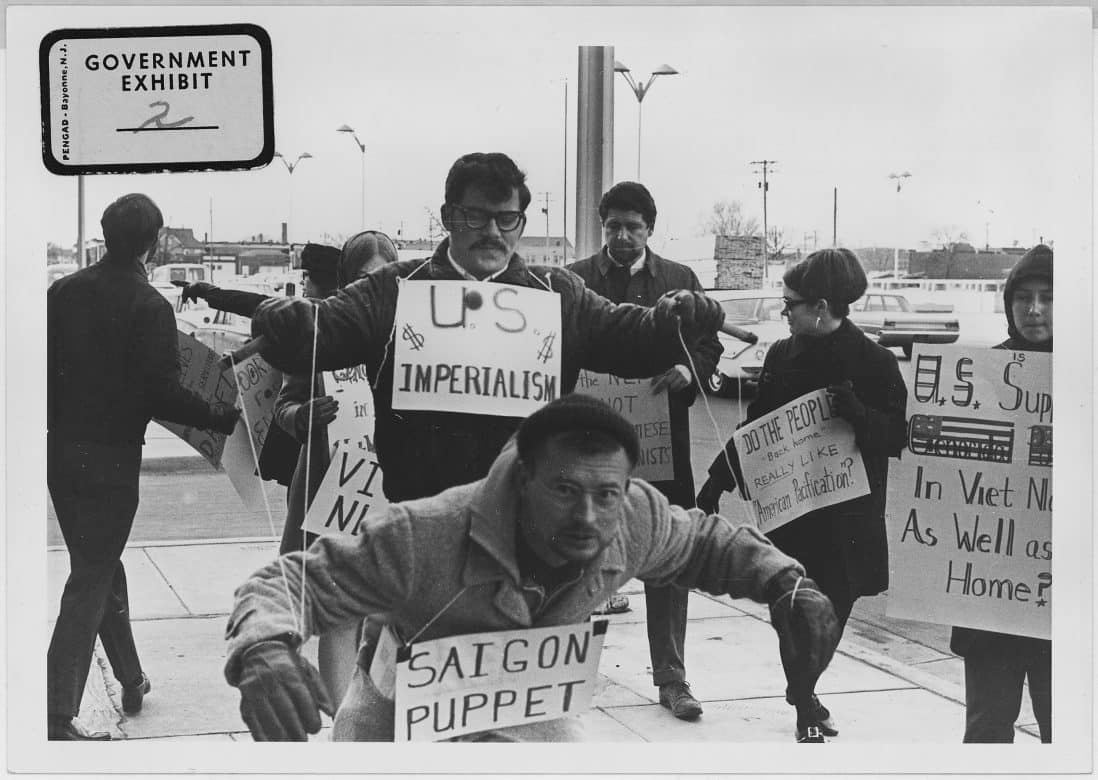
Vietnam War protesters. 1967. Wichita, Kans
Vietnam War protesters. 1967. Wichita, Kans. U.S. District Court for the Second (Wichita) Division of the District of Kansas. (06/09/1890 - ).

Harry Targ is a professor of political science and director of the interdisciplinary program in Peace Studies at Purdue University in West Lafayette, Indiana.

Since the end of the Second World War, undergraduate and graduate education in international relations has been largely shaped by four theoretical approaches. As an undergraduate in the 1950s, I was exposed to the logic and rhetorical elegance of theories of political realism. The textbook used in my first course in international politics was a later version of Hans Morgenthau’s Politics among Nations, and in my subsequent courses, Morgenthau’s version of realpolitik was supplemented by the work of realist writers such as George Kennan, Reinhold Niebuhr, Henry Kissinger, and E. H. Carr. While varying widely in their politics and background, all saw the root causes of violence and war as grounded in “human nature.”

As a graduate student in the 1960s, I was inspired by the new science of international politics and the claim that by gathering enough data and analyzing it carefully, using the latest statistical techniques, scholars could develop an integrated theory of international politics that could replace limiting assumptions about human nature. We could study war, intra-state violence, revolution, economic cooperation, and institution-building with rigor. At last, scholars could develop a science of human behavior that would parallel the natural and physical sciences.

Based on the lingering assumptions of realism and the passion for constructing a science of international relations, two areas were subjected to specific inquiry: national security and modernization. Security studies was designed to use the tools of science to determine how nations could best defend their physical space and deter aggression. Modernization studies emphasized processes of economic development that could improve living standards, particularly through markets and democratic institutions. In the end, the American field of international politics was dominated by this nexus of realism, behavioralism (the quasi-scientific study of international behavior), security studies, and modernization.

Not coincidentally, these approaches to research and education in international politics arose at the height of the Cold War. The United States was embarking on a dramatic escalation of its adventure in Southeast Asia, and defense spending was expanding such that President Eisenhower warned of a growing “military-industrial complex.” As the war in Vietnam grew more controversial, the prevailing international-relations perspectives were increasingly challenged, both in the classrooms and the streets. But for the most part, studies based on paradigms of realism, behavioralism, security, and modernization remained disconnected from broader debates about the world.

To the era’s activists and radicals, the cause of this disparity between the academic study of international politics and the social reality of the anti-war movement was obvious. The former was influenced and supported by governmental institutions, including the Department of Defense and the Central Intelligence Agency, and in the main, its theories and approaches served intellectually to justify U.S. foreign policy—from nuclear buildups and military interventions to sponsoring coups and assassinations. In sum, the midcentury American science of international politics, which shaped a generation of students, was an ideological tool serving the foreign policy of the United States and its allies.

Political Economy and Foreign Policy

Anti-imperial sentiment has had a long history in public discourse on U.S. foreign policy. But by the 1950s, the virulently anti-communist and conformist environments of academia, the media, and electoral politics had caused discussion of the United States as an imperial power virtually to disappear. The last prominent political figure to criticize U.S. Cold War policy was Henry Wallace, the Progressive Party candidate for president in 1948. A year after Wallace’s defeat, eleven unions were purged from the Congress of Industrial Organizations for their leftwing politics, including their support for Wallace.1 The voice of militant labor was silenced, and this was followed, more famously, by anti-communist purges in radio, television, and the movies. Prominent progressive figures lost their jobs, livelihoods, and access to a broad public.

Academic fields were transformed into ideological training grounds in support of the United States’ mission in the world. In history and social science, new scholarship portrayed an American politics, history, and society founded on pluralist democracy rather than political elitism, consensus-building rather than class struggle, and groups, not classes, as the basic units of society.

Indeed, in the 1950s, some realists represented the most “radical” of critics of U.S. foreign policy. While they did not highlight economic interest, the pursuit of empire, or overreaction to the Soviet threat, they did argue that U.S. national interests had to be defined more carefully in security terms. They challenged the view that moral purpose and global vision should or could guide foreign policy. Theorists such as Morgenthau claimed that international relations should be motivated by needs of national security, not some grand campaign against international communism.

At the same time, however, a handful of historians began to challenge these dominant narratives. In particular, the history department at the University of Wisconsin encouraged young scholars to examine the economic taproots of U.S. foreign policy. In 1959, the university’s most influential historian, William Appleman Williams, broke new ground with The Tragedy of American Diplomacy. His students and others began to challenge reigning orthodoxy about international relations and the historic role of the United States in the world. Williams documented the rise of an American empire that expanded after the Civil War, while other historians began to conceive of the conquest of the North American continent as part of an empire-building process founded on the slaughter of millions of native peoples and the seizure of a large section of the landmass of Mexico. Still others studied the kidnapping and enslavement of millions of Africans as central to the construction of the Southern cotton economy, and ultimately to the global capitalist system.

In The Tragedy of American Diplomacy, along with The Contours of American History (1961) and The Roots of the Modern American Empire (1969), Williams located the origins of U.S. imperial expansion in the rise of agricultural production and the need for a growing economy to find markets overseas, particularly after domestic outlets had been capped with the closing of the “frontier.” Drawing on Frederick Jackson Turner’s “frontier thesis,” U.S. leaders believed that a new, global American empire was needed to sell products, secure natural resources, and find investment opportunities.

The rift between realist thinking and the newer radical scholarship is clearly illustrated by their contrasting interpretations of Secretary of State John Hay’s articulation of a new Open Door policy during the administration of William McKinley in 1898. In a series of notes, Hay warned European leaders that the United States regarded Asia as “open” to U.S. trade and investment, as occasioned by the disintegration of the Chinese state into civil war and the occupation of the country’s regions by European states and Japan. The United States insisted that unfettered access to markets in China be honored—and by implication, that the closing of such markets to U.S. goods might lead to confrontation.

For realists, the Hay “Open Door Notes” illustrated the propensity of policymakers to make threats that far exceeded any likely action. The strategic gap between rhetoric and reality, they argued, had long characterized U.S. foreign policy, from the 1890s to the era of President Woodrow Wilson’s calls for democratization to the vehement stance against the spread of communism expressed by every Cold War president.2

Revisionists such as Williams instead argued that the Open Door Notes presaged the emerging U.S. global imperial vision.3 Hay’s demands that the world respect the country’s right to penetrate economies everywhere would become the guiding standard for the U.S. role in the world.

Some of Williams’s writings seemed to emphasize material reality—the needs of capitalism—and others the beliefs held by elites, namely the overriding necessity of new markets. Among the revisionist school of historians, which also included Lloyd Gardner, Gar Alperowitz, and Thomas Paterson, was Gabriel Kolko, author of The Politics of War and, with Joyce Kolko, The Limits of Power: United States Foreign Policy from 1945 to 1954.4 In these volumes, the authors laid out in more graphic and precise terms the material underpinnings of U.S. Cold War policy. The Kolkos emphasized the material and ideological menace that international communism, particularly the example of the Soviet Union and popular Communist parties in the third world, represented to the construction of a global capitalist empire after the Second World War.

For the Kolkos and other revisionists, the expansion of socialism constituted a global threat to capital accumulation. With the end of the Second World War, there were widespread fears that the decline in wartime demand for U.S. products would bring economic stagnation and a return to the depression of the 1930s. The Marshall Plan, lauded as a humanitarian program for the rebuilding of war-torn Europe, was at its base a program to increase demand and secure markets for U.S. products. With the specter of an international communist threat, military spending, another source of demand, would likewise help retain customers, including the U.S. government itself. The idea of empire, which Williams so stressed, was underscored by the materiality of capitalist dynamics.

The historical revisionists thus introduced a political-economic approach to the study of foreign policy. This frame emphasized different factors shaping U.S. global behavior than did those that singularly emphasized national security. The realists referred to human nature and the inevitable attributes of state behavior, particularly the pursuit of power. The traditionalists highlighted the threat to security of certain kinds of states, mostly from international communism. For them, the modern international system was driven by a vast ideological contest between free and democratic states and totalitarian ones. Power, security, and anti-communism were together central to understanding U.S. foreign policy, not economic interest.

The revisionist approach emphasized several different components of policy. First, the new historians saw fundamental connections between economics and politics. Whether the theoretical starting point was Adam Smith or Karl Marx, they looked to the underlying dynamics, needs, and goals of the economic system as sources of policy. These writers began from the assumption that economic interest infused political systems and international relations.

While the realists acknowledged economic interest as a factor of some importance to policy-making, it was considered merely one of a multiplicity of variables shaping international behavior. By contrast, revisionists argued that while the forces of security, ideology, elite personalities, and even “human nature” had some role to play, all were influenced in the end by economic imperatives. The behavior of dominant nation-states from the seventeenth through the twentieth century involved trade, investment, financial speculation, the pursuit of slave or cheap labor, and access to natural resources. The pursuit of economic gain drove the system of international relations, and while sometimes this required cooperation, at other times it necessitated war, conquest, and colonization.

The revisionists made a further innovation at the level of discourse: during the Cold War, the mere mention of the word “capitalism” signaled that the user was a Marxist. Consequently, without naming the economic system, any hope of analyzing its relation to politics and policy was foreclosed. And that meant ignoring the possible relevance of the dominant economic system from the fifteenth century on. But, as has been suggested, some historians and social scientists who employed the political-economic perspective recognized that as an economic system evolved, international relations changed with it. This was so because capitalist enterprises and their supporting states accumulated more and more wealth, expanded at breakneck speed, consolidated both economic and political power, and sometimes built armies to facilitate further growth.

Some historians, borrowing from Marx, studied the evolution of capitalism by analyzing the accumulation of capital and newer forms of the organization of labor. At first, theorists wrote of the rise of capitalism out of feudalism. Marx called this the age of “primitive” or “primary” accumulation, because profit came from the enslavement of peoples, the conquest of territories, and the use of brute force. Subsequently, trade became a significant feature of the new system, and capitalists traversed the globe to sell the products produced by slave and wage labor.

This era of commercial capitalism was dwarfed, however, by the emergence of industrial capitalism. New production techniques developed, particularly factory systems and mass production. The promotion and sale of products in domestic and global markets increased. By the 1870s, the accumulation of capital in products and profits created enormous surpluses in the developed countries. These required new outlets for sale, new ways to put money capital to work, and ever-expanding concentrations of capital in manufacturing and financial institutions. By the mid-twentieth century, some theorists wrote of a new era of “monopoly capitalism,” a global economic system in which most commercial and financial activities were controlled by a small number of multinational corporations and banks.5

The revisionists of the 1960s argued that much of this economic history was ignored entirely by mainstream analyses of international relations. They responded by uncovering the reality of the U.S. role in the world, concentrating on specific cases of links between economics and politics. These included the influence of the country’s largest oil companies on the U.S.-managed overthrow of Mohammed Mosaddegh in Iran in 1953 or the coup in Guatemala in 1954 after president Jacobo Árbenz threatened to nationalize lands owned by the United Fruit Company. And while some revisionists did see the Soviet Union as a security threat to the United States, the broad consensus of the political-economy approach was that socialism as a world force threatened the continued global expansion of capitalism. As the nature of the anti-capitalist forces and challenges in particular countries changed, so too did the needs and tactics of U.S. foreign policy.

The political-economy approach also regarded class structure as central to the understanding of the foreign policy of any nation. Some classes dominate the political system at the expense of others. In capitalist societies, those who own or control the means of production dominate political life.

Therefore, while realists and traditionalists prioritize states as the most important actors in world affairs, political economists see states and classes as inextricably connected. Writers of all schools write about rich and poor states and powerful and weak states. Most, however, stop there. The state is central. Political economists and historical revisionists connected states to classes, and vice versa.

Finally, while revisionist historians worked on the principle that class interest controlled the foreign policy process, they tended to take a “hegemonic” view of that control, leaving little room in their theoretical frame for counterforces of resistance. The resulting analyses often seemed to imply that the United States was omniscient, all-powerful, unbeatable, and unchangeable in its conduct. After the Cuban Revolution and the Vietnam War, however, some analysts began to focus on challenges to U.S. hegemony around the world, especially in the global South. However, in the main, the historical revisionists developed a top-down understanding of international relations. Much of the anti-American ferment in the world, including anticolonial struggles, revolutions, and third world coalition-building, received insufficient attention.

The Revisionist Legacy

Ways of thinking have consequences. Generations of students in the twentieth century were exposed to analyses of international relations that emphasized certain purportedly iron laws of state behavior. Others were taught that international politics was best understood by embarking on statistically based studies that disaggregated political reality into a complex array of discrete variables. Still other students of international relations were encouraged to specialize in security studies or modernization and democratization. As the Vietnam War escalated, activists began to turn to a small group of historians for an alternative understanding of U.S. involvement in the country. The activism and scholarship of the Vietnam era began the process of challenging the hegemony of intellectual systems that had generally supported the U.S. role in the world.

Although that hegemony has been weakened, the traditional ways of studying international relations in the United States remain influential. Many studies are ahistorical, atomizing political reality while marginalizing the causal role of economics, and ignoring the effect of class interests in the making of foreign policy. The old enemy, international communism, is gone, but a new one, international terrorism, has taken its place. And like their Cold War precursors, mainstream theorists of international relations normalize war, regime change, and an ever-expanding military and security state.

Hegemonic thinking during the Vietnam era was questioned by scholars who challenged professional barriers and ideological taboos. Social movements demanded new thinking about world affairs. And scholar-activists began to revisit the work of maligned theorists such as Marx and V. I. Lenin. Historical curiosity increasingly led them to ask not only what happened, but why. Breaking through hegemonic ideas remains a vital task today.

Notes

  1. An old but still compelling history of U.S. labor struggles and anti-communism in the early years of the Cold War can be found in Richard O. Boyer and Herbert M. Morais, Labor’s Untold Story (New York: United Electrical, Radio and Machine Workers of America, 1955).
  2. See George F. Kennan, American Diplomacy, 1900–1950 (Chicago: University of Chicago Press, 1969).
  3. William Appleman Williams, The Tragedy of American Diplomacy (New York: Delta, 1962).
  4. Lloyd C. Gardner, Arthur Schlesinger Jr., and Hans J. Morgenthau, The Origins of the Cold War (Waltham, MA: Genn, 1970); Gar Alperowitz, Atomic Diplomacy (New York: Vintage, 1965); Thomas G. Paterson, Soviet-American Confrontation (Baltimore: Johns Hopkins University Press, 1973); Gabriel Kolko, The Roots of American Foreign Policy (Boston: Beacon, 1969) and The Politics of War (New York: Vintage, 1968); Joyce Kolko and Gabriel Kolko, The Limits of Power (New York: Harper, 1972).
  5. Paul A. Baran and Paul M. Sweezy, Monopoly Capital (New York: Monthly Review Press, 1966).

Sunday, December 17, 2017

THE BANKS ARE (STILL) MADE OF MARBLE


HARRY TARG
https://www.youtube.com/watch?v=x-o3CJytIPE

The United Nations Office of the High Commissioner for Human Rights issued a report written by its representative, Philip Alston, after an extensive visit to the United States. The report was called “A Journey Through a Land of Extreme Poverty; Welcome to America” and was based on personal observations and an examination of longitudinal and comparative data. He found in California, West Virginia, Alabama, Puerto Rico and elsewhere extremes of poverty and inadequate access to housing, health care, education, and other social needs. He noted that along with the increasing economic misery for the many there was a growing concentration of wealth for the few (the guardian.com, December 15, 2017)

In an NPR interview Alston noted that every other wealthy country provides more for its citizenry than the United States and is more equal in wealth and income. China, he said, a newly developed country, has lowered the gaps in wealth, income, and social well-being more effectively than the United States over the last 15 years.

Paradoxically, this damning report appeared at the same time as the Congress and the President are finalizing a new tax bill that will dramatically increase wealth, income, and security for the tiny ruling class at the growing expense of the vast majority of the United States population: workers, women, African Americans, immigrants, and children, youth, and the elderly.

Many economists are systematically analyzing the impacts of these negative economic trends across time and the draconian effect the new tax bill will have on the whole structure of reform programs that were put in place since the Great Depression of the 1930s. But sometimes the analysis, critique, and call for action is most effectively reflected in song. Thus the repost below:


Reposted from New Clear Vision, August 10, 2011

Print Friendly, PDF & Email

Sometimes We Have to Sing and Cry and Hit the Streets…

by Harry Targ

I’m not a Red Diaper baby. I didn’t read Marx until the 1970s. I don’t know when I decided I was a Marxist. I didn’t start teaching Marx and political economy until the late 1970s. But I became a small “r” red when I first heard the folk group, The Weavers in the 1950s. Then on to Pete Seeger alone, Woody Guthrie, Cisco Houston, and later Arlo Guthrie, Phil Ochs, and even Kris Kristofferson and Bruce Springsteen.

I still listen to the music that makes me angry, makes me cry, and makes me want to hit the streets. I forget the fine tuned lectures I listen to (and even give) on neoliberal globalization, the tendency of the rate of profit to fall, over-production and under-consumption, and financialization — and break into song and tears as I hear the old music in the car or at home.

The deficit battle (now “tax reform”), which is a farce except for the pain the outcome will cause working people, reminded me of the Weavers blasting out “The Banks Are Made of Marble.” They sang of travels around the country seeing all the suffering that the capitalist system was causing; “the weary farmer,” the idle seaman, the miner scrubbing coal dust from off his back, “heard the children cryin” as they froze in their shacks, and the suffering of workers everywhere.

Why does the song suggest there is so much suffering all across America? The answer is so simple:

The banks are made of marble
With a guard at every door
And the vaults are stuffed with silver
That the miner sweated for

The song, written by Les Rice in 1948, said the antidote to this situation was workers getting together and making a stand. He predicted that the result would be a good one:

Then we’d own those banks of marble
With a guard at every door
And we’d share those vaults of silver
That we have sweated for

I was also thinking about an old Robin Hood song written by Woody Guthrie in the 1930s about an Oklahoma legend, Pretty Boy Floyd. According to Woody’s rendition, Pretty Boy Floyd got into a fight with a deputy sheriff and killed him. Floyd was forced to flee and allegedly took up a life of crime. At least authorities and journalists blamed Floyd for every robbery or killing that occurred in the state of Oklahoma. “Every crime in Oklahoma was added to his name.”

But in true Robin Hood fashion, Pretty Boy Floyd stole from the rich and gave to the poor. Floyd, the outlaw, paid the mortgage for a starving farmer. Another time when Floyd begged for and received a meal in a rural household, he placed a thousand dollar bill under his napkin when he finished dinner. One Christmas Day Floyd left a carload of groceries for starving families on relief in Oklahoma City.

And in these days of massive unemployment, mortgage foreclosures, criminal wealth, and staggering poverty, through the voice of Pretty Boy Floyd, Woody Guthrie tells the wrenching story of capitalism that today is not too much different from during his time:

Yes, as through this world I’ve wandered
I’ve seen lots of funny men;
Some will rob you with a six-gun,
And some with a fountain pen.

And as through your life you travel,
Yes, as through your life you roam,
You won’t never see an outlaw
Drive a family from their home.

Originally from Diary of a Heartland Radical

The Bookshelf

CHALLENGING LATE CAPITALISM by Harry R. Targ

Challenging Late Capitalism