Sunday, March 8, 2020

WORKING CLASS SOCIALIST,GRASSROOTS LABOR ORGANIZER,FEMINIST, FILM STAR

Thoughts on the Life of Vicky Starr A “Union Maid”  (https://youtu.be/74gvcvXlgnM)
A repost from January 10, 2010


Harry Targ

I read recently that Vicky Starr died on Thanksgiving Day, November 26, 2009. She was 93 years old. Thinking about Vicky Starr (or for fans of the film Union Maids Stella Nowicki) reminded me about how her life, which many of us learned of through the film, was so inspirational.

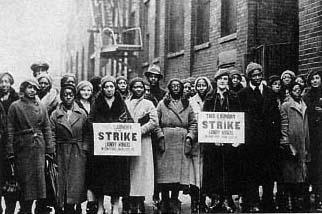
As a teenager, Vicky Starr left the family farm in Michigan and arrived on the Southside of Chicago in 1933. She stayed in the home of Herb and Jane March, Communist activists who had come to Chicago to organize the packing house workers in the huge Stockyards. Under March’s tutelage she sought employment in the Yards and almost immediately began to network with workers to build a union of workers in the days leading up to the formation of the Congress of Industrial Organizations (CIO).

The processing of meat from the 1880s until the late 1950s was centered in Chicago. The Stockyards, housing the Big Four packers (Armour, Cudahy, Swift, and Wilson), employed thousands of workers. Because the work was so dangerous and unpleasant, it was largely carried out by the most marginalized sectors of the working class.

In the era of Upton Sinclair’s, The Jungle, workers were primarily immigrants from Eastern and Southern Europe. After World War 1 and the “the Great Migration,” African Americans secured the lowest paid and most dangerous jobs in the Yards. Historic union organizing drives in 1904, and 1921 faltered because of racism and ethnic conflict among workers. Communist and socialist organizers in the Yards, such as March, realized that combating racism was central to organizing industrial unionism in the meat packing industry.

And it was rank-and-file activists like Vicky Starr who tirelessly met with workers, helped write leaflets and newsletters, interacted with the radical students from the University of Chicago who had offered their assistance to union organizing drives, and communicated with sympathetic members of the influential Catholic Church in the city.

As a member of the Young Communist League, Starr and her comrades would read classic Marxist and Leninist texts. Since Starr would be identified with organizing campaigns by her bosses she often lost her job in the yards. When that occurred she would apply for work at another packing house company using a different name.

She told Alice and Staughton Lynd (Rank and File, 1973) many years later: “When I look back now, I really think we had a lot of guts. But I didn’t even stop to think about it at the time. It was something that had to be done. We had a goal. That’s what we felt had to be done and we did it.”

In 1937, workers established the Packinghouse Workers Organizing Committee (PWOC). Despite resistance by the major meat packers, state violence, red-baiting against union organizers by the state and the American Federation of Labor’s Amalgamated Meat Cutters (AMC), the United Packinghouse Workers of America (UPWA-CIO) was constituted in 1943. Until its merger with other unions, it remained a militant trade union that fought racism and red-baiting and publicly opposed United States foreign policies such as participation in the Korean War. And during its formative years in the mid-1940s Vicky Starr served for a time as Education Director for District 1 of UPWA.

Central to Starr’s contribution to the working class from the time she was a member of the Young Communist League, to the budding labor movement, the formation of the UPWA, and later as an organizer of clerical workers at the University of Chicago was her constant struggle against racism and sexism. After the formation of UPWA Starr said “We tried to make sure that there were both Negroes and whites as officers, stewards…in all the locals.” She fought residential segregation and participated in building the Back of the Yards Council on Chicago’s south side, and worked to end the exclusion of African Americans from professional sports. And in the end she recalled that the most militant trade unionists on the shop floor, the beef kill, were African Americans.

As an organizer in the 30s and a UPWA staffer in the 40s she combated sexism as well. “Women had an awfully tough time in the union because the men brought their prejudices there.” Women often had the most demeaning jobs in the Yards, wage rates discriminated against them, their special needs, such as child care received no attention, and they often were fearful of demanding their rights on the shop floor and in the union.

As a socialist, Starr reflected on those halcyon days of UPWA-CIO organizing. She said that there was a sense that workers were ready to come together. There was a growing feeling of working class solidarity. Union organizers would show up at the Stockyards with literature and speeches. And at the grassroots she and others were on the shop floor spreading the word informally about the union.

And socialism needed to be addressed in terms of the concrete benefits of people’s lives. “You had to talk about it in terms of what it would mean for that person. We learned that you can’t manipulate people but that you really had to be concerned with the interests and needs of the people. However, you also had to have a platform--a projection of where you were going.”

Starr left the Yards in 1945, was forced underground for a time in the McCarthy period, raised four children and returned to work as a secretary at the prestigious University of Chicago. She still had “a platform” at the university, organizing all non-professional staff. Despite predictable resistance from the bastion of liberalism in higher education she applied the grassroots organizing skills she learned as a teenager in the stockyards to achieve victory for clerical workers. Teamsters Local 743 was recognized in 1978. Vicky Starr became the first shop steward of the new local.

But Starr’s contribution to the American working class, Black and White, male and female did not remain unnoticed beyond the shop/office. Alice and Staughton Lynd captured her remembrances of CIO organizing in the 1973 book Rank and File and the clerical workers struggle in the 2000 book New Rank and File. And especially, “Stella Nowicki” was one of three stars (the others were Sylvia Woods and Kate Hyndman) in the wonderful documentary (Union Maids, 1977) about women organizing in the CIO in the 1930s.

This last project made Vicky Starr a major celebrity. It brought to the attention of new generations of activists the fighting spirit of the 1930s, the central role Communists played in the battles, and the absolute centrality to organizing the working class of fighting racism and sexism.

Still relevant today, Union Maids (and the Lynds collections of interviews), can help inspire, educate, and inform activists about tactics, strategy, and basic principles of organizing.

Vicky Starr concluded her 1973 interview saying: “It was a privilege and a wonderful experience to participate in the excitement of those times.”

It is important to remember Vicky Starr for what she did for the working class, particularly industrial and clerical workers. And reflections on her life and work can still inform activists as they struggle for economic justice today.


Wednesday, February 26, 2020

SEIZE THE MOMENT:2020

SEIZE THE MOMENT: BERNIE SANDERS AND BUILDING THE PROGRESSIVE MAJORITY (originally posted February 6, 2016)

This essay was originally posted in advance of the 2016 primaries. It drew upon the social movements and debates of the years preceding that campaign season. But the political currents which included “the left,” grassroots social movements in the tradition of the Occupy Movement, and the variety of single and multi-issue progressive groups in similar form still exist today.

What is different about 2020 from 2016 is the qualitatively more dire circumstances in which we live under the Trump administration. Whether we are talking about the climate, white supremacy, grievous inequality, the celebration  of misogyny, a new arms race and Cold War, the life chances and quality of life of the vast majority of humankind, the situation is worse.

While no one candidate for president can fix the mess, and indeed the minimum requirement of substantial change requires a sustained political movement, the Sanders campaign, its young, diverse, and energetic supporters, and elected officials and cultural workers who have joined the campaign, make it clear that supporting and working for Bernie Sanders is vital to the future of the country and the planet. The fundamental question that must be asked as we engage in the political process is: will the Sanders campaign and movement have the prospect of reducing human misery, irrespective of whether he is a Socialist, a Social Democrat, a New Deal Liberal, or a Populist. The answer to that question is undeniably “yes.”

Harry Targ
The multiracial working class in alliance with trade unions, women, African Americans, Latinos and other people of color, youth, and progressive sectors of business now form the promising components of the progressive majority. The profound challenge before the working class and its allies is to organize this majority into a coherent force capable of responding to the various issues it confronts. (“Goals and Principles,” Committees of Correspondence for Democracy and Socialism, adopted at its 6th National Convention, July, 2009, www.cc-ds.org).

Protest Movements in the United States

            In addition to anecdotal evidence, aggregate data confirms the continuation and expansion of activist groups and protest activities all across the face of the globe. For example in the United States, Mark Solomon in an important essay “Whither the Socialist Left? Thinking the ‘Unthinkable’” (March 6, 2013, www.portside.org)  discusses the long history of socialism in the United States, the brutal repression against it, damaging sectarian battles on the left, the miniscule size of socialist organizations today and yet paradoxically the growing sympathy for the idea of socialism among Americans, particularly young people. He calls for “the convergence of socialist organizations committed to non-sectarian democratic struggle, engagement with mass movements, and open debate in search of effective responses to present crises and to projecting a socialist future.”  The Solomon article does not conceptualize “left unity” and “building the progressive majority” as separate and distinct projects but as fundamentally interconnected. For him, and many others, the role of the left in the labor movement and other mass movements gave shape, direction, and theoretical cohesion to the battles that won worker rights in the 1930s.

            Solomon’s call has stimulated debate among activists around the idea of “left unity.” The appeal for left unity is made more powerful by socialism’s appeal, the current global crises of capitalism, rising mobilizations around the world, and living experiments with small-scale socialism such as the construction of a variety of workers’ cooperatives.

            Effective campaigns around “left unity” in recent years have prioritized “revolutionary education,” drawing upon the tools of the internet to construct an accessible body of theory and debate about strategy and tactics that could solidify left forces and move the progressive majority into a socialist direction. The emerging Online University of the Left (OUL), an electronic source for classical and modern theoretical literature about Marxism, contemporary debates about strategy and tactics, videos, reading lists, and course syllabi, constitute one example of left unity. The OUL serves as one of many resources for study groups, formal coursework, and discussions among socialists and progressives. Those who advocate for “left unity” or left “convergence” celebrate these many developments, from workers cooperatives to popular education, as they advocate for the construction of a unified socialist left.

            A second manifestation of political activism, the Occupy Movement, first surfacing in the media in September, 2011, initiated and renewed traditions of organized and spontaneous mass movements around issues that affect peoples’ immediate lives such as housing foreclosure, debt, jobs, wages, the environment, and the negative role of money in U.S. politics. Perhaps the four most significant contributions of the Occupy Movement have been:

            1.Introducing grassroots processes of decision-making.

            2.Conceptualizing modern battles for social and economic justice as between the one percent (the holders of most wealth and power in society) versus the 99 percent (weak, economically marginalized, and dispossessed, including the “precariat”). 

            3.Insisting that struggles for radical change be spontaneous, often eschewing traditional political processes.

            4.Linking struggles locally, nationally, and globally.

            During the height of its visibility some 500 cities and towns experienced Occupy mobilizations around social justice issues. While less frequent, Occupy campaigns still exist, particularly in cities where larger progressive communities reside. Calls for left unity correctly ground their claims in a long and rich history of organized struggle while “occupiers” and other activists today have been inspired by the bottom-up and spontaneous uprisings of 2011 (both international and within the United States).

            A third, and not opposed, approach to political change at this time has been labeled “building a progressive majority.” This approach assumes that large segments of the U.S. population agree on a variety of issues. Some are activists in electoral politics, others in trade unions, and more in single issue groups. In addition, many who share common views of worker rights, the environment, health care, undue influence of money in politics, immigrant rights etc. are not active politically. The progressive majority perspective argues that the project for the short-term is to mobilize the millions of people who share common views on the need for significant if not fundamental change in economics and politics. 

           Often organizers conceptualize the progressive majority as the broad mass of people who share views on politics and economics that are ‘centrist” or “left.” Consequently, over the long run, “left” participants see their task as three-fold. First, they must work on the issues that concern majorities of those at the local and national level. Second, they struggle to convince their political associates that the problems most people face have common causes (particularly capitalism). Third, “left” participants see the need to link issues so that class, race, gender, and the environment, for example, are understood as part of the common problem that people face.

           A 2005-2007 data set called “Start” (startguide.org) showed that there were some “500 leading organizations in the United States working for progressive change on a national level.” START divided these 500 organizations into twelve categories based on their main activities. These included progressive electoral, peace and foreign policy, economic justice, civil liberties, health advocacy, labor, women’s and environmental organizations.  Of course, their membership, geographic presence, financial resources, and strategic and tactical vision varied widely. And, many of the variety of progressive organizations at the national level were reproduced at the local and state levels as well.

           In sum, when looking at contemporary social change in the United States at least three tendencies have been articulated: left unity, the Occupy Movement, and building a progressive majority. Each highlights its own priorities as to vision, strategy, tactics, and political contexts. In addition, the relative appeal of each may be affected by age, class, gender, race, and issue prioritization as well. However, these approaches need not be seen as contradictory. Rather the activism borne of each approach may parallel the others. (the discussion of the three tendencies of activism appeared in Harry Targ, “The Fusion Politics Response to 21st Century Imperialism From Arab Spring to Moral Mondays,” ouleft.org, and was presented at the “Moving Beyond Capitalism” Conference, Center for Global Justice, San Miguel de Allende Mexico, July 29-August 5, 2014). 

Building the Progressive Majority in 2016

        The statement above from CCDS was published in 2009 and the description of the three political tendencies in the United States was presented in 2014. Since then, the Moral Mondays Movement in North Carolina captured national attention and stimulated a growing campaign around Reverend William Barber’s narrative of United States history referring to the “three reconstructions” and the articulation of his theory of “fusion politics.”

        The egregious police violence against African Americans, particularly young men and women of color, has sparked a vibrant Black Lives Matter campaign that has caused a renewed interest in understanding the functions the police serve, the role of white supremacy, rightwing populism, and Michelle Alexander’s “New Jim Crow” in America.

        Militant workers in growing sectors of the economy are rising up. Fast food workers are organizing around the “Fight for 15.” Health and home care, and other service sector workers are demanding the right to have their unions recognized. And teachers, transportation workers, and state employees have hit the streets and legislative assemblies to demand worker rights.

        The peace movement has begun to resuscitate itself challenging a new cold war with Russia, boots on the ground and drones in the air to fight ISIS, and the unbridled growth of the military/industrial complex.

         Finally, environmentalists have made a convincing case that the connection between neoliberal global capitalism and environmental catastrophe “changes everything.”

        The three tendencies presented above—left unity, the Occupy Movement,  and building a progressive majority—continue to be reflected in different kinds of organizing around the country based on the issues, levels of organization, predominant ideological manifestations, local political cultures, and the composition of movements in different places based upon class, race, gender, sexual identity, religious affiliation and issue orientation. And all these tendencies are worthy of attention and support, particularly in the 21st century “time of chaos.”

        But a new campaign (potentially a movement) has emerged since the summer, 2015. Bernie Sanders, an aging left-oriented Senator from Vermont began his long uphill march to secure the Democratic Party nomination for the presidency. A sixties activist on civil rights and peace, a populist mayor of Burlington, Vermont, a Congressman and Senator from that state, Sanders, since his early days of political activism,  has articulated an anti-Wall Street, anti-finance capital mantra that has its roots in various progressive currents in United States history, These include the populist campaigns of the 1890s,  the militant workers struggles of the  Wobblies during the Progressive era, the popular electoral campaigns of five-time Socialist Party candidate for President, Eugene V. Debs from 1900 to 1920; the industrial union movement of  the 1930s which built the Congress of Industrial Organizations (CIO) and support for the New Deal legislation that provided some measure of economic security to many workers; to the civil rights and anti-war movements of the 1960s and beyond.

        Sanders has proceeded to excoriate finance capital and to link the enormous accumulation of wealth and income at one pole of American society and the maintenance and growth of the misery of the masses on the other. He has advanced his narrative by linking class, to race, to gender issues, and has begun to incorporate the apocalyptic possibilities of a future without addressing climate change. In a word, he has articulated a program that the CCDS program defined as the vision of “the progressive majority.”

        The vision of a progressive majority is one that emphasizes the systematic articulation of the causes of human misery and what needs to be done to overcome them and the belief that the vision already exists among the majority of the American people. So far, the popularity of the Sanders campaign, the particular enthusiasm it is generating at the grassroots, including from youth, labor, feminist, anti-racist, and environmental organizations, and the demographics reflected in the Iowa caucus turnout and polling data, suggest that activists from the three tendencies identified above should direct their energies to supporting the Sanders presidential run. Most importantly, the Sanders campaign has inspired the possibility of building a long-standing progressive movement that will survive and grow until the November, 2016 election and beyond.


Tuesday, February 11, 2020

REMEMBERING MALCOLM AND MANNING (A Former Colleague at Purdue University)

A Repost from Diary of a Heartland Radical

Harry Targ

And finally, I am deeply grateful to the real Malcolm X, the man behind the myth, who courageously challenged and transformed himself, seeking to achieve a vision of a world without racism. Without erasing his mistakes and contradictions, Malcolm embodies a definitive yardstick by which all other Americans who aspire to a mantle of leadership should be measured (Manning Marable, Malcolm X, A Life of Reinvention, 2011, 493).

Professor Manning Marable was a member of the Political Science and Sociology Departments at Purdue University during the 1986-87 academic year. His scholarship, activism, and ground-breaking books and articles inspired faculty and students even though his stay at our university was brief. His classic theoretical work, "How Capitalism Underdeveloped Black America," along with over 20 books and hundreds of articles, inspired social science scholarship on class, race, and gender. His weekly essays, "Along the Color Line," were published in over 250 community newspapers and magazines for years. He once told me that writing for concerned citizens about public issues was the most rewarding work he ever did. He was a role model for all young, concerned and committed scholar/activists (Harry Targ in Purdue University Black Cultural Center Newsletter, April, 2011).

I just finished reading the powerful biography of Malcolm X authored by Manning Marable. My encounter with this book was as fixating and transforming as I remember my reading of Malcolm’s autobiography in the 1960s. While I lack the deep sense of Malcolm X’s impact on African American politics and cultural identity that others have, I feel compelled to write something about this reading experience. Manning Marable died April 1, 2011. (Michael Eric Dyson and Bill Fletcher reviewed the book and Manning Marable’s life on Democracy Now  
https://youtu.be/Ri_unYMs6wk).

During my first year at Purdue University in north central Indiana in 1968, I requested to teach a course called “Contemporary Political Problems.” Since I was on the cusp of becoming a political activist in belated response to the civil rights and anti-war movements, I thought I could use this course to have an extended conversation with students about where we needed to be going intellectually and politically.

My plan was to assign a series of books that reflected different left currents, politically and culturally, and get us all to reflect on their value for understanding 1968 America and what to do about it. We read Abbie Hoffman, Ken Kesey, Herbert Marcuse, the Port Huron and Weatherman statements, and The Autobiography of Malcolm X.

While my students and I embraced, endorsed, or rejected various of these authors, we were profoundly impacted by the power of Malcolm X’s personal biography and transformations from the streets to the international arena. As the word got out about the course, and largely because of Malcolm X, sectors of the Purdue campus got the word that there was a new “radical” in the Political Science department. Therefore, I owe my growing enrollments to Malcolm X.

More important, during the second semester in which I taught the course, I had a very quiet and respectful African American student in the class. He was a member of Purdue’s track team. One day, after he showed up at the local airport sporting a very thin, almost invisible, mustache the track coach ordered him off the plane. Why? Because he had unauthorized facial hair. His modest symbolic act, growing the mustache, set off extended protest activities over several weeks.

Shortly before this incident, we had spent a couple of weeks in class discussing Malcolm X’s autobiography. During one class period this very quiet person announced to the rest of us that we should consider ourselves lucky that he chose to participate in this class. I saw him forty years later for a fleeting moment. He remembered me and said that he had read Malcolm X’s autobiography for the first time in my class. The student’s emerging boldness and his articulated sense of pride must have had something to do with his reading of Malcolm X.

Reflecting on the Marable biography, I was struck by the capacity of people to change their ways of thinking, their ideologies, and their practice. Marable attributes some of Malcolm X’s development to his conscious desire to reinvent himself and to do so as he told his life story to Alex Haley, his autobiographical collaborator. Despite the world of racism, repression, and theological rigidity Malcolm experienced, Marable records how Malcolm X’s experience and practical political work was in fact transforming.

Different people gleaned different things from reading Malcolm X’s autobiography, and the same is true of a reading of Manning Marable’s stirring and frank biography. While those of us on the left were most inspired by the last two years of Malcolm X’s life, my student was probably impacted as much by Malcolm’s developing sense of pride and self-worth in a society that demeaned and ridiculed people of color

Reading Malcolm and Marable reminds us, that while we bring change through our organizational affiliations, each individual can have a role to play in achieving that change. Not all of us can be Malcolm X, Che Guevara, Dolores Huerta, or Mother Jones. But we can make a difference.

In addition, Manning Marable makes a particularly strong case for Malcolm X as an internationalist. The United Nations had adopted a Declaration on Human Rights in 1948 but human rights discourse was not part of the language of international relations until Malcolm X demanded the international community address the issue.

For Malcolm X, United States racism, while violating the civil rights of its Black and Brown citizens, was also violating the fundamental human rights of peoples at home and abroad. At the time of his assassination, Malcolm X was working to build a coalition of largely former colonial states to demand that each and every country, and particularly the United States, respect the human rights of all peoples. Multiple problems including racism, poverty, disease, hunger, political repression and sexual abuse were problems at the root of twentieth century human circumstance AND the United States was a major violator of human rights.

Marable describes in great detail Malcolm X’s frenetic travels through Africa and the Middle East to build a coalition of Black and Brown peoples to demand in the United Nations and every other political forum the establishment of human rights. Bombing Vietnamese people and killing Black children in Birmingham were part of the same problem. And, this campaign was being launched at the very same time that the countries of the Global South were struggling to construct a non-aligned movement to retake the resources, wealth, and human dignity that had been stripped from peoples by colonialism, neo-colonialism, and imperialism. This was the position that Dr. Martin Luther King came to in 1967, as articulated in his famous speech at Riverside Church in New York. Malcolm X was introducing this global human rights project in 1964.

Marable’s Malcolm X therefore transformed himself from a minor street hustler, to a Black Muslim, to a visible world leader advocating a global human rights agenda. This is the Malcolm X that has meant so much to us over the years, along with his insistence that Black and Brown people be accorded respect everywhere and they should honor and respect themselves. But, Marable carefully documents Malcolm X’s flaws as well as his strengths. He was anti-Semitic, misogynist, not unsympathetic to violence, and a man engaged in intense, some-times petty, political struggles with his organizational colleagues.

Manning Marable humanizes Malcolm X. Humanizing our heroes makes our efforts to pass the messages and symbols of the past to newer generations of activists more convincing. Young people do not need to see progressive heroes as untainted by their own humanity. And when we present those who make a contribution to building a better world to new generations, the examples of their flaws make it clear that no one is beyond personal and political redemption.

Finally, the biographer, Manning Marable, as my statement at the outset suggests, was a profoundly important scholar/activist. Marable used his historical knowledge, social scientific analytical skills, and political values to craft a career of writing and activism that impacted his students, his academic colleagues, and his fellow socialists in the struggle for a better world. Telling Malcolm X’s story was Marable’s way of advocating for fundamental social change in a deeply troubled world.

An earlier version if this essay appeared in July, 2011.

Sunday, February 9, 2020

Monday, February 3, 2020

ESSAYS ON RACISM: REVISITING SOME PURDUE UNIVERSITY HISTORY

Harry Targ

As I revisit Black History Month at Purdue University, I am reminded of the enormous contributions African American students have made to whatever advances toward diversity and equity have occurred. I also remember initiatives that Purdue University faculty and administrators have taken to increase the rights and opportunities of “underrepresented minorities” on the campus. But the fact remains that Black student enrollments as a percentage of total enrollments at the West Lafayette campus have not grown; that Black student enrollments as a percentage of the total student population is two-thirds lower than the population of African Americans in the state of Indiana and the nation at large; and the percentage of African American faculty has not grown either.

As the informative documentary “Black Purdue” suggests https://youtu.be/lMaQyMyQpDc,  there have been significant changes at Purdue University since the 1960s, but also significant changes are still required. The demands of students coming out of the post-Ferguson rally on the Purdue campus in the fall of 2015 bear repeating.  https://youtu.be/lMaQyMyQpDc

This Black History Month we should continue to celebrate the heroics of  Black students at Purdue, including those in the late 1960s and 2015, and continue to support their just demands.
                                                           

RACISM ON THE CAMPUS: THE STRUGGLE CONTINUES

Harry Targ  Diary of a Heartland Radical


Originally posted on Sunday, November 15, 2015: Reposted January 27, 2017


(In November, 2015 Purdue students rallied in solidarity with African American students at other universities. One year later, Purdue University students protested the appearance of racist, Islamophobic, and anti-Semitic flyers around the campus attributed to a neo-fascist national organization. Subsequent to the November 20, 2016 protest a series of demands were made to the administration that would recognize the rhetorical threat the flyers represented. They also called for educational opportunities that would explain why the flyers created a threatening campus environment. Currently a group of students are sitting in at the executive building to dramatize their concerns. The essay below helps to ground the student activism today in the history of struggles to create a climate free of discrimination at one university).

********************************************************************


If there is no struggle, there is no progress. Frederick Douglass


The problem of the twentieth century is the problem of the color line. W.E.B. DuBois


What a proud contrast to the environments that appear to prevail at places like Missouri and Yale. Mitch Daniels


All across the country students, black and white, hit the streets and the campus malls to protest racism; structural and interpersonal. One thousand students rallied at Purdue University on Friday, November 13, to show solidarity with students at the University of Missouri and to announce 13 demands they were making to address racism at Purdue; a racism that the university president says no longer exists. 


Of course nationally and locally the struggle for social and economic justice is historic. Rev. William Barber, leader of the Moral Mondays Movement, points to the “Three Reconstructions” in post-Civil War American history. The First Reconstruction occurred in the 1860s and 1870s when black and white farmers and workers came together to write constitutions and to create a new democratic Southern politics. The hope this first reconstruction raised for a truly democratic America was dashed by a shift to the right of the federal government, the reemergence of the old Southern ruling class, and the rise of a brutal violent terrorist organization, the Ku Klux Klan. Racist policies, coupled with terrorism, instilled formal racial segregation in the South and subtle forms of institutionalized racism throughout the rest of the country.


The Second Reconstruction, Barber asserts, was inspired by the Brown vs. Board of Education Supreme Court decision which declared that segregated schools were unconstitutional. With militant sectors of labor, a grassroots Southern civil rights movement revived all across the country. In the 1960s, it culminated in civil rights legislation that outlawed racial segregation and guaranteed voting rights. Also the “war on poverty” was launched. Shortly after these victories, the Republican Party presidential candidate Richard Nixon employed the so-called “Southern Strategy” to shift federal and state politics to the right. The forerunners of today’s Tea Party rightwing reaction expanded their political power at the federal and state levels.


Rev. Barber believes that, with the movement that elected President Obama, there has emerged a Third Reconstruction. It features the mobilization of  masses of people--blacks and whites, men and women, gays and straights, blue collar and white collar workers, young and old, people of faith and those who choose no faith--coming together to reconstitute the struggle for the achievement of a truly democratic vision. This vision is of a society that is participatory, egalitarian, and economically and psychologically fulfilling.


The resurgence of protests on college campuses, although narrowly focused, represents the contemporary form of the kinds of struggles for social justice Frederick Douglass talked about.  For example, on the campus of Purdue University, the struggle for racial justice has a long history. For the first 60 years of the twentieth century the African American population was less than one percent of the student body.  The numbers of African American students grew to a few hundred in the 1960s. 

And in the context of the Second Reconstruction and activism around civil rights and opposition to the war in Vietnam, some students organized a “Negro History Study Group”(which later became the Black Student Union). In 1968, to dramatize what they saw as institutional racism coupled with an environment of racial hostility, more than 150 Black students carrying brown bags marched to the Executive Building. At the building they took bricks from the bags. The bricks were piled up and a sign “Or the Fire Next Time,” was set next to the bricks. The students submitted a series of demands including the development of an African American Studies Program and a Black Cultural Center.  


The demonstration was dramatic. The demands clear. The justice of their motivation was unassailable. Administrators and faculty set up committees to discuss the protests. And in the short run, only minor changes were implemented, such as Purdue’s 1968 hiring of the first African American professor in Liberal Arts.


One year later, after an African American member of the track team was castigated for wearing a mustache and his verbal response led to his arrest, Black students launched another protest march with more demands. This time the Administration and the Board of Trustees authorized the establishment of the Black Cultural Center, which today is an educational, social, and architectural hub of the campus. In 1973, Antonio Zamora, educator, accomplished musician, and experienced administrator was hired to lead the campus effort to make the BCC the vital embodiment of the university that it has become. 


One of the leaders of the 1969 protest, Eric McCaskill, told then President Hovde by phone during the protest march and visit to the Executive Building: “We are somebody. I am somebody.” Forty-six years later one thousand similarly motivated students rallied together on Friday, November 13, 2015 on the Purdue campus. They expressed outrage at the systematic violence against people of color throughout the society and the perpetuation of racism in virtually every institution. On the Purdue campus they protested the lack of full, fair representation of African Americans on the faculty and in the student body, a climate on and off campus that perpetuates racism, and the continuation of all the old stereotypes of minority students that has prevailed for years. They also shared their solidarity with the students of the University of Missouri and they made it crystal clear their disagreement with the statement by the Purdue University President that the Purdue campus was different.


The organizers provided thirteen demands including:

-an acknowledgement by the President of Purdue University that a hostile and discriminatory environment still exists at Purdue.


-the reinstatement of a Chief Diversity Officer with student involvement in the hiring process.


-the creation of a “required comprehensive awareness curriculum.”


-the establishment of a campus police advisory board.


-a 30 percent increase of underrepresented minorities in the student body and on the faculty by 2019-2020.


-greater representatives of minority groups on student government bodies.


Frederick Douglass was correct.  Progress requires struggle. DuBois is still correct about the twenty-first century as he was about the prior one: the problem of our day remains “the color line.” And many of those who observed, participated in, and applauded the organizers of this latest protest at Purdue believe that the struggles are long, the victories sometimes transitory, and each generation of activists is participating in a process of fundamental change that will move society in a more humane direction. The generations of Purdue students of the 1960s and the second decade of the twenty-first century are linked in a chain for justice.

*****************************************************************


ACTION, NOT STUDIES, NEEDED TO ADDRESS RACISM IN HIGHER EDUCATION

Harry Targ, Fall, 2015

The Office of the Provost [of Purdue University] recently established the Diversity Transformation Award, which challenges faculty to create research projects that improve recruitment, retention and overall success among underrepresented minority students and faculty, such as African-Americans, Hispanics, or people with disabilities. (Taya Flores, “Purdue Invests $1M into Diversity,” Journal and Courier, August 29, 2015).

The newspaper article cited above did not indicate whether or not the current  administration was aware of the efforts at Purdue that had been carried out in the past to address issues of recruitment and retention of faculty and students of color. In addition, the article did not refer to the extensive published research literature that has investigated strengths and weaknesses of policies many universities and colleges have adopted in the past. The subsequent posting on a Purdue website provided a more detailed and nuanced description of the research and programs that may be funded including brief mention of extending or adapting current programs of research and action. 

However, there is no mention of the many efforts that have been taken at Purdue University in the past to increase recruitment and retention of students, faculty of color, and staff nor does the article allude to prior extensive experiments and research at universities comparable to Purdue University. The Diversity Transformation Award Program (DTAP) might revisit and assess prior policy and research programs as part of the University’s commitment to diversifying the academic community. Selected examples are described below.

In the late 1980s, then Vice-President of Purdue University and Dean of the Graduate School Robert Ringel assembled a group of some forty faculty members from various colleges and programs in the university to address recruitment and retention of African American graduate and undergraduate students. These faculty members reflected the same lack of diversity that existed among the student body, undergraduate and graduate, in the university at-large. However, for all their limitations they were chosen by Vice-President Ringel because of their interest in promoting diversity. Those who participated enthusiastically endorsed the effort.

The faculty committee decided to create sub-committees to address recruitment and retention. Each sub-committee surveyed existing research, interviewed students, and developed a series of recommendations for the Vice-President to consider. Prior to this mobilization of faculty, Ringel had already established a program that invited college seniors from historically Black colleges to visit campus to consider pursuing graduate work at Purdue University. The projects initiated by Vice-President Ringel motivated faculty to give their time and expertise to making Purdue University, a public institution, as diverse a campus community as existed in the state of Indiana.

Several years later, Judith Gappa, University Vice-President for Human Relations, distributed a report authored with Myra D. Mason, Director of the Diversity Resource Office, entitled “From Barriers to Bridges: The Purdue University Plan for Enhancing Diversity.” The report was based on student surveys and focus-groups as well as data gathered about existing programs of action concerning recruitment and retention around the campus. The report listed a variety of successes in the pursuit of diversifying the student body and educational programs. 

It also referred to shortcomings such as inadequate funding for programs addressing diversity. Perhaps the most serious remaining issue cited was that of the 647 students surveyed: “…most do not believe the West Lafayette campus has yet achieved a positive climate for diversity. Black students experience a predominantly white campus differently from other groups; many minority students often feel isolated in the community. There is a need to recruit and hire larger numbers of minority faculty and staff” (Purdue News, “Purdue Diversity Report Completed,” September 8, 1997).

In 1997, Janice Eddy, an expert on creating environments in organizations that are sensitive to diverse work force populations, was hired to inform faculty, staff, and students about issues of racism, sexism, and other forms of discrimination. She organized multicultural forums that were held across the campus, but primarily in the Colleges of Engineering, Science, and Agriculture, involving faculty, students, and staff. The goals of the two-day forums were to develop “cultural competence” and to create an environment of “inclusion and diversity.” The project was based on the assumption that preparing faculty and staff to engage in a more culturally diverse world was a necessary first step in providing for a tolerant and welcoming campus atmosphere for students. 

Eddy in collaboration with Barbara Benedict Bunker studied the impacts of the Purdue program, reporting on their results in “Innovations in Inclusion: The Purdue Faculty and Staff Diversity Story, 1997-2008” (Purdue Press, 2009). The publication chronicles the efforts to implement multicultural forums around campus and provides some assessments of successes and failures.

In 2009, the Black Cultural Center presented the first showing of an hour-long documentary “Black Purdue.” The first half-hour documented institutionalized racism at Purdue University from its foundation in 1869 until the late 1960s. It highlighted the 1969 Black student protests that demanded respect, a Black Cultural Center, and an education for the entire campus that reflected the history, values, and culture of the diverse population of the country. The second half of the video described various mentoring programs and student success stories of graduates in engineering, science, business, and liberal arts.  https://youtu.be/lMaQyMyQpDc

Purdue’s struggles with its racist past, student protest, and efforts to develop programs to increase recruitment and retention of faculty and students were paralleled by similar experiences at colleges and universities everywhere. Research based articles in education, the social sciences, and the teaching of science and engineering, suggest the enormous efforts that educational institutions have engaged in to overcome the history of racism in America. 

Caroline Sotello Viernes Turner, Juan Carlos Gonzalez, and J. Luke Wood published an article “Faculty of Color in Academe: What 20 Years of Literature Tells Us,” Journal of Diversity in Higher Education, 2008, Vol. 1, No. 3. In it, the authors summarized results of 252 research-based publications by 300 authors that studied the causes and possible remedies for the under-representation (just 17 percent of full-time faculty) of minority faculty. The authors pointed out that “from 1988 to 2007 there was a continued rise in publications addressing the issue of the low representation of faculty of color.” The survey “documents supports, challenges, and recommendations to address barriers and build on successes.” It  was designed to review many years of scholarship to inform “researchers and practitioners” who were interested in better understanding recruiting and retaining faculty of color and developing policies to achieve these goals.  

The documentary film referred to above, various protests, and anecdotal evidence from racial incidents over the years suggest that racism has been and is a problem on the campus of Purdue University. Data indicates that faculty, staff, and students of color remain below the proportions of people of color in the state of Indiana. In the society at large, income and wealth inequality disproportionately disadvantages African-Americans and Latinos. 

Given the record of programs and studies of recruitment and retention of African Americans at Purdue University and the knowledge that is available from studies of programs at comparable universities, new ones will be enriched by building on knowledge of past research and action; not entirely starting over.

Also, new programs at Purdue might draw upon the experiences and wisdom of minority students already at Purdue. The video, “Black Purdue,” made it clear that much of the positive change that has occurred on the campus since the 1960s has resulted from the passionate, articulate, and courageous protests of students of that generation.

In sum, participants in the Diversity Transformation Award Program (DTAP) at Purdue University should reflect on the history of racism on the campus and the many efforts, some mentioned above, that were pursued to address it. The DTAP briefly mentioned consulting existing literature and studying programs of action carried out elsewhere. These efforts should be prioritized. In addition, Diversity and Inclusion administrators might compare historic efforts at Purdue University and elsewhere to recruit and retain women faculty and students to develop programs of action in reference to under-represented minorities.

In the end deliberations might lead to the conclusion that putting resources in the hands of those who need it, prospective students and faculty, might be a more effective first step in creating a more representative campus community. New programs and research projects may then usefully follow commitments of support to Indiana students and new faculty.

Wednesday, January 29, 2020

CHALLENGING UNITED STATES FOREIGN POLICY TOWARD ISRAEL IS NOT ANTI-SEMITISM! A Repost


Harry Targ


Global Economic Context         

Looking at the last third of the twentieth century, Canadian economist James Davies, in a study prepared by the World Institute for Development Economics Research, wrote “income inequality has been rising for the past 20 to 25 years and we think that is true for inequality in the distribution of wealth.” In 2000 the study showed that the top 1 percent of the world’s population accounted for 40 percent of its total net worth, with the bottom half owning 1.1 percent. Edward Wolff, another economist participating in the study, wrote “With the notable exception of China and India, the third world has drifted behind.” (New York Times, December 6, 2006).

The starkest interpretation of this kind of data was reflected in a 2003 article by Egyptian economist Samir Amin. He asserted that the global economy is creating what he called “the precarious classes.” Both in agriculture and manufacturing they cannot count on day-to-day remunerative activity to survive. Amin estimated that 2/3 to 3/4 of humankind are among the “precarious classes.”

Relevance to the Middle East in the 21st Century

A financial publication entitled “Arab Banker” printed a summary of a 2007 World Bank study, “Two Years After London: Restarting Palestinian Economic Recovery.” The World Bank, the Arab Banker, and other sources presented the following alarming data:

-The percentage of Gazans living in poverty steadily increased from 1998 (21.6%) to 2006 (35%).

-Israeli policies barring imports and exports which isolated Gaza from the Israeli and global economy made matters worse; a 90 % decline in Gaza’s industrial operations occurred between the 2006 parliamentary election victory of Hamas and 2007.

-Industrial employment in Gaza declined from 35,000 in 2005 to 4,200 in 2007. 

During the first decade of the new century, comparative economic data on Israel and the occupied territories indicated that West Bank and Gaza gross national product per capita was about 10 percent of that of Israel.

More recently, the United Nations issued a report entitled “Socio-Economic and Food Security Survey 2012: West Bank and Gaza Strip, Palestine.” This report was produced under the auspices of the Food and Agriculture Organization, the United Nations Relief and Works Agency for Palestinian Refugees in the Near East, and the World Food program. It documented a connection between food insecurity in Palestine and external constraints on the economies of the West Bank and Gaza imposed by occupation and blockades. Among their findings were the following:

-34 percent of Palestinian households, comprising over 1.5 million people, live in situations of food insecurity (19 percent in the West Bank and 57 percent in Gaza).

-Food insecurity increased since 2009, derived from growing unemployment, declining purchasing power, and slowed or abandoned aid thus decreasing jobs, income, and consumption.

-Food insecure households (often with larger families) are more likely to experience disabilities and chronic illnesses.

The report made three general recommendations: lift the embargo on Gaza, increase West Bank access to the Israeli economy, and support efforts to increase economic productivity in the West Bank and Gaza.

The Middle East Wars

The contested land of Palestine had been largely populated by Muslim peoples from the 7th century until the mid-twentieth century.  In 1947, the year that the United Nations recommended the partition of Palestine into two states, only 1/3 of the land’s inhabitants were of Jewish background. On May 14, 1948, David Ben-Gurion, the Executive Head of the World Zionist Organization and the chairman of the Jewish Agency in Palestine, declared the establishment of a new state of Israel, and the first Middle East war between the new Israeli army and Arab states ensued. Palestinians and Arab neighbors regarded the creation of the new state as an occupation of the historic residents of the land. Over the course of this first Middle East war and those that followed hundreds of thousands of Palestinians became a displaced population.

Subsequently wars occurred in 1956, 1967, 1973, 1982, and intermittently from the 1980s until today. (In the 1967 war Israel occupied, the West Bank, Gaza, the Old City of Jerusalem, the Sinai Peninsula, and the Golan Heights, formerly Syrian land). These wars were fought between Israelis, Palestinians and states neighboring Israel. Disputes involved multiple issues including the legitimacy of the state of Israel; Israeli expansion, particularly its continuing construction of settlements in the West Bank and the displacement of Palestinian people; the rights of Palestinians inside Israel, and control of water and land throughout the region. Various organizations challenging the Israeli state and land expansion emerged over the last fifty years including the Palestine Liberation Organization, Hamas, and Hezbollah. Several nations supported contending parties to the Israeli/Palestinian conflict such as the United States and the former Soviet Union during the Cold War, former European colonial powers such as Great Britain and France, and neighboring Arab and other Muslim states.

The United States became Israel’s main ally during all these years. Since 1979 Israel has been the largest recipient on a per capita basis of foreign assistance from the United States of any of the latter’s clients. In addition, Israel has become the best equipped and most powerful military force in the region, largely due to the billions of dollars of US military assistance. Israel is the only state with nuclear weapons in the region. In a recent budget decision, the United States has agreed to provide military assistance totaling $3.8 billion per annum for ten years to Israel beginning in 2019.

Finally, pro-Israel lobby groups in the United States support continued military and economic aid to Israel. Israel, with United States support, opposes serious negotiations with what is now the Palestinian Authority in the West Bank and Hamas-ruled Gaza. It is expected that recent West Bank/Gaza Palestinian agreements will harden Israeli opposition to serious negotiation.

Of course, Israel opposes initiatives from peace groups in the US and the international community. Currently, militant pro-Israel lobby groups as well as the Israeli government are pressuring Congress to pass legislation overturning Obama administration accords with Iran on nuclear weapons. Many also advocate US-led  military action against Iran.

Violence and instability in the region, the tragedy of 9/11, worldwide terrorism directed against US targets, and insurmountable and spreading conflicts have been directly related to Israel’s economic isolation of and military actions toward the Palestinian people and the continuing US support of Israel’s policies. Within the United States, critics of US support of Israel are excoriated and politicians are intimidated such that policy debate on Israel’s treatment of the Palestinians inside Israel as well as economic embargoes and military attacks on interim Palestinian institutions and people in Gaza and the West Bank are largely censored from public discourse.

The particular mantra of rightwing groups, including Christian nationalists and Republicans and Democrats alike, label any critics of Israeli policy as “anti-Semitic.” Some of the strongest voices opposed to the total United States military and economic support for Israel come from progressives in the Jewish community. More Jewish people are becoming critics of Israel’s inhumane treatment of the Palestinian people. Many of these people proudly identify with their historical heritage of support for social and economic justice all around the world and are outraged by recent disingenuous claims of sympathy for the Jewish people from Conservative politicians in both political parties, think tanks and religious lobby groups, and sectors of the mainstream media.

Politics and Economics of the Middle East Today

Nar Arafeh, a Rhodes scholar at Oxford University, challenges the idea that economic development in the West Bank and Gaza alone could bring peace to the region. She argues that unless economic change is coupled with increased Palestinian political rights in the region resistance to Israel’s political/military domination will continue.

As to economics, although Palestine is expected to experience 3.5% growth in GDP in 2017, that growth is largely based on construction, presumably rebuilding housing units destroyed by Israeli bombs. She points out that the boost in construction in recent years in the West Bank and Gaza is coupled with economic stagnation including low growth and inadequate wages, increased unemployment, and declining foreign assistance. Israel controls the flow of labor from the West Bank to production sites as needed and limits more substantially Palestinian labor from Gaza. Arafeh says that “The ‘Palestinian Economy is a political construct, shaped to serve the more powerful player: Israel.” (Nar Arafeh, “Palestine’s Economic Outlook-April, 2017. Al Jazeera).

And on the human rights front, an Amnesty International report entitled, “Israel and Occupied Palestinian Territories Report 2016/2017” stated that:

Israeli forces unlawfully killed Palestinian civilians, including children, in both Israel and the Occupied Palestinian Territories (OPT), and detained thousands of Palestinians from the OPT who opposed Israel’s continuing military occupation, holding hundreds in administrative detention. Torture and other ill-treatment of detainees remained rife and was committed with impunity. The authorities continued to promote illegal settlements in the West Bank, including by attempting to retroactively “legalize” settlements built on private Palestinian land, and severely restricted Palestinians’ freedom of movement, closing some areas after attacks by Palestinians on Israelis. Israeli forces continued to blockade the Gaza Strip, subjecting its population of 1.9 million to collective punishment, and to demolish homes of Palestinians in the West Bank and of Bedouin villagers in Israel’s Negev/Naqab region, forcibly evicting residents.

What Does This Mean?

First, violence and political instability in the world is intimately connected to the absence of economic well-being.  The economic crises faced in recent years in the industrial capitalist world are small compared to the punishing crises of survival that some countries of the Global South still experience in the 21st century; countries and territories of the Middle East are prime examples.

Second, data suggests clearly that in the occupied territories (the West Bank, Gaza, and the Golan Heights, all conquered in the 1967 Middle East war) the notion of “precariousness” (joblessness, land theft, food insecurity, grotesque economic and political inequalities) is an apt way to describe the condition of the Palestinian people.

Third, shifting currents in Palestinian politics have been connected to patterns of economic growth and decay. In the 1950s and 1960s, secular leaders in the Arab world, including Palestinians, offered a vision of economic change and political autonomy for their people that was processed in Washington and European capitals as threatening to dominant economic interests. President Nasser of Egypt who opened relations with the Soviet Union and began to talk about Arab Socialism was a prime target of concern. Paradoxically, the US began to support political actors in the region with a religious agenda, countries such as Saudi Arabia and later in the 1980s followers of Osama Bin Laden who were fighting Soviet forces in Afghanistan. In the 1980s also the United States supported Hamas in Palestine.

There is no easy solution but the United States and other wealthy countries have an obligation to participate in a disinterested economic reconstruction of the occupied territories and support for complete political autonomy of the Palestinian people. Only that will break the back of anger, hatred, and political instability. The United States should stop fueling the violence in the region by ending military aid to Israel. Economic reconstruction requires negotiation toward the creation of a viable secular Israeli state in which all participate or a separate Palestinian state with land repatriation and guarantees of security from Israeli military attack. In addition, Israeli settlements in the West Bank need to be dismantled. Economic development must be coupled with economic justice.

In the United States, the political climate needs to begin to change so that a resumption of frank dialogue can proceed concerning foreign policy toward Israel, ending the violence in the region, and supporting economic justice and political rights for the Palestinian people. For example, is it wise and humane for the United States to commit $3.8 billion annually in for military aid to Israel for the next ten years?

Labeling those who propose different United States foreign policies toward Israel as anti-Semitic do a disservice to peoples of the region and defame US activists, including Jews, who support peace and justice for the Palestinian people.


The Bookshelf

CHALLENGING LATE CAPITALISM by Harry R. Targ

Challenging Late Capitalism