Tuesday, October 18, 2022

TELLING THE STORY OF FEMALE ELECTRICIANS

A Review of a New Small Book That Tells Young Women They Can be Electricians Too 

Harry Targ

People work for a lot of reasons; reasons that are not necessarily in conflict. First, people work to earn a living. Only the super-rich, the ruling class, do not have to work as most people experience it. Second, people work to produce goods and services that serve their communities; from the food we eat, to the buildings we live in, to the education our children receive, to the medical care that keeps us healthy and alive. Third, people work because it fills time and hopefully, gives dignity and hope. People identify with their jobs and to a degree their self-concepts are shaped by their jobs.

However, for many work does not provide sufficient resources to live healthy lives. Workers often are forced to produce objects that do not serve communities but facilitate destroying them, such as manufacturing arms, or pursuing certain kinds of police work or surveillance. And for many workers, boring, routine, assembly line jobs do not give dignity and hope. They dehumanize people. And finally, work is foisted upon people against their will in a system of economic exploitation that for many constitutes modern slavery. And to do this capitalists, managers, and bosses exploit workers often reinforcing old cultural ideas about who can do what kind of work.

But with the rise of the feminist movement, progressive trade unions, and demands in society for cultural change, workers, particularly women workers are finding work that earns livable wages, channels their energies and talents to the community, and provides them self-satisfying and dignified labor.

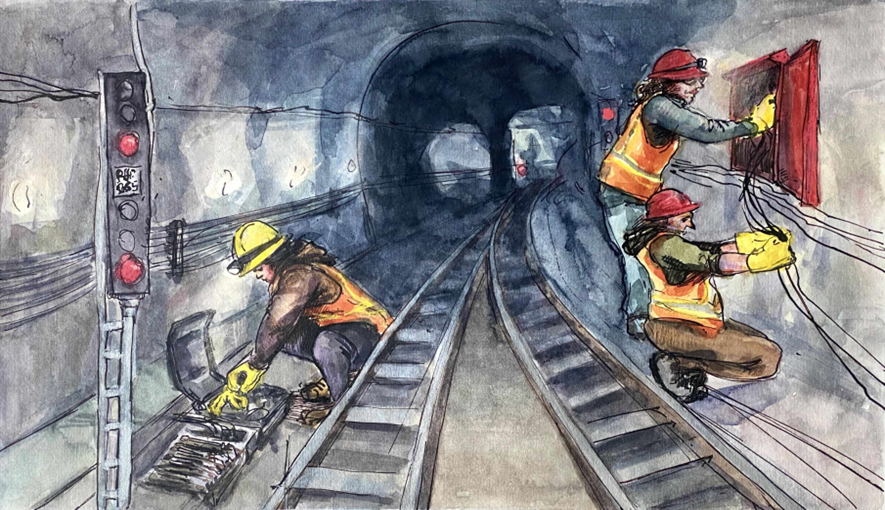
WireWomen: What It’s Like to be a Female Union Electrician (Hardball and Little Heroes Press, 2022) is a beautiful book, text and wonderful graphics, that describes and celebrates women electricians. It is written by seven women and one-man all apprentice electricians, and one journey woman and a professor of labor economics, It is illustrated by a “multi-disciplinary artist” interested in the intersections between art and social movements, The apprentices are members of the International Brotherhood of Electrical Workers (IBEW) Local 3 in New York. These IBEW apprentices take a five-year electricians course which includes training in the classroom and on-the-job. In addition, apprentices take college courses leading to an associate or bachelor’s degree in Labor Studies at Empire State College, SUNY.

The text exudes the pride and enthusiasm these apprentices have for the work they are being trained to do. “We pull wire with the strength of an elephant tugging out tree trunks, we climb ladders with the agility of a mountain lion scaling a peak, and we read blueprints with wisdom and inquisitiveness of an owl. We use our extraordinary powers to build and light up our city.”

The text describes the success these apprentices have achieved in their “search for daily meaning,” helping to build skyscrapers, installing revolving doors, adding electrical wires to tall buildings, wiring subway systems, wiring guidance systems for Air Traffic Controllers at airports, and even stringing the lights for the Christmas tree in Rockefeller Center. And all of these tasks are beautifully presented in colorful, exciting illustrations adjacent to the text which highlight the vital role electricians play in society.


And WireWomen reminds readers, mostly girls and young women (but males as well) that the possibilities of careers as electricians are available to everyone. The book demands that young people forget the old stereotypes of who could do what work. It encourages young women particularly to pursue their evolving interests and dreams. If they are curious about electricity, have a fascination for using tools, want to know “how things work,” the book suggests, they can enroll in a union apprentice program, learn a skill, and secure lucrative employment doing self-actualizing work. “We like to make our work look good because we take pride in what we do and are committed to doing a good job….We use our brains, eyes, ears, and touch to make sure everything is just right.” As Studs Terkel once wrote:


WireWomen come from all income levels, ethnicities, and races, and from different kinds of prior job experiences. And what brings them together is their passion and curiosity and a union that is committed to the dignity of work and workers. The union provides “the best training, excellent health care and pensions, safe working conditions, and good pay.” In New York state the average wage of electricians is $81,340. In the United States union women in all jobs earn a lot more than women in non-union jobs (about $195 per week more).


WireWomen also is an example of a potentially powerful new genre of literature that combines text and illustration in an engaging way. In ways analogous to graphic novels and documentaries, the reader is drawn into the text by the attractiveness and power of the visual images that accompany it. And in the case of WireWomen the authors want to attract and engage the readers with a message, challenging traditional stereotypes of what women can do. Also, the authors wish to recognize that progressive trade unions can facilitate growing opportunities of women in the workplace.

Educational institutions and union locals should order multiple copies of WireWomen to hand out to young women (and men) who evidence some curiosity about becoming an electrician. It could be an excellent recruiting tool.

(Hardball and Little Heroes Press publishes fiction and non-fiction books for adults and children that take a working-class perspective. The Lennie Moss series written by Tim Sheard and numerous other fictional books about workers and unions entertain and enlighten. The Little Heroes series provides education and entertainment for younger readers.)      https://www.hardballpress.com/index.html


Sunday, October 16, 2022

"PLAYING THE CHINA CARD" (Differently): 2022 Update

Harry Targ


(It is time to change from confrontation to cooperation: End the New Cold War now.  But as David Sanger reports on the recently released 48 page “National Security Strategy” document:

“But what leaps from the pages of Mr. Biden’s strategy, which was drafted by the National Security Council with input from around the administration, is a relentless focus on China.

Much of the military planning described in the administration’s document is meant to counter China in space, cyberspace and at sea. Each of those arenas requires very different arms, software and strategies than the push to contain Russia on the ground in Europe. The document describes a more aggressive U.S. effort to enhance cybersecurity and urges work with allies and the private sector to “withstand attempts to degrade our shared technology advances” by limiting Chinese and other investment in the United States and controlling exports of key technologies to China. “David Sanger, “Biden’s National Security Strategy Focuses on China, Russia and Democracy at Home,” The New York Times, October 12, 2022).


Beginning in 1969 President Richard Nixon, guided by his National Security Advisor, Henry Kissinger, fashioned a new policy toward China; what became known as “playing the China card.” It was motivated by a desire to push back and ultimately create regime change in the Soviet Union. Cognizant of growing hostilities between the two large communist states, Nixon and Kissinger developed this plan to play one off against the other. Central to this policy was launching a diplomatic process that led to the 1979 US formal diplomatic recognition of China. During the 1970s, the United States and China supported the same political allies in various parts of the world, Southern Africa, and Southeast Asia for example. The split in the Socialist world between the Soviet Union and China significantly contributed to the collapse of the Soviet Union and the weakening of socialism, for a time, on the world stage. Thus, from a US imperial point of view “playing the China card” worked.

In a speech on Thursday July 23, 2020, Secretary of State Mike Pompeo declared that the Nixon opening to China was a mistake. “We must admit a hard truth that should guide us in the years and decades to come that if we want to have a free 21st century, and not the Chinese century of which Xi Jinping dreams, the old paradigm of blind engagement with China simply won’t get it done. We must not continue it and we must not return to it.” (Edward Wong, Steven Lee Myers, “Officials Push U.S.-China Relations Toward Point of No Return,” The New York Times, July 25, 2020). If it is true that the Nixon/Kissinger foreign policy toward China did in fact facilitate the weakening of socialism as a world force, why was the former Secretary of State now calling “playing the China card” a mistake?

The answer to this question, or more broadly why is United States foreign policy, from Trump to Biden, returning to a policy hostile to China, perhaps creating a “New Cold War?” The answer has several parts. First, as Alfred McCoy has described (In the Shadows of the American Century: The Rise and Decline of US Global Power, Haymarket Books, 2017), the United States, relatively speaking, is a declining power. As to economic growth, scientific and technological developments, productivity, and trade, the US, compared to China particularly, is experiencing stagnation or decline. China has engaged in massive global projects in transportation, trade, and scientific advances and by 2030 based on many measures will advance beyond the US.


According to McCoy, the United States has embarked on a path to overcome its declining relative economic hegemony by increasingly investing in military advances: a space force, a new generation of nuclear weapons, cyber security, biometrics, and maintaining or enhancing a global military presence particularly in the Pacific (what Obama spokespersons called “the Asian pivot”). In other words, rather than accommodating to a new multipolar world in the 21st century, the United States is seeking to reestablish its global hegemony through military means.


Second, the United States is desperately seeking to overcome the end of its monopoly on technological advances. In computerization, transportation, pharmaceuticals, it is challenging Chinese innovations, claiming that China’s advances are derived not from its domestic creativity but from “pirating” from United States companies. For example, the prestigious and influential Council on Foreign Relations issued a report in 2019 entitled “Innovation and National Security: Keeping Our Edge.” The report warned that “…the United States risks falling behind its competitors, principally China.” China is investing significantly in new technologies, CFR claims, which they predict will make China the biggest inventor by 2030. Also, to achieve this goal they are “exploiting” the openness of the US by violating intellectual property rights and spying. Therefore, the CFR concluded, since technological innovation is linked to economic and military advantage and since US leadership in technology and science is at risk, the nation must recommit to rebuilding its scientific prowess.

Third, while the United States is engaged in efforts at regime change around the world and is using brutal economic sanctions to starve people into submission (such as in Venezuela, Cuba, Iran and 36 other countries victimized by economic sanctions), China is increasing its economic ties to these countries through investments, trade, and assistance. And China opposes these US policies in international organizations. In broad terms Chinese policy stands with the majority of countries in the Global South while the United States seeks to control developments there.


Fourth, although Biden’s foreign policy as well as his predecessors, is designed to recreate a Cold War, with China as the target, a policy also embraced by most Democrats, there is at the same time counter-pressure from sectors of the capitalist class who have ties to the Chinese economy: investment, global supply chains, and financial speculation. Moreover, sectors of Chinese capital own or have substantial control over many US corporations and banks. In addition, the Chinese government controls over $1 trillion of US debt. For these sectors of US capital, economic ties with China remain economically critical. In addition, some writers, such as Jerry Harris, point to the emergence of a “transnational capitalist class” whose interests are not tied to any nation-state (Global Capitalism and the Crisis of Democracy, Clarity Press, 2016).

Consequently, while the trajectory of US policy is toward a return to cold war, there is some push back by economic and political elites as well. Although with the emphasis on domestic investments in technology highlighted in the 2022 National Security document mentioned by Sanger, it appears the advocates of a New Cold War with China seem to be in control of US foreign policy. (The CHIPS and Science Act of 2022 reflects this renewed commitment to technological advance in the United States).


Fifth, American domestic politics provide an additional cause of the transformation of US/China policy. The popularity of the Democratic Party and President Biden remain low. Therefore, a classic antidote for politicians experiencing declining popularity is to construct an external enemy, “an other,” which can redirect the attention of the public from their personal troubles. It is this external enemy that becomes the source of domestic problems in political discourse. In this context the President is talking tough with the “enemy” of the United States, and, as former Secretary of State Pompeo suggested, it was about time that the US government gave up illusions about working with China.

Finally, the ideological package of racism, white supremacy, and American Exceptionalism so prevalent in United States history resurfaced in dramatic ways in the Trump years and continues today. White supremacy at home is inextricably connected with American Exceptionalism abroad. For example, President Theodore Roosevelt in 1910 claimed that the white race has been critical to civilization.  Years later Madeleine Albright, the Secretary of State in the Clinton Administration (and more recently President Barack Obama) spoke about the United States as the “indispensable nation,” a model of economics and politics for the world. For President Biden, the US stands with “democracy” against the world’s leading “authoritarians.” This sense of omniscience has been basic to the ideological justification of United States imperial rule.

Each of these elements, from the changing shape of economic and military capabilities to political exigencies, to the pathologies of culture, require a peace and justice movement that stands for peaceful coexistence, demilitarization, building a world of economic justice, rights of people to determine their own destiny, and inalterable opposition on to racism, white supremacy, and exceptionalisms of all kinds.

Thursday, October 13, 2022

THE CUBA STORY: THE MISSILE CRISIS 60 YEARS AGO-The Danger of Nuclear War Persists!

(Revised from a post of October 9, 2012)

 Harry Targ

“The Russian and US presidents should identify more ambitious and comprehensive limits on nuclear weapons and delivery systems by the end of 2022. They should both agree to reduce reliance on nuclear weapons by limiting their roles, missions, and platforms, and decrease budgets accordingly.” https://thebulletin.org/doomsday-clock/current-time/?utm_source=Google&utm_medium=Ads&utm_campaign=SearchAds&utm_content=DoomsdayClock_2022Statement&gclid=EAIaIQobChMIqu_uoKvd-gIVH8mUCR0uSwo1EAAYASAAEgKPFPD_BwE

“just as the full destructive implications of climate change threatening the very existence of humanity are in large part denied by the powers that be, so are the full planetary effects of nuclear war, which scientific research about nuclear winter tells us will effectively annihilate the population of every continent on Earth.” (John Bellamy Foster, https://peoplesworld.org/article/stopping-the-nuclear-war-danger-must-be-at-the-top-of-a-peace-agenda/

 In the missile crisis the Kennedys played their dangerous game skillfully….But all their skill would have been to no avail if in the end Khrushchev had preferred his prestige, as they preferred theirs, to the danger of a world war. In this respect we are all indebted to Khrushchev. ”(I.F. Stone, “What If Khrushchev Hadn’t Backed Down?”  In a Time of Torment, Vintage, 1967).


The Kennedy Administration Goes to the Brink of Nuclear War

The period between the failed Bay of Pigs invasion in April, 1961, the implementation of the Alliance of Progress economic assistance program, and the Cuban Missile Crisis in October, 1962 was one of escalating hostilities. Fidel Castro declared Cuba a Socialist state. The United States pressured members of the Organization of American States (OAS) to expel Cuba. The CIA began campaigns to assassinate the Cuban leader and President Kennedy initiated the complete economic blockade that exists until today. In addition, Castro warned that the U.S. was continuing to plan for another invasion (called “Operation Mongoose” and authorized by President Kennedy in November 1961), During this period, the Soviet Union began providing more economic and military support to the Cubans, including anti-aircraft missiles and jet aircraft.

In October 1962, U.S. spy planes sighted the construction of Soviet surface-to-air missile installations and the presence of Soviet medium-range bombers on Cuban soil. These sightings were made after Republican leaders had begun to attack Kennedy for allowing a Soviet military presence on the island. Kennedy had warned the Soviets in September not to install “offensive” military capabilities in Cuba. Photos indicated that the Soviets had also begun to build ground-to-ground missile installations on the island, which Kennedy defined as “offensive” and a threat to national security.

After securing the photographs Kennedy assembled a special team of advisors, known as EXCOM, to discuss various responses the United States might make. He excluded any strategy that prioritized taking the issue to the United Nations for resolution.

After much deliberation EXCOM focused on two policy responses: a strategic air strike against Soviet targets in Cuba or a blockade of incoming Soviet ships coupled with threats of further action if the Soviet missiles were not withdrawn. Both options had a high probability of escalating to nuclear war if the Soviet Union refused to back down.

High drama, much of it televised, followed the initiation of a naval blockade of Soviet ships heading across the Atlantic to Cuba. Fortunately, the leader of the Soviet Union, Nikita Khrushchev, sent notes to the President that led to a tacit agreement between the two leaders whereby Soviet missiles would be withdrawn from Cuba and the United States would promise not to invade Cuba to overthrow the Castro government. In addition, the President indicated that obsolete U.S. missiles in Turkey would be disassembled over time. And some of the negotiations leading to the de-escalation of tensions had proceeded in so-called “back channels,” in secret.

Can We Rely on Leaders?

Most scholars argue that the missile crisis constituted Kennedy’s finest hour as statesman and diplomat. They agree with the administration view that the missiles constituted a threat to U.S. security, despite Secretary of Defense Robert McNamara’s claim in EXCOM meetings that the missiles did not change the strategic balance between the United States and the Soviet Union. Most of these scholars have agreed that the symbolic value of the installation of Soviet missiles could have had grave consequences for U.S. “credibility.”

Given the importance of the missiles, leading social scientists have written that the Kennedy team carefully considered a multitude of policy responses. EXCOM did not ignore competing analyses, as had been done in the decisional process prior to the Bay of Pigs. The blockade policy that was adopted, experts believe, constituted a rational application of force that it was hoped would lead to de-escalation of tensions. But all observers agreed that the United States and the Soviet Union had gone to the brink of nuclear war. Even the President estimated that there was a fifty percent probability of full-scale nuclear war.

In the end the Soviets withdrew their missiles. Analysts said the Soviet Union suffered a propaganda defeat for putting the missiles on Cuban soil in the first place and then withdrawing them after U.S. threats. Khrushchev was criticized by the Chinese government and within a year he was ousted from leadership in the Soviet Union.

Is Risking Nuclear War Ever Justified?

In the light of this U.S. “victory,” Kennedy has been defined as courageous and rational. The real meaning of the Cuban Missile Crisis, however, is different, even sixty years after the event. The crisis suggests that the United States quest to maintain and enhance its empire would lead it to go to any extreme, even nuclear war, to defend the interests of capitalism. To avoid serious losses, whether symbolic or material, for capitalism, any policy was justified.

Further, in terms of U.S. politics, Kennedy was calculating the effects of the missiles on the chances for his party to retain control of Congress in 1962. A second “defeat” over Cuba (the Bay of Pigs was the first) would have heightened the opposition’s criticisms of his foreign policy.

Finally, in personal terms, Kennedy was driven by the need to establish a public image as courageous and powerful in confronting the Soviets. Khrushchev had spoken harshly to him at a summit meeting in Vienna in 1961 and Castro had been victorious at the Bay of Pigs. The President’s own “credibility” had been damaged and a show of force in October 1962, was necessary for his career.

Because of imperialism, politics, and personal political fortunes, the world almost went to nuclear war sixty years ago. As I.F. Stone suggested shortly after the crisis, nuclear war was avoided because the Soviet Union chose to withdraw from the tense conflict rather than to engage in it further.

National Security Archives files subsequently suggested that “the historical record shows that the decisions leading to the crisis which almost brought nuclear war have been repeated over and over again since the early 1960s” ( www.gwu.edu/~nsarchiv/). The danger of the unabashed and irresponsible use of force and the legitimation of the idea that diplomacy can be conducted using nuclear weapons and other devastating weapons systems still represents a threat to human survival.

These comments were adapted from Harry Targ, Strategy of an Empire in Decline: Cold War II, 1986. It is the third essay in a series on “The Cuba Story” available at https://heartlandradical.blogspot.com/2022/04/the-cubaunited-states-story-1959-1962.html?fbclid=IwAR0c7AE_Xa8gFUobC0VdZ-1COC2SPW-Ib3bH1lBF6n2O4oS380R7gElIGDo


l.blogspot.com.

Wednesday, October 5, 2022

HOW THE WORLD IS FRAMED: SPOKESPERSONS FROM THE HEGEMONIC POWER AND THE GLOBAL SOUTH

Harry Targ

(This essay was written in 2022 just after President Gustavo Petro spoke at the United Nations. In 2023 he spoke again. He later was interviewed by Amy Goodman and elaborated on the perspective of the Global South about peace, justice, and the threat to human survival. https://youtu.be/6-6Ni7jbi3U?si=CdPsWUWWOTFFUsDw)

Insights from Social Science


A long time ago the eminent political scientist Murray Edelman wrote a book entitled The Symbolic Uses of Politics. In it he postulated that most people experience the political world not through concrete reality but through emotional symbols. For example, the classic way in which people relate to their political institutions is through the flag of their nation. Americans viewing the flag see images of men in combat fighting for freedom or men and women standing in line waiting to vote for their preferred political candidates. A colorful cloth with stars and stripes gets transformed in our consciousness into a rich, glamorized history even when the emotive images are in direct contradiction to people’s lives.

In addition, Edelman suggests the ways in which the emotional symbols get embedded and reinforced in the consciousness of peoples by borrowing from anthropological writings on myth and ritual. Myths are networks of emotional symbols that collectively tell a story that explains “reality.” Rituals reinforce in behavior the mythology of public life. We need only reflect on the pledge to the flag that opens elementary and secondary school class sessions in rich and poor communities alike or regular meetings of AFL-CIO labor councils.

Edelman pointed out that emotional symbols (he called them “condensational”) provide the primary way people connect with the world beyond immediate experience. The extraordinary complexity of the modern world is reduced to a series of powerful symbols such as the threats of “international communism” or “terrorism.”

Media analyst Todd Gitlin, wrote about “media frames;” that is the ways in which media construct the symbols and myths that shape information about the world. Print media shapes what we read, who are regarded as authoritative spokespersons, and what visual images shape our thinking about countries, issues such as war and peace, trade, investment, and the global climate. Television emphasizes visual images rather than words. Whatever the media form, points of view are embedded in the words and images communicated.


Writers such as Noam Chomsky and Edward Herman, Michael Parenti, and Robert McChesney accept implicitly Edelman’s counsel that people experience the world indirectly and usually in emotional form. They also assume, as does Gitlin, that what we read, see, and hear about the world is framed for us. They go further to suggest that what Marx called the “false conceptions about ourselves” in symbols, myths, rituals, and frames are usually the product of ruling class interests.

How the Washington Post Sees the World


Charles Lane, “Migration’s ‘Root Cause’ is Latin American Socialist Dictatorship,” Washington Post, September 21, 2022, wrote about the migration this year of 200,000 Cubans. He also pointed out that such migrations over the years have involved thousands of fleeing Venezuelans: “The exodus is thus a tremendous compliment to the United States and other democratic capitalist countries. We should appreciate it.”

For Lane, the “root cause” of such migrations, of course, is communist dictatorship, a pattern of people fleeing their home countries because of dictatorship and failed economies.  Lane may have been aware of the declassified State Department document, “The Decline and Fall of Castro,” quoted in a speech by Senator Patrick Leahy, February 7, 2022, that US policy’s purpose was “denying money and supplies to Cuba, to decrease monetary and real wages, to bring about hunger, desperation, and the overthrow of [the] government.”  Cuba became the model for applying economic sanctions against governments which the US tried to bring down.

Today US sanctions have been levied against more than 20 countries. And in most cases, while citizens of these countries suffer, most remained committed to their governments and/or reject United States intervention. And Cuba, despite Lane’s dismissal of it as a dictatorship, has remained a beacon of hope, a model of economic and political development for the Global South. Health care is free, education is free. Cubans in their communities discuss and debate issues and vote on key constitutional changes. Most recently this is illustrated by the national vote on a proposed new Families Code to give legitimacy and rights to all kinds of families and children. And paradoxically virtually every country in the world (except for the US and Israel) condemns the US economic blockade.

And in another editorial statement on the Chinese “challenge” to the United States the author writes: “In just over 40 years, the People’s Republic of China has arisen from the political chaos and poverty of the Mao Zedong era to become a powerhouse on the world stage. Its unmistakable clout is intensifying its rivalry with the United States over which country will dominate the global order and, crucially, which system will stand as the world’s political and economic model: the authoritarianism and state capitalism of China, or the liberal democracy and market-oriented economy of the United States.”  Thus, the media frame is global competition between authoritarianism and “state capitalism” versus markets and democracy (Dexter Roberts, “At Stake in the U.S.-China Rivalry: The Shape of the Global Political Order,” Washington Post, September 22, 2022).

And the Washington Post and other corporate media usually reflect a common agenda. For example, from a Washington Post editorial, May 21, 2016:


“HARDLY A day goes by without evidence that the liberal international order of the past seven decades is being erodedChina and Russia are attempting to fashion a world in their own illiberal image…This poses an enormous trial for the next U.S. president. We say trial because no matter who takes the Oval Office, it will demand courage and difficult decisions to save the liberal international order. As a new report from the Center for a New American Security points out, this order is worth saving…”

But How Others See the United States: The Powerful Voice of the New President of Colombia Gustavo Petro


Recently elected president of Colombia, Gustavo Petro made a powerful presentation at the opening of the United Nations General Assembly on the plunder of the Global South by the Global North, a portrait markedly different from the view of the “liberal international order” repeated over and over again by the corporate media and foreign policy spokespersons of the United States.  Petro’s major points concluded the following:


THE WORLD IS DIVERSE IN ITS LANDS, LIVING THINGS, AND PEOPLE

“I come from one of the three most beautiful countries on Earth.

There is an explosion of life there. Thousands of multicolored species in the seas, in the skies, in the lands…I come from the land of yellow butterflies and magic. There in the mountains and valleys of all greens, not only do the abundant waters flow down, but also the torrents of blood. I come from a land of bloody beauty.”

BUT THE WORLD ALSO IS A VIOLENT PLACE

“The jungle that tries to save us, is at the same time, destroyed. To destroy the coca plant, they spray poisons, glyphosate in mass that runs through the waters, they arrest its growers and imprison them. For destroying or possessing the coca leaf, one million Latin Americans are killed and two million Afro-Americans are imprisoned in North America. Destroy the plant that kills, they shout from the North, but the plant is but one more of the millions that perish when they unleash the fire on the jungle. Destroying the jungle, the Amazon, has become the slogan followed by States and businessmen. The cry of scientists baptizing the rainforest as one of the great climatic pillars is unimportant.”


AND THE CAUSE OF THE VIOLENCE? THE GREED OF THE GLOBAL NORTH

“For the world’s power relations, the jungle and its inhabitants are to blame for the plague that plagues them. The power relations are plagued by the addiction to money, to perpetuate themselves, to oil, to cocaine and to the hardest drugs to be able to anesthetize themselves more. Nothing is more hypocritical than the discourse to save the rainforest. The jungle is burning, gentlemen, while you make war and play with it. The rainforest, the climatic pillar of the world, disappears with all its life.”


AND THE VICTIMS? LAND AND PEOPLE

“Coca and the peasants who grow it, because they have nothing else to grow, are demonized. You are only interested in my country to spray poisons on our jungles, to take our men to jail and put our women in exclusion. You are not interested in the education of the child, but in killing its jungle and extracting coal and oil from its entrails. The sponge that absorbs the poison is useless, they prefer to throw more poisons into the atmosphere.”


AND THE PURSUIT OF POWER IS TO MAKE UP FOR THE EMPTINESS OF CONSUMER SOCIETY

“These are the things of world power, things of injustice, things of irrationality, because world power has become irrational. They see in the exuberance of the jungle, in its vitality, the lustful, the sinful; the guilty origin of the sadness of their societies, imbued with the unlimited compulsion to have and to consume. How to hide the loneliness of the heart, its dryness in the midst of societies without affection, competitive to the point of imprisoning the soul in solitude, if not by blaming the plant, the man who cultivates it, the libertarian secrets of the jungle.

According to the irrational power of the world, it is not the fault of the market that cuts back on existence, it is the fault of the jungle and those who inhabit it. The bank accounts have become unlimited, the money saved by the most powerful of the earth will not even be able to be spent in the time of the centuries.”

THE CULPRIT? MONEY AND UNBRIDLED CONSUMPTION

“The culprit is their society educated in endless consumption, in the stupid confusion between consumption and happiness that allows the pockets of power to fill with money. The culprit of drug addiction is not the jungle, it is the irrationality of your world power. Try to give some reason to your power. Turn on the lights of the century again. The war on drugs has lasted 40 years, if we do not correct the course and it continues for another 40 years, the United States will see 2,800,000 young people die of overdose from fentanyl, which is not produced in our Latin America. It will see millions of Afro-Americans imprisoned in its private jails.

The Afro-prisoner will become a business of prison companies, a million more Latin Americans will die murdered, our waters and our green fields will be filled with blood, the dream of democracy will die in my America as well as in Anglo-Saxon America.”.


THE EXCUSE FOR DESPOILING NATURE AND MAKING PERSONS EXPENDABLE

“They invaded in the name of oil and gas. They discovered in the 21st century the worst of their addictions: addiction to money and oil. Wars have served them as an excuse not to act against the climate crisis. Wars have shown them how dependent they are on what will kill the human species.

If you observe that the peoples are filling up with hunger and thirst and migrating by the millions towards the north, towards where the water is; then you enclose them, build walls, deploy machine guns, shoot at them. You expel them as if they were not human beings, you reproduce five times the mentality of those who politically created the gas chambers and the concentration camps, you reproduce on a planetary scale 1933.”


LATIN AMERICA (AND THE WORLD) MUST UNITE AGAINST THIS SYSTEM OF GLOBAL ECONOMIC AND MILITARY POWER

“If you do not have the capacity to finance the fund for the revitalization of the forests, if it weighs more to allocate money to weapons than to life, then reduce the foreign debt to free our own budgetary spaces and with them, carry out the task of saving humanity and life on the planet. We can do it if you don’t want to. Just exchange debt for life, for nature. I propose, and I call upon Latin America to do so, to dialogue in order to end the war. Do not pressure us to align ourselves in the fields of war.

It is time for PEACE.

Let the Slavic peoples talk to each other, let the peoples of the world talk to each other. War is only a trap that brings the end of time closer in the great orgy of irrationality.

What Does All This Mean for Peace and Justice Activists

There are lessons to be learned by analyzing significant narratives of the contemporary world order. First, narratives are inextricably connected to the position from which the narrative comes. Is the narrative one disseminated by spokespersons of the wealthiest country in the world or from a spokesperson from a poor and marginalized country, for example? Second, narratives often reflect the interests of the powerful, economically, politically, and militarily (such as Washington Post writers) or those who speak for the interests of most nations and peoples (such as the President of Colombia). Third, these narratives have consequences. They justify policies that may or may not be in the interests of humanity. They may justify violence, plunder of resources, the exploitation of workers or they may envision a future of greater equality and the satisfaction of human needs. Finally, as Edelman, Gitlin, and others suggest, our understanding of the world is often controlled and manipulated by those in power. Today the dominant symbols, myths, and media frames from the Global North must be challenged. And President Gustavo Petro has contributed eloquently to this task.


The Bookshelf

CHALLENGING LATE CAPITALISM by Harry R. Targ

Challenging Late Capitalism