Saturday, July 22, 2023

Washington's New Cold War: a book review

Harry Targ

Socialism and Democracy

A Book Review:

John Bellamy Foster, John Ross, and Deborah Veneziale, with an introduction by Vijay Prashad, Washington’s New Cold War: A Socialist Perspective, Monthly Review Press, 2023, 99 pp.
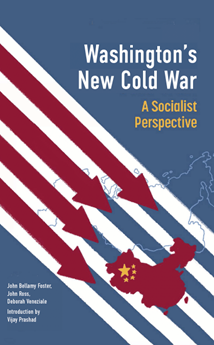

The authors of this volume describe in vivid detail the role United States militarism is playing in leading the world down the path to nuclear and environmental destruction. Vijay Prashad, in his brief introduction reports on a conversation he had in 2003 with a US State Department spokesman who reported that US policy is based on “short-term pain and long-term gain.” In sum, Prashad says, the spokesperson was suggesting that the United States was prepared to inflict pain and suffering on victims in other nations and among the working class in the United States in exchange for the long-term revitalization of US hegemony abroad and at home. Prashad reports that this comment was made at the outset of the war in Iraq and two years after the US attacked Afghanistan.

Then John Ross, in a lengthy and comprehensive essay describes the  “increasing international military aggression” of the United States characteristic of the recent past. He points out that before Ukraine, US military action primarily targeted poor and/or non-nuclear countries such as Panama, Iraq, Serbia, Afghanistan, and Libya. Now, Ross warns, the US is engaged in a war against Russia, a nuclear state.

He describes compellingly the thirty-year escalation of US involvement in Ukraine; the expansion of NATO, participation in the Maidan coup, the funding and training of the Ukrainian military, the dismissal of the provisions of the Minsk Accords, and the transferring billions of dollars to Ukraine to fight the Russian armies. He suggests that the Ukraine model is being used against China, by escalating tensions over Taiwan. The author concludes that the Ukraine War and the provocations toward confrontation with China are manifestations of the US project  of reestablishing  hegemony in a world in which China and the rest of the Global South are seen as challenges to US economic and political dominance. To use Ross’s words the US;

relative economic position has weakened tremendously, but its military power is great. Therefore, it attempts to move issues to the military terrain, which explains its escalating military aggression and why this is a permanent trend.”

And he warns us: “This means that humanity has entered a very dangerous period. (21-22).

In the second essay, Deborah Veneziale examines the domestic actors in the United States that are leading the way down a war path. She interrogates for 2023 what has been called the “military/industrial complex.” She demonstrates how once competing factions of the foreign policy elite have come together to advocate a policy of return to US global hegemony, particularly targeting China as the bulwark of opposition to the project. Essentially, she suggests that the controversial document prepared by former defense official Paul Wolfowitz in 1992 calling for the US “to maintain a permanent unipolar position” has been embraced by all major parties to the foreign policy-making process. Second, these elites have decided that China is the main enemy. And third, she describes “the merging of belligerent foreign policy elites” which include influential think tanks, military contractors, big tech corporations, and elite decision-makers circulating from military corporations to governments and back to the corporations again. As she writes:

“The military-industrial complex, composed of generals, politicians, tech companies, and private military contractors, is pursuing a massive expansion of U.S. military capacity. Today, nearly all in Washington use China as well as Russia as their pretext for this build up” (54).


Finally, John Bellamy Foster raises the specter of the inextricable connections between the danger of nuclear war and environmental collapse. He uses E. P. Thompson’s 1980s discussion of “exterminisms” to link the danger of nuclear war with the danger of “nuclear winter.” In other words, the escalating tensions described in the other essays could lead along with death and destruction by nuclear war to a radical elimination of the viability of the planet due to fire, smoke, dramatic declines in the earth’s temperature, and the end to the capacity of survivors to redevelop agriculture. We, he claims, are playing with the dangers of the two “exterminisms,” killing of people and the destruction of the planet. And, ultimately these potential life destroying crises, the New Cold War, have their roots in the logic of capitalism.

After summarizing some of the science that has led to the confirmation of the likelihood of a “nuclear winter” coming from nuclear war, Foster described the dangerous shift in US military policy from a strategy of deterrence (“counter value” or “counter city”), with the former Soviet Union, to a “counterforce” strategy.

The earlier nuclear strategy of the United States and the Soviet Union, MAD, or mutually assured destruction, was based on the proposition that the US (and the former Soviet Union) would maintain enough nuclear capacity to survive a first strike from their enemy and respond in kind. This second-strike capacity would insure that neither side would strike first, knowing that their own society would be destroyed.

In the Reagan period US military doctrine  shifted to a “counterforce” strategy, that is billions of dollars are being invested in developing the capacity to destroy a potential enemy’s second strike capacity, by hitting their military targets first. This counterforce strategy, most theorists have argued, makes nuclear war more likely. Some of this fear might have been behind the Russian assault on Ukraine.

In sum the authors portray a contemporary reality that includes the US drive to recreate global hegemony in a more multipolar world and dramatically escalated tensions among nations with nuclear weapons. US policy is rationalized by white supremacist ideology. Finally, enormous profits are derived from dramatically increased military spending.

The small size of the volume, the richness of the data, and the enormity of the warnings make this an important volume for use in classrooms and study groups.

While accessible for discussion, shortcomings remain:

1.The volume does not address or evaluate the intentions of key adversary actors. Particularly, not enough attention is given to the fact that Russia did invade Ukraine, in a sense precipitating the global crisis the authors address.

2.The authors give insufficient attention to contradictions: disagreements within the US foreign policy elite (such as among the so-called “realists” and the influential role of the Quincy Institute as an example), debates among the military, the role (insufficient though it is) of the so-called Squad in Congress, and perhaps most importantly the US and the global peace movement.

3.The authors do not address adequately “what is to be done.” Foster’s compelling linkage of the “exterminisms” of nuclear war and nuclear winter could/should be a centerpiece of peace and environmental movements coming together more effectively. And surely, now, in the midst of the so-called deficit debate the connections between growing economic immiseration, rising healthcare costs, homelessness, and, on the other hand military spending, close to a trillion dollars, should be the basis for rebuilding a unified mass-based movement that sees the connections between United States foreign and domestic policy


Saturday, July 15, 2023

Remembering the Great Society and Jesse Jackson: A Repost


28 SEPTEMBER 2011

Harry Targ : 

President Lyndon B. Johnson meets with Martin Luther King, Jr. in the White House Cabinet Room. Photo from Wikimedia Commons.

Remembering the Great Society:
Addressing poverty and hunger in America

By Harry Targ / The Rag Blog / September 28, 2011

On Monday, September 26, the Reverend Jesse Jackson visited Ohio University, located at the northern edge of Appalachia. President Lyndon Johnson had introduced his vision of a “Great Society” in 1964 at this site and Jackson was returning 47 years later to call for the establishment of a White House commission to address poverty and hunger in America.

Jackson pointed out that Athens County, Ohio, where he spoke, represented “ground zero” as to poverty in America today. Thirty-two percent of county residents live in poverty.

The fact that increased poverty is a national problem was underscored in a September 13 press release from the United States Census Bureau. The Census Bureau reported that 46.2 million people lived below the poverty line in 2010, the highest number in 52 years. In 2010, 15.1 percent of Americans lived in poverty, the highest percent since 1993. The poverty line for a family of four was $22,314.

The New York Times
 (September 14, 2011) quoted Professor Lawrence Katz, economist, who said that “this is truly a lost decade. We think of America as a place where every generation is doing better, but we’re looking at a period when the median family is in worse shape than it was in the late 1990s.”

In a press release, the Census Bureau identified some additional data which reflects the economic status of large numbers of Americans:
  • The number of Americans below the poverty line in 2010 increased by 900,000 over 2009.
  • Proportions of Black and Hispanic citizens living in poverty increased from 2009 to 2010. Black poverty rose to 27 percent from 25 percent; Hispanic poverty 26 percent from 25 percent.
  • 48 million Americans, 18 to 64 years of age, did not work at all in 2010, up from 45 million in 2009.
  • Median income declines were greatest among the young, ages 15 to 24, who experienced a 9 percent decline between 2009 and 2010.
  • Childhood poverty rates rose from 20.7 percent in 2009 to 22 percent in 2010.
Timothy Smeeding, Director, Institute for Research and Poverty at the University of Wisconsin, was quoted in the New York Times article: “We’re risking a new underclass. Young, less-educated adults, mainly men, can’t support their children and form stable families because they are jobless.”

Arloc Sherman, from the Center on Budget and Policy Priorities, reminded readers that the level of poverty was higher and median income was lower in 2007 than 2001.

In this economic context, it was surprising that the calls by Reverend Jackson for a new Great Society largely were ignored by the liberal blogosphere as well as most of the mainstream media.

One impressive exception was an interview on Up with Chris Hayes, MSNBC, on Sunday, September 25. On this program, Jackson pointed out that if it had not been for President Johnson’s disastrous Vietnam War policy he would have been recognized as one of the transformational presidents in American history.

The Leadership Conference on Civil and Human Rights has pointed out in an interesting essay entitled “Race, Class and Economic Justice” that the Johnson programs, the “Great Society,” and its “War on Poverty,” were grounded in the civil rights struggle for jobs and justice. When LBJ’s program got mired in the escalating war in Vietnam, Dr. Martin Luther King launched the “Poor People’s Campaign.”

Both the Great Society and the Poor People’s Campaign need to be revisited as young people, workers, men and women of all races and classes, mobilize along Wall Street and in virtually every city and town in America to demand economic and social justice. And as the Reverend Jackson reminded students and citizens of Athens County on September 13, LBJ’s program was a comprehensive one linking government and community groups. Among its major achievements the following need to be celebrated:
  • The Food Stamp Act (1964) provided low income families with access to adequate food.
  • The Economic Opportunity Act (1964) created the Job Corps, VISTA, and other community-based programs.
  • The Tax Reduction Act (1964) cut income tax rates for low-income families.
  • The Civil Rights Act (1964) outlawed discrimination in housing, employment, and public accommodations.
  • The Wilderness Preservation Act (1964) protected over 9 million acres of national forests from developers.
  • The Elementary and Secondary School Act (1965) provided federal aid to schools with low-income students, including the establishment of the Head Start program.
  • Amendments to the Social Security Act (1965) established Medicare for retirees and Medicaid for low-income health care recipients.
  • The Voting Rights Act (1965) ended racial discrimination in voting.
  • The Water Quality Act (1965) required states to clean up polluted rivers and lakes.
  • The Omnibus Housing Act (1965) provided for low income housing.
  • The Higher Education Act (1965) created scholarships for college students.
  • The School Lunch and Child Nutrition Act (1968) was expanded to provide food to low-income children in schools and day care facilities.
Between 1964 and 1968 the United States Congress passed 226 of 252 bills into law. Federal funds transferred to the poor increased from $9.9 billion in 1960 to $30 billion in 1968. One million workers received job training from these programs and 2 million children experienced pre-school Head Start programs by 1968.

Progressives should revisit this history and tell the story of the successes and failures of the 1960s vision and programs and work for the fulfillment of the dream articulated by Dr. King and LBJ. Both visions presupposed the connection between government, communities, and activists.

And, it should be made clear that the Great Society floundered, not because of errors in the vision or programs, or because of “government bureaucrats,” or because the “free market” could serve human needs better, but because of a disastrous imperial war that sapped the support for vibrant and needed domestic programs.

Slogans about Money for Jobs and Justice, Not for War, constitute the lessons for today. The Reverend Jesse Jackson should be supported in his efforts to revive the vision of the Great Society.

https://www.thenation.com/article/politics/jesse-jackson-is-keeping-hope-alive/


Saturday, July 8, 2023

CHE VERSUS CLUSTER BOMBS: SAYING ‘NO’ TO POLITICS AS USUAL

 Harry Targ


The New York Times on July 7 announced: “With Ukraine burning through stockpiles of conventional weapons, Biden administration officials decided they had little choice but to provide cluster munitions, despite their lasting danger for civilians, particularly children.”

It is appropriate to condemn all weapons used by all parties in wars targeting adults and children. The Ukraine War started with a Russia invasion of Ukraine. The Ukrainian military responded. Ukraine was joined in one way or another by several nations, particularly countries in the North Atlantic Treaty Organization. This war was started by Russia, and the invasion should be condemned. However, volumes have been written about historic contexts that are relevant to understanding why the invasion occurred. Perhaps knowledge of these histories might help lead to a settlement of the war.

Significant sectors of the US peace movement have responded to the war by condemning the Russian invasion, calling for a ceasefire on all sides, and urging the beginning of a process of negotiations that could lead to a permanent end to the killing.

Because the US peace movement is located geographically and politically in the United States it most appropriately has criticized US policy: on supplying weapons to Ukraine, on increasing involvement of NATO in the war, and on pressuring other countries to join the war in support of Ukraine. As the violence has advanced, some analysts have begun to worry about an escalation to nuclear war between the West and Russia and a spread of war to the South China Sea, against China.

At the same time, progressive forces in the United States are increasingly mobilizing against the far rightwing in domestic politics. In the arena of electoral politics, the Republican Party primarily stands for economic deregulation, increasing the concentration of wealth at one pole and economic impoverishment at the other, recreating Jim Crow racism in virtually every institution, and returning to the long history of patriarchy and homophobia. Progressives realize that the rightwing, a majority of the Republican party, have to be opposed.

But, in contradiction, while progressives strategize about defending and rebuilding  America, they feel obliged, many claim, to support the Democratic Party. Unfortunately, this same Democratic Party, seeks to recreate US global hegemony in a multipolar world, willingly risks nuclear war, and imposes economic sanctions (starving) on at least 30 countries.

Today a bipartisan coalition of Democrats and Republicans have revitalized a permanent war economy that effects science, education, culture, and how scarce resources are allocated.

And now, the Biden Administration has decided to transfer cluster bombs to the Ukraine War. The use of cluster bombs is opposed by at least 120 countries and major human rights organizations. Cluster bombs, along with land mines, can survive long after the wars for which they were used.

Therefore, progressives are faced with a profound contradiction: oppose rightwing reaction at home (represented mostly by the Republican Party) by supporting very modest progressive policies (mostly in the Democratic Party) advocated by politicians who support war and militarism overseas. This dilemma is felt everywhere by peace and justice activists.

But what is often left out of the calculus is the fundamental contradiction that exists between pursuing a better life in the United States while United States foreign policy causes more pain, suffering, and risks of wider wars overseas. In short, privileges at home exist at the expense of others around the world.

The project for US progressives is to create a movement, or movements, that is based on Che Guevara’s injunction: “always be capable of feeling deeply any injustice, committed against anyone, anywhere in the world.


Tuesday, July 4, 2023

CELEBRATING PROGRESSIVE CULTURE

 (Racism, misogyny, poverty, war, environmental disaster, and extraordinary military waste make this July 4th difficult for many of us to celebrate. However, we too have our history and our promise for a better future. HT)

(Originally posted on Sunday, April 26, 2009)

Harry Targ


Creator: Carolyn Kaster Credit: ASSOCIATED PRESS


Social movements are defined in several ways; their leadership, their membership, their vision, their strategies, their resources, and their successes and failures. We often forget, however, that each of these elements are woven together by a culture. This culture can be poetic, dramatic, pictorial, or musical, or some of each. The culture provides a way for people in all different places, engaged in all different parts of the mass movement, to experience a common sense of themselves and what they share with others. It may be the case that a movement without a culture is a movement without a sense of vision, of shared purpose, of passion.

It is these thoughts that come to mind this week as we remember Pete Seeger, a man who brought song to our hearts and minds for 70 years. Pete and those musicians who were inspired by him helped influence many of us to join the great twentieth century movements for social change: labor, civil rights, feminist, ecology, anti-war. It was through his practice, getting sometimes thousands of fans to sing together in unison about building a better world, that people learned that working together is how change occurs.

And when progressives look back at the twentieth century and see a very mixed record of successes and failures, glorious victories and tragic defeats, it is the culture that reminds people of the nobility of the goals that social movements pursued and what still needs to be achieved. And no greater symbol of redemption of twentieth century progressive movements and cultures was evidenced than Pete’s leading 500,000 people in front of the Lincoln Memorial two days before the inauguration of President Barack Obama in singing Woody Guthrie’s “This Land is Your Land.” Pete included the verses that delegitimized private property and celebrated the continued struggle for fundamental social change.

That performance reminded older people of the fundamental justice of the old movements and the need to create new movements with new cultures in the 21st century. Vital to that brief sing out also was the message that the old political culture should not be forgotten even as new politics and culture is created. The old and the new are like links in a chain.

A few additional words:

Paul Robeson: “Continued study and research into the origins of the folk music of various peoples in many parts of the world revealed that there is a world body-a universal body-of folk music based upon a universal pentatonic (five tone) scale. Interested as I am in the universality of (hu)mankind-in the fundamental relationship of all peoples to one another-this idea of a universal body of music intrigued me, and I pursued it along many fascinating paths.”


Woody Guthrie: “I hate a song that makes you think that you are not any good. I hate a song that makes you think that you are just born to lose. Bound to lose. No good to nobody. No good for nothing. Because you are too old or too young or too fat or too slim. Too ugly or too this or too that. Songs that run you down or poke fun at you on account of your bad luck or hard traveling. I am out to fight those songs to my very last breath of air and my last drop of blood….”

Malvina Reynolds:. “God Bless the grass That grows through the crack They roll the concrete over it To try and keep it back The concrete gets tired Of what it has to do It breaks and it buckles And the grass grows through. God bless the grass”


 Pete Seeger: “Imagine a big see-saw, with a basketful of rocks sitting on one end. That end is down on the ground. At the other end, up in the air, is a basket half full of sand. Some of us are trying to fill it, using teaspoons. Most folks laugh at us: “Don’t you know the sand is leaking out even as you put it in?” We say that’s true, but we’re getting more people with more teaspoons all the time. One of these days that basket of sand will be full and you’ll see this whole see-saw just tip the opposite way. People will say, “Gee how did it happen so suddenly?” Us, and our goddam teaspoons.”


Thursday, June 29, 2023

Envisioning a New Society

 Harry Targ


https://fed4mr.org/2023/04/18/theres-a-big-pot-of-climate-bill-money/


“We live in a world dominated by global capital, a world in which capital divides us, setting the people of each country against each other to see who can produce more cheaply by driving wages, working conditions, and environmental standards to the lowest level in order to survive in the war of all against all….The most immediate obstacle, though is the belief in TINA (There is No Alternative, HT). Without the vision of a better world, every crisis of capitalism (such as the one upon us) can bring in the end only a painful restructuring--with the pain felt by those already exploited and excluded.”

 \(Michael A. Lebowitz, Build It Now: Socialism for the Twenty-First Century, Monthly Review, 2006, 50).

The material below is a revision of an essay I published a long time ago inspired by youthful debates many were having about what kind of society we need to create to facilitate the full flowering of humankind (“Social Science and a New Social Order,” Journal of Peace Research, 1971). As Lebowitz implies we need to return to conversations about what a better future would look like. If we fail to talk about our preferred future we will become overwhelmed with cynicism and lose the capacity to do more than react to those who want to reverse legislative gains.

Specific features of a new society

 Progressive visions of a new society draw upon real and imagined communities that provide for the socio-economic and psychic needs of their members. Many of these visions include the following principles:

     a) A new society requires equal or equitable distribution of economic resources. This principle presupposes also a commitment to racial justice, gender equality, the right to love and bond with whomever one chooses, and a vision of the oneness of humankind with nature.

    b) A new society should consist of basic socio-political units that do not exceed a size whereby all people in the unit can and do interact with each other. Voluntary face-to-face contact and knowledge of the values, beliefs, and desires of other community members will increase modes of cooperation which are central to the viability of the new society.

   c) Political, social, and economic decisions should be made on the basis of voluntary participation. Those decisions that affect people’s lives will be made on the basis of their involvement.

   d) Political decision-making may entail one of or a combination of three possible modes. Some communities might decide to make decisions on the basis of complete consensus and others might decide on the use of majority rule. Some communities might create representative bodies to make decisions for the larger community with regular rotation of leaders.

   e) Political, social, and economic units might be defined as temporary so that the dissolution and adjustment of these units can be carried out at any time. Communities ought to continue only so long as they fulfill the needs of their members. However, while embracing change, communities might find virtue in providing some institutional continuity over time, particularly in terms of economic wellbeing.

Assumptions of the new society

Any new society that we envision, of course, will be based upon underlying assumptions. Evaluation of each plan necessitates a critical analysis of both its central features and the explicit and implicit assumptions embedded in it. For example the proposals made above make several assumptions:

   a) A new society based upon local control and participatory democracy assumes that this control in conjunction with equal distribution of resources will decrease the level of alienation among the population and hence the incidence of social bigotry. The more humans control their own social and physical environment, the less likely they will be to project hostilities onto others. Similarly, if they have equal access to economic resources, no material justification for hostility will exist.

  b) Although it is assumed that an equitable distribution of resources, community control, and the possibility of mobility will dramatically reduce conflict between socio-political units, conflicts from a variety of causes will probably persist. However, internal and cross- community conflict will be in what may be called 'human scale' because the scope and intensity of conflict among small communities will be greatly reduced.

The 'enemy' will not be an abstraction in the new society but the real person living across one's communal borders. As political scientist Quincy Wright put it a long time ago, “the larger the group and the less accessible all its members to direct sensory contact with all the others and their activities, the less available are instinct, custom, or universal acceptance as bases of group behavior, and the more symbols and opinions about them are the stimuli and guides for behavior. In the large groups which make war in modern civilization, symbols have been responsible for initiating and guiding that particular behavior.” 'Direct sensory contact' will replace symbol manipulation by economic and political elites in the nation state.

  c)The emphasis on primary political and social control at the community level and the creation of small-scale societies necessitate the existence of some significant cross-community or cross-national units, significant for certain functions such as dispersal of funds throughout a nation or region.

Three possible superordinate units could emerge. The most likely in the near future would be the mixed centralized-decentralized system proposed by Paul Goodman whereby 'non-human' actions are carried out at the national level such as the dispersal of resources to communities, accounting operations, and other computerized actions. Intermediate units such as state governments could be eliminated, and the significant decisions affecting individuals made in their communities. Another alternative involves the creation of domestic or international regions providing the superordinate functions in conjunction with the communities. Superordinate limited political units could emerge out of transformations of regional international organizations such as the European Union or the North American Free Trade Agreement. Finally, the breakdown of the nation-state might yield a new macro-micro community interaction system. Any of these possibilities requires that superordinate functions must be clearly defined, made as automatic as possible (not subject to technocratic manipulation), and structures must be continuously evaluate

    d)Central to the new society is the assumption that society can develop a new non-work ethos, that the system of economic abundance and automation, when stripped of its false productivity, consumption, featherbedding, and the imposition of scarcities, can reduce some of what we know as laborious work. Traditional labor could be reduced although other work such as care giving is likely to increase. And given the reduction of work, human beings can find ways to use life time for sociability and pleasure as well as necessary labor. This suggests several alternative life styles, including extensive continuous education and community participation in the arts.

    e)It is further assumed that the wealth and income of the world would be redistributed transforming the economic system whereby basic needs and functional comforts are made available to all. National armies, hand-picked neo-colonial elites, and foreign corporations no longer will control the direction of change in the Global South allowing members of the latter to choose their destinies independently. Further as the new societies spread from territory to territory one might hope for the emergence of economic redistribution that provides comforts for the world’s citizens. The stimulus for change could begin locally and nationally and spread throughout the world.

    f) Finally, the vision of the new society assumes the possibility and, indeed, the necessity of humans regaining control of the technological world. Developed societies have experienced the growth and dominance of organizational/technological rationality, a rationality committed to organizational maintenance and expansion irrespective of the human needs of its members. The goal of a new society is ultimately to achieve individual and community rationality based upon means and ends in human scale. Specifically, a new social order presupposes that technology can be decentralized, that efficiency necessary for modern existence does not require centralized political and social control. Social organization can determine technological organization.

 Strategies for change

Political activists spend much time discussing strategies for change. Scrutiny of relevant history and assessments of contemporary practice are most beneficially used by progressives to guide their efforts to bring about change within communities, nations, and the international system. It is presumed that to bring about a new society such as that discussed above, a multiplicity of strategies need to be utilized, giving credence to personality, environmental, and systemic variations--and class, race, and gender--with particular emphasis upon spontaneity, creativity, self-doubt, and constant reappraisal.

Of continued importance to change and of utility for achieving a new society is continued education—education for change which would be truly revolutionary.  Education involves, where relevant, academic argumentation, political organization around specific issues, and personal commitments in visible ways to new value systems and life styles. Substantial change requires mass support: hence large numbers of people must be exposed to the spirit of a new society so that they see alternatives and, hopefully, choose to work for their achievement.

Along with educational value, the building of new institutions may provide the skeletal structures of a new society within the parameters of the old. With increasing tension and disarray in 21st century societies, the existence of new, more appealing alternative embryonic structures will provide the substance for new loyalties and commitments when the threshold of tensions make new institutions crucial. As Staughton Lynd has argued, radical social change in the United States occurred when people, of necessity, built new institutions at the community level and crises stimulated the development of new loyalties to these institutions. Eventually the substance of these institutions spilled over from community to community across the nation. The growth of worker cooperatives might be an example.

Finally, those seeking the achievement of a new social order should involve themselves in the ongoing political process, openly and honestly articulating the substance of principles explicit in the quest for a new society. This means the utilization of electoral politics, street heat, and left organizing to communicate with the public, to build people power, and to achieve policies that move towards a new society.

Let us fight cynicism and resume the debate about building a better future!


Monday, June 26, 2023

SATURDAY ‘STAND FOR PEACE’ CALLS FOR AN END TO THE BLOCKADE OF CUBA

Harry Targ

 photo credit to Mariah Hiles 

Cuba has been victimized by a United States blockade since 1962, sometimes called an “embargo,” that has included a unilateral ban on trade with Cuba. In addition, US policy since President Trump came in office has included pressuring other countries to suspend all commerce with the island nation. Travel to Cuba is heavily regulated. Also, Trump put Cuba on the “state sponsor of terrorism” list to further restrict Cuba’s access to loans from the World Bank and other financial institutions and the ability of other nations to engage commercially with the island. In a word, United States policy toward Cuba is designed to “starve” the Cuban people. And while presidential candidate Joe Biden during the 2020 campaign promised to end Trump’s vicious policies he has not done so.

To protest these brutal US policies toward Cuba Wisconsin Peace Action, paralleling weekend actions occurring around the nation, devoted its weekly “Stand for Peace” rally on June 24 to demand an end to the Blockade of Cuba and particularly to take Cuba off the terrorism list. The Milwaukee rally was organized in collaboration with the Wisconsin Coalition to Normalize Relations With Cuba and the Milwaukee chapter of the Party for Socialism and Liberation (PSL).

Thirty activists stood with signs at four corners of a busy Milwaukee intersection calling for the normalizing of relations with Cuba, taking Cuba off the terrorism list, and reminding passersby that Cuba, contrary to the US, has a free, sophisticated health care system available to all. Other Stand for Peace activists carried their placards calling for cuts in military spending and urging the United States to exert its influence to end the fighting in Ukraine.

The Wisconsin Cuba Coalition and PSL have worked diligently to encourage Milwaukeeans to write President Biden, urging him for starters to take Cuba off the terrorism list. In part, the letter says that “leaving Cuba on this list is indefensible, as Cuba works to recover and reboot its economy after the Covid-19 pandemic…The world community recognizes that Cuba has a long history of providing healthcare and saving lives around the world. Cuba has nothing to do with ‘sponsoring terror’.”


photo credit to Mariah Hiles 

To find more information about the letter and joining in the campaign to normalize relations with Cuba  go to www.WICuba.org or write WICubaCoalition@gmail.com

The Wisconsin Cuba Coalition and the Party for Liberation and Socialism will be sponsoring a “Healthcare for All, in Cuba and the US” film and discussion, Tuesday, July 25, 2023, 6 pm. at the Mitchell Street Library, 906 W. Historic Mitchell Street, Milwaukee. Everyone in the area is welcome to attend.


The Bookshelf

CHALLENGING LATE CAPITALISM by Harry R. Targ

Challenging Late Capitalism