Wednesday, August 16, 2023

UNIVERSITIES AND THE NEW COLD WAR (Original essay posted on August 6, 2019)

Harry Targ, 

As the short video below points out the production of weapons is intimately connected to foreign policy. And as President Eisenhower warned a long time ago the military/industrial complex would be penetrating, shaping, and distorting every institution and policy in the United States. And, as the essay below suggests, this penetration includes universities and local communities. May 12, 2022.

https://youtu.be/N3pnFR7DeZA

**************************


“Purdue is advancing a broad defense innovation capability, distinguished by its depth, breadth, and speed, with the goal of contributing to our nation’s third offset strategy of innovation by integration of existing strengths and forming new partnerships. The depth in quality and creativity of Purdue research centers is, and will remain, our strongest asset. The breadth responds to the need expressed by multiple DoD customers for a ‘total package’: new, integrated solutions (technologies, transition), new talent (graduates highly trained in relevant problems), and new modes of knowledge access (personnel exchange, training, distance education)."

Purdue University researchers conducted over $40M of sponsored research in the 2014-2015 academic year and, in doing so, educated hundreds of graduate and undergraduate students in cutting edge technologies.” https://www.purdue.edu/research/defense-innovation/


“NDIA, in partnership with Purdue University, will host a comprehensive program on hypersonic systems. Together with government, industry, and academia, NDIA will present the technical foundations of hypersonic systems, the current approach to rapidly developing hypersonic capabilities, and the warfighter, policy, and acquisition perspectives on delivering a sustainable operational capability” "2019 Hypersonics Capabilities Conference," NDIA 100,  ndia.org.

The National Defense Industry Association NDIA is an association of defense industry contractors who lobby for increased military expenditures. Its members are described as “informed opinion leaders” dedicated to improved national security.

 And Now:

 Purdue University is launching a center to advocate for Taiwan as a trusted partner and encourage US investment in the nation, former US undersecretary of state for economic growth, energy and the environment Keith Krach told a news conference in Taipei yesterday

Krach, chairman of the Krach Institute for Tech Diplomacy at Purdue, first announced plans for the establishment of the Taiwan Center for Innovation and Prosperity before his arrival in Taiwan on Wednesday for a four-day visit.\

The center would be a partnership between public and private sectors in the US and Taiwan to “advocate for Taiwan internationally and attract more global partners,” the institute said.

Purdue launching center to advocate for Taiwan

    • By Liu Tzu-hsuan / Staff reporter

https://www.taipeitimes.com/News/taiwan/archives/2023/08/12/2003804626?utm_source=sfmcPT&utm_medium=email&utm_campaign=230815PurdueToday&utm_term=Purdue+launching+center+to+advocate+for+Taiwan&utm_id=773245&sfmc_id=0038c00003HUJYnAAP


****************************************************************************

Purdue’s Discovery Park launched in 2001 with a grant from the state of Indiana and expanded by a $25 million Lilly Endowment as a nanotechnology center. Today it is a $1.15 billion research and learning complex that combines Purdue’s expertise in science, engineering, technology, and biology, with connections to the corporate world. As its website suggests: “Leveraging Lilly Endowment’s investment, Discovery Park has created an innovative environment where major global challenges are examined objectively, generating new ideas and directions for future generations.”


One of Discovery Park’s core strengths is “Global Security.” Key research on this subject is designed to respond to security threats, global instability, defense needs, terrorism, nuclear deterrence and proliferation, basically responding to “the most pressing security and defense challenges facing the nation and the world.”

Chief Discovery Park scientist, Professor Tomas Diaz de la Rubia posted an essay entitled “The New Future of Warfare” (Purdue University Discovery Park Vice President’s Blog, (October 1, 2018). In it he addressed the emerging salience of new military technologies based on artificial intelligence (AI) and war. De la Rubia speculated that future wars will not be fought on battlefields but rather in cities or in cyberspace. New AI weapons of war in the hands of presumed enemies could constitute an existential threat to the survival of the United States. Discovery Park, he indicated, is already engaged in vital research on biomorphic robots, automatic target recognition for Unmanned Aerial Vehicles, automatic targeting for drones, and other technologies. In short, a core Discovery Park mission includes the preparation for and implementation of war. And this is necessary because as Professor de la Rubia argued:

“It has become apparent that the U.S. is no longer guaranteed top dog status on the dance card that is the future of war. In order to maintain military superiority the focus must shift from traditional weapons of war to advanced systems that rely on A.I.-based weaponry. The stakes are just too high and the prize too great for the U.S. to be left behind. All the more reason to call upon Purdue University and its inestimable capacity to weave together academia, research, and industry for the greater good. We’re stepping up to secure our place in the future of our country, and there’s much more to come!” He warned that China had announced that it would overtake the US by 2030 in the global artificial intelligence market.

 Recently, the NDIA and Purdue University hosted a conference on “hypersonics,” the development of high speed weapons systems, stimulated by a $2.4 billion allocation in the 2020 defense budget. According to a Purdue press release, the university has one of the most comprehensive hypersonic research capabilities. University President Mitch Daniels declared that the university was “…ready to establish itself as the ‘university hub’ of hypersonic research and development.” Indiana Governor Eric Holcomb declared that “Hypersonics systems are our state’s number one defense priority, and I’m glad we can bring industry leaders together at Purdue University to showcase what Indiana can offer.” (“NDIA, Purdue Launching Inaugural Hypersonics Capabilities Conference to Advance Transformational Military Capabilities,” Purdue Research Foundation News, July 29, 2019).  Some comments suggested also that this new military research agenda would lead to greater economic development in the Greater Lafayette area. One particularly bizarre spokesperson justified the Purdue commitment to high speed warfare by referring to the mission of the Morrill Act of 1862 establishing land-grant universities (Dave Bangert, “Purdue ‘Doubling Down” on Military Research on Hypersonic Flight, Weapons,”  Lafayette Journal and Courier, July 30, 2019).

These statements illustrate that Purdue University, a large land-grant university, increasingly is committing its skills to research, development, training, and the production of the instruments of war. Such commitments have been made with little discussion in the broader university community. 

 Important theoretical questions are not being raised. For example, is war inevitable? Are other countries a threat to the United States? Should we conceptualize the world in the twenty-first century as one in which the United States and China are competitors and threats to each other? Should the United States commit itself to remaining the number one power in the world, however that is defined? Or should research prioritize human development and conflict resolution rather than “security? Is there a relationship between poverty, hunger, environmental devastation, the spread of weapons and war and violence? One wonders if more of government and corporate resources should be allocated to these many issues, rather than to ill-conceived, notions of national “security.” And, finally, do collaborative efforts between universities, such as Purdue, with defense contractors and the Department of Defense best serve the needs of national security, conflict reduction, research, or education? And, in the end, does not this collaboration between the military, the university, and industry constitute a huge robbery of the wealth of society at the expense of social and economic development, ecological survival, and the prospects of peace?

President Eisenhower in 1960 warned about an unwarranted growth of the influence of the military/industrial complex in American society. Today he would characterize the danger as the military/industrial/academic complex. It includes the shifting of the research and education missions of higher education away from human development to war-making. 

These qualitative changes in university priorities are being made largely in non-transparent decision-making ways. But when challenged, the military/industrial/academic complex tends to defend its existence by claiming war is inevitable. And to secure support, when questioned, self-identified experts construct narratives of enemies; whether they be the Communists, the terrorists, China, the Cubans, the Venezuelans, artificial intelligence, or all of the above. As Andrew Bacevich so compellingly has argued, ever since the end of World War Two, the United States has created a “permanent war economy.” Given the increasing financial challenges universities face in the twenty-first century, collaboration with this permanent war economy becomes attractive to university administrators.

For more on the concept of the military/industrial complex see:

https://heartlandradical.blogspot.com/2010/12/speeches-that-speak-to-our-times.html

And the military/industrial/academic complex:

https://heartlandradical.blogspot.com/2022/06/the-militaryindustrial-academic-complex.html

For a discussion about competing paradigms in the study of international relations see:

 https://monthlyreview.org/2017/12/01/cold-war-revisionism-revisited/


Monday, July 24, 2023

END THE BLOCKADE: CELEBRATE THE CUBAN REVOLUTION


Harry Targ

On July 26, 1953,…  a small band of courageous and principled young Cubans stormed the Moncada Barracks in the city of Santiago, in Eastern Cuba. Though that uprising failed to dislodge the dictatorship of Fulgencio Batista, it was the beginning of a movement that has changed the world forever. (Peoples World, July 25, 2014)  https://www.peoplesworld.org/article/movement-that-changed-the-world-began-in-cuba-july-26-195/

And yet Americans are more ignorant of the nature of the Cuban Revolution and U.S.-Cuban relations than are the people of almost any other country in the world. Except for those few Americans with access to a handful of liberal and radical publications the people of this country have been subjected to an unrelieved campaign of distortion, or outright slander of Fidel Castro and the revolution he leads. The determined hostility of American leaders to the Cuban Revolution, the implementation of a system of economic harassment, and the threat of military intervention, not only endanger the Cuban Revolution, but increase the tempo of the cold war at home and abroad (Editors, “The Cuban Revolution: The New Crisis in Cold War Ideology,” Studies on the Left, Volume 1, Number, 1960, 1).

 The story of the Cuban revolution needs to be retold as we move ahead to establish a new United States/Cuban relationship.

 Cuba was a colony of the Spanish for 400 years, an economic vassal of the British and the United States for more than 100 years, and a slave state from the fifteenth century to the end of the nineteenth century.

 The domination of the island by foreigners, juxtaposed with a culture enriched by African roots (the indigenous people were largely obliterated by the Spanish), led to repeated efforts to resist colonialism before 1898 and neo-colonialism after that. Slaves, Afro/Cubans, and Spanish born landowners seeking freedom from the Spanish crown often rose up to overthrow the yoke of imperialism.

Cuban Revolutionaries, inspired by visionary poet Jose Marti, were on the verge of defeating Spanish colonialism in the 1890s. The United States sent armies to the island to defeat the Spanish and establish a puppet government to insure its economic and political control.  To secure support for the war at home the American media and popular music were filled with images of Cuba as the “damsel in distress” and bungling Afro/Cuban revolutionaries. The dominant ideology of the United States, manifest destiny and white Christian duty, drove the argument for war on Spain.

After the 1898 war, the United States military, with the support of small numbers of compliant Cubans, created a government that would open the door completely for United States investments, commercial penetration, an externally-controlled tourist sector, and North American gangsters. The U.S. neo-colonial regime on the island stimulated pockets of economic development in a sea of human misery. Responding to grotesque economic suffering in the 1950s a band of revolutionaries (led by Fidel Castro, Che Guevara, Camilo Cienfuegos, Celia Sanchez, and Haydee Santamaria) defeated the U.S. backed military regime of Fulgencio Batista.

The Cuban Revolution of 1959 began in the nineteenth century and was driven by 400 years of nationalism, a vision of democracy, and a passion for economic justice. This vision was articulated in Fidel Castro’s famous “History Will Absolve Me” speech presented before being sentenced to prison after a failed military action against Batista in 1953. He spoke of five goals of his revolution: returning power to the people; giving land to the people who work it; providing workers a significant share of profits from corporations; granting sugar planters a quota of the value of the crop they produce; and confiscating lands acquired through fraud. Then he said, the Revolution would carry out agrarian reform, nationalize key sectors of the economy, institute educational reforms, and provide a decent livelihood for manual and intellectual labor.

The problem of the land, the problem of industrialization, the problem of housing, the problem of unemployment, the problem of education and the problem of the people’s health: these are the six problems we would take immediate steps to solve, along with restoration of civil liberties and political democracy (Fidel Castro, “ History Will Absolve Me,” Castro Internet Archive https://www.marxists.org/history/cuba/archive/castro/1953/10/16.htm

Almost immediately the revolutionaries who had seized power in January, 1959 began to implement the program envisioned by the Castro speech. Over the next fifty years, with heated debates inside Cuba, experiments--some successful, some failed--were carried out. Despite international pressures and the changing global political economy, much of the program has been institutionalized to the benefit of most Cubans. 

Education and health care are free to all Cubans. Basic, but modest, nutritional needs have been met. Cubans have participated in significant political discussion about public policy. And Cuban society has been a laboratory for experimentation. In the 1960s Cubans discussed whether there was a need for monetary incentives to motivate work or whether revolutionary enthusiasm was sufficient to maintain production. Debates occurred over the years also about whether a state-directed economy, a mixed one, or some combination would best promote development; how to engage in international solidarity; and whether there was a need to affiliate with superpowers such as the former Soviet Union. Central to the Cuban model is the proposition that when policies work, they get institutionalized; when they fail, they get changed.

The United States reaction to the Cuban Revolution has been as the Studies on the Left article warned in 1960. U.S. policy has included military invasions, sabotage, assassination attempts on the life of Fidel Castro, an economic blockade, subversion including beaming propaganda radio and television broadcasts to the island, efforts to isolate Cuba from the international system, restrictions on United States travelers to the island, listing Cuba as a state sponsor of terrorism, and in the long-run most importantly portraying in government statements and the mass media the image of Cuba as a totalitarian state that oppresses its people.

 The U.S. economic embargo has not been lifted. The Helms-Burton Act, which prohibits foreign companies from having commercial relations with the island and then the United States, has not been repealed. And in 2015 the House of Representatives passed a resolution that challenged President Obama’s executive authority to expand the categories of U.S. citizens who can travel to Cuba without applying for a license from the Treasury Department. In addition, many issues of relevance to the two countries such as those involving immigration, control of drug trafficking, and cooperation on disaster relief are yet to be resolved.

Most Americans, including Cuban/Americans, support the full normalization of relations. But a small number of politicians from both political parties who oppose normalization of relations are using their legislative and public political leverage to reverse the will of the American and Cuban people. One example is the misrepresentation of the case of Assata Shakur, who has lived in Cuba for over thirty years. Shakur, a former member of the Black Panther Party was tried and convicted on dubious grounds of murdering a police officer in New Jersey and who fled to Cuba in 1984, is being used by anti-Cuban activists to resist the normalization of relations, claiming that Cuba is harboring “terrorists.”

The dramatic gestures by Presidents Obama and Castro in 2015 set the stage for the normalization of diplomatic relations but Presidents Trump and Biden reversed the modest progress in US/Cuban relations that had begun.  Therefore, activists in 2023 need to expand their demands.

First, they must continue to pressure their legislators to repeal the Helms-Burton Act and oppose any efforts by their peers to re-impose legislation that will stop the process of change. Cuba must be taken off the list of State Department terrorist states which imposes even more draconian sanctions on the island. Lobbying should be complemented by rallies and marches. Support should be given to those organizations which have been in the front lines of Cuba Solidarity for years such as Pastors for Peace. In addition, people to people exchanges, community to community outreach, and high school and university study abroad programs should be encouraged.

Second, those in solidarity with the Cuban Revolution should support economic reforms being introduced on the island that reflect the best principles of the Cuban Revolution: independence, democracy, and human well-being. The clearest manifestation of these principles is reflected in the development of workplace cooperatives in both cities and the countryside. Cubans are being encouraged to engage in work that produces goods and services for their communities in ways that empower workers and decentralize production and decision-making. Educating the American public to the fact that Cuba is embarking on new economic arrangements that encourage workplace democracy contradict the media image that the people are embracing entrepreneurial capitalism.

Third, the solidarity movement should continue the process of public education about Cuba, explaining the realities of Cuban history, celebrating Cuban accomplishments in health care and education, and recognizing the richness and diversity of Cuban culture. Ironically, despite the long and often painful relationship the Cuban people have had with the United States, the diversity of the two nation’s cultures are inextricably connected. That shared experience should be celebrated.

Finally, solidarity with the Cuban people provides an opportunity to educate Americans to the reality that the United States is not “the indispensable nation,” but one among many with virtues and flaws. Cubans have celebrated their own history and culture but have done so without disrespecting the experiences of other nations and peoples. We in the United States could learn from that perspective.


Saturday, July 22, 2023

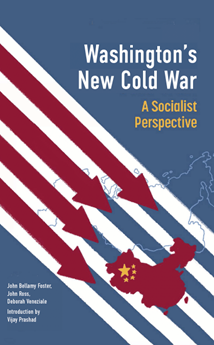
Washington's New Cold War: a book review

Harry Targ

Socialism and Democracy

A Book Review:

John Bellamy Foster, John Ross, and Deborah Veneziale, with an introduction by Vijay Prashad, Washington’s New Cold War: A Socialist Perspective, Monthly Review Press, 2023, 99 pp.


The authors of this volume describe in vivid detail the role United States militarism is playing in leading the world down the path to nuclear and environmental destruction. Vijay Prashad, in his brief introduction reports on a conversation he had in 2003 with a US State Department spokesman who reported that US policy is based on “short-term pain and long-term gain.” In sum, Prashad says, the spokesperson was suggesting that the United States was prepared to inflict pain and suffering on victims in other nations and among the working class in the United States in exchange for the long-term revitalization of US hegemony abroad and at home. Prashad reports that this comment was made at the outset of the war in Iraq and two years after the US attacked Afghanistan.

Then John Ross, in a lengthy and comprehensive essay describes the  “increasing international military aggression” of the United States characteristic of the recent past. He points out that before Ukraine, US military action primarily targeted poor and/or non-nuclear countries such as Panama, Iraq, Serbia, Afghanistan, and Libya. Now, Ross warns, the US is engaged in a war against Russia, a nuclear state.

He describes compellingly the thirty-year escalation of US involvement in Ukraine; the expansion of NATO, participation in the Maidan coup, the funding and training of the Ukrainian military, the dismissal of the provisions of the Minsk Accords, and the transferring billions of dollars to Ukraine to fight the Russian armies. He suggests that the Ukraine model is being used against China, by escalating tensions over Taiwan. The author concludes that the Ukraine War and the provocations toward confrontation with China are manifestations of the US project  of reestablishing  hegemony in a world in which China and the rest of the Global South are seen as challenges to US economic and political dominance. To use Ross’s words the US;

“ relative economic position has weakened tremendously, but its military power is great. Therefore, it attempts to move issues to the military terrain, which explains its escalating military aggression and why this is a permanent trend.”

And he warns us: “This means that humanity has entered a very dangerous period. (21-22).

In the second essay, Deborah Veneziale examines the domestic actors in the United States that are leading the way down a war path. She interrogates for 2023 what has been called the “military/industrial complex.” She demonstrates how once competing factions of the foreign policy elite have come together to advocate a policy of return to US global hegemony, particularly targeting China as the bulwark of opposition to the project. Essentially, she suggests that the controversial document prepared by former defense official Paul Wolfowitz in 1992 calling for the US “to maintain a permanent unipolar position” has been embraced by all major parties to the foreign policy-making process. Second, these elites have decided that China is the main enemy. And third, she describes “the merging of belligerent foreign policy elites” which include influential think tanks, military contractors, big tech corporations, and elite decision-makers circulating from military corporations to governments and back to the corporations again. As she writes:

“The military-industrial complex, composed of generals, politicians, tech companies, and private military contractors, is pursuing a massive expansion of U.S. military capacity. Today, nearly all in Washington use China as well as Russia as their pretext for this build up” (54).


Finally, John Bellamy Foster raises the specter of the inextricable connections between the danger of nuclear war and environmental collapse. He uses E. P. Thompson’s 1980s discussion of “exterminisms” to link the danger of nuclear war with the danger of “nuclear winter.” In other words, the escalating tensions described in the other essays could lead along with death and destruction by nuclear war to a radical elimination of the viability of the planet due to fire, smoke, dramatic declines in the earth’s temperature, and the end to the capacity of survivors to redevelop agriculture. We, he claims, are playing with the dangers of the two “exterminisms,” killing of people and the destruction of the planet. And, ultimately these potential life destroying crises, the New Cold War, have their roots in the logic of capitalism.

After summarizing some of the science that has led to the confirmation of the likelihood of a “nuclear winter” coming from nuclear war, Foster described the dangerous shift in US military policy from a strategy of deterrence (“counter value” or “counter city”), with the former Soviet Union, to a “counterforce” strategy.

The earlier nuclear strategy of the United States and the Soviet Union, MAD, or mutually assured destruction, was based on the proposition that the US (and the former Soviet Union) would maintain enough nuclear capacity to survive a first strike from their enemy and respond in kind. This second-strike capacity would insure that neither side would strike first, knowing that their own society would be destroyed.

In the Reagan period US military doctrine  shifted to a “counterforce” strategy, that is billions of dollars are being invested in developing the capacity to destroy a potential enemy’s second strike capacity, by hitting their military targets first. This counterforce strategy, most theorists have argued, makes nuclear war more likely. Some of this fear might have been behind the Russian assault on Ukraine.

In sum the authors portray a contemporary reality that includes the US drive to recreate global hegemony in a more multipolar world and dramatically escalated tensions among nations with nuclear weapons. US policy is rationalized by white supremacist ideology. Finally, enormous profits are derived from dramatically increased military spending.

The small size of the volume, the richness of the data, and the enormity of the warnings make this an important volume for use in classrooms and study groups.

While accessible for discussion, shortcomings remain:

1.The volume does not address or evaluate the intentions of key adversary actors. Particularly, not enough attention is given to the fact that Russia did invade Ukraine, in a sense precipitating the global crisis the authors address.

2.The authors give insufficient attention to contradictions: disagreements within the US foreign policy elite (such as among the so-called “realists” and the influential role of the Quincy Institute as an example), debates among the military, the role (insufficient though it is) of the so-called Squad in Congress, and perhaps most importantly the US and the global peace movement.

3.The authors do not address adequately “what is to be done.” Foster’s compelling linkage of the “exterminisms” of nuclear war and nuclear winter could/should be a centerpiece of peace and environmental movements coming together more effectively. And surely, now, in the midst of the so-called deficit debate the connections between growing economic immiseration, rising healthcare costs, homelessness, and, on the other hand military spending, close to a trillion dollars, should be the basis for rebuilding a unified mass-based movement that sees the connections between United States foreign and domestic policy


Saturday, July 15, 2023

Remembering the Great Society and Jesse Jackson: A Repost


28 SEPTEMBER 2011

Harry Targ : 

President Lyndon B. Johnson meets with Martin Luther King, Jr. in the White House Cabinet Room. Photo from Wikimedia Commons.

Remembering the Great Society:
Addressing poverty and hunger in America

By Harry Targ / The Rag Blog / September 28, 2011

On Monday, September 26, the Reverend Jesse Jackson visited Ohio University, located at the northern edge of Appalachia. President Lyndon Johnson had introduced his vision of a “Great Society” in 1964 at this site and Jackson was returning 47 years later to call for the establishment of a White House commission to address poverty and hunger in America.

Jackson pointed out that Athens County, Ohio, where he spoke, represented “ground zero” as to poverty in America today. Thirty-two percent of county residents live in poverty.

The fact that increased poverty is a national problem was underscored in a September 13 press release from the United States Census Bureau. The Census Bureau reported that 46.2 million people lived below the poverty line in 2010, the highest number in 52 years. In 2010, 15.1 percent of Americans lived in poverty, the highest percent since 1993. The poverty line for a family of four was $22,314.

The New York Times
 (September 14, 2011) quoted Professor Lawrence Katz, economist, who said that “this is truly a lost decade. We think of America as a place where every generation is doing better, but we’re looking at a period when the median family is in worse shape than it was in the late 1990s.”

In a press release, the Census Bureau identified some additional data which reflects the economic status of large numbers of Americans:
  • The number of Americans below the poverty line in 2010 increased by 900,000 over 2009.
  • Proportions of Black and Hispanic citizens living in poverty increased from 2009 to 2010. Black poverty rose to 27 percent from 25 percent; Hispanic poverty 26 percent from 25 percent.
  • 48 million Americans, 18 to 64 years of age, did not work at all in 2010, up from 45 million in 2009.
  • Median income declines were greatest among the young, ages 15 to 24, who experienced a 9 percent decline between 2009 and 2010.
  • Childhood poverty rates rose from 20.7 percent in 2009 to 22 percent in 2010.
Timothy Smeeding, Director, Institute for Research and Poverty at the University of Wisconsin, was quoted in the New York Times article: “We’re risking a new underclass. Young, less-educated adults, mainly men, can’t support their children and form stable families because they are jobless.”

Arloc Sherman, from the Center on Budget and Policy Priorities, reminded readers that the level of poverty was higher and median income was lower in 2007 than 2001.

In this economic context, it was surprising that the calls by Reverend Jackson for a new Great Society largely were ignored by the liberal blogosphere as well as most of the mainstream media.

One impressive exception was an interview on Up with Chris Hayes, MSNBC, on Sunday, September 25. On this program, Jackson pointed out that if it had not been for President Johnson’s disastrous Vietnam War policy he would have been recognized as one of the transformational presidents in American history.

The Leadership Conference on Civil and Human Rights has pointed out in an interesting essay entitled “Race, Class and Economic Justice” that the Johnson programs, the “Great Society,” and its “War on Poverty,” were grounded in the civil rights struggle for jobs and justice. When LBJ’s program got mired in the escalating war in Vietnam, Dr. Martin Luther King launched the “Poor People’s Campaign.”

Both the Great Society and the Poor People’s Campaign need to be revisited as young people, workers, men and women of all races and classes, mobilize along Wall Street and in virtually every city and town in America to demand economic and social justice. And as the Reverend Jackson reminded students and citizens of Athens County on September 13, LBJ’s program was a comprehensive one linking government and community groups. Among its major achievements the following need to be celebrated:
  • The Food Stamp Act (1964) provided low income families with access to adequate food.
  • The Economic Opportunity Act (1964) created the Job Corps, VISTA, and other community-based programs.
  • The Tax Reduction Act (1964) cut income tax rates for low-income families.
  • The Civil Rights Act (1964) outlawed discrimination in housing, employment, and public accommodations.
  • The Wilderness Preservation Act (1964) protected over 9 million acres of national forests from developers.
  • The Elementary and Secondary School Act (1965) provided federal aid to schools with low-income students, including the establishment of the Head Start program.
  • Amendments to the Social Security Act (1965) established Medicare for retirees and Medicaid for low-income health care recipients.
  • The Voting Rights Act (1965) ended racial discrimination in voting.
  • The Water Quality Act (1965) required states to clean up polluted rivers and lakes.
  • The Omnibus Housing Act (1965) provided for low income housing.
  • The Higher Education Act (1965) created scholarships for college students.
  • The School Lunch and Child Nutrition Act (1968) was expanded to provide food to low-income children in schools and day care facilities.
Between 1964 and 1968 the United States Congress passed 226 of 252 bills into law. Federal funds transferred to the poor increased from $9.9 billion in 1960 to $30 billion in 1968. One million workers received job training from these programs and 2 million children experienced pre-school Head Start programs by 1968.

Progressives should revisit this history and tell the story of the successes and failures of the 1960s vision and programs and work for the fulfillment of the dream articulated by Dr. King and LBJ. Both visions presupposed the connection between government, communities, and activists.

And, it should be made clear that the Great Society floundered, not because of errors in the vision or programs, or because of “government bureaucrats,” or because the “free market” could serve human needs better, but because of a disastrous imperial war that sapped the support for vibrant and needed domestic programs.

Slogans about Money for Jobs and Justice, Not for War, constitute the lessons for today. The Reverend Jesse Jackson should be supported in his efforts to revive the vision of the Great Society.

https://www.thenation.com/article/politics/jesse-jackson-is-keeping-hope-alive/


Saturday, July 8, 2023

CHE VERSUS CLUSTER BOMBS: SAYING ‘NO’ TO POLITICS AS USUAL

 Harry Targ


The New York Times on July 7 announced: “With Ukraine burning through stockpiles of conventional weapons, Biden administration officials decided they had little choice but to provide cluster munitions, despite their lasting danger for civilians, particularly children.”

It is appropriate to condemn all weapons used by all parties in wars targeting adults and children. The Ukraine War started with a Russia invasion of Ukraine. The Ukrainian military responded. Ukraine was joined in one way or another by several nations, particularly countries in the North Atlantic Treaty Organization. This war was started by Russia, and the invasion should be condemned. However, volumes have been written about historic contexts that are relevant to understanding why the invasion occurred. Perhaps knowledge of these histories might help lead to a settlement of the war.

Significant sectors of the US peace movement have responded to the war by condemning the Russian invasion, calling for a ceasefire on all sides, and urging the beginning of a process of negotiations that could lead to a permanent end to the killing.

Because the US peace movement is located geographically and politically in the United States it most appropriately has criticized US policy: on supplying weapons to Ukraine, on increasing involvement of NATO in the war, and on pressuring other countries to join the war in support of Ukraine. As the violence has advanced, some analysts have begun to worry about an escalation to nuclear war between the West and Russia and a spread of war to the South China Sea, against China.

At the same time, progressive forces in the United States are increasingly mobilizing against the far rightwing in domestic politics. In the arena of electoral politics, the Republican Party primarily stands for economic deregulation, increasing the concentration of wealth at one pole and economic impoverishment at the other, recreating Jim Crow racism in virtually every institution, and returning to the long history of patriarchy and homophobia. Progressives realize that the rightwing, a majority of the Republican party, have to be opposed.

But, in contradiction, while progressives strategize about defending and rebuilding  America, they feel obliged, many claim, to support the Democratic Party. Unfortunately, this same Democratic Party, seeks to recreate US global hegemony in a multipolar world, willingly risks nuclear war, and imposes economic sanctions (starving) on at least 30 countries.

Today a bipartisan coalition of Democrats and Republicans have revitalized a permanent war economy that effects science, education, culture, and how scarce resources are allocated.

And now, the Biden Administration has decided to transfer cluster bombs to the Ukraine War. The use of cluster bombs is opposed by at least 120 countries and major human rights organizations. Cluster bombs, along with land mines, can survive long after the wars for which they were used.

Therefore, progressives are faced with a profound contradiction: oppose rightwing reaction at home (represented mostly by the Republican Party) by supporting very modest progressive policies (mostly in the Democratic Party) advocated by politicians who support war and militarism overseas. This dilemma is felt everywhere by peace and justice activists.

But what is often left out of the calculus is the fundamental contradiction that exists between pursuing a better life in the United States while United States foreign policy causes more pain, suffering, and risks of wider wars overseas. In short, privileges at home exist at the expense of others around the world.

The project for US progressives is to create a movement, or movements, that is based on Che Guevara’s injunction: “always be capable of feeling deeply any injustice, committed against anyone, anywhere in the world.”


The Bookshelf

CHALLENGING LATE CAPITALISM by Harry R. Targ

Challenging Late Capitalism