
https://heartlandradical.blogspot.com/2024/09/us-supports-israels-brutal-war-to.html
Diary of a Heartland Radical: ANTISEMITISM CHARGES: THE NEW MCCARTHYISM
Harry Targ
(“Biden: ‘All-out war
is possible’ in the Middle East”. President Joe Biden warned
Wednesday that “all-out war is possible” in the Middle East, acknowledging the
limits of his own persistent diplomatic efforts at achieving a cease-fire deal.
(Politico, September 25, 2024)
Monday, April 15, 2024

|

MEASURING TARGETS
OF US IMPERIALISM: HISTORY, ECONOMICS, GEOPOLITICS, CULTURE AND IRAN
Harry Targ
U.S. Imperialism in the Beginning
Modern imperialism is intimately connected to the globalization of
capitalism, the quest for enhanced military capabilities, geopolitical
thinking, and ideologies of national and racial superiority. The rise of the
United States empire occurred as the industrial revolution spread to North
America after the civil war. Farmers began to produce agricultural surpluses
requiring overseas customers, factories were built to produce iron, steel,
textiles, and food products, railroads were constructed to traverse the North
American continent, and financiers created large banks, trusts, and holding
companies to parley agricultural and manufacturing profits into huge
concentrations of cash.
Perhaps the benchmark of the U.S. emergence as an imperial power was the
Spanish/Cuban/American war. The U.S. established its hegemony in the Western
Hemisphere, replacing the Spanish and challenging the British, and became an
Asian power, crushing rebellion and planting its military in the Philippines.
The empire has grown, despite resistance, to this day.
While U.S. expansion occurs wherever a vacuum of power exists, and an
opportunity to formally or informally control a regime and/or territory,
particular countries have had enduring salience for the U.S. Iran is such a
country.
Scale of Significance for U.S. Imperialism
To help understand the attention U.S. policy-makers give some countries, it is
possible to reflect on what is called here the Scale of Significance for U.S.
Imperialism (SSUSI). The SSUSI has three interconnected dimensions that relate
to the relative importance policy-makers give to some countries compared to
others.
First, as an original motivation for expansion, economic interests are primary.
Historically, United States policy has been driven by the need to secure
customers for U.S. products, outlets for manufacturing investment
opportunities, opportunities for financial speculation, and vital natural
resources.
Second, geopolitics and military hegemony matter. Empires require ready access
to regions and trouble spots all around the world. When Teddy Roosevelt, as
Assistant Secretary of the Navy, Vice President, and President of the United
States, articulated the first warning of the need for global power he spoke of
the development of a “two-ocean” navy. The U.S., he said, must become an
Atlantic and a Pacific power; thus prioritizing the projection of military
power in the Western Hemisphere and Asia. If the achievement of global power
was dependent upon resources drawn from everywhere, military and political
hegemony in the Persian Gulf, the Middle East, and parts of Africa also
required attention.
Third, as the imperial project grows, certain political regimes and cultures
take on particular importance for policy-makers and the American people.
Foreign policy elites claim that the U.S. has a special responsibility for
them. If these roles are rejected by the targeted country, the experience burns
itself into the consciousness of the people. For example, Cuba was seen by U.S.
rulers as far back as Thomas Jefferson as soon to be part of the United States.
Cuba’s rejection of this presumption of U.S. tutelage has been a scar on the
U.S. sense of itself ever since the spread of revolutionary ferment on the
island.
The Danger of War With Iran Today
Reflecting on the SSUSI adds to the discussion about current United States
foreign policy toward Iran. The history of U.S./Iranian relations has been long
and painful. Before the dramatic United States involvement in that country,
Iran’s vital oil resource had been under control of the weakening British
empire. In 1901 the Anglo-Iranian Oil Company (now British Petroleum)
consolidated control of much of the production, refining, and export of Iranian
oil. Local oligarchs received only 16 percent of the oil revenue from the
global sale of the oil.
After World War II, with a young monarch Mohammad Reza Shah serving as the
Iranian ruler and Iranian masses living in poverty, Iranian nationalists
mobilized to seize control of their valuable resource. Upper class nationalist
Mohammed Mossadegh became Prime Minister and asserted the power of the
parliament over the monarchy. The parliament voted to nationalize the
Anglo-Iranian Oil Company.
The British government enlisted the United States in 1953 to overthrow the
Mossadegh regime using covert operations directed by the CIA. After Mossadegh
was imprisoned and the Shah given full power to impose his will on an angry
population, a new oil consortium agreement was established in 1954 which
allowed five U.S. oil companies to gain a 40 percent share of Iranian oil.
Anglo-Iranian would retain another 40 percent, and the rest would be given to
rich Iranians.
Over the years, the Shah’s regime became the bulwark of US power in the
increasingly vital Persian Gulf region. In the Nixon period, Iran was defined
as a key “gendarme” state, which would serve as a surrogate western police
power to oversee the region. Presumably Iran would protect the flow of Gulf oil
to the United States, Europe, and Japan. By the 1970s, the Shah’s military was
the fifth largest in the world.
To the great surprise of left critics of the Shah’s dictatorship, the CIA, and
the Carter administration, the Shah’s regime began to crumble in the summer of
1978 as large strikes were organized by oil workers against the regime. In
January, 1979 secretly organized massive street protests led by the religious
community doomed the regime. As Iranian soldiers refused to fire upon street
demonstrators, President Carter’s National Security Advisor, Zbigniew
Brzezinski, urged the president to send troops to Iran to save the U.S.
regional policeman, the Shah, from overthrow. That proposal was rejected by
Carter.
After jockeying for power in the post-revolutionary period, religious leaders
consolidated their power over the political system. To add embarrassment to
loss of economic and geopolitical control over the vital Persian Gulf region,
Iranian students took 52 U.S. diplomats and military attaches hostage and held
them for 444 days. In 1980 Carter authorized a military rescue effort
that failed. The bungled military operation further damaged the image of
infallibility that American foreign policy elites, and the public, held about
the nation’s power and destiny.
In the 1980s, to challenge Iran’s potential for becoming the hegemonic power in
the Gulf, the Reagan administration sided with Iraq in the brutal war between
it and Iran. In 1988, shortly before the end of the Iraq/Iran war U.S. planes
shot down a civilian Iranian airliner killing 290 people aboard.
Subsequent to the ignoble history of U.S. support for the Shah’s dictatorship,
militarization, the overthrow of Mossadegh, the embarrassment of the hostage
taking, funding Iraq in the brutal Gulf war of the 1980s, the United States has
maintained hostility to Iran despite occasional signals from the latter of a
desire to establish better relations. U.S. policy has included an economic
embargo, efforts to create region-wide opposition to the regime, expressions of
support for a large and justifiable internal movement for democracy and
secularization in the country, and encouragement, more or less, for growing
Israeli threats against Iran. Given this troubled history of US/Iranian
relations spanning at least 60 years, the current threats of war expressed by
both Israel and the United States are not surprising.
Returning to SSUSI and Iranian Relations
As an emerging global power, United States needs for natural resources,
customers for consumer and military products, investment opportunities, and
outlets for energy companies grew throughout the twentieth century. One of the
significant historical junctures in the transfer of economic and geopolitical
power in the world from the declining British empire and the rising U.S. empire
was the agreement to redistribute control of Iranian oil in 1954. The Anglo-Iranian
Oil Company was obliged to share Iranian oil with the then five U.S. oil
giants.
As U.S. oil needs and those of its friends in Europe increased, control of the
Persian Gulf region and access to its oil became more vital. Furthermore, since
a hostile Iran could control the Strait of Hormuz, the Iranian revolution of
1979 posed an increasing geopolitical problem for American dominance.
The impulse in 1979 to send U.S. troops to save the Shah’s regime was driven by
both economics and geopolitics. It was only because other Carter advisers
disagreed with the National Security Advisor on the possibility of saving the
Shah that a U.S. intervention stalled in 1979. But in 1980 an Iraq/Iran war
provided an opportunity, it was hoped, to weaken Iran’s potential control of
the region.
Finally, the U.S. decision-makers since 1953 saw a special relationship between
this country and Iran. The U.S. put the Shah in power, plied him with enormous
military power, encouraged and facilitated significant cultural exchanges, and
defined his regime as a junior partner in policing the region.
The rapidity of the Shah’s overthrow and the anger expressed by the Iranian
people about its historic relationship to the American people communicated to
the world declining U.S. power. Consequently, U.S. hostility to Iran in
subsequent decades using a variety of issues including processing uranium is
not surprising.
Tuesday, August 20, 2013
Chalmers Johnson wrote in 2001 about “blowback” that
it “is a CIA term first used in March 1954 in a recently declassified
report on the 1953 operation to overthrow the government of Mohammed Mossadegh
in Iran. It is a metaphor for the unintended consequences of the US
government's international activities that have been kept secret from the
American people. The CIA's fears that there might ultimately be some blowback
from its egregious interference in the affairs of Iran were well founded.….
This misguided ‘covert operation’ of the US government helped convince many
capable people throughout the Islamic world that the United States was an
implacable enemy.” (The Nation, October 15, 2001).
The CIA initiated overthrow of the regime of Mohammed
Mossadegh sixty years ago on August 19, 1953 was precipitated by what Melvin
Gurtov called “the politics of oil and cold war together.” Because it was the
leading oil producer in the Middle East and the fourth largest in the world and
it was geographically close to the former Soviet Union, President Eisenhower
was prevailed upon to launch the CIA covert war on Iran long encouraged by
Great Britain.
The immediate background for the ouster of Mossadegh
was Iran’s nationalization of its oil production. Most Iranians were living in
poverty in the 1940s as the Iranian government received only ten percent of the
royalties on its oil sales on the world market. The discrepancy between Iran’s
large production of oil and the limited return it received led Prime Minister
Mohammed Mossadegh, a liberal nationalist, to call for the nationalization of
the Anglo-Iranian Oil Company in 1951. Despite opposition from Iran’s small
ruling class, the parliament and masses of the Iranian people endorsed the plan
to seize control of its oil. Mossadegh became the symbol of Iranian
sovereignty.
Ironically, Mossadegh assumed the United States would
support Iran’s move toward economic autonomy. But, in Washington, the Iranian
leader was viewed as a demagogue, his emerging rival the Shah of Iran (the
sitting monarch of Iran) as “more moderate.”
After the nationalization, the British, supported by
the United States, boycotted oil produced by the Iranian Oil Company. The
British lobbied Washington to launch a military intervention but the Truman
Administration feared such an action would work to the advantage of the Iranian
Communists, the Tudeh Party.
The boycott led to economic strains in Iran, and
Mossadegh compensated for the loss of revenue by increasing taxes on the rich.
This generated growing opposition from the tiny ruling class, and they
encouraged political instability. In 1953, to rally his people, Mossadegh
carried out a plebiscite, a vote on his policies. The Iranian people
overwhelmingly endorsed the nationalization of Iranian oil. In addition,
Mossadegh initiated efforts to mend political fences with the former Soviet
Union and the Tudeh Party.
As a result of the plebiscite, and Mossadegh’s
openings to the Left, the United States came around to the British view;
Mossadegh had to go. As one U.S. defense department official put it:
“When the crisis came on and the thing was about to
collapse, we violated our normal criteria and among other things we did, we
provided the army immediately on an emergency basis….The guns that they had in
their hands, the trucks that they rode in, the armored cars that they drove
through the streets, and the radio communications that permitted their control,
were all furnished through the military defense assistance program…. Had it not
been for this program, a government unfriendly to the United States probably
would now be in power.” (Richard Barnet, Intervention and
Revolution, 1972).
The Shah, who had fled Iran after the plebiscite,
returned when Mossadegh was ousted. A new prime minister was appointed by him
who committed Iran to the defense of the “free” world. U.S. military and
economic aid was resumed, and Iran joined the CENTO alliance (an alliance of
pro-West regional states).
In August, 1954, a new oil consortium was established.
Five U.S. oil companies gained control of forty percent of Iranian oil, equal
to that of returning British firms. Iran compensated the Anglo-Iranian Oil
Company for its losses by paying $70 million, which Iran received as aid from
the United States. The Iranian ruling class was accorded fifty percent of
profits from future oil sales. President Eisenhower declared that the events of
1953 and 1954 were ushering in a new era of “economic progress and stability”
in Iran and that it was now to be an independent country in “the family of free
nations.”
In brief, the United States overthrew a popularly
elected and overwhelmingly endorsed regime in Iran. The payoff the United
States received, with British acquiescence, was a dramatic increase in access
by U.S. oil companies to Iranian oil at the expense of the Anglo-Iranian Oil
Company. The overthrow of Mossadegh and the backing of the return of the Shah
to full control of the regime led to U.S. support for one of the world’s most
repressive and militarized regimes. By the 1970s, 70,000 of the Shah’s opponents
were in political prisons. Workers and religious activists rose up against the
Shah in 1979, leading to the rapid revolutionary overthrow of his military
state.
As Chalmers Johnson suggested many years later, the
United States role in the world is still plagued by “blowback.” Masses of
people all across the globe, particularly in the Persian Gulf, the Middle East,
and East Asia, regard the United States as the major threat to their economic
and political independence. And the covert operation against Mohammed Mossadegh
in Iran is one place where such global mistrust began.
HYBRID WARS AGAINST IRAN
Saturday, January 25, 2020
from https://heartlandradical.blogspot.com/2020/01/hybrid-warswhat-is-new-and-what-is-not.html
Iran has been a country of particular concern of the United States at least
since the end of World War II. The US propped up the Shah (Mohammad Reza
Pahlavi) at the outset of the war to protect US bases which were used to
transfer war materials to the former Soviet Union. After Prime Minister
Mohammed Mossadegh, elected in 1951, nationalized Iran’s valuable oil resource,
Great Britain, whose Anglo-Iranian Oil Company had “owned “ the oil, began to
urge the US to overthrow the democratically elected Prime Minister, instill
full power in the monarch, the Shah, and reprivatize Iranian oil. In 1953 the
US Central Intelligence Agency launched a coup to overthrow the Prime Minister
and to establish the Shah as Iran’s all-powerful dictator. His brutality and repression
lasted for years until a mass-based worker and religious-led movement ousted
him from power in 1979. In the aftermath of the ouster of the Shah, religious
leaders consolidated their control of the state, the Shah fled to the United
States for medical treatment, the new regime demanded his return to stand trial
for his crimes, and Iranian students took 52 US embassy personnel hostage for
444 days.
The United States responses to the transformation of the Iranian regime
included President Carter’s declaration of his “doctrine,” which proclaimed
that instabilities in the Persian Gulf region were vital to US national
security. The US began to fund Iraq in its eight-year bloody war against Iran,
which led to 500,000 Iranians killed. The United States urged Israel to invade
Lebanon, escalate attacks on Palestine, and in general tilted in opposition to
Iran and its allies in the region. The US also increased the sale of
technologically sophisticated arms to Saudi Arabia. Therefore in the 1980s, US
policy in the Persian Gulf and Middle East regions was driven by the growing
hostility of Iran to the United States (once a pillar of US support in the
Persian Gulf), the continued need of Europe and Japan for Iranian oil, and
Iran’s vital geographic location, particularly in terms of its potential
control of the flow of oil to Europe and Japan. But, in
addition, the Iranian people had violated a cardinal rule of US global
hegemony. They had risen up against rule by an American puppet. Much like Cuba
in the Western Hemisphere, Iranians declared that they no longer would abide by
a leader chosen by the United States and not them. (In fact, in the Nixon
Administration, the Shah’s regime was identified as the key “gendarme” state in
the Persian Gulf, the local US police enforcer).
Ever since the hostage crisis of 1979, the United States has imposed economic
sanctions of one sort or another on Iran. After the long years of damage to the
Iranian economy and the people at large, the Nuclear Treaty of 2015
(the Joint Comprehensive Plan of Action), was negotiated by Iran, the United
States, member countries of the European Union, and Security Council members,
Russia and China. Along with Iran’s promise to stop the production
of potential nuclear material, signatories agreed to end the freezing of
Iranian assets deposited in US and European banks, to eliminate various
prohibitions on Western investment in the Iranian economy, and to remove trade
restrictions.
Almost immediately after the sanctions were lifted in the aftermath of the
Nuclear Treaty, the Iranian economy grew: a 12 percent growth in GDP in 2016
and an additional but modest 3.7 percent in 2017. However, in 2018 President
Trump withdrew from the Nuclear Treaty and re-imposed crippling sanctions. As a
result, the Iranian economy contracted by 4.8 percent in 2018 and in a BBC
report projected a further decline of 9.5 percent in 2019.
Iran’s oil exports and hence production was hit particularly hard. The value of
Iranian currency declined dramatically and inflation in the country rose,
particularly for the price of food. (BBC News. “Six Charts That Show How
Hard US Sanctions Have Hit Iran,” December 2, 2019). Sanctions reduced
purchasing power, increased the cost of living for food and transportation,
reduced access of Iranian students studying abroad to financial resources, and
led to the reduction of public services.
This is the story of hybrid war against Iran: along with military threats and
attempts to isolate Iran diplomatically, make the people suffer and cause
increased outrage at the material conditions of life. The hope is that the
people will rise up and overthrow the regime in power (and, of course,
instances of corruption and repression will magnify protest responses).
The scenario has been repeated over and over: Guatemala and Iran in the early
1950s, Cuba since 1960, and now Venezuela and Iran again. And make
no mistake about it: economic sanctions are targeted against civilian
populations and constitute a strategy of war against the people, motivating
them to rise up against their governments.
Meanings of the Hybrid War Concept for the Peace Movement
We can deduce a variety of conclusions from the Law of Hybrid Wars.
First, twenty-first century imperialism is not solely or primarily about direct
military confrontation such as wars and/or covert acts of terrorism against
targeted nations.
Second, hegemonic powers, such as the United States, see coalitions of states
as a threat to global dominance. This is true in Eurasia, the countries along
the Silk Road, and in Latin America where a crippled Bolivarian Revolution
survives.
Third, policymakers do not primarily act impulsively. They see a threat, which
includes transnational cooperation and resistance. Strategists then identify
weak links in threatened coalitions. They formulate multi-dimensional,
stage-by-stage responses. And these responses involve economics, culture,
sowing seeds of division, promoting demonic narratives about target states, and
at the same time they leave “all options on the table,” which means traditional
military action.
Finally, it behooves the peace movement to be cognizant of twenty-first century
methods of imperialism. It must fashion strategies that clearly and
compellingly identify and combat economic sanctions recognizing that they,
indeed, are acts of war.


Noam Chomsky, Current Affairs, Amnesty International, Al Jazeera, Harry Targ

https://currentaffairs.adda247.com/greater-israel-map/
US Supports Israel with $3 billion in Military Aid Per Year Since 1979: this year $18 billion more
“… the crises will be serious in what President
Eisenhower called “the most strategically important area in the world.” In the
early post-War years, the United States in effect extended the Monroe Doctrine
to the Middle East, barring any interference apart from Britain, assumed to be
a loyal dependency and quickly punished when it occasionally got out of hand
(as in 1956). The strategic importance of the region lies primarily in its
immense petroleum reserves and the global power accorded by control over them;
and, crucially, from the huge profits that flow to the Anglo-American rulers,
which have been of critical importance for their economies. It has been
necessary to ensure that this enormous wealth flows primarily to the West, not
to the people of the region.”(Noam Chomsky, Excerpted from Fateful Triangle,
1999).
https://youtu.be/Mtcj9oTxgzA?si=e0ApT_t-mTJ-LWd4
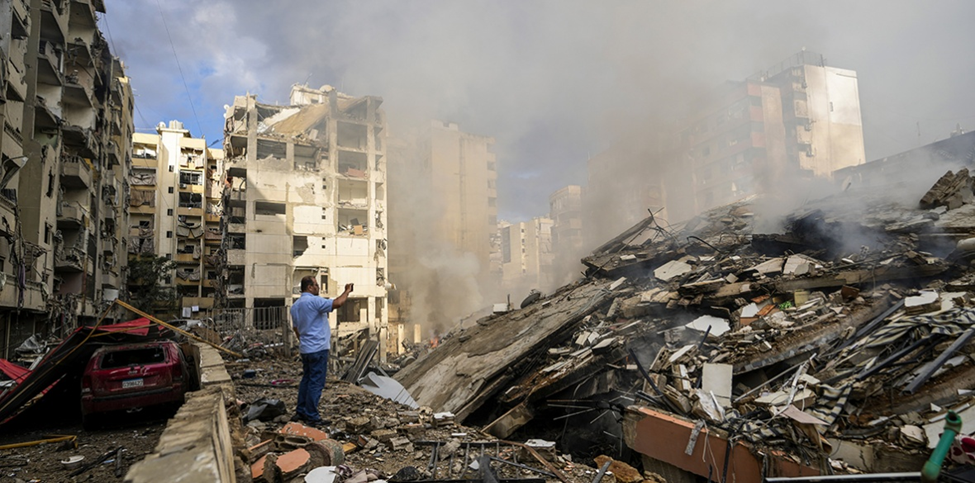
The Current Campaign of Israeli/US Genocide in
the Middle East

https://www.aljazeera.com/news/2024/9/24/israel-attacks-lebanon-in-maps-and-charts-live-tracker
The Middle East and the Peace Movement
Most
American politicians express their belief that the US must maintain a special
relationship with the state of Israel. One of the few active mobilizations for
peace today is the worldwide campaign to demand governments, corporations, and
other institutions boycott, and divest holdings in what is regarded as an
apartheid state, Israel, which oppresses its Palestinian population and those living in the
Occupied Territories. The campaign is so effective that along with national
politicians, governors and state legislatures have taken stands against the BDS
campaign.
Next to
the historic US ties to Israel, most analysts see the deconstruction of the
Middle East as a direct result of the
Iraq war initiated in 2003. Since then, Syria, Libya, Yemen and other countries
have been torn apart by civil war fueled by western, primarily US,
intervention,
The Middle East policies of the United States, and its proxy Israel, have created a growing resistance, directed at western targets and an ideological campaign against all the traditional imperial powers who dominated the region for hundreds of years.
With this as a backdrop, Israeli responses with United States complicity is stepped up high-tech killing justified by a public campaign that demonizes Muslims everywhere in the world including in the United States.
It is the
obligation of the US peace movement to work even more vigorously to oppose US
imperialism in the region and the transfer of military aid to Israel, and to
demand autonomy for the Palestinian people. And for now the peace movement must
continue to demand that the US pressure Israel to stop the bombing and killing
of people in the entire region. The Greater Middle East vision of the United
States and Israel has been a brutal vision.
Harry Targ
(The story below
appeared in the Purdue University periodical electronic newsletter “Purdue
Today” on September 19, 2024. It
celebrates the new Liberal Arts program, Cornerstone, established during the administration of
former Purdue President Mitch Daniels. It describes ACTA’s recognition of the
Liberal Arts program as a “hidden gem.” Also hidden was the political
background of ACTA and its affiliates, ALEC and the State Policy Network.

In the
recent book, Democracy in Chains: The Deep History of the Radical
Right’s Stealth Plan for America, Nancy MacLean traces the
intellectual development of the libertarian right and its connection with the
Koch Brothers and state programs to promote an ideologically-driven policy
agenda. She argues that many of the libertarian right’s policy proposals
would be opposed if public discourse and majoritarian democracy prevailed.
Consequently, she suggests, efforts are made to limit transparency, public discussion,
and legislative and electoral participation in major public policies.
Public universities are among the institutions in which the
lack of transparency is becoming the norm. The tradition of shared governance
is being trampled on. Educational decisions are being made by politicians,
administrators and boards of trustees without any advice and consent from
educators and taxpayers. Under the guise of a “business model” driven by
metrics and profit-making, many years of educational practices are being
overturned by administrators with little educational experience. Great state universities
such as those in Wisconsin, Michigan, Texas, North Carolina, and Indiana are
being reconstructed. Programs of teaching and research are being uprooted.
Sometimes ongoing programs are abolished. And new liberal arts curricula
measure success by creating narrowly trained job seekers. Research is
increasingly channeled to meet the needs of corporations or the military.
The
Vision of the 21st Century University
The President of Purdue University, Mitch Daniels, on
October 12, 2018 received the Philip Merrill Award for Outstanding
Contributions to Liberal Arts Education presented by the American Council of
Trustees and Alumni (ACTA). Daniels reported with enthusiasm that Purdue
University is the third “most STEM-centric school in the country,” with over 60
percent of its undergraduate students matriculating in engineering, chemistry,
physics, and agricultural and biological sciences. And he implied that there is
a struggle going on in great universities everywhere about what should
constitute liberal arts (Mitchell E. Daniels Jr. “Re-liberalizing the Liberal
Arts,” Washington, October 12, 2018, goacta.org.) From Daniels’ point of view,
administrators cannot wait for liberal arts programs in the twenty-first
century to transform themselves. This is so because liberal arts education
today consists of “conformity of thought, intolerance of dissent and sometimes
an authoritarian tendency to quash it, a rejection of the finest of the Western
and Enlightenment traditions in favor of unscholarly revisionism and
pseudo-disciplines.”
Daniels
then railed against the “one-sided view of the world” being presented in
liberal arts classrooms in opposition to critical thinking. He appropriately
celebrated the “clash of competing ideas,” but characterized liberal arts
curricula and research as dogmatic and authoritarian. (Many liberal arts
educators would argue that old ideas are always revisited bringing new,
diverse, perspectives to bear on traditional disciplinary formulations in the
social sciences and humanities). In other words, while most scholars
and students appreciate the openness and creativity of education and
scholarship that has resulted from the last fifty years of ferment, debate, and
thought characteristic of the intellectual life of higher education, Daniels
advocates to the contrary that the newer scholarship and education should be
challenged and expunged (Daniels referred in his lecture to some of
his intellectual mentors including Charles Murray and Jeb Bush).
Daniels added that the tenure system protects dogmatists
rather than what he would regard as free thinkers. He characterized modern
liberal arts education as “the celebration of mediocrity;” the liberal arts as
the home of “illiberal viewpoints;” and as the transmitter of “conformity of
thought.” He condemned what he called “shoddy scholarship” as well. “Hopelessly
abstruse, jargon-laden papers from so-called ‘studies’ programs read like
self-parodies.” He claimed, with no evidence, that “…fewer than half the
published studies across the social sciences can be replicated.”
And
the final and most damaging claim Daniels made was that practitioners of
liberal arts make their subject matter boring. He asserted that histories are
written without heroes, excitement, “…glory, the human elements…”
All this, Daniels suggested, requires reform of liberal
arts from outside the clutches of the educators in the various fields he
condemned. At Purdue University change is occurring because of a program called
Cornerstone which brings STEM students to specially crafted liberal arts
courses. “Enrollees will read Locke, Hobbes, and Jefferson as well as other
works in the Great Books tradition.” Reading the great books, which according
to Daniels are not already being taught in existing courses, and offering various
dual degree and fast track three-year degrees, he said, are responses to the
needs of the business community for liberal arts graduates.
And as
to free speech on campus, Daniels castigated students who, he asserted were
coached by faculty, made unwarranted demands on him to denounce fascist and
racist flyers on campus. And without any sense of irony, Daniels quoted 1960s
Chancellor of the University of California system of higher education Clark
Kerr who said that a proper university “is not engaged in making ideas safe for
students. It is engaged in making students safe for ideas.” He apparently did
not recall that students at the University of California launched the Free
Speech Movement on their campus in 1964 because Kerr’s administration banned
literature tables on campus.
Discussions of Higher Education Are Held in Secret
Lastly,
Daniels praised the work of the American Council of Trustees and Alumni (ACTA).
ACTA, formed in 1995, says it works “…to support liberal arts education, uphold
high academic standards, safeguard the free exchange of ideas on campus, and
ensure that the next generation receives a philosophically rich, high-quality
college education at an affordable price.” Henry Giroux has characterized ACTA
as “…not a friend of academic freedom, nor is it comfortable with John Dewey’s
notion that education should be responsive to the deepest conflicts of our
time…” (Henry Giroux, The University in Chains, Paragon
Publishers, 2007, p. 161).
ACTA, while claiming to be independent, is an associate
member of the State Policy Network. SPN is a “think tank” with affiliates in 49
states. SPN groups are affiliated with the American Legislative Exchange
Council (ALEC) which was a creation of the billionaire Koch brothers and
rightwing organizations such as the Bradley Foundation, to promote a radical
libertarian policy agenda in virtually every state. Jane Mayer, Nancy MacLean
and others have shown that ALEC, SPN, and ACTA leaders realized that public
discourse and transparency in political and other institutions might lead
publics, often majorities, to reject their anti-government, “free-market”
agendas.
Universities
historically have had public discussions about curricula and most universities,
including Purdue University, have institutionalized mechanisms for
decision-making on educational policy matters. Faculty Senates, curricula
committees, and promotion and tenure committees, have been the lifeblood of
higher education. And, appropriately enough, as a result of student movements
on college campuses, students have been included in conversations about
educational matters as well. And, some state universities value the input of
citizens and a broad representative array of alumni from their universities,
not just the wealthy who become the core of boards of trustees or the small
number who can afford to donate millions of dollars.
What the Daniels speech represents is a capsule summary of
the Daniels vision of what liberal arts should be. It is largely a series of
claims about modern liberal arts programs, diametrically opposed to the
reality. It is a policy brief for his campus that Daniels presented to the
non-transparent ACTA, an affiliate of a larger covert institutional network
with a presence in every state. The network is committed to a radical
transformation of economic, political, and educational institutions, a radical libertarian
America. Since the liberal arts tradition includes a rigorous conversation
about this and other visions, questions of the direction of higher education at
Purdue University deserve a rich diverse public conversation among educators,
students, and citizens. Private conversations within and between organizations
that restrict this conversation violate the spirit of higher education.
https://www.sourcewatch.org/index.php/American_Council_of_Trustees_and_Alumni

Harry Targ and Stephen David

Behind the turmoil of the Ukraine and Israeli wars, tensions between the
United States and China, African contestation over neo-colonial political,
economic, and military influence, and US meddling in the politics of Latin
America, there are fundamental forces in play that seek to rearrange and change
the architectures of global social relations. Simply put: the world, especially
the Global South has had enough of Western oppressive systems and its imperial
thrust.
New institutions and solidarities, beyond the control and wishes of the
West, are emerging in the Global South. These involve changing patterns of
trade, finance, uses of national currencies in place of the dollar and Euro,
and new expansive trade corridors and routes. Perhaps most importantly, in the
Global South, the voices of criticism of the unjust and dictatorial conduct of
the United States and its allies is on a sharp rise. There is a renewed belief
in sovereignty and a new form of political economy that supports more just
international social relations then were institutionalized in the Bretton Woods
system after World War Two. In short,
the hundreds of years of forms of
“linking” of North and South are increasingly being challenged.
And now candidate Trump on the campaign trail is warning his supporters
of the “dedollarization” movement that is advancing around the world and
promises to crush it if he is elected. The link below is to a recent Trump
campaign speech and a useful discussion of dedolarization and the rising of the
BRICS movement.
https://geopoliticaleconomy.com/2024/09/13/trump-threat-punish-dedollarization-dollar/
In short, there is much happening in what might be called “the new
international realities” which must concern progressives around the world.
These changes require us to include them in our analyses and long run struggle against the “rules based” capitalist
empire.
Harry Targ

https://heartlandradical.blogspot.com/2021/07/the-contradictions-facing-21st-century.html
Ultimately the civic literacy requirement was instituted and Purdue educators moved on to reflect on other issues. However, a recent article in the Purdue Exponent, the student newspaper, suggested that Purdue University was not able to negotiate with county officials the possibility of Purdue students voting at locations on campus in the November election. The article noted that students were able to vote at polling stations on the Purdue campus in 2020, but alas will not be able to do so this November.
One would assume that voting for our national, state,
and local political leaders would be at the top of the list of criteria for
“civic literacy.” And given problems of growing student enrollments,
transportation, and other issues, one would assume that the university, from
the standpoint of democratic participation, would prioritize procedures to
maximize voter turnout. Implicit in the newspaper story is the message that
just the opposite is true.


