Monday, December 2, 2024

Red Scares in Higher Education Continue

 Harry Targ

(Some of the text below appeared in Jacobin and Monthly Review Online, and various essays in Diary of a Heartland Radical).
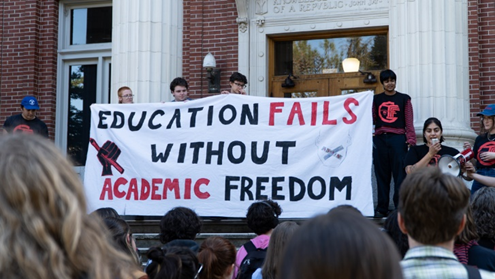
https://www.purdueexponent.org/campus/general_news/purdue-faculty-sea-202-review-intellectual-diversity/article_42c39aca-ac24-11ef-a476-bbf5a2a72f7a.html


Students with Graduate Teaching Fellows Federation (GTFF) holding a sign for the protest. (Saj Sundaram/Emerald). University od Oregon

“Wasn’t That a Time” (a song by the Weavers and Pete Seeger)

https://youtu.be/y096F_jFy3c?si=b9GEmAaClMjveZzk

Ellen Schrecker documented the enormous impact that the red scare of the 1940s and 1950s had on higher education in her book, No Ivory Tower: McCarthyism and the Universities (1988).  She interviewed academic victims of McCarthyite attacks on faculty at prestigious universities.  They were subpoenaed to testify before state legislative or Congressional committees about their former political affiliations and associations.  As was the requirements of the times, those ordered to testify could not just admit to their own political activities but were required to give witness against others who they may have known.

https://academeblog.org/2021/09/12/yes-these-bills-are-the-new-mccarthyism/

Some victims were former members of the Communist Party, others were signatories to petitions supporting the Spanish loyalists during their civil war, and still others had supported banning atomic weapons.  The most troubling element of the red scare story was the fact that university administrations refused to defend those of their faculty attacked and in fact, as she reported, some university officials demanded that their faculty cooperate with the investigatory committees.  Her subjects reported that they received little or no support from administrators because officials wished to protect their universities from funding reductions.

Since the collapse of the cold war international system, some scholars began to examine other aspects of the anti-communist hysteria as it related to the academy.  Fones-Wolf[1]  and others addressed the multiplicity of ways in which funding priorities, rightwing assaults, official pronouncements from government officials, lobbying efforts by big business groups, and shifting electoral political currents affected and shaped the content of academic programs.  

For example, disciplines can be seen as reflecting dominant “paradigms” which include assumptions about what the subject entails, what aspects of the subject deserve study, what theories are most appropriate for understanding the subject of the field, and what methods should be used to study subjects in the field.  All the social sciences and humanities privileged paradigms that did not challenge ongoing U.S. cold war assumptions about the world.

In each case, dominant paradigms of the 1950s and beyond constituted a rejection of 1930s and 1940s thinking, which was shaped by the labor and other struggles of the Depression era.  For example, literature shifted from privileging proletarian novels to the “new criticism,” separating “the text” from historical contexts.  History shifted from a model of historical change that highlighted conflict to one that emphasized consensus-building.  Sociology shifted from class struggle/stratification models of society to “structural functional” approaches.  Political science shifted from “elitism” and institutional approaches to emphasizing “pluralism,” in political processes.  For political science, every citizen in a “democracy,” it was said, could somehow participate in political decision-making.

In other words, the military-industrial-academic complex shaped personnel recruitment and retention and the substance of research and teaching.  Some new disciplines, such as Soviet studies, were funded and rewarded at selected universities and the scholars trained at these institutions then secured jobs elsewhere.  Thus an anti-communist lens on the world was propagated.  Disciplines with more ready access to research dollars — from engineering to psychology — defined their research agendas to comport with government and corporate needs.

In response to the university in the “permanent military economy,” students in the 1960s began to demand new scholarship and education.  Opposition to the Vietnam War particularly stimulated demands on professors to rethink the historical character and motivation of United States foreign policy.  William Appleman Williams and his students, the so-called revisionists, articulated a view that the United States practiced imperialism ever since it became an industrial power.  Classrooms where international relations and foreign policy were taught became “contested terrain” for argumentation and debate between the older and more benign view of the U.S. role in the world and the view of the U.S. as imperial power.  Dependency and world system theories gained prominence.

The contestations spread.  Students demanded more diverse and complicated analyses of race and racism in America, patriarchy and sexism in gender relations, and working-class history.  Every discipline and every dominant paradigm was subjected to challenge.  The challenges were also reflected in radical caucuses in professional associations and even in some of the more upright (and “uptight”) signature professional journals.  As a result there was a diminution of red scares in higher education, for a time.

The spirit of ideological struggle in the academy diminished after the Vietnam War and especially after Ronald Reagan became president.  Reagan brought back militant cold war policies, radically increased military expenditures, declared Vietnam a “noble cause,” and developed a sustained campaign to crush dissent and reduce the strength of the labor movement.  The climate on campus to some degree returned to the 1950s.

However, a whole generation of 60s-trained academics were now tenured faculty at universities around the country.  They had institutionalized programs in African American Studies, Women’s Studies, Peace Studies, and Middle East Studies.  Critical theorists populated education schools, American Studies programs, and other pockets of the university.  These faculty continued the debate with keepers of dominant paradigms, created interdisciplinary programs, and developed programs shaped by key social issues such as racism, class exploitation, gender discrimination, and war.

A New Round of McCarthyism

But by the 1990s, a new red scare was surfacing.  Some conservative academics and their constituencies talked about declining standards brought by the new programs.  Others criticized what they regarded as an insufficiently rosy view of United States history.  They claimed that the United States was being unfairly condemned for being complicit, for example, in a holocaust against Native Americans or because slavery and racism were central to the history of the country.  They formed academic associations and interest groups to defend against critical scholarship.

Then David Horowitz came along.  Overseeing a multi-million-dollar foundation funded by rightwing groups, Horowitz launched a campaign to purify academia of those who had records of teaching, research, and publication that he saw as unduly critical of the United States, ruling political or economic elites, or the global political economy.  He opposed those scholar-activists who participated in political movements or in any way connecting their professional life with their political lives.  And he opposed those academics who participated in academic programs that were interdisciplinary, problem-focused, and not tied to traditional fields of study. 

Horowitz published a book in 2006, The Professors: The 101 Most Dangerous Academics in America (2006), in which he presented distorted profiles of illustrative faculty whom he believed had violated academic standards because of a variety of transgressions.  Most of those identified either engaged in political activity and/or participated in interdisciplinary scholarly programs that he found offensive: again Middle East Studies, Women’s Studies, African-American Studies, American Studies, and Peace Studies.

In conjunction with the book and similar assaults on those he disagreed with on his electronic news magazine, Horowitz encouraged right-wing students to challenge the legitimacy of these professors on college campuses and tried to get conservative student groups to get state legislatures to endorse so-called “student bill-of-rights legislation.”  Such legislation would have established oversight by state legislatures over colleges and universities, especially their hiring practices.

In addition, Lynn Cheney, the former vice-president’s wife, and former Senator Joe Lieberman, senator from Connecticut, helped create an organization called the American Council of Trustees and Alumni (ACTA).  As Giroux summarized it, “. . ACTA actively supports policing classroom knowledge, monitoring curricula, and limiting the autonomy of teachers and students as part of its larger assault on academic freedom”.[2]

Horowitz, ACTA, and others who attacked the university targeted visible academics for scrutiny and persecution.  Ward Churchill, a provocative professor of  Ethnic Studies, at the University of Colorado, was fired after a university committee was created to review his scholarship because of  controversial remarks he made off campus.  Norman Finkelstein, a DePaul University political scientist who had written several books critical of interpreters of Israeli history and foreign policy, was denied tenure after a coordinated attack from outside his university led by Harvard Law Professor Alan Dershowitz.  Distinguished political scientists John Mearsheimer and Stephen Walt were the subject of vitriol and false charges of antisemitism because they published a long essay and book analyzing the “Israeli lobby.”

This red scare against higher education of the last twenty years had failures and successes.  Horowitz had  a visible presence on national cable television and radio, particular on Fox News  He used it to attack some of the 101 dangerous professors.  However, his supporters were not able to get any of their legislative proposals accepted.  Also, most university administrators defended their faculty from the crude assaults from Horowitz and his followers.  In addition, many of the 101 and others like them stepped up their public defenses of their scholarship and teaching.  In addition, it was unusual then for any students to level attacks against targeted professors.  If anything, they defended the right of professors to be critical analysts in their subject areas in the classroom.

But, the new red scare reinforced and legitimized the dominant paradigms in various academic disciples and created an environment of intellectual caution in the academy.  While the impacts were immeasurable, younger faculty could not help but be intimidated by the public attacks on their senior colleagues.  The system of tenure and promotion in most institutions remained vulnerable to public pressures, individual reviewer bias, and honest disagreements among faculty about whether published work and teaching is worthy of promotion and tenure.  Therefore, just as the administrators and faculty of the 1950s felt intimidated by outside assault on their institutions, those passing judgment on  faculty might saw the necessity of caution in hiring and retaining faculty whose perspectives were new, different, radical, and engaged.

Intellectuals, the Critical Organic Discourse Model, and Higher Education

The red scares of the past rekindled debate concerning the role of higher education and faculty as to research, teaching, and activism.  Those propagating the red scare insisted that education should focus on celebrating American society, history, and institutions.  Anything less, to them, constituted bias and a violation of the principles of academic freedom.  In addition, educators, it was argued, should not engage in political activism.  Being an academic and being a citizen must remain separate.

While ACTA and others complained about the negativity of those reflecting on United States history, more sophisticated red scare spokespersons, including Horowitz himself, emphasized one or another of two different approaches to the academy.  Some argued that the professorate must be “fair and balanced” in their academic work.  That is, they should in the classroom present all points of view, indicating favoritism to none.  Presumably their research and writing should strive for this balance as well. Some asked whether portraits of th inquisition or 20th century fascism necessitated telling “both sides of the story”).

Parallel to the fair and balanced position was the argument that teachers and researchers should be objective, that is, apolitical, and indifferent to the merits of competing sides to a conflict being studied.  The objectivity standard required that the professor abstain, in his/her public role from participation in society.  (It should be noted that some targets of the red scare attacks responded by claiming they were fair and balanced and objective, and occasionally their students have defended them on these grounds as well).  In fact, when Horowitz was asked on national television if he had proof that his victims had not been fair and balanced and objective in the classroom, he was been forced to admit that he had no way of knowing since he and his researchers had not had occasion to observe the professors in question.

While being fair, balanced, and objective are worthy goals, they stand in contradiction to the history of the university alluded to throughout this paper.  What I call the critical and organic discourse model is a more appropriate standard of scholarship, teaching, and engagement for these critical times.  It has several dimensions: speaking truth to power; critically reflecting on all institutions and processes in society, privileging unpopular ideas, and applying those ideas in social settings where they may be helpful to bring about change.

The last point, inspired by Gramsci’s idea of the “organic intellectual” and the discussion by Jacoby and others about the role of the “public intellectual,” suggest that knowledge in the end comes from and should be used in support of those in society who have been disenfranchised politically, economically, and culturally.  As Gramsci put it, “The mode of being of the new intellectual can no longer consist in eloquence, which is an exterior and momentary mover of feelings and passions, but in active participation in practical life, as constructor, organizer, ‘permanent persuader,’ and not just a simple orator. . .” [3].  Gramsci’s “organic intellectual” is the intellectual who is connected to various social groups or movements and acts in concert with and stimulates the activities of such groups.  The organic intellectual in class society is linked to the project for historical change of the working class.  Historically the university has not served their needs, and those who embrace this model of teaching, research, and engagement should stand with the disenfranchised, such as the working class.

The New Context

https://www.campusreform.org/article/aaup-trump-greatest-threat-academic-freedom-since-mccarthy/8414

In sum, the most important elements of the critical and organic discourse model involve giving voice to the voiceless and engaging in education, research, and activity to pursue peace, social, and economic justice.

However, since the rise of candidate and President Trump and his MAGA allies, the pervasive influence of the Koch Foundation and its various instrumentalities such as the State Policy Networks and ACTA, and US escalated military involvement in Ukraine and support for Israeli violence in the Middle East, a new “red scare” has emerged. Politicians of both political parties lave launched in Congress and state legislatures attacks on what was known as academic freedom.

The Purdue Exponent story linked above refers to just one effort of politicians and  administrators  to shape and constrain what goes on in the classroom. Faculty are being subjected to regular reviews about the content of their curricula; their syllabi are subject to scrutiny by those who may not be familiar with the subject matter; students are encouraged to report any discomfort they may feel in a class; and certain stances inside the classroom or out by faculty who criticize United States history, polices or practices can be deemed  supportive of authoritarianism or “antisemitism”.

In short, the university as a place where students are exposed to the breathe of ideas from the past, debate new ideas, and are encouraged to develop their own identities and perspectives on the world based upon their educational experiences is being replaced with a site for indoctrination to whatever political or economic dogma is being promoted at the current time. This is a very dangerous time for the survival of higher education.


                                            From Inside Higher Education

[1] Ellen Fones-Wolf, Selling Free Enterprise: The Business Assault on Labor and Liberalism, 1945-60, University of Illinois Press, 1994.

[2] Henry Giroux, The University in Chains, Paradigm, 2007, 16).

[3] Antonio Gramsci, Selections From the Prison Notebooks, International Publishers,10.

Tuesday, November 26, 2024

REMEMBERING CUBA: END THE BLOCKADE! REMOVE CUBA FROM THE LIST OF STATE SPONSORS OF TERRORISM

 Harry Targ


Thursday, April 5, 2012

ECONOMICS, POLITICS, AND CULTURE:THE CUBAN EXPERIENCE

Harry Targ

(These remarks were prepared for a presentation before a musical performance at Purdue University by Sierra Maestra, the stirring band formed at the University of Havana in 1976. The band was named after the mountain range in Eastern Cuba that was the site of the formation of the Cuban revolutionary force that overthrew the U.S. supported dictator in the 1950s. The nine-person band promotes and celebrates the classic Cuba Son music that has its roots in the diversity of class, race, ethnicity, and gender in Cuban history).

People’s lives begin with the struggle for existence and are supplemented by the pursuit of joy and liberation. Culture, often reflecting the pain of daily existence and the vision of a better life, is intimately embedded in history, economics, and politics.

Cuba’s revolutionary poet Jose Marti describes his place in history, economics, and politics.

“I am a truthful man,
From the land of the palm,
Before dying, I want to
Share these poems of my soul.

My poems are light green,
But they are also flaming red
My verses are like a wounded fawn.
Seeking refuge in the mountain.

(Pete Seeger reports learning these two additional Marti verses from a Cuban of African descent in 1983.)

Red, as in the desert,
Rose the sun on the horizon.
It shone on a dead slave
Hanging from a tree of the mountain.

A child saw it, trembled,
With passion for those that wept,
And swore that with his blood
He would wash away that crime.”

Latin American social theorists and activists of the era of the Cuban revolutionary process (since the 1950s) defined the economic and political context of countries like Cuba, less passionately but rigorously, as a result of dependency. For example, Brazilian social scientist, Theotonio Dos Santos wrote about what he called “the structure of dependence.”

“Dependence is a situation in which a certain group of countries have their economy conditioned by the development and expansion of another economy, to which the former is subject.”

Andre Gunter Frank, looking at the broad sweep of history beginning with the rise of capitalism out of feudalism referred to “the development of underdevelopment.” During the fifteenth century the sectors of the globe now referred to as the “Global North” and “Global South” were roughly equal in economic and military power. But as a result of the globalization of capitalism and militarism, some countries, primarily in Europe and North America, developed at the expense of most of the other countries of the world.

Dependency theorists began to include domestic class structures in their analysis of relations between dominant and dependent nations. In addition to dominant and weak countries bound by exploitation and violence, within both powerful and weak countries class structures existed. In fact, rulers in poor countries usually were tied by interests and ideology to the interests and ideology of the ruling classes in powerful countries. And, most importantly, the poor, the exploited, the repressed in both rich and poor countries shared common experiences, often a common outlook, and potentially a common culture.

I have written a book chapter about “Themes in Cuban History” from the point of view of dominance and dependence (from Harry R. Targ, Cuba and the USA: A New World Order? International Publishers, 1992). The chapter addresses:

-Spanish conquest between 1511 and 1515

-Cuba as sugar producer

-Cuba as slave society. By 1827 over 50 percent of Cuban residents were of African descent.

-Britain’s economic and military penetration of the island beginning in the 18th century

-Revolutionary ferment, particularly slave revolts, permeating 19th century Cuban society

-The visions of U.S. leaders, including Thomas Jefferson, that some day Cuba would join the new nation to the North.

-U.S. investor penetration of the island, challenging the Spanish and British. By the 1880s over 80 percent of sugar exports went to the United States and large plantations on the island were owned by Americans.

-The Spanish/Cuban/American war of 1898 which lead to a full transfer of colonial and neo-colonial hegemony from the Spanish and British to the United States

-The United States establishment of economic, political, and cultural domination of the island from 1898 to 1959. Subordinate wealthy and powerful Cubans controlled the political system, benefitting from U.S. hegemony, while “the poor people of this earth” on the island made up the vast majority.

-1953 to 1959 armed struggle which overthrew the Batista dictatorship and the elimination of U.S. interests on the island.

-1959 to the present Cuba haltingly, with international and domestic opposition, pursuing a new society to “wash away that crime” of long years of empire and dependency.

How is this history relevant to indigenous Cuban music and its connections with U.S. culture?

Culture, it seems to me, grows out of the experience of peoples. That experience is shaped by history, economics, and politics. Music is a common way of communicating and sharing experience, particularly of pain and joy.

The seeds of a common Cuban culture were planted in various fields--Africa, the sugar plantations of the island, and growing relations between Cubans and people of African descent in the region, including the United States.

Finally, culture can be revolutionary when it expresses pain, implies a better life, and extends the experiences of some to others--of similar class, racial, ethnic, and gender histories.

So as we listen to Sierra Maestra and reflect on the roots of its music, its contribution to jazz in the U.S., and the commonalities of Cuban Son and U.S jazz and blues, we might remember Marti’s expression from the poet’s point of view:

“With the poor people of this earth,
I want to share my lot.
The little streams of the mountains
Please me more than the sea.”

(All verses quoted here are from Pete Seeger, Where Have all the Flowers Gone; A Singer’s Stories, Songs, Seeds, Robberies, A Sing Out Publication,1993).

Wednesday, August 5, 2009


BLOCKADE ON CUBA STIFLES INTELLECTUAL EXCHANGE

(The Obama administration has begun to make modest changes in United States policy toward Cuba , such as easing travel to the island by Cuban Americans and transferring money to relatives, but the economic, cultural, and educational blockade of the island remains. The mainstream press continues to publish decontextualized accounts of "dictatorship," "bureaucracy," and"economic chaos" on the island.

For example, The New York Times published a story recently pridefully announcing that with US Homeland Security support "6,000" Cuban doctors and other health professionals have fled the island or their humanitarian assignments in other countries to come to the United States since 2002. The article, by Mirta Ouito, "Doctors in Cuba Start Over in the U.S."August 4, 2009, does mention that Cuba has sent 185,000 health professionals to 103 countries over the last 50 years. But she writes: "Yet for many Cuban doctors, who earn the equivalent of $25 a month, the lure of a life of freedom and opportunities in the United States is too strong to resist." She sites an American Medical Association official who estimates that one of four doctors in the United States was trained overseas. While the author describes the difficulties Cuban medical defectors face in pursuing their profession, she seemed undisturbed by the irony of a US government program designed to attract trained health professionals from doing important work in countries of the Global South at the same time that the most developed country in the world has to increasingly rely on international doctors to meet the needs of the American people.

Below is reprinted a 2004 article that described one example of literally hundreds of academic exchanges that flourished before former President George Bush tightened the blockade of Cuba. The 50-year blockade must end and egalitarian exchanges between the people of North America and Cuba must be reestablished for the benefit of all).

Harry Targ
June 17, 2004


Fourteen students and two professors returned to Purdue University on June 9 from an 18 day study abroad trip to Cuba. The students, from the Schools of Agriculture and Liberal Arts, completed an interdisciplinary course called “Experiencing Cuba.”The course included four days of formal instruction at the Agrarian University of Havana, an institution much like Purdue. In addition site visits were made to a tobacco farm and factory, an urban garden where the new Cuban commitment to sustainable agriculture was illustrated, an ecological preserve, and a botanical garden specializing in exhibiting and studying tropical plants. Students also toured a special facility for Cubans with mental and physical disabilities. As to politics, culture, and history, students visited museums specializing in Cuban history, religion, and the arts. The Purdue group had occasion to interact with Cubans in many places including the university, in neighborhoods, and in other urban and rural settings. The trip was capped by a six-day 700 mile ride across the island from Havana city to Santiago de Cuba on the Caribbean.

The course was organized by faculty in the School of Agriculture and Liberal Arts as part of a project to link Purdue University to appropriate academic institutions on the island. The project would link Purdue and Cuban faculty with interests in collaborative research, graduate students who wish to pursue research projects involving Cuba, and undergraduate students who wish to study in Cuba. It is hoped that at some time Cuban faculty and students will be able to study at Purdue University when United States policy toward Cuba changes.

The organizers of the Purdue/Cuba project launched the program because Cuba has had special historic ties, positive and negative, with the United States that warrant study. Also, Cuba for the last 45 years has been a social laboratory for the development of diverse social, economic, and cultural policies that interest peoples around the world as well as the United States. For example, Cuba’s health and educational programs have long been of interest. In the 1990s Cuba’s adoption of policies to promote sustainable agriculture have been seen by some as a possible model for other developing countries.

The Purdue study abroad course in Cuba was not among the first. In fact, over the last decade the Treasury Department has issued education licenses to over 750 colleges, universities, and high schools to develop such courses. During the Purdue visit to the island, for example, there were faculty/student groups from the University of Georgia, the University of Charleston, Duke, and William and Mary. A University of Michigan group was to arrive in June.

Treasury Department licensing of university programs is required because the United States has had a 40-year economic embargo and travel ban on free and open exchange with the island nation. Established by President’s Eisenhower and Kennedy, the embargo and travel ban were designed to cause economic and political chaos in Cuba that would lead to the collapse of its revolutionary government. Since the policy never led to the desired outcome, the U.S. in the 1990s began to modify the policy to let selective groups of people travel to Cuba, and in 2001 to allow so-called humanitarian sales of food products to the island on a pay-as-you go basis. U.S. academic institutions and other organized trips to the island would be authorized by Treasury if the programs had a clear educational purpose. Just during the first quarter of 2004, 1,300 Americans participated in 60 educational programs in Cuba. Despite the broad based support by liberals and conservatives, Democrats and Republicans to abolish the economic embargo and the travel ban, the Bush administration piece-by-piece has been eliminating the minimal educational and economic connections with the island.

In early May, 2004, the administration announced that it would accept a series of draconian recommendations from an appointed task force on Cuban policy to stimulate “regime change” in Cuba. Universities which in the past had been issued two-year licenses for educational travel would now have to apply for a new license each year. Educational programs shorter than a full semester would require special permission and would have to adopt the goal of U.S. policy toward Cuba, that is “regime change.” Faculty who engage in research on Cuba or who travel to the island to arrange for educational programs will be further limited in their right to travel.

Along with the efforts to eliminate the academic exchanges with Cuba, the new Bush policies cut dramatically the rights of Cuban Americans to travel to visit relatives on the island. Heretofore, they could travel once a year and such travel could be to visit extended family members. Now Cuban Americans can travel to the island only once every three years and to only visit parents or children. The amount of money Cuban Americans can send to their relatives on the island was radically cut as well.

In 2003, the Treasury Department’s Office of Foreign Assets Control (OFAC), which is charged with enforcing sanctions against several countries and terrorist networks and drug traffickers, as well as overseeing travel to Cuba, spent $3.3 million of its $21.2 million budget on Cuba. Similarly, the Department of Homeland Security has used extensive personnel and resources to interview travelers to and from the island. Enforcing the archaic ban on Cuba has used disproportionately large amounts of resources compared with the struggle against terrorism and drugs in the world.

Almost all the Purdue students who traveled and studied in Cuba reported that the experience was intellectually stimulating. While student evaluations of the strengths and weaknesses of the Cuban experiment varied, most shared the belief that free and open exchange of experiences between peoples is truly educational. It is time to end the U.S. blockade and travel ban on Cuba so that two peoples, so close and yet so far from each other, can learn from each other’s experiences.


Saturday, November 9, 2024

THE COMPATIBILITY OF MATERIAL AND MORAL ARGUMENTS: BERNIE SANDERS MEETS REV. WILLIAM BARBER

 Harry Targ


(The essay below was written in January 2018, I found it by accident and decided to repost it as we move beyond the 2024 elections. The ideas of Sanders and Barber still make sense to me as a vision and basis for tactics and strategy. November 9, 2024).

An article appeared recently on the internet announcing a public conversation to be held January 19, 2018 at Duke University between Senator Bernie Sanders and Rev. William Barber. The discussion, “The Enduring Challenge of a Moral Economy: 50 Years After Dr. King Challenged Racism, Poverty, and Militarism,” will be moderated by Duke University Chapel Dean Luke A. Powery.

As prior dialogues between them suggest, this conversation will not be a debate but an articulation of parallel theoretical and practical insights about politics by two of the most compelling progressive leaders today.

At root, but not in so many words, Sanders offers a narrative about a class society in which one class, the one percent, exploit and oppress another class, the 99 percent. Implicitly this dynamic is driven by the pursuit of profit. For him the antidote to this system is democracy and socialism.

The Sanders vision draws from the Marxist theoretical tradition but more importantly it is infused with the historic US tradition of populism and the socialism of such prominent and diverse political leaders as Eugene V. Debs, Jane Addams, and Dr. Martin Luther King.

Sanders prioritizes in his analysis, the capitalist system, autocratic political institutions, “false” ideologies that only recognize individuals, not communities or society, and institutionalized greed and immorality. Change, he believes, requires the mobilization of the 99 percent in the electoral arena and the streets to transform societal institutions.

Rev. Barber’s Moral Mondays movement, begun over a decade ago, was inspired by the dramatic rightward shift in North Carolina (and later national) public policies which effectively increased poverty, diminished access to health care and education, suppressed the right to vote, and in other ways attacked workers, people of color, women, and gays. Moral Mondays catalyzed a variety of groups who were morally outraged about the substantial increase in varieties of pain and suffering of vast majorities of people. And Rev. Barber realized that while groups and communities were angry over a variety of issues, their concerns overlapped. He was convinced that various angry constituencies could be brought together to collectively challenge an immoral system that hurt everybody; workers, people of color, women, LBGTQ individuals, and people of spiritual or secular traditions. Thus, the idea of “fusion politics” was articulated.

Moral Mondays was initiated by the spiritual community and it was motivated by the basic proposition that what was happening to people’s lives was immoral. Rev. Barber, therefore, built a movement based upon ethical systems derived from constitutional and/or theological premises that promoted social justice, human rights, and human dignity.

The Sanders campaign was grounded in material reality: economic exploitation, profit seeking at the expense of human development, and the maintenance of an economic system based on institutionalized avarice. Rev. Barber’s campaign was based on an ethical reality; that is that exploitation, poverty, racism, sexism, and homophobia were morally wrong. Although the basic constituents of each campaign varied (Sanders supporters tended to come from the working class, labor, and young people interested in socialism while Barber’s constituencies included leading civil rights organizations, faith communities, and issue-oriented advocacy groups) the constituencies overlapped.

At the dawn of 2018 (now 2025), most human beings, workers, people of color, women, gays, and almost everyone alive who lives in a physical space threatened by environmental change, have a stake in resisting the shift toward an apocalyptic economic, political, cultural, militaristic, and environmental universe. They could support a vision of a new society that prioritizes community over individualism, participatory democracy over authoritarianism, and human solidarity over hate.

Consequently, the movements coming out of the two currents (Our Revolution out of the Sanders candidacy and the New Poor People’s Campaign out of Moral Mondays) should join hands in a common struggle. Analyses of public troubles can begin with stances on political economy or public immorality but they cover the same ground AND they propose the same solution; a caring, participatory, just society.

So the vision of this latest dialogue between Senator Sanders and Rev. Barber should be inspirational. It should stimulate both communities to act in unity.

That is the political task of 2025 and beyond.


Thursday, November 7, 2024

ESSAYS ON THE RISE OF TRUMPISM: ECONOMICS, POLITICS, RACISM

 Harry Targ


1.The Trump Phenomena: How Does It Apply to 2024

The comments below have been adapted and edited from an earlier assessment of the constellation of political forces that led to the surprise victory and support for Donald Trump, first in 2016 and now.

Trump’s core constituency all along has been sectors of finance capital, high tech billionaires, insurance, real estate, the military/industrial complex, and drug companies whose profits have come from domestic investments or sales and speculation overseas. It also includes portions of small and medium-sized businesses whose viabilities have been threatened, not by big government, but by the further monopolization of the economy.

In addition, some workers displaced by the underside of neoliberalism, including capital flight, automation, and trade, have supported Trump because they saw no positive economic future in a Hillary Clinton presidency in 2016 or a Kamala Harris presidency in 2024. Finally, the Trump constituency has included a percentage of voters who are ideological legatees of white supremacy and Christian nationalism. 

Therefore, the Trump coalition from 2016 to today has consisted of fractions of capital who gain from a more muscular and economically nationalist policy agenda, marginalized portions of the so-called “middle class,” sectors of the working class, and portions of all of these whose political learning has centered on the history and consciousness of white supremacy (“make America great again”).

Trump’s major adversaries have come from a core sector of the ruling class that has dominated the policy process at least since the 1980s, the neoliberal globalists. In response to the squeeze on profits of the 1970s, the capitalist elites began to promote a dramatic shift in the character of the economy in the direction of “neoliberalism.” Drawing upon an economic ideology with a long history from Adam Smith, to Milton Friedman, to mainstream neoclassical economists of the late twentieth century, every administration from Carter to Trump has engaged in deregulation of economic life, reduced or modified government programs that help the poor and working classes, weakened  rights of workers and their unions, and  the privatization of  public institutions. The Republicans have advocated the privatization of Social Security and the postal service. Note these policies have been tepidly opposed by sectors of the Democratic Party at the national level but have been fiercely institutionalized in many of the 50 states, mostly red states.

The neoliberals in both Democratic and Republican administrations “went global;” developing a network of economic ties via trade agreements, the globalization of production, and integrating corporate boards. Capitalist elites from every continent began to develop common approaches to national policy via such informal organizations as the Trilateral Commission, meetings of the G7 countries, and the annual World Economic Forum.

Debt poor countries were the first to be forced to embrace neoliberal policies, followed by the former Socialist Bloc countries, then the Western European social democracies, and finally the United States. A significant portion of this qualitative change in the way capitalism works has involved increased financial speculation (as a proportion of the total gross domestic product), dramatic increases in global inequality in wealth and income, and increasing economic marginalization of workers, particularly women, people of color and immigrants.

Candidate Donald Trump in 2016 orchestrated a campaign against the neoliberal globalists who dominated the political process in the United States since the 1980s. While he epitomizes finance capital, albeit domestic as well as foreign, and represents the less than one percent who rule the world, he presented himself as a spokesperson for the economically marginalized. He attacked some of the capitalist class of which he is a member. In addition, he blamed the marginalization of the vast majority on some of their own; people of color, women, and immigrants. Of course, this was the centerpiece of his 2024 campaign, drawing on the history of White Supremacy and American Exceptionalism embedded in US history.

Resistance to Trump, 2017 to 2020

Since the November 2016 election, masses of people mobilized in a variety of ways against the agenda of the newly elected president. The women’s marches and rallies of January 21, 2017 and International Women’s Day on March 8 were historic in size and global reach. During the rest of Trump’s first term, there were huge mobilizations to reduce the use of fossil fuels and prevent climate disaster, to support immigrant rights, to provide basic health care, and around police killings.

A multiplicity of groups formed or increased in size since January, 2017: former Bernie Sanders supporters; anti-racists mobilizations particularly against police violence; those calling for sanctuary cities and defending the human rights of immigrants; progressive Democratic organizations; climate change activists, and women’s organizations.

Traditional left organizations, such as the Democratic Socialists of America, benefiting from the Sanders campaign, tripled in size between 2016 and 2020. And organizations such as The American Civil Liberties Union and Planned Parenthood  reported large increases in financial contributions. Since the 2016 election the mobilization of millions of people  bolstered the spirits of progressives everywhere. They felt that at this point in history a new progressivism was about to be born. But the story has been made complicated by the nature of the opposition to Trumpism.

Oppositions to Trumpism: Neoliberal and Progressive

Paradoxically, while 1996-2020 was “a teachable moment” as well as a movement building moment, progressive forces continued to struggle to be organized. In and around the Democratic Party there were conflicts over the vision and the politics it ought to embrace at that time and in the coming period. The Sanders supporters, inside and outside the Democratic Party, and progressive Congress persons such as the “Squad” marshalled much support for a progressive agenda: single-payer health care, a green jobs agenda, protecting the environment, tax reform, building not destroying immigrant rights, defending women’s rights, and cutting military spending. With the brutal policies advocated and already instituted by the Trump administration, progressive democrats and their allies on the left worked mightily to articulate a program, and create some organizational unity to challenge Trumpism. And that struggle remained relevant after the 2020 election of Joe Biden, who supported some of these policies. But candidate Trump in 2020 received in excess of 70 million votes for reelection and exceeded that number in 2024.

The dilemma for progressives is that opposition to Trumpism and all it stands for has been and must be a key component of reigniting a progressive majority in the coming decade. But if it does not address the fundamental failures of the neoliberal agenda, including challenging neoliberal globalization, including support for war, convert interventions, and militarism, the current phase of capitalism, Trump’s grassroots support will continue as he occupies the White House in 2025. Working people who ordinarily would vote for more liberal candidates for public office need to believe that future candidates from the local to the national level are prepared to address the issues, often economic, that concern them.

Therefore, the fundamental project for progressives today, 2025, includes mobilizing against Trumpism while articulating an alternative political and economic analysis of the current state of capitalist development. In concrete terms, this approach means challenging the legitimacy of the legacy of the Trump administration and its allies in Congress while articulating the perspective that mainstream Democrats, the neoliberal globalists, are part of the problem, not the solution.

This alternative analysis requires a bold challenge inside the electoral arena and in the streets that calls for progressive reforms: single-payer health care; cutting the military-budget; creating government programs to put people to work on living wage jobs in infrastructure, social services, and public education; addressing climate change: and fiscal and regulatory policies that reduce the grotesque inequality of wealth and income which has increased since the 1980s. It might boldly include discussions of a guaranteed income for all and/or the right to a job for every member of the society.

The tasks are challenging but another world is still possible.


2.Transforming Politics and Elections


Writers have identified the onset of capitalism with slavery, land grabs, brutal violence, and globalization. Out of this came an industrial revolution that over two hundred years rearranged the processes of extraction of raw materials, manufacturing, the global distribution of goods and services, and the accumulation of incredible wealth by small global ruling classes and the expansion of human misery for the vast majority. In the twentieth century, banks assumed great power and control of national economies and political systems.

Changes in the global political economy gave rise to revolutionary ferment, socialist systems, and massive campaigns demanding economic justice including the right to form trade unions. In the twentieth century governments were forced to adjust the capital accumulation process to accommodate some worker demands. A small number of socialist states struggled to create new economic and political systems. From the 1930s to the 1970s the United States responded to massive social movements by carrying out modest political and economic reforms which combined substantial growth and ruling class wealth with policies to redistribute some of it to meet the needs of workers.

By the 1970s, because of declining profit rates, over-production and under-consumption, a state fiscal crisis, rising oil prices, and expanding worker power, the “golden age” of the welfare capitalist state was dismantled. Of particular significance was the shift from a manufacturing- based economy to financial speculation. To accommodate finance capital President Ronald Reagan in 1980 embraced a series of economic policies which transformed the system of welfare state capitalism, initiated in the period of the New Deal in the 1930s to a new economic program referred to as neoliberalism. 

Reagan gutted government programs, reduced taxes for the rich, launched a frontal assault on trade unions, and increased military budgets. The official rationale for the new public policies was that “government was not the solution; government was the problem.” Inspired by Prime Minister Margaret Thatcher in England, and promoted by Western-dominated economic institutions such as the International Monetary Fund and World Bank, the so-called “Washington consensus” was imposed on the world: forcing virtually every country to cut government spending, privatize public institutions, and to produce for global rather than local markets.  U.S. capital outsourced manufacturing to countries with cheap labor and expanded its direct foreign investment.

In the United States political arena, pockets of resistance to neoliberalism, or austerity, grew.  The national Democratic Party, for the most part, embraced the Reagan Revolution but vibrant presidential campaigns of Reverend Jesse Jackson in 1984 and 1988 challenged the direction of change in the United States. Jackson launched a movement, the Rainbow Coalition, which was designed to mobilize workers, people of color, women, and youth to reverse the panoply of Reagan policies. Despite enormous popularity, the Jackson campaign could not break through the wall of collaboration of the Democratic Party.

On the Republican side, right-wing populist Pat Buchanan challenged the Reagan consensus, particularly on so-called free trade in 1992. Others, such as Ross Perot, ran for president primarily on the basis of opposition to the yet to be approved North America Free Trade Agreement (NAFTA). Both efforts were motivated by sectors of capital that were domestic in character, in contradistinction to the growing primacy of globalized financial capital. 1992 Democratic candidate Bill Clinton remained cautious on NAFTA as he promised American workers that he would represent their interests.

Upon election, Clinton proceeded to cajole recalcitrant Democrats in Congress to vote “yes” on NAFTA. Over the next twenty years NAFTA led to the loss of at least a million jobs in the United States and created a downward pressure on workers’ wages. Meanwhile the Mexican economy declined, relying on growing food imports and massive migration. Clinton continued the Reagan era programs by cutting modest but critical welfare programs, supporting efforts to increase the incarceration of masses of people of color who lost economic opportunity because of the neoliberal policy agenda, and worked to expand the so-called neoliberal-framed trade agenda by helping to create the World Trade Organization. While there was high tech job growth during the Clinton years (1992-2000), real wages for most workers continued their steady decline, manufacturing jobs continued to go overseas, and due to aggressive United States interventions economic migration from Latin American and Asia increased.

Reflecting on this historical overview from a political perspective several conclusions seem clear. First, the economic and political characteristics of the “golden age” of the United States, that is the growth and distribution of wealth benefiting workers between the late 1930s and the late 1960s, were anomalies.

Second, as a result of the economic crises of the 1970s, politics shifted from support of government programs for the many to austerity and wealth for the few. The Reagan Revolution of the 1980s constituted a qualitative shift from welfare to growth and from providing some benefits to the working class to extracting more from them to increase profits. The Reagan Revolution expanded the economic shift to financialization.  Ideologically, pluralities of Americans were convinced that the economic problems they faced were because of too much government.

By the 1990s, the pluralities drawn to Reaganomics increased to majorities as a result of the support given to it by the Clinton Administration. NAFTA, mass incarceration, and welfare reform supported by “third wave” Democrats like Clinton legitimized the Reagan Revolution.

Based on this extrapolation from economic and political history, the 2016 presidential election campaign on the Democratic Party side was critical. Candidate Hillary Clinton spoke for the interests of financial speculation, trade regimes, privatization of public institutions, and accommodations with Reagan descendants in the United States Congress. 

Candidate Bernie Sanders, however, represented a fundamentally different public policy agenda; one that began with the most marginalized rather than the economic elite. It presumed that by bolstering the economic opportunities of workers, the poor, people of color, women, and youth, a buoyant economic recovery could occur that “trickles up” from the base. His program endorsed some redistribution of wealth and the provision of health care, education, a job, and adequate housing as basic human rights. His vision also was and is of a “moral economy,” one in which every person is provided with the opportunity to achieve all of her or his human potential that is possible in the twenty-first century.

Questions remain about whether a “political” and “moral” revolution is fully achievable without fundamental structural change in the U.S. and the global political economy, but there is no question that the Sanders campaigns of 2016 and 2020 represented an effort to reverse the policies established by Presidents Reagan and Bill Clinton during the late twentieth century.


3.Some of the Material Reasons for the Current Crisis and Alternatives


Introduction

The twenty-first century economic reality has created a new class society with a dominant class of concentrated wealth at one extreme and a growing class of economically insecure in the other.  More and more of those in the latter have become  political activists, particularly among the young,  women, and people of color episodically in the twenty-first century.  

This new class society in the United States parallels similar economic changes in both rich and poor countries. As a result of the changes in global and domestic economies social movements have arisen everywhere. From Cairo, Egypt to Madison, Wisconsin, from Greece to Chile, from Syriza and Podemos, to Minneapolis,  to the Sanders campaigns, the cry for change, often a demand for socialism, has spread. The outcome of this new activism remains unclear  after November 4, 2024, but the prospects for positive social and political change remain possible despite the 2024 election.

The New Class Society

In 1999, Robert Perrucci and Earl Wysong published the first of four editions of a perceptive sociological analysis that identified what the authors identified as “the new class society.” They employed a Marxist and Weberian analysis of class that combined workers’ relationships to the means of production with their organizational position.

Using data reflecting their synthetic definition of class, these authors concluded that the popular portrait of a U.S. class system consisting of a small ruling class, a large “middle class,” and a small percentage of economically and politically marginalized people was, by the 1970s, no longer an accurate way to describe society. The class system of the days of relative prosperity from the 1940s until the late 1960s, which looked like a diamond with a broad middle, had become a class system looking like a “double diamond.”

In the new class society, the first diamond, the top one, consists of the “privileged class” composed of a “super-class,” “credentialed class managers,” and “professionals.” All together these representatives of privilege constitute about 20 percent of the population. All the others constitute a “new working class,” some living in relative comfort but most engaged in wage labor with the constant threat of job loss and wage stagnation, some modestly self-employed, and a large part-time labor force. This is the second diamond representing 80 percent of the population.

In short, the political economy that emerged nearly fifty years ago is one in which a shrinking ruling class that owns or controls capital has accumulated enormous wealth and dominates today’s economy. At the other end an increasingly insecure working class in terms of jobs and income has grown exponentially.

Peter Temin, an MIT economist, confirms the earlier sociological work in his new book “The Vanishing Middle Class.” This book also identifies an emerging two-class society with wealth and power concentrated at the top and poverty and powerlessness at the bottom. In what Temin calls the “dual economy,” the ruling class consists of the finance, technology, and electronics sectors (FTE), representing the top twenty percent as opposed to “the low wage sector;” clerks, assemblers, laborers, and service workers who provide the comforts and profits for the top twenty percent.

In summary, both volumes suggest that in terms of wealth and power conflicts of interest have to be seen not between the one percent and everyone else but between the twenty percent who own/control/ or administer the capitalist system and the eighty percent who constitute increasingly marginalized labor serving the interests of the wealthy and powerful.

The Precariat

Guy Standing, a British economist, has written about the “precariat,” a growing portion of the worldwide work force, Temin’s “ low wage sector,” who live in economic insecurity. The term, precariat, refers to a synthesis of the idea of the proletariat, workers who sell their ability to provide labor to a capitalist for a wage, and precarity, or economic existence that is unpredictable, marginal, and insecure. Job scarcity and wage stagnation increasingly are experienced by workers with professional skills and credentials as well as the traditional working class.

Standing argues that all across the globe workers, particularly young workers, live in situations of economic insecurity and unpredictability, irrespective of credentials, that in the past guaranteed jobs and living wages. Of course, the precariat do not have any of the guarantees of union membership and their skills leave them often working on a part-time contract basis and in isolation from fellow workers. In addition the precariat include workers in the “informal sector.” These are workers who often will do anything to survive from day to day: for example, day labor, street vending, drug dealing, petty crime, or prostitution.

Accumulation by Dispossession

David Harvey, a Marxist geographer, revisited Marx’s description of primitive accumulation in his book, “The Seventeen Contradictions of Capitalism.”  Capitalism was created on the backs of slaves, the slaughter of indigenous people, and the expropriation of already occupied land. In other words, through kidnapping, forced labor, slaughter, and occupation, capitalism was born. The expropriation of resources, people, and land led to the accumulation of wealth that spurred development and growth.

Harvey then argues that the primitive accumulation of the fifteenth century is similar in outcome to the “accumulation by dispossession,” of the twenty-first century. Today workers lose their property and their personal income in a debt system that sucks their scarce earnings and property. Examples include defaults on mortgage loans and bank repossessions and governmental decisions to confiscate property for purposes of urban redevelopment. Accumulation by dispossession, while not as violent as in the era of primitive accumulation, has the same outcome: expropriating the value of the work of the many for the riches of the few.

Growing Economic Inequality and Urban Decay and Gentrification

Virtually every study of the distribution of wealth and income in the United States demonstrates a dramatic increase in inequality. Also studies sponsored by international organizations report that despite declines in worldwide absolute poverty, the trajectory of growing inequality in wealth and income is a central feature of the global economy. In addition, declining inequality between countries, such as that between China and the countries of the European Union, have occurred while inequalities within these countries have widened. In the United States income and wealth inequality which declined from the 1930s until the 1960s has returned to levels not seen since the 1920s.

The patterns of inequality are visible in geographic spaces as well. As more and more people are forced to migrate to cities, what Mike Davis calls “global slums,”  demarcations of areas of opulence and poverty become visible. Members of the top twenty percent are consumers of expensive living spaces, elite schools, and vibrant recreational facilities. They also lobby for public funds to create recreational attractions that entice tourists to bolster local economies. Gentrified city spaces are protected by fences and police.

On the other hand, the bottom eighty percent live in varying degrees of poverty. Housing stocks crumble, neighborhoods are overcrowded, public services are increasingly underfunded, and populations are left to lead lives of quiet desperation and intra-community violence. In the new class society different sectors of the population live in isolation from each other, except when political conflict and violence spread across communities.

Also in the new class society youth become pessimistic about their futures. Despite the fact that media and academic studies claim that upward mobility is tied to scholastic achievement, the schools they attend are underfunded. And the cost of higher education, the main source of credentialing the young, has become prohibitively expensive. For those who accumulate massive student debt the experience feels like a modern-day variant of indentured servitude. Jobs for those who do not attend college are scarce and reside primarily in the low-wage service sector. And so-called STEM jobs (science, technology, engineering, and mathematics) are not as plentiful as college promotional brochures suggest. Along with the precarity of the traditional working class is a rising precarity of a new working class of highly educated but unemployable young people.

Racism

Manning Marable published a perceptive essay in 2006 entitled “Globalization and Racialization.” In it he adapted, based upon the twenty-first century global political economy, the prophetic statement by W. E. B. Du Bois that the problem of the twentieth century was the color line. Marable suggested that the new global political economy was based upon capital flight, as well-paid manufacturing jobs left the United States for sweatshops in the Global South. Unemployment  increased in the United States. Downward pressures on wages and benefits paid workers in poor countries reduced the economic conditions of US workers. The decline of organized labor in the United States and the Global South weakened the bargaining position of workers everywhere.

Marable suggested that the people most vulnerable to the massive changes in the global economy were the already marginalized people of color. Unemployment rates in poor and Black communities skyrocketed, particularly among youth. The new gentrification and shift in politics from welfare state capitalism to austerity led to declining public services in poor communities. This has had particularly devastating impacts on educational institutions.

With declining economic opportunities, a growing sense of hopelessness, draconian government policies such as the wars on drugs and crime, literally millions of African Americans, and other people of color, have become victims of mass incarceration, what Michelle Alexander calls “The New Jim Crow.” Finally, many states have laws that prevent former felons from voting. The Marable framework, which he refers to as “global apartheid” and “the New Racial Domain,” thus links globalization of production to racism; particularly growing unemployment and urban decay, criminalization, mass incarceration, and voter disenfranchisement.

Neoliberalism: the Latest Stage of Capitalism

The so-called “golden age of the US economy,” 1945 to 1968, may have been an anomaly in American history. The United States emerged from World War Two as the economic and military hegemonic power. The war led to a fourfold increase in United States trade compared with the late 1930s. In 1945 it produced about 2/3 of all the industrial goods manufactured in the world and US investments constituted about ¾ of all the world’s investments. With fears of stagnation accompanying the war’s end, the Truman Administration launched a massive program of military investment to forestall declining demand for US goods and services.

In terms of international relations, the United States played an instrumental role in establishing powerful international economic institutions, such as the International Monetary Fund and World Bank. It helped rebuild an anti-communist Europe through a massive financial aid system. It later established foreign assistance programs for newly “independent” countries requiring their commitment to the maintenance of a global capitalist system.

At home a United States economy was created that stimulated high mass consumption. People were socialized to believe that their self-worth was determined by the quantity and quality of goods and services they consumed. The new communication medium, television, educated viewers as to the products that were available (as well as the enemies overseas who were the threat to the domestic consumer society).

However, by the late 1960s, markets were glutted and demand for goods lessened even though wages and benefits for some workers increased. Federal and state governments had been increasing services such as education, health care, and transportation. Both profit rates and consumer demand declined. Growing political protest against the Vietnam war and racism across the country added to emerging economic stagnation.

By the 1970s, the squeeze on profits and reduced demand, was exacerbated by Middle East wars and large increases in the price of oil, which made some corporations and banks richer while economic stagnation, including both high inflation and unemployment, ensued. At this point, the United States economy began a shift to what David Harvey calls “financialization.” A small number of banks and corporations, mostly US but also European and Japanese, began to shift from encouraging manufacturing growth to financial speculation. A “new” debt system was encouraged, one in which oil-poor countries borrowed more and more money from bankers to pay for continued oil imports. In exchange debtor nations would promise to carry out new economic policies at home: cut government spending, privatize public institutions, deregulate domestic economies, and shift economic activities from production for domestic use to production for sale in the world market.

Thus, the new era of “neoliberal globalization” was initiated. The new system was driven by financial speculators, declining autonomy of nation-states, and the downsizing of wages and benefits everywhere. At the same time rates of profit for speculators increased and smaller numbers of banks and other financial institutions increasingly dominated the global economy. This system was initiated in the Global South, spread to Western Europe and after the fall of the Soviet Union and its allies to Eastern Europe. In the 1980s neoliberalism was embraced by Prime Minister Thatcher in Great Britain and President Ronald Reagan in the United States. The best way to characterize policy in the age of neoliberal globalization is “austerity,” reducing the economic opportunities of the many for the benefit of the few.

Neoliberal globalization is the systemic source of the new class society (or the dual economy), the rise of the precariat, accumulation by dispossession, growing inequality and urban gentrification, and the expansion of racism.

A Revitalized Interest in Socialism in the Twenty-First Century  

As history has shown, the accumulation of wealth and power by ruling elites, or dominant classes, never goes unchecked. The drive for domination breeds resistance. And resistance takes many forms: traditional revolutionary practices, building alternative economic and political institutions, non-violent refusal to obey the institutions that support economic misery and political repression, and where practical, participation in electoral processes. Social change is many-sided and several strategies together are most likely to bring positive results.

History shows also that struggles for change are broadly political, require organization, mass mobilization, and education. Change requires analyses of the causes of the problems needing solution and a vision of what a better future might look like. And there is an inextricable connection between the causes of the problems, the tactics needed to change the situation, and a vision of a better society.

The analyses above highlight the changing character of the global political economy, emerging class structures, and the growing vulnerabilities of literally millions of people: young and old: Black, Brown, and White; female and male; gay and straight; and at all levels of education and training. At the root of the problem is the capitalist system, a system whose reason for being is the maximization of profit. People today are talking about a new society, a socialist society. Socialism implies a political economy in which people contribute their talents, their labors, for the public good and share equitably in the product of their labor. And socialism presumes democratic participation in work places, the political system, and the community.  

References

Robert A. Perrucci and Earl Wysong. The New Class Society, Rowman and Littlefield, 1999 (the first of four editions).

Peter Temin, The Vanishing Middle Class: Prejudice and Power in a Dual Economy, MIT Press, 2017.

Victor Tan Chen, “The Dual Economy,” Working Class Perspectives, 
https://workingclassstudies.wordpress.com/2017/07/24/the-dual-economy/

Guy Standing, The Precariat: The New Dangerous Class, Bloomsbury Academic, 2014.

David Harvey, Seventeen Contradictions and the End of Capitalism,  Oxford University Press, 2015.

Mike Davis, Planet of Slums, Verso, 2017.

Harry Targ, Challenging Late Capitalism, Neoliberal Globalization and Militarism, Lulu.com, 2006.

Manning Marable, “Globalization and Racialization,” ZNET, zcom.org, March 2, 2009.

Various articles on political economy, social movements, peace and justice in Harry Targ, Diary of a Heartland Radical, www.heartlandradical.blogspot.com


The Bookshelf

CHALLENGING LATE CAPITALISM by Harry R. Targ

Challenging Late Capitalism