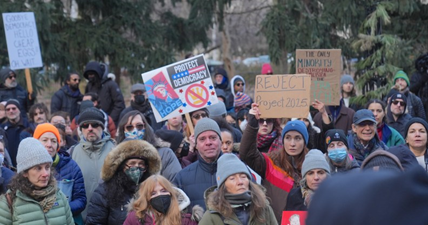
Wednesday, February 26, 2025

The Need to Find New Ways to Resist Oligarchy and Reaction in 2025

 Harry Targ


Gandhi once wrote, “Even the most powerful cannot rule without the cooperation of the ruled.” A Trump tyranny will not be able to continue without the support and acquiescence of those whose lives and future it is destroying. It will only be able to pursue its destructive course if they enable or acquiesce in it. A movement can overcome the most powerful regime if it can withdraw that cooperation.
https://pdacnm.org/2025/02/08/defending-society-against-maga-tyranny/

https://strikecommentaries.substack.com/p/what-really-happened-in-the-first?utm_source=post-email-title&publication_id=1095730&post_id=158416089&utm_campaign=email-post-title&isFreemail=true&r=103rn&triedRedirect=true&utm_medium=email


So as we begin the latest phase of educating, agitating, and organizing the multitudes we might reflect on the patterns of resistance that have been used in the past and may still be useful today. Jeremy Brecher has recently published a lengthy discussion of forms of “social self-defense” which give direction to how progressives, the multitudes, might resist the onslaught of President Trump/Musk’s new policies and parallel policies imposed on people at the state and local levels.

In addition, peace traditions as well as the labor left have engaged in patterns of resistance at various points in history. Gene Sharp’s 198 forms of non-violent resistance provide a useful checklist which may have applicability to today’s struggles.https://commonslibrary.org/198-methods-of-nonviolent-action/

Moving Ahead in 2025 the Following Questions Remain

1.How do we organize locally and statewide, particularly in “red states”

2.How do we develop in our literature and public agenda the view that what we are struggling against is a forty-year program of austerity, redistributing the wealth and power from the many to the few. And how can we effectively show that our local struggles parallel those in other states and countries.

 3.How can we effectively link our theoretical understanding of history, much like Rev. Barber’s provocative discussion of the three reconstructions, to the concrete campaigns we are engaged in

4.How can we take the general worldview and discuss:

   -the threat to voting rights

   -racist police practices

   -the transformation of a 150-year tradition of public education into for-profit charter schools

    -the deregulation of environmental controls at the very same time that fires, floods, draughts are increasing

    -the rationing of health care and the rising cost of medication

    -the use of state enticements to bring investors who create low wage jobs that worsen income inequality

    -the use of government to destroy the right of workers to form unions of their choosing and to honor the work of those unions to defend worker rights

    -the support for war and violence everywhere and the danger of nuclear war

Below are the substantive strategic issues that we face, now with a brutal new billionaire racist oligarchy.

 -the proportion of work devoted to inside and outside strategies

 -the relative weight and autonomy to be given to national, state and community organizations

 -the connections between socialist, labor, environmentalist, peace, anti-racist, feminist, educational and other organizations

 - the relationships we need to create between varying decision-making bodies, local organizations and issue committees  

 - finally thinking tactically such as relating to Gene Sharp’s 198 forms of non-violent activity.

https://www.brandeis.edu/peace-conflict/pdfs/198-methods-non-violent-action.pdf

Conclusion

The world is in turmoil. Protests across the globe have some common origins, causes, and solutions. While communities have their own problems, they are not too different from those elsewhere. The ongoing work must involve addressing specific issues while being cognizant of the general, building coalitions of shared responsibility and respect, organizing people power from the streets to the centers of power, and reconstructing institutions that serve, not oppress the people.


Friday, February 21, 2025

DRONES, BANKS, AND MULTITUDES: 2025 IS TIME TO RESIST

 Harry Targ


                                           Code Pink image

In this age of tweets, sound bites, and short-hand references to broad and complicated swaths of history, what political scientist Murray Edelman called “symbolic” politics, becomes “real” politics. Three symbols represent politics today; “drones,” “banks,” and “multitudes.”

Drones refer metaphorically to state-directed murder, often using the latest technology to target and assassinate those who have been defined by officials as the enemy or as threats to society, or just plain criminals. Based on recommendations by key decision-makers, civilian, military, and police, the U.S. has increasingly relied on new high-tech instruments of murder. Drones, smart bombs, and chemicals are used to kill, maim, and disable people abroad and at home with little or no threat to the safety of the personnel pushing the buttons, dropping the bombs, or spraying the victims. These newer forms of murder continue to be paralleled by a variety of police beatings and shootings and executions sanctified by governments attributing crime to the poor and people of color. And, of course, drones serve  metaphorically to represent states, particularly the United States, supporting wars everywhere. Therefore, the 21st century nation-state, to paraphrase sociologist Max Weber’s original definition, is the organization that holds the monopoly of the “legitimate” implementation of murder at home and globally.

Banks are real but as symbols refer to a capitalist economic system which organizes workers to generate wealth which is increasingly appropriated by the few. The industrial revolution of the nineteenth century saw huge manufacturing corporations mobilizing working classes and stealing the wealth that they produced. When rates of profit began to decline the corporate elites collaborated with the heads of banks, institutions which at one time served as the accountants and vaults for accumulated profits. Great mergers of manufacturing and banking capital in the early twentieth century and more so since the 1970s contributed to a new kind of capitalist economy based on finance. Most transactions now are speculative: buying and selling stocks and bonds, the creation of hedge funds, and real estate and insurance investments. Banks and investment houses are global. (Now we see the emergence of a sector of capital that generates profit from new computerized technologies.) They produce enormous profit without creating useful products for people to use or consume. And, the banking metaphor represents a vision of an economic system that has become grotesquely unequal.

The third metaphor, the multitudes (borrowed from abstract formulations by Italian theorist Antonio Negri) refers to the rising up of masses of people-- the traditional working class, the unemployed, youth without hope, youth with vision, women long oppressed, people of all races, and people who clean streets or live on them, serve coffee at Starbucks, and even write software programs for big corporations. The multitudes, Negri suggests, represent the underside of a new global order, an economic empire that traverses the earth bursting out of its national and sovereign boundaries.

Drones and banks represent both the coercive and the manipulative power of capitalism. Americans see examples of each on television or computer screens every day; killings, police violence, masses of homeless, and, in addition, the advertisement of an array of enticing products to purchase while rates of poverty and inequality of income and wealth rise.

What is also becoming a regular feature of our electronic experience is resistance, anger, and collective mobilization. This is occurring across the globe--Arab spring; student protest in Santiago, Chile; angry Israeli citizens; workers in Athens, Greece; students and public workers in Madison, Wisconsin, Columbus, Ohio, and Indianapolis, Indiana, the rise of Black Lives Matter, and more recently protest of US support of Israeli genocidal policies and brutal attacks on immigrants. And since the assumption of office of the new president of the United States large protests have occurred in all fifty states including those very recently against the firing of masses of public employees.

It is unclear what will come of all of this except that the contradictions between drones and banks versus the multitudes is becoming more clear and the transformation of society that is so desperately needed just might occur as a result.

Social Movement History 

Social movement activism has spread like wildfire across the entire globe over the last two decades. One group of scholars studied “protest incidents” in over 80 countries from 2006-2013. They found 840 protests in these countries with at least half motivated by demands for economic changes and democratization. A centerpiece of movements from Greece to Chile, to Spain, to Canada to the United States has been outrage against neoliberal policies (sometimes referred to as “austerity” policies).

Fundamentally these policies involved shifting wealth from the vast majority to the tiny minority. In the United States, the Occupy Movement introduced an accurate metaphor for this transformation: the one percent versus the 99 percent. Moral Mondays movements and more recently New Poor Peoples campaigns in over a dozen states in the South and Midwest emerged as one large-scale protest against the imposition of austerity and the weakening of democratic institutions.

Since October 2023 protests against Israel’s genocidal violence against the Palestinian people, mobilizations against NATO and the war in Ukraine, and protest against US sanctions against over 30 countries around the world have added a global character to recent mobilizations of multitudes. And some of this activism has helped to stimulate organizing efforts of much of the world’s population in institutions of the Global South. In addition, mobilizations in the Global South have inspired protests in the United States.

David Harvey, a political theorist, has posited a “co-revolutionary theory” about social movements. He argues that because there are so many problems in so many different locations in society political activism can and must start anywhere. If one is at a university or elsewhere in the education system struggles over “mental constructs’ matter. If persons are engaged in or near the electoral arena targeting politicians must be done. Work in the corporate sector, the media, government institutions are all sites for the application of political pressure and organizing. What needs to be remembered however is that all the separate struggles are interconnected and that activists need to understand how each struggle relates to every other struggle. Also, victory in one place and time does not mean that the goals of struggle have been achieved. In the end, Harvey argues that the interconnected crises relating to class, race, gender, homophobia, war and peace, and the environment are intimately connected to the capitalist system.

Further, activists debate the utility of political engagement around elections and legislation compared to mass movement activity. Some progressives have proposed as a solution to this dilemma, developing an “inside/outside” strategy. The inside/outside strategy argues for pursuing electoral work, electing candidates who might act on the people’s behalf, and lobbying to secure legislative victories, even if such efforts cannot solve the panoply of economic, environmental, war, racial and other problems that are faced. Electoral and legislative work, however, needs to be supplemented by “street heat;” building a mass movement that can be mobilized to publicly demonstrate its outrage and its demands for change. The outside strategy might include creating a large, disciplined organization with resources that can respond to and lead the mass movement of people for change. It is through the outside strategy that politicians can be forced to carry out the will of the people.

Rev. William Barber ten years ago through his “fusion politics” approach incorporated all of the above thinking. Fusion politics, he said, emphasizes the need for progressive groups to work together in coalitions, in partnerships, in common organizational fronts to bring the energy of all groups together. Ruling classes or power elites do not respond to change unless masses of organizations and people come together to make demands. 

The 99 percent do not have the material resources- the money, ownership of media outlets, influence over education and police power-to bring about change. All they have potentially are their numbers. And the fusion politics model is about mobilizing masses of people, developing effective and democratic organizations, and applying people power all across the political and economic map.


Global Resistance in the 21st Century


Resistance generates more attempts at economic hegemony, political subversion, the application of military power, and patterns of “humanitarian interventionism” and diplomatic techniques, called “soft power,” to defuse it. But as recent events suggest resistance of various kinds is spreading throughout global society.  

The impetus for adding resistance to any understanding of imperialism has many sources including Howard Zinn’s seminal history of popular movements in the United States, “The People’s History of the United States.” Zinn argued convincingly that in each period of American history ruling classes were challenged, shaped, weakened, and in a few cases defeated because of movements of indigenous people, workers, women, people of color, middle class progressives and others who stood up to challenge the status quo.

More recently, Vijay Prashad, author of “The Darker Nations,” compiled a narrative of post-World War II international relations that privileged the resistance from the Global South. World history was as much shaped by anti-colonial movements, the construction of the non-aligned movement, conferences and programs supporting liberation struggles and women’s rights, as it was by big power contestation. The Prashad book was subtitled “A People’s History of the Third World.”

The 21st century has witnessed a variety of forms of resistance to global hegemony and the perpetuation of neo-liberal globalization across the face of the globe. First, various forms of systemic resistance have emerged. These often emphasize the reconfiguration of nation-states and their relationships that have long been ignored. The two largest economies in the world, China and India, have experienced economic growth rates well more than the industrial capitalist countries. China has developed a global export and investment program in Latin America and Africa that exceeds that of the United States and Europe.

In addition, the rising economic powers have begun a process of global institution building to rework the international economic institutions and rules of decision-making on the world stage. On March 26-27, 2013, the BRICS met in Durban, South Africa. While critical of BRICS shortcomings Patrick Bond, Senior Professor of Development Studies and Director of the University of KwaZulu-Natal Centre for Civil Society, in a collection of readings on the subject introduces BRICS with an emphasis on its potential:

In Durban, five heads of state meet to assure the rest of Africa that their countries’ corporations are better investors in infrastructure, mining, oil and agriculture than the traditional European and US multinationals. The Brazil-Russia-India-China-SA summit also includes 16 heads of state from Africa, including notorious tyrants. A new ‘BRICS bank’ will probably be launched. There will be more talk about monetary alternatives to the US dollar.

On the Latin American continent, most residents of the region mourned the death of Hugo Chavez, the leader of the Bolivarian Revolution. Under Chavez’s leadership, inspiration, and support from oil revenues, Venezuela launched the latest round of state resistance to the colossus of the north, the United States. 

The Bolivarian Revolution also stimulated political change based on various degrees of grassroots democratization, the construction of workers’ cooperatives, and a shift from neo-liberal economic policy to economic populism. With a growing web of participants, Bolivia, Ecuador, Brazil, Uruguay, and Nicaragua, and, of course, Cuba, the tragic loss of Chavez did not mean the end to the Bolivarian Revolution.  

But the story of 21st century resistance is not just about countries, alliances, new economic institutions that mimic the old. Grassroots social movements have been spreading like wildfire  across the face of the globe. The story can begin in many places and at various times: the new social movements of the 1980s; the Zapatistas of the 1990s; the anti-globalization/anti-IMF campaigns going back to the 1960s and continuing off and on until the new century; or repeated mass mobilizations against a Free Trade Agreement for the Americas.

Since 2011, the world has been inspired by Arab Spring, workers’ mobilizations all across the industrial heartland of the United States, student strikes in Quebec, the state of California, and in Santiago, Chile. Beginning in 2001 mass organizations from around the world began to assemble in Porto Alegre, Brazil billing their meeting of some 10,000 strong, the World Social Forum. They did not wish to create a common political program. They sought to launch a global social movement where ideas are shared, issues and demands from the base of societies could be raised, and in general the neo-liberal global agenda reinforced at the World Economic Forum in Switzerland could be challenged. 

The Need to Find New Ways to Resist Oligarchy and Reaction in 2025


Gandhi once wrote, “Even the most powerful cannot rule without the cooperation of the ruled.” A Trump tyranny will not be able to continue without the support and acquiescence of those whose lives and future it is destroying. It will only be able to pursue its destructive course if they enable or acquiesce in it. A movement can overcome the most powerful regime if it can withdraw that cooperation.

https://pdacnm.org/2025/02/08/defending-society-against-maga-tyranny/

So as we begin the latest phase of educating, agitating, and organizing the multitudes we might reflect on the patterns of resistance that have been used in the past and may still be useful today. Jeremy Brecher, has recently published a lengthy discussion of forms of “social self-defense” which give direction of how progressives, the multitudes, might resist the onslaught of President Trump/Musks’s new policies and parallel policies imposed on people at the state and local levels.

In addition, peace traditions as well as the labor left have engaged in patterns of resistance at various points in history. Gene Sharp’s 198 forms of non-violent resistance provide a useful checklist which may have applicability to today’s struggles.

https://commonslibrary.org/198-methods-of-nonviolent-action/

Moving Ahead in 2025 the Following Questions Remain

1.How do we organize locally and statewide, particularly in “red states”

2.How do we develop in our literature and public agenda the view that what we are struggling against a forty-year program of austerity, redistributing the wealth and power from the many to the few. And how can we effectively show that our local struggles parallel those in other states and countries.

 3.How can we effectively link our theoretical understanding of history, much like Rev. Barber’s provocative discussion of the three reconstructions, to the concrete campaigns we are engaged in

4.How can we take the general worldview and discuss:

   -the threat to voting rights

   -racist police practices

   -the transformation of a 150-year tradition of public education  into for-profit charter schools

    -the deregulation of environmental controls at the very same time that fires, floods, draughts are increasing

    -the rationing of health care and the rising cost of medication

    -the use of state enticements to bring investors who create low wage jobs that worsen income inequality

    -the use of government to destroy the right of workers to form unions of their choosing and to honor the work of those unions to defend worker rights

    -the support for war and violence everywhere and the danger of nuclear war

These are the substantive issues that we face, now with a brutal new billionaire racist oligarchy.

 -the proportion of work devoted to inside and outside strategies

 -the relative weight and autonomy to be given to national, state and community organizations

 -the connections between socialist, labor, environmentalist, peace, anti-racist, feminist, educational and other organizations

 - the relationship between the varying decision-making bodies, local organizations and issue committees  

 - finally thinking tactically such as relating to Gene Sharp’s 198 forms of non-violent activity.

https://www.brandeis.edu/peace-conflict/pdfs/198-methods-non-violent-action.pdf

Conclusion

The world is in turmoil. Protests across the globe have some common origins, causes, and solutions. While communities have their own problems, they are not too different from those elsewhere. The ongoing work must involve addressing the particular while being cognizant of the general, building coalitions of shared responsibility and respect, organizing people power from the centers of power to the streets, and reconstructing institutions that serve, not oppress the people.

Sunday, February 16, 2025

 Posted in Cuba News February 15, 2025

CCDS: The Middle East Wars and United States Imperialism


A black background with a black square

Description automatically generated with medium confidence

TEYWPBJELVME7I6XHYLDS5D2OU image

The Committees of Correspondence For Democracy And Socialism (CCDS):

The Middle East Wars and United States Imperialism

By the CCDS Peace & Solidarity Committee

Feb 10, 2025 


We in CCDS believe there can be no moral, ethical, or ideological justification to excuse the brutality and modern-day barbarity of US supported Israeli actions in Gaza since October 2023. 

Palestine is first and foremost a settler occupied land where Zionists, assisted by western colonial and imperial powers, imposed a colonial set of social relations on its majority Arab Muslim peoples. This majority prevailed from the 7th century to the mid-20th century. Then, prior to the state of Israel being declared the Nakba began, that is, clearing the land of Arab Palestinians. 

In the 1890s A World Zionist Organization was formed with the overt intent of creating a Jewish homeland in the Palestine region along the lines of a Jewish nation state. But why Palestine, and not any other place? A long Jewish historical association with the land of Palestine, and a firmly established religious and social strife involving Christianity would provide the emotional bonds and a powerful symbol to anchor a Zionist political ideology with global reach and appeal. 

The UK, which held the mandate to govern Palestine, gave the green light to the Zionist project through the Balfour Declaration. In 1947, in the face of years of terrorizing violence directed at Muslims by Zionist settlers, and an alarmingly increasing resettlement of Jews in Palestine, the United Nations recommended the partition of Palestine into two states. At that time, only 1/3 of the land’s inhabitants were of Jewish background.

On May 14, 1948, David Ben-Gurion, the Executive Head of the World Zionist Organization and the chairman of the Jewish Agency in Palestine, declared the establishment of a new state of Israel. Palestinians and Arab neighbors viewed this as an occupation of the residents’ historic land. And the first Middle East war between the new Israel supported by the UK and the US, and Arab states ensued. 

During, and under the cover of this war, the Zionists intensified the Nakba which has taken various forms over the decades. Hundreds of thousands of Palestinians were displaced from their homes, villages, towns, and country to bring us to a Jewish majority on the ground today.

Subsequent wars followed in 1956, 1967, 1973, 1982, and intermittently from the 1980s to today’s brutal, genocidal war on the Palestinian people in Gaza and the West Bank. These wars supported by the West emboldened Israel to extend its territory both within and beyond its borders. Israel occupied the West Bank, Gaza, the Old City of Jerusalem, the Sinai Peninsula, and the Golan Heights. Through settler and state sanctioned violence Palestinians were terrorized and cleared off their lands; villages and towns replaced by new Jewish settlements and the territory of Israel expanded. 

These wars, then and now, have been waged by Israelis, with unconditional Western support, against Palestinians and neighboring Arab states. The deeply embedded issues fueling this inimical void are two-fold:

Internally: the legitimacy of the state of Israel; the dehumanizing apartheid and racist policies towards Palestinians; the control and weaponizing of energy, water, airspace, and movement to impose a pervasive repressive regime over Palestinian lives; the transformation of the lived reality of the Palestinians into a veritable open-air prison; a draconian military justice system curtailing civilian life; and an on-going unrestrained settler violence as a prelude to settlement expansion and ultimately the removal of the Palestinian people. 

Externally: Palestine is centered in a web of geopolitical interests. Control of the region's oil economy is vital for Western corporate and cartel capitalism’s global economic hegemony. So is Palestine’s geopolitical location along a historical bridge connecting Western Europe and North Africa to Asia. Israel also features prominently in the US led capitalist empire’s quest for control of the territory and its resources from the Red Sea to the Adriatic Sea and control of the Mediterranean Sea. For these Western interests, Israel is the vital outpost to ensure geopolitical control. It performs the role of destabilizer and attack force.

Various organizations like the Palestine Liberation Organization, Hamas, and Hezbollah emerged to challenge and resist the Israeli state and its land expansion over the last fifty years. The United States, Britain, France, the former Soviet Union, and neighboring Arab states have all played significant roles in the development of this conflict. 

Emerging from World War II as the most powerful economic and military power on the globe, the United States cultivated a special relation of support for Israel that refuses to falter even in the face of starkly evident genocidal actions against humanity. Israel has the most powerful military in the region suited up with the latest in military technology and weapons from the US; is a nuclear power and boasts a powerful global intelligence network. The United States, through finance; technology and intelligence sharing; military support; and its veto privileges in international institutions, has aided and abetted every aspect of this abominable state.

In the very period of Israel’s genocide, between October 2023 and October 2024, the US provided Israel with $17.9 billion, and devastating bombs that make a mockery of nuclear scares. The US provides Israel with enough military material to defend itself from any other country’s intervention. And today, the US president openly advocates for the total disappearance of Palestinians in Palestine to be replaced by others from or favored by the US. We therefore hold the United States equally culpable for all of Israel’s crimes against humanity. The United States is also deeply enmeshed in the expansionist drama unfolding in Syria. Even further it is involved in imperialist regime change and secession programs in many parts of the world.  

Today, pro-Israel lobby groups in the United States support continued military and economic aid to Israel. Israel, with United States support, opposes serious negotiations with the legitimate Palestinian Authority in the West Bank and Hamas in Gaza. That the countries of the world, for multiple and strategic reasons, have not been able to militarily intercede in this genocide in Gaza may result in a hardening of Israeli opposition to any serious negotiation in the aftermath of signing a temporary cease-fire. Israel and the pro-Israeli United States appear untroubled by the global tide of criticism from the real international community and its demand for a just peace.

We in CCDS believe there can be no moral, ethical, ideological, or other justification to excuse the brutality and modern day barbarity of US supported Israeli actions in Gaza since October 2023. This is first, a crime against Palestinians; then it is a crime against all of humanity - a crime against all of us. We condemn the actions of the US for its complicity and partnership in Israel’s genocidal actions. 

We call on our fellow US citizens and residents, institutions, and political organizations to stand firm against the genocidal and expansionist actions in Palestine and beyond. 

We demand in the name of peace, justice, democracy, and freedom for all the world’s peoples, 

·    an end to Israeli support 

·    an end to legislative endeavors to curtail just criticism of Israeli actions

·    an end to imperial designs 

·    an end to regime change

·    an end to our military presence around the world

·    an end to hybrid wars

·    an end to support for terrorists and assassins 

Let us stand for a just and shared future for all in the world. 


Saturday, February 15, 2025

Why Migration

Harry Targ


(“The vice president’s speech in Munich, expressing support for far-right, anti-immigration parties and criticizing suppression of conservative voices, was a global extension of his core political themes.”  Mchael C. Bender, Vance Shocks Europe With a Message That He Has Long Promoted at Home” New York Times, February 14, 2025)

People migrate from one place to another for a variety of reasons. A good part of that migration has to do with international relations, national economies, and the increasingly globalized economy. Literally millions of people have moved from one geographic space to another in the twenty-first century, in most cases for reasons of physical fear or economic need. Two prominent causes that “push” people to leave their communities and homeland relate to “hybrid wars” and neoliberal globalization.

Hybrid wars refer to the long-term policies of imperial powers to systematically undermine political regimes that pursue policies and goals that challenge their global hegemony. Over long periods of time imperial powers have used force, covert operations, supporting pliant local elites, and funneling money to disrupt local political processes. If targeted countries still reject outside interference the imperial power uses force to overthrow recalcitrant governments. In the 1980s all these tactics were used by the United States to crush revolutionary ferment in Central America. Of course, the US hybrid war strategy has been a staple of United States policy in the region ever since President Franklin Roosevelt declared the policy of “The Good Neighbor.”

Neoliberalism  refers to the variety of policies that rich capitalist countries and international institutions such as the International Monetary Fund, the World Bank, and the World Trade Organization have imposed on debt-ridden poor countries. These policies require poor countries to cut back on public services, deregulate their economies, reduce tariffs that protect their own industries and agriculture, and in other ways insist that poor countries open their economies to foreign investment and trade penetration. The impacts of neoliberalism have been to impose austerity on largely marginalized populations. Their agriculture and industries have been undermined by subsidized agribusinesses from the Global North and global investors. Since the initiation of neoliberal policies in the 1970s gaps between rich and poor nations and rich and poor people within nations have grown all across the world, with a few exceptions such as China.

In sum, people everywhere have experienced the creation of repressive regimes and economic policies that have shifted vast majorities from modest survival to deep poverty. (Susan Jonas once wrote that the Guatemalan people lived more secure lives before the arrival of Spanish colonizers in the fifteenth century than ever since). The globalization of the economy, increased violence and repression within countries (largely involving United States interference), increasing income and wealth inequality and poverty, and the rise of repressive regimes everywhere, has led to massive emigration. Some estimates indicate that 37 million people left their home countries (some 45 countries) between 2010 and 2015 for humanitarian reasons.

One of the ironies of world history is that capital in the form of investments, trade, the purchase of natural resources, the globalization of production, and military interventions have been common and necessary features of capitalism since its emergence in the sixteenth century. But, paradoxically, and except for the global slave trade and selected periods of history, the movement of people has been illegal. (Sometimes branding migrants as “illegal” has been a device to cheapen their labor). The idea of national sovereignty has been used to justify categorizing some human migrants as “illegal.” If capital is and has been legal, the movement of people should be legal as well. It makes no sense, nor is it humane, to brand any human beings as “illegal.”

In sum, the expression of fear, outrage, and lack of sensitivity for those who have been forced to migrate by Vice President Vance reflects a cruelty and lack of humanity that is central to United States foreign and domestic politics. And he, and his administration, are becoming allied with those Europeans who share his ideology.

Wednesday, February 12, 2025

REMEMBERING “STAR WARS” OR “THE STRATEGIC DEFENSE INITIATIVE”

 Some Fantasies Never Die, particularly if they are profitable.

Harry Targ

(Alan MacLeod / MintPress News Donald Trump has announced his intention to build a gigantic anti-ballistic missile system to counter Chinese and Russian nuclear weapons, and he is recruiting Elon Musk to help him. The Pentagon has long dreamed of constructing an American “Iron dome.” https://scheerpost.com/2025/02/11/the-pentagon-is-recruiting-elon-musk-to-help-them-win-a-nuclear-war/)

In the 1980s, President Ronald Reagan was instituting a military budget that in total was greater than all US military expenditures from the founding of the nation until the 1980s. Military doctrine, in accordance with the huge increase in military spending, shifted from maintaining a capability to deter aggression from other nations, particularly the former Soviet Union, to the development of a first strike capability, that is to be able to strike an enemy first. This shift in policy was coupled with the president claiming that the former Soviet Union constituted an “evil empire,” one that had to be pushed back, weakened, and destroyed.


As part of the reinstitution of a New Cold War with the Soviet Union, after a decade of détente, Reagan announced in a dramatic speech the development of the new Strategic Defense Initiative (SDI), which became known as the “Star Wars” program. The president claimed that the United States could develop a space-based defensive shield that could protect North America from any attack from a foreign power.

SDI became a boondoggle for the military/industrial complex. Especially universities saw the project as a source of significant increases in revenue. However, large sectors of the scientific community declared that Star Wars was wasteful and technologically impossible to achieve. (Many Purdue University professors signed a petition promising not to accept any Star Wars funding).

Along with its lack of feasibility, most strategic analysts questioned the President’s claim that SDI was merely a defensive weapon. They argued, in the context of Reagan’s hostile rhetoric about the Soviet Union and the claim that the US could achieve physical protection from attack, that the Soviets would perceive SDI as an offensive weapon. They might conclude that the United States was developing a defensive shield so that it might choose to launch a first-strike against the Soviet Union.

The military doctrine of “deterrence,” dominating military thinking on both sides of the Cold War for years was that neither power could afford to launch a first-strike attack on the other because the second-strike response would be so devastating that functioning societies in both countries would be destroyed. Former Secretary of Defense Robert McNamara aptly labeled this doctrine Mutually Assured Destruction (or MAD). In short, with SDI, an enemy of the US could believe that they might be attacked at any time. Consequently “Star Wars” was profoundly destabilizing, increasing the possibility of nuclear war.

Twenty-six years later, President Trump declared that the United States henceforth would recognize that space should be the site for military preparedness to defend national security. To achieve this goal the US Space Force would lead the way (Gregory Niguidula, “Trump’s Space Force is a Strategic Mistake,” Bulletin of the Atomic Scientists, January 21, 2019). In the National Defense authorization Act of 2020, Congress approved the idea of establishing a new sixth branch of the military, the United States Space Force.

Meanwhile, the United States in 2025 continues to have over 800 military bases of various sizes around the world and military programs with almost 40 countries, sometimes including private military contractors. The United States also pursues what VJ Prashad calls “hybrid wars,” economic sanctions, covert operations, and ideological campaigns against so-called “authoritarian” states.

Perhaps most threatening from the standpoint of increasing the probability of war is a dramatic increase in verbal hostilities toward China. The rhetoric has been coupled with warnings from influential think tanks that the United States, “the world’s leading democracy,” was falling behind Chinese in influence, power, economic capabilities, and mostly technological advances. In addition, the Obama Administration declared that the United States was pivoting its security concerns to Asia. Trump and Biden have moved US ships to the South China Sea, sought an alliance with Asian nations against China, and recently President Biden signed a naval agreement with Australia.

Observers of the international scene regard these developments in US/China relations, over the last three administrations as profoundly destabilizing, perhaps a “New Cold War.” Of course, the most horrific possibility is escalation from conventional to nuclear war. Therefore, it is in this context that the creation of a sixth branch of the military, the United States Space Force, and its growing penetration of major domestic institutions, including universities, is troubling.

This new branch of the military, seeking legitimacy and the expansion of its own power and resources, is embedding itself in what could be called the military/industrial/academic complex. And, from the standpoint of universities, which are experiencing declining financial resources, new space-oriented research constitutes a vital source of revenue paralleling that provided by the dubious Star Wars program of the 1980s.

So from “Star Wars” to the “Iron Dome” profits soar and the danger of nuclear war increases.


From "Dr Strangelove, or: How I Learned to Stop Worrying and Love the Bomb" a movie 1984 film      

      https://www.youtube.com/watch?v=LNC0YwuGLqg
     

        General Turgidson:

Mr. President, we are rapidly approaching a moment of truth both for ourselves as human beings and for the life of our nation. Now, the truth is not always a pleasant thing, but it is necessary now make a choice, to choose between two admittedly regrettable, but nevertheless, distinguishable post-war environments: one where you got twenty million people killed, and the other where you got a hundred and fifty million people killed.

President Muffley:

You're talking about mass murder, General, not war.

Turgidson:

Mr. President, I'm not saying we wouldn't get our hair mussed. But I do say... no more than ten to twenty million killed, tops. Uh... dependent on the breaks.

The Bookshelf

CHALLENGING LATE CAPITALISM by Harry R. Targ

Challenging Late Capitalism