Saturday, December 13, 2025

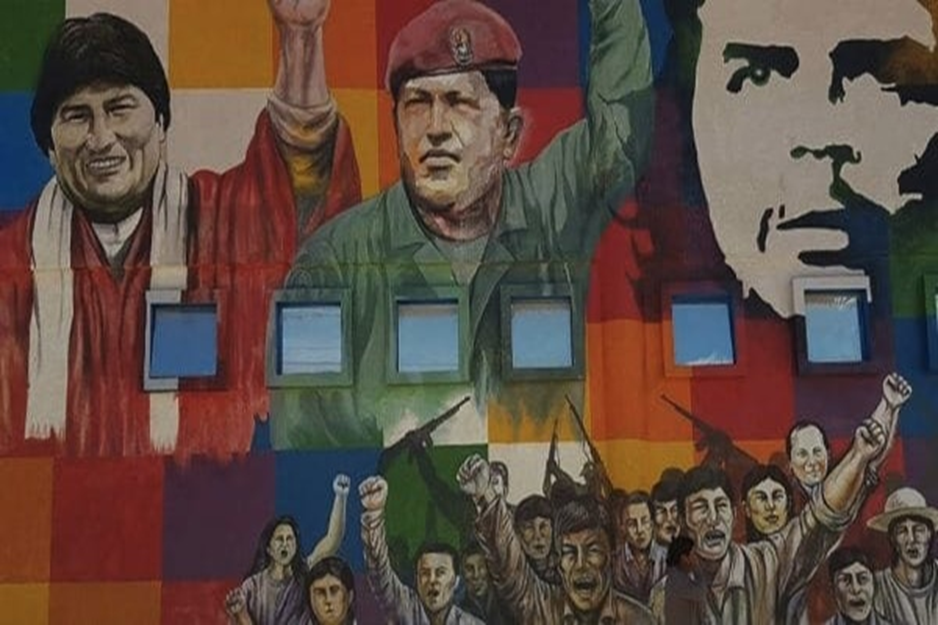
NO TO WAR ON VENEZUELA, CUBA, AND THE BOLIVARIAN REVOLUTION

 Harry Targ


 At least 87 Venezuelans have been murdered by the US military in recent air strikes on boats in the Caribbean and Eastern Pacific. More recently the US captured a Venezuelan tanker carrying oil to overseas customers. President Trump has threatened direct military attacks on Venezuela and added similar verbal threats against Colombia. No commentator outside the administration believes the lies that the boats had anything to do with drug trafficking. Many liken the claim to President George Walker Bush’s claim that Iraq had weapons of mass destruction. The real reason for the US aggression has been articulated in the recently released National Security Strategy document

The "Trump Corollary" Articulated in the Newly Released National Security Strategy (November 2025)

"We want to ensure that the Western Hemisphere remains reasonably stable and well-governed enough to prevent and discourage mass migration to the United States; we want a Hemisphere whose governments cooperate with us against narco-terrorists, cartels, and other transnational criminal organizations; we want a Hemisphere that remains free of hostile foreign incursion or ownership of key assets, and that supports critical supply chains; and we want to ensure our continued access to key strategic locations. In other words, we will assert and enforce a “Trump Corollary” to the Monroe Doctrine;" 

https://www.whitehouse.gov/wp-content/uploads/2025/12/2025-National-Security-Strategy.pdf

Congress has mandated that each new administration articulate its foreign policy views and priorities for the years ahead. The document referred to above illuminates and describes the visions and policies of the Trump Administration. The document articulates an "American First" foreign policy of military projection and the reassertion of US hegemony in the Western Hemisphere. 

As to the Western Hemisphere the document says:

-"We must look to expand our network in the region"

-The National Security Council will "immediately begin a robust interagency process to task agencies...to identify strategic points and resources..."

-"Non-Hemispheric competitors have made major inroads in our Hemisphere..."

-Prior administrations have allowed the imposition of outside influence to happen: "another great American strategic mistake of recent decades."

-To rollback outside influence in the Hemisphere as to "espionage, cybersecurity, debt-traps, and other ways" the U.S. should "leverage in finance and technology to induce countries to reject such assistance."

-In Latin America and around the world the US "should make clear that American goods, services, and technologies are a far better buy in the long run...requiring closer collaboration between the U.S. Government and the American private sector."

The Bolivarian Revolution

The Bolivarian Revolution, initiated by former Venezuelan President Hugo Chavez in the 1990s, stimulated political change throughout Latin American based on varying degrees of grassroots democratization, the construction of workers’ cooperatives, and a shift from neoliberal economic policies to economic populism. And now the Trump administration is committed to:

-destroying the Bolivarian Revolution

-Crushing movements of Latin American countries who seek solidarity with the countries of the Global South

-Opposing Latin American countries that seek to increase their commercial relations with China

-Reasserting white supremacy and American Exceptionalism, the spirit of the US policy in the Western Hemisphere articulated by James Monroe, Theodore Roosevelt, and Donald Trump


Thursday, December 11, 2025

Educational Institutions and Ideological Hegemony: The Destruction of the University Today

A person standing next to a building with a jar of money

AI-generated content may be incorrect.

Harry Targ

It is obvious that the maintenance of any political or economic order is based on the education of the young in such a way as to give legitimacy to it. In the 1960s political scientists began to study what they called “political socialization:” how and what people learn about the norms, values, and procedures that govern the maintenance of society. Some studies found that children begin to accept the virtues of political institutions, the presidency, the courts, political parties, at very young ages. What they learn about politics in the home is reinforced and developed in school systems. Selective presentations of history and the arts is provided by formal content and repeated rituals, such as the pledge to the flag, competitive sports, routinized social life such as dances. 

In addition, as theorists such as Jim Berlin have argued, the educational system not only produces and reproduces citizenship, but it also reproduces workers, giving young people appropriate skills in language an mathematics. Educational theorists have pointed out that the character of education develops and changes as the economy changes, from competitive to industrial, to monopoly capitalism.

In addition to adding “socialization” to the lexicon of analysis political scientists began to write about “political culture,” or the values and beliefs that dominate the thinking of most members of a society. Political culture includes ideas about the basic units of society, individuals or communities for example, the relative importance in the society of cooperation or conflict, the role of “human nature” or the role of institutions as primary forces in shaping society.  Perhaps most basic in the United States is the relative acceptance of private property or public goods as prime values.

In higher education, curricula reinforce and solidify the dominant ideas of the political culture. It is seen as social science and humanities disciplines reify standard paradigms about history, what is great art and philosophy, and what values are beyond reproach. In the post-World War II period in the United States the dominant political culture was tinged with virulent anticommunism, the demonic other. Ruling classes, powerful corporations, and state institutions oversaw what was defined as legitimate educational content.

Meanwhile business schools and science and engineering programs were training young people to serve in and promote the dominant political economy. The humanities and social sciences grounded student learning in the acceptable political culture while the fields, what we call STEM, trained these same students in the tools of system maintenance. The former president of the University of California, Clark Kerr, coined the term “multiversity” to describe the functions of such institutions in the late twentieth century and he made it clear that the multiversity was supposed to serve the national security interests of the United States.

As Clark Kerr was leading the California university system young people became increasingly engaged in struggles against racism and escalating war in Vietnam. While some educational institutions became more repressive, as with the shootings of students at Jackson State and Kent State Universities, increased discourse on college campuses, sometimes initiated by faculty, was critical of the dominant political culture and its normal functioning, that is training workers for the economic machine. 

The university, to use a workplace metaphor, became “contested terrain.” Some faculty and students began to criticize the capitalist system, the war machine, the privatization of the commons, and histories that seemed to endorse patriarchy and racism. From the vantage point of those who rule, ideological hegemony had to be reimposed in the educational system. As conservative talk show host Rush Limbaugh once proclaimed, “we,’ that is conservatives, control all major institutions except for the university.

In the twenty-first century, efforts of the defenders of capitalism have sought to reimpose the traditional political culture by privatizing public schools. Not only are charter schools a profitable source of investment, but they by virtue of their existence and curriculum reify the idea of the market, private over public goods, and opposition to teachers as workers and teacher unions, and the elimination of the tradition of public education entirely.

At the university level, traditional study of history and the arts (with all their ideological contestation) are being defunded while colleges and universities define science, technology, engineering, and mathematics (STEM) as the primary purpose for having education systems. And major funds for STEM education and research come from huge corporations, particularly digital, drug, and agricultural corporations, and the military. 

And in the spirit of Limbaugh, the Koch brothers, the Association of Trustees and Administrators (ACTA), the State Policy Network, and the Associated Legislative Executive Council (ALEC) have worked with state legislatures to recreate in the early post-World II days what Kerr spoke approvingly of the multiversity. In sum. education from kindergarten through the university is increasingly designed to instill the ideology of the dominant political culture and to create a twenty-first century work force to serve the needs of monopoly/finance/global capitalism.

The Indiana Example

Today we see a brutal assault and destruction of the diversity of scholarship and education at Indiana University by a MAGA governor and state legislature. While less visible the same efforts to destroy higher education are occurring at the other major Hoosier university, Purdue. The state legislature passed laws that require annual reviews of instructors to see that they include all perspectives in their teaching. Even tenured faculty, tenure a long-honored commitment to protect faculty from capricious attacks on their teaching and research, may be fired if they do not meet the criteria of “fairness and balance,” (which presumably would require faculty to present the pluses and minuses of Hitler’s Germany or the Spanish Inquisition). Legislation also requires these institutions to take complaints from students concerning their professors on any number of things, often without providing proof or identifying themselves by name.

In addition, Indiana University which has been known for its multiplicity of language programs must shut them down if they do not have a sufficient number of majors. About 40 such language programs have been eliminated. Both universities have been encouraged to eliminate humanities programs, interdisciplinary programs, and programs that address diversity, equity, and identities. 

https://www.ipm.org/news/2025-09-12/funding-cut-for-iu-programs-that-do-not-advance-american-interests-or-values

The universities have shifted their resources to artificial intelligence and collaboration with the military and large pharmaceutical companies. And generally, both universities are prioritizing so-called STEM education. Legislators and university administrators claim that the only salient measure of university success is whether college graduates get jobs. (ironically some data suggests that many STEM college graduates are not finding jobs and employers in the corporate sector are mostly interested in hiring graduates who write well, have analytical skills, and have a sensibility about the world outside the workplace).

All of these changes are occurring at the same time that both universities have acted in various way to repress dissenting voices and acts that oppose these changing educational  policies and  policies of the national and state governments on race, gender, and support for US wars. At IU, for example, police with weapons were called on campus in response to protests of US support for Israel’s genocide against Palestinians.

In sum, the state government, college administrators, and the federal government are seeking to roll back higher education to it historic role of training young people to serve the society as is and to socialize them to accept the legitimacy of government policies and US institutions.(Perhaps the most egregious of these policies is to reduce or eliminate course work and research that address the undersides of US history such as the experiences of slavery and war).

Friday, December 5, 2025

NOW THE TRUMP COROLLARY TO THE MONROE DOCTRINE

 Harry Targ


Within a few years of the U.S. colonization of Cuba and the Philippines, President Theodore Roosevelt elaborated on the U.S. world mission. He spoke of the necessity of promoting peace and justice in the world: a project that required adequate military capabilities both for “securing respect for itself and of doing good to others.” To those who claim that the United States seeks material advantage in its activist policy toward the countries of the Western Hemisphere, Roosevelt responded that such claims were untrue. The U.S., he said, is motivated by altruism: “All that this country desires is to see the neighboring countries stable, orderly, and prosperous. Any country whose people conduct themselves well can count upon our hearty friendship.”

Cuba was an example, he said: “If every country washed by the Caribbean Sea would show the progress in stable and just civilization which with the aid of the Platt Amendment Cuba has shown since our troops left the island, and which so many of the republics in both Americas are constantly and brilliantly showing, all questions of interference by the Nation with their affairs would be at an end.”

He assured Latin Americans in this address to Congress in 1904 that if “….if they thus obey the primary laws of civilized society they may rest assured that they will be treated by us in a spirit of cordial and helpful sympathy. We would interfere with them only in the last resort….” (“Roosevelt Corollary to the Monroe Doctrine,” President’s Annual Message to Congress, December 6, 1904). 

During a presentation in Norway in 1910 Roosevelt praised the U.S. for leaving Cuba as promised after the war to return only   temporarily because of “a disaster…a revolution” such that “we were obliged to land troops again.”

The President proudly declared: “And before I left the Presidency Cuba resumed its career as a separate republic, holding its head erect as a sovereign state among the other nations of the earth. All that our people want is just exactly what the Cuban people themselves want—that is, a continuance of order within the island, and peace and prosperity, so that there shall be no shadow of an excuse for any outside intervention.” (“the Colonial Policy of the United States,” An Address Delivered at Christiania, Norway, May 5, 1910).

Earlier on January 18, 1909, to the Methodist Episcopal Church (“The Expansion of the White Races”) Roosevelt applauded the increasing presence--he estimated 100 million people—of “European races” throughout the world. The indigenous peoples of the Western Hemisphere have been assimilated with their “intruders” with the end result “that the Indian population of America is larger today than it was when Columbus discovered the continent and stands on a far higher plane of happiness and efficiency.”

And to highlight the missionary message Roosevelt added: “Of course the best that can happen to any people that has not already a high civilization of its own is to assimilate and profit by American or European ideas, the ideas of civilization and Christianity, without submitting to alien control; but such control, in spite of all its defects, is in a very large number of cases the prerequisite condition to the moral and material advance of the peoples who dwell in the darker corners of the earth.” 

The "Trump Corollary" Articulated in the Newly Released National Security Strategy (November 2025)

"We want to ensure that the Western Hemisphere remains reasonably stable and well-governed enough to prevent and discourage mass migration to the United States; we want a Hemisphere whose governments cooperate with us against narco-terrorists, cartels, and other transnational criminal organizations; we want a Hemisphere that remains free of hostile foreign incursion or ownership of key assets, and that supports critical supply chains; and we want to ensure our continued access to key strategic locations. In other words, we will assert and enforce a “Trump Corollary” to the Monroe Doctrine;" 

https://www.whitehouse.gov/wp-content/uploads/2025/12/2025-National-Security-Strategy.pdf

And military pacts in the region:

https://www.theguardian.com/us-news/2025/dec/23/us-trump-administration-signs-security-deals-across-latin-america?fbclid=IwY2xjawO403xicmlkETFJR1IxQXUzNWN6dFRUTTF4c3J0YwZhcHBfaWQQMjIyMDM5MTc4ODIwMDg5MgABHmmZiorX8OY7qZGLR

Congress has mandated that each new administration articulate its foreign policy views and priorities for the years ahead. The document referred to above illuminates and describes the visions and policies of the Trump Administration. The document articulates the failures of the post-Cold War policies of prior administrations and articulates an "American First" foreign policy of military projection, insisting on allies to pay more for defense, solidifying global access to US military forces and commerce, and reasserting US hegemony in the Western Hemisphere. 

As to the Western Hemisphere the document says:

-"We must look to expand our network in the region"

-The National Security Council will "immediately begin a robust interagency process to task agencies...to identify strategic points and resources..."

-"Non-Hemispheric competitors have made major inroads in our Hemisphere..."

-Prior administrations have allowed the imposition of outside influence to happen: "another great American strategic mistake of recent decades."

-To rollback outside influence in the Hemisphere as to "espionage, cybersecurity, debt-traps, and other ways" the U.S. should "leverage in finance and technology to induce countries to reject such assistance."

-In Latin America and around the world the US "should make clear that American goods, services, and technologies are a far better buy in the long run...requiring closer collaboration between the U.S. Government and the American private sector."

And the document suggests that the "Trump Corollary" is not just about the Western Hemisphere but also foresees a worldwide struggle against Chinese influence particularly in the Indo-Pacific region. "the source of almost half the world's GDP based on purchasing power parity (PPP)." 

Recognizing the Chinese economic challenge the document asserts that what makes America different is "our openness, transparency, trustworthiness, commitment to freedom and innovation, and free market capitalism..." And while the struggle with China for a world presence is largely economic, "a favorable conventional military balance remains an essential component of strategic competition." 

The document includes discussions of the Middle East, Africa, and the revitalization of Europe. In his cover letter Trump boasts of the correctives that have occurred in United States foreign policy in the first nine months of his second term: "we have brought our nation-and the world- back from the brink of catastrophe and disaster...No administration in history has achieved so dramatic a turnaround in so short a time."

Conclusion

What the National Security Strategy document underscores is the intellectual background of what has been clearly observed about US foreign policy:

--a worldwide campaign to override any challenges to US economic and military hegemony.

--the maintenance and enhancement of a national security apparatus including a trillion-dollar military budget, a warfighting and interventionist capacity, a hybrid war campaign, murder on the high seas

--an ideological rationale that celebrates "free enterprise" capitalism, a mythology about American Democracy, the superiority of "the white race," the demonization of diversity, equity, and inclusion, and the likeminded demonization of "immigrants." 

--All the demons that have been articulated by Trump are enshrined in the idea and the practice of the Global South.

And finally, the theory and practice of the National Security Strategy document is an update of the theory and practice articulated by Theodore Roosevelt since the so-called Spanish-American War as US industrial capitalism and militarism became a global force.


Tuesday, December 2, 2025

PROCESSES OF CHANGE AND PATTERNS OF RESISTANCE

 Harry Targ

(In an extraordinary rebuke to Donald Trump on Thursday, the Indiana state Senate rejected a gerrymandered congressional map relentlessly pushed by the president and his allies that would have given Republicans a lopsided 9-0 advantage in the state’s House delegation by eliminating the seats of two Democratic members of Congress. The final vote was 31-19 in the state Senate, where Republicans have a supermajority: Twenty-one Republicans joined 10 Democrats to defeat the legislation.

Republican state senators who opposed the gerrymandered map sharply criticized the months-long pressure campaign by Trump and his allies, which led to threats of violence and intimidation against at least 11 state lawmakers.) 

https://www.motherjones.com/politics/2025/12/indiana-republican-redistricting-trump-bill-fails/


Change

Upon historical reflection we have seen many paths to social/political/ economic change. Some are great leaps, others incremental movements from one kind of political order to another. The Russian Revolution had its roots in multiple failed mobilizations and an outburst of protest in 1917 that led to a reformist, then a revolutionary government that step by step moved the society along. Not all the moves were wise, humane, or in keeping with original goals, but they were changes, nevertheless. For China, revolution entailed a long military struggle and the same case for Vietnam. Lastly, the Cuban case involved armed struggle, followed by policy implementations of various sorts.
A more modest set of changes over fifty years in the United States was initiated by a New Deal, followed by a Fair Deal, and a Great Society. These were halting and sometimes forestalled more fundamental changes. But I think it is fair to say that in each case the lives of majorities were positively impacted by the change. And whether it is revolutionary or reformist, we want people’s lives to be improved and pain and suffering reduced. Maybe that should be our standard for judging candidates, policies, institutions, and visions. Any all those that improve lives should be supported, only asking how can we do better?
Patterns of Resistance

Of course, ruling classes, oligarchs, generals, and others seek to resist change and reverse it if at all possible. Sometimes regimes emerge which seek to damage rather than improve lives. They seek to reverse progress because such reversal serves their own interests. They use corruption, lies, police forces, and armies to reverse what has already been achieved. Progressives must always be wary of those who will undermine human progress. And when the reactionaries gain power resistances are called for.
What we are seeing today in the United States and countries elsewhere, are sustained efforts to reverse human progress. But Patterns of Resistance to reversals of human progress must and do emerge to protect what has been gained and to stop the erosion of human progress. Patterns of Resistance in our own day take a variety of forms: protests, rallies, electoral campaigns, popular education, building social movements and political parties, and in some places armed resistance takes place. Those seeking to protect the gains in human progress need to study, learn from, and organize patterns of resistance that are viable in communities, cities, and the nation at large. Patterns of resistance vary. All should be viewed as part of the processes of change that are moving society further in the direction of human progress.
In the dark days of Trumpism, let us celebrate elections in New York, Seattle and elsewhere, the mobilization of communities in Chicago who stand against military thugs, massive rallies in towns and cities throughout the nation, groups who organize against racism, sexism, war, and for access to education and healthcare and give support to our brothers and sisters who oppose armed imperialism in their countries. And, perhaps most of all, we should create unity in our common struggles for uplifting humankind.


Friday, November 21, 2025

Notes on Long-term and Recent US Interest in Latin America

 The influence of the United States in the Western Hemisphere has weakened since the onset of the Bolivarian Revolution in the early part of the 21st century. Also Latin Americans oppose the long-standing efforts of the US to isolate Cuba.  However, during the Trump Administration  Obama era “soft power” approaches toward Cuba were reversed. Trump initiated 243 new economic sanctions against the island. Biden did not lift most of them. Cuba solidarity activists estimate, the economic blockade of Cuba is more severe now than any time since its initiation in 1960.

June 6-10, 2022, the United States orchestrated a “Summit of the Americas,” excluding invitations for Cuba, Venezuela, and Nicaragua. Several Hemisphere nations refused to participate in the meetings in protest. Mexico and other countries in the region have  called for the revitalizing of regional economic and political organizations without United States participation and interference. In the United Nations General Assembly all Latin American countries and virtually all countries in the Global South vote annually to condemn the US blockade of Cuba. While governments in Colombia, Bolivia (till recently), and elsewhere have emerged to resume the “Pink Tide,” the rise of reaction in Peru and Argentina suggest that the right in Latin America (and the United States) are attempting to push back against it.

And now US air strikes kill Venezuelans and Colombians in unwarranted attacks on boats in the Caribbean and President Trump authorizes covert operations ("hybrid war") and threatens major war against Venezuela.


[Source: mronline.org]

Wednesday, November 19, 2025

INDIANA POLITICS TODAY

 Harry Targ

No photo description available.

Attention among progressives is appropriately  paid to the exciting New York mayoral victory of Zohran Mandomi, gubernatorial races in Virginia and New Jersey, and the ongoing resistance to ICE in Los Angeles and Chicago. But it is also important to be aware of repression and resistance everywhere.

The state of Indiana is one such venue. At the last election a MAGA candidate won the governorship, a Christian nationalist became Lieutenant Governor, and the two legislative branches retained Republican super majorities.

Despite stereotypes of Indiana, it was not always this way politically. In the recent past Indiana elected Democratic governors, such as the popular Evan Bayh, and Senators Bayh and Joe Donnelly. As recently as 2006, the Indiana House of Representatives had a Democratic Party majority. 

In 1990, Indiana was the state with the tenth largest union density. When former Governor (and former Purdue University president) Mitch Daniels won the 2006 election he escalated the process of weakening organized labor in the state by leading the campaign to make Indiana a Right to Work State and denying state employees the right to join a union. Deindustrialization over the last twenty years coupled with anti-labor policies played a role in shifting state politics from purple to red. In addition, the Tea Party, Koch Foundation supported institutions, and other rightwing forces also worked to move the state red. (Even Daniels’ Republican successor, Eric Holcomb, was not rightwing enough as he was excoriated by Republicans for insuring that Indiana followed Covid protocols).

Within the last month, Trump clone, recently elected Governor Mike Braun called for Indiana to redistrict so that the two Democratic Congresspersons would be replaced by Republicans (already Republicans hold seven of the nine House seats). And to their credit leading Republican politicians, including Daniels, announced their opposition to mid-decade congressional redistricting. Trump responded with outrage to State Senate chair Rodric Bray’s recent announcement that there was not enough support for a special session to redistrict the state. As a result, Trump has called for primarying any state legislator in the Republican side of the aisle who opposed redistricting.

Also, Indiana has rushed headlong over the last year to promote incentives for semiconductor factories, environmentally dangerous data centers, military contractors, and nuclear power. At the same time state politicians and compliant administrators are dismantling diverse academic programs at Indiana’s major universities. All these policies are put in place as the percentage of Hoosier households, United Way researchers show, living below a livable income has reached 38 percent, a five percent rise since 2014. In short, Indiana, along with many other states is institutionalizing the programs of the MAGA faction of US political life while the quality of life of Hoosiers worsens.

But, progressives need to be aware of rising resistance in red states such as in Indiana as well. Masses of Hoosiers marched up and down the state during the 50501 and No Kings rallies. Even in Tippecanoe County (Lafayette and West Lafayette), there were 4,000 marchers during the latest No Kings rally. The rally was coupled with tabling by groups as diverse as Greater Lafayette Indivisible, progressive Democrats, immigrant rights, the American Association of University Professors, the League of Women Voters, and Jewish Voice for Peace. The community also has organizations such as Standing Up for Racial Justice (SURJ), the Young Democratic Socialists of America (YDSA), various new organizations which seek to retain diversity programs at Purdue University and around the community, and Christians who are objecting to what Christian Nationalists stand for.

In addition, the Debs Foundation had its annual awards dinner in Terre Haute, Deb’s home. This year’s award recipient was Bernie Sanders. He was presented with the distinguished Debs award by Alexandria Ocasio-Cortez before 700 banquet attendees (the event was sold out and many who wished to attend were unable to).

What does all this add up to? First, the Trump agenda, reactionary, anti-worker, anti-education, anti-immigrant, anti-healthcare etc. is being imposed everywhere. But second, and important for our work and our vision, is the fact that resistance is growing in all different ways: whether it involves electing a Democratic Socialist Mayor in New York,  community uprisings against ICE in Chicago streets,  boycotting manufacturers and governments that have ties to Middle East genocide,  organizing Starbucks workers, to large rallies and campaigns against gerrymandering in Indiana.


Monday, November 17, 2025

Radical Politics in Indiana, the 1960s, and Social Movements: A Conversation Between Vince Emanuele and Harry Targ


Below is a conversation between Vince and Harry about Indiana politics, our radical traditions, labor, electoral politics, Trumpism in 2020.  and visions of a better future. (It is 56 minutes but raises issues that are still relevant today).

https://youtu.be/NsX4ks0m6e8?si=KMMBKMSUKs7zEwZU

The Bookshelf

CHALLENGING LATE CAPITALISM by Harry R. Targ

Challenging Late Capitalism