Saturday, May 6, 2023

Webinar on the Transformation of Higher Education May 22, 9 pm Eastern

 Committees of Correspondence for Democracy and Socialism (CCDS)

Socialist Education Project

4th Monday Webinar

 May 22, 2023

 9 pm Eastern Daylight Time


A Conversation About the Transformation of Higher Education: Shifting from a Wholistic Education to STEM, Branding and Privatizing Educational Services, and Militarization


https://www.lulu.com/shop/harry-targ-and-daniel-morris/from-upton-sinclairs-goose-step-to-the-neoliberal-university/paperback/product-vzdwyk.html?q=harry+targ&page=1&pageSize=4


The authors, Dan Morris and Harry Targ, two Purdue University professors,  use their institution as a case study to examine the changing nature of the American 'multiversity.' They take a book from an earlier time, Upton Sinclair's 'The Goose-Step A Study of American Education” from 1926, which exposed the capitalist corruption of the ivory tower, and bring it up to date with descriptions of far-reaching changes in higher education today.


You are invited to a Zoom meeting.
When: May 22, 2023 09:00 PM Eastern Time (US and Canada)

Register in advance for this meeting:
https://us02web.zoom.us/meeting/register/tZUpduyprzIuG9Qnl-KmaMxNXARWktZ1-JDe


Join Zoom 
https://us02web.zoom.us/j/81415119410?pwd=MVhaWFdWMkhNRXM1U0ZzalQ3dkJxUT09

Meeting ID: 814 1511 9410
Passcode: 440772
One tap mobile
+16469313860,,81415119410#,,,,*440772# US
+19294362866,,81415119410#,,,,*440772# US (New York)

Dial by your location
        +1 646 931 3860 US
        +1 929 436 2866 US (New York)
        +1 301 715 8592 US (Washington DC)
        +1 305 224 1968 US
        +1 309 205 3325 US
        +1 312 626 6799 US (Chicago)
        +1 346 248 7799 US (Houston)
        +1 360 209 5623 US
        +1 386 347 5053 US
        +1 507 473 4847 US
        +1 564 217 2000 US
        +1 669 444 9171 US
        +1 669 900 6833 US (San Jose)
        +1 689 278 1000 US
        +1 719 359 4580 US
        +1 253 205 0468 US
        +1 253 215 8782 US (Tacoma)
Meeting ID: 814 1511 9410
Passcode: 440772
Find your local number: 
https://us02web.zoom.us/u/k08MInsfp


Wednesday, May 3, 2023

It is Time to Examine Alternatives to The Deficit Myth

Harry Targ


During the last several years, newer generations of economists have begun to question the proposition that the federal debt constitutes a fundamental threat to the survival of the US economy and polity. For example, Stephanie Kelton, a Professor of Economics at the University of Stonybrook, builds on the emerging tradition of “modern monetary theory” (MMT). (The Deficit Myth: Modern Monetary Theory and the Birth of the People’s Economy, Public Affairs, 2020).


Professor Kelton discusses four key elements of MMT. First, using the household budget as a metaphor for governmental budgeting is inappropriate. Family debt can be incurred but over time must be repaid. In the twenty-first century many households and individuals can charge goods and services they purchase but the expenditures have to be paid for in a relatively short order. Politicians of both parties then argue by analogy that government expenditures have to be repaid. Therefore, short-term deficits should be avoided or repaid in subsequent national budgets. Of course, these strictures are not adhered to even by the most fiscally conservative politicians. They give blank checks to the military, and they support pork barrel legislation advantageous to their favorite lobbyists and districts. And, of course, these same politicians who oppose deficit spending are the first to endorse massive tax cuts for the rich.

Second, Professor Kelton argues, however, that while some spending might be irresponsible, sovereign governments are not analogous to household or individual spenders. This raises the issue of sovereignty. Max Weber pointed out over one hundred years ago that states hold a monopoly on the legitimate use of violence. Modern Monetary Theorists argue that nation-states also have a monopoly on the issuing of money. States can print as much money as is needed by the economy. Contrary to individuals and families, who are not sovereign, governments do not have to repay themselves.

Third, therefore, sovereign governments can use their capacity to print money to support projects that promote the general health and welfare of the society. They do not have to accept the myth that the debt will somehow punish future generations, create chaos, and destroy the normal course of social and political interactions.

Fourth, the deficit hawks warn that the printing of money could have negative consequences, the most often discussed is uncontrollable inflation. That is, with the printing of more and more money, the price of goods and services could skyrocket. Professor Kelton and others have referred to historical examples of unbridled inflation that destabilized economies and societies, what former Indiana governor Mitch Daniels called “the failed regimes of history.” Although Kelton argues that inflationary spirals can occur, and have historically occurred, it has been because too much money chased too few goods and services. In other words, if citizens/consumers acquire more money while the production of goods and services stagnate, the price of those commodities can rise to dangerous levels. What this suggests to MMT is that the printing of money should be proportional to societal needs, the availability of goods and services, and the employment of workers.

In sum, MMT suggests that the printing of money can be calibrated to the fulfillment of short and long-term needs.  Money could and should be provided for health care for all, support for education (K through university), structural renovation, transitioning away from fossil fuels, the creation of jobs for all and universal basic income programs, and support for a Green New Deal. These programs were vitally needed before the pandemic and are even more essential since its onset. Of course, cutting military spending, pork-barrel legislation, and creating a progressive tax system helps. But the human needs articulated by progressives should be defended. And doing so requires a realistic assessment of the causes and consequences of national debt. History has shown that the idea of “the debt” has been an ideological tool used to challenge the creation of a just society. 

Friday, April 28, 2023

MAY DAY BRINGS THOUGHTS OF SOCIALIST ALTERNATIVES

 Harry Targ

(Originally posted on Friday, May 1, 2009)


Posted on United for Peace and Justice Website


Sketching Today’s Global Political Economy

During the latest phase of monopoly and finance capital (1945- to the present) enormous changes occurred in the global political economy. First, the United States emerged as a superpower and in an effort to crush the threat of socialism around the world committed itself to constructing a “permanent war economy.” This permanent war economy would create the military capacity to destroy alternatives to global capitalism, stimulate and maintain a high growth manufacturing economy, justify an anti-communist crusade to crush the left in the United States, and co-opt and/or repress working class demands for change. In addition, the permanent war economy would occasion the perpetuation of racism and patriarchy in public and private life.

As the years passed corporate rates of profit began to decline as a result of rising competition among capitalist states, over-production and under-consumption, an increasing fiscal crisis of the capitalist state, and rising prices of core natural resources (particularly oil). With a growing crisis, global corporate and finance capital shifted from investments in production of goods and services to financial speculation. Thus capitalist investment steadily shifted to financialization, or the investment in paper-stocks, bonds, private equity and hedge funds and other forms of speculative investment. Financial speculation was encouraged by state tax policies, “free trade” agreements, an expanded international system of indebtedness, and increased reliance on consumer debt.

Multinational corporations which continued to produce goods and services sought to overcome declining profit rates. This, they concluded, could only be achieved by reducing the costs of labor. To overcome the demand for higher real wages, health and other benefits, and worker rights, manufacturing facilities were moved from core capitalist states to poor countries where lower wages were paid. Thus, in wealthier countries millions of relatively high paying jobs were lost while production of goods increasingly moved to sweatshops in poor countries. Wealthy capitalist states experienced deindustrialization.

Finally, assisted by technological advances, from computers to new forms of shipping, financial speculation and deindustrialization fueled the full flowering of globalization, or the radically increased patterns of cross border interactions-economic, political, and cultural. Globalization began to transform the world into one integrated global political economy.

In short, we may speak of a four-fold set of parallel political and economic developments that have occurred since the end of World War II, in which the United States has played a leading role:  

1.creating a permanent war economy 

2.financialization 

3.deindustrialization

4.globalization. 

(Complicating this narrative of 15 years ago is the rise of China as a significant economic and technological competitor of the United States. Europe and Japan, and the emergence of greater collaboration economically and politically of many of the countries of the Global South).

Should We Be Thinking About Socialism Today?


A rich and vital set of images of a socialist future comes down to us from the utopians, anarchists, and Marxists, the martyrs of the first May Day, and the variety of experiments with socialism attempted in Asia, Eastern Europe, Western Europe, Africa, and the Caribbean. Extracting from the multiple reasons why individuals and movements chose socialism one reason stands out; that is, that capitalism historically is and has been a cruel and inhumane system, a system borne and fueled by slavery, genocide, super exploitation of workers, tactics of division based on race and gender, and an almost total disregard for the natural environment that sustains life. Building a permanent war economy, financialization, deindustrialization, and globalization are merely extensions of the cruel and heartless pursuit of profit which has been the fundamental driving force of the capitalist mode of production.


Drawing on the history and the images of a better future coupled with the brutality of the capitalist era, we might conceive of a 21st century socialist future that has four main dimensions.

First, we need to create institutions that are created and staffed by the working classes and serve the interests of the working classes. While scholars and activists may disagree about what “class” means in today’s complicated world, it is clear that the vast majority of humankind do not own or control the means of production, nor do they usually have an instrumental place in political institutions. Therefore, socialism involves, in the Marxist sense, the creation of a workers’ state and since most of us are workers (more than 90 percent of the US population for example), a state must be established that represents and serves the interests of the many, not the few.

Second, our vision of socialism is a society in which the working classes fully participate in the institutions that shape their lives and in the creation of the policies that these institutions develop to serve the needs of all the people.

Third, socialism also implies the creation of public policies that sustain life. Socialism in this sense is about good jobs, incomes that provide for human needs, access to health care for all, adequate housing and transportation, a livable environment, and an end to discrimination and war.

Fourth, socialism is also about the creation of institutions and policies that maximize human potential. A socialist society provides the intellectual tools to stimulate creativity, celebrate diversity, and facilitate writing poetry, singing and dancing, basking in nature’s glow, and living, working, and loving with others in humanly sustainable communities.

Continuing Political Struggles

Today we remain terribly far from any of these dimensions of socialism. But paradoxically, humankind at this point in time has the technological tools to build a mass movement to create a socialist future. We can communicate instantaneously with peoples all over the world. We can access information about the world that challenges the narrow ruling class media frames about the human condition. We have in the face of brutal war, environmental devastation, enduring racism, super exploitation of workers everywhere mass movements of workers, women, people of color, indigenous people, and youth who are demanding changes. Increasingly public discourse is based upon the realization that our future will bring either extinction or survival. Socialism, although it is not labeled as such, represents human survival.

Where do we who believe that socialism offers the best hope for survival stand at this critical juncture? We are weak. Many of us are older. Some of us have remained mired in old formulas about change. Nevertheless, we can make a contribution to building a socialist future. In fact we have a critical role to play.

We must articulate systematic understandings of the global political economy and where it came from: permanent war, financialization, deindustrialization, and globalization. We need to articulate what impacts these processes have had on class, race, gender, and the environment. In other words, we need to convince activists that almost all things wrong with the world are connected and are intimately tied to the development of capitalism as the dominant mode of production.

We need to take our place in political struggles that demand an expanded role for workers in political institutions. We need to insist that the working classes participate in all political decisions.

We need to wage campaigns that could sustain life: jobs, living wages, single payer health care, climate change, ending militarism and war, etc. Our contribution can include making connections between the variety of single issues, insisting that participants in mass movements take cognizance of and work on the other single issues that constitute the mosaic of problems that require transformation. We must remember that in the end the basic policies that sustain life require building socialism. Most struggles, such as those to achieve living wages or a single payer health care system for example, plant the seeds for building a broader socialist society. We can incorporate our socialist vision in our debates about single issues: if we demand a living wage, why not talk about equality for example?

We need to rearticulate our belief that human beings have a vast potential for good, for creativity, and given a just society, we all could move away from classism, racism, and sexism. We could pursue our talents and interests in the context of a sharing and cooperative society.

By working for institutional incorporation (empowerment) and life-sustaining and enhancing policies we will be planting the seeds for a socialist society.

“In our hands is placed a power greater than their hoarded gold,
Greater than the might of armies, magnified a thousand-fold.
We can bring to birth a new world from the ashes of the old.
For the union makes us strong”


From “Solidarity Forever,” Ralph Chaplin lyrics, 1915.


https://youtu.be/9g1IArAW5Dk


Sunday, April 23, 2023

The Military/Industrial/Academic Complex

Raytheon Comes to Purdue University

Harry Targ


From “While Its Humanities Programs Suffer From Budget Cuts, Purdue University Increases Focus on Military”, Covert Action, June 15, 2022)

https://covertactionmagazine.com/2022/06/15/while-its-humanities-programs-suffer-from-budget-cuts-purdue-university-increases-its-focus-on-the-military/


The Raytheon Technologies Corporation reported that “Raytheon Technologies is working with the University of Arizona, Texas A&M University, Purdue University, the U.S. Air Force Academy and other academic institutions on hypersonic research and testing, to include the use of wind tunnels to emulate flight conditions and accelerate development.”

Raytheon, one of the five largest defense contractors in the world, sold more than $64 billion in military hardware in 2021. Raytheon profits will be higher in 2022 because of the war in Eastern Europe. Recently, Gregory Hayes, the CEO of Raytheon and a Purdue University graduate who was given an honorary doctorate by Purdue’s Krannert School of Management, predicted that the war in Ukraine will be good for his company’s business.


[Source: twitter.com]

As researchers William Hartung and Julia Gledhill put it: “The war in Ukraine will indeed be a bonanza for the likes of Raytheon and Lockheed Martin. First of all, there will be the contracts to resupply weapons like Raytheon’s Stinger anti-aircraft missile and the Raytheon/Lockheed Martin–produced Javelin anti-tank missile that Washington has already provided to Ukraine by the thousands. The bigger stream of profits, however, will come from assured post-conflict increases in national-security spending here and in Europe justified, at least in part, by the Russian invasion and the disaster that’s followed.”


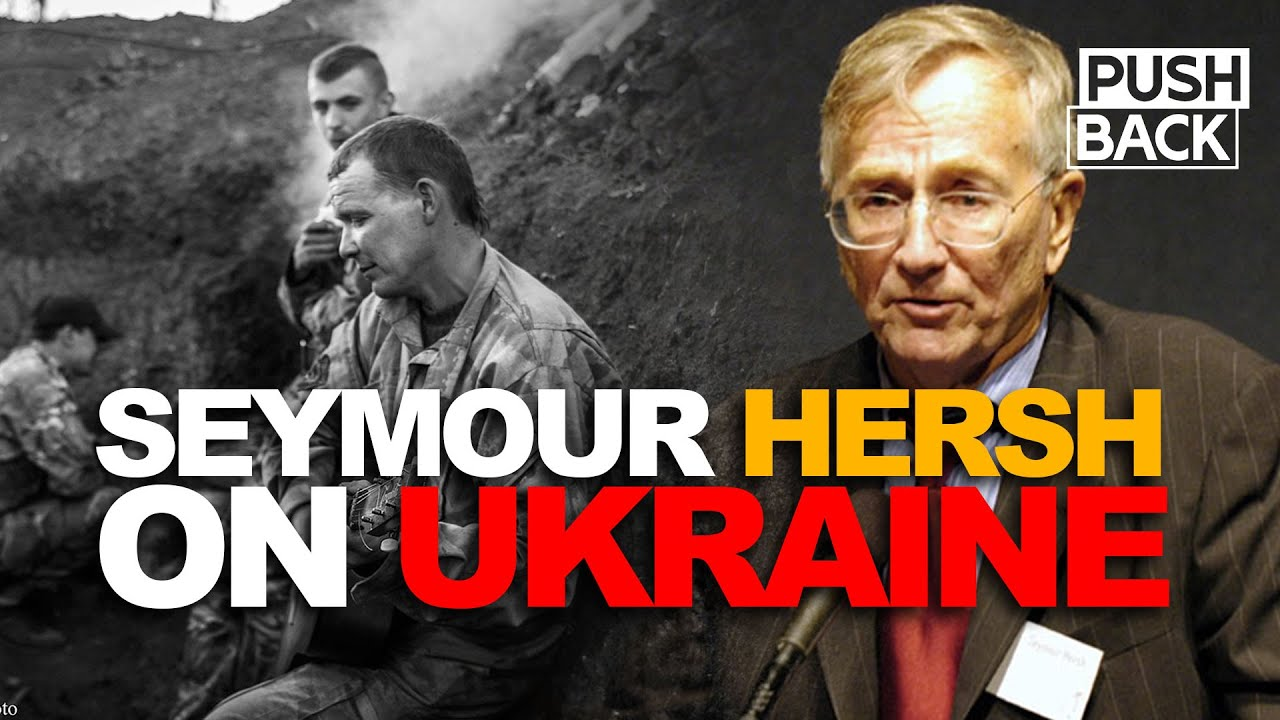
The Grass is Greener-2023-04-19-A chat with the legendary Seymour Hersh (and later Harry Targ)

Stream the Grass is Greener, 4/19/23: a chat with Seymour Hersh on WXRW Riverwest Radio 104.1 for  30 minutes followed by a conversation with Harry Targ

https://on.soundcloud.com/DDwrS

"We snagged a 30-minute interview with legendary journalist Seymour Hersh regarding his latest piece on the Ukraine war. We chat it up, then we fill the hour with our old friend, Professor Harry Targ, discussing the Hersh article. It's a pretty good show!"


Friday, April 21, 2023

REFLECTIONS ON THE UKRAINE WAR IN 2023

 Harry Targ


Most accounts of the Ukraine crisis still ignore the extraordinary expansion of NATO in the 1990s and the 2014 coup against the elected government of Ukraine carried out with the covert support of the United States. Including this in the accounts today adds important context, not for determining “good guys and bad guys,” but for figuring out  where peace forces should stand. Reflection on this context does not deny the immoral and inhumane Russian invasion of Ukraine.  


My takeaways so far are the following:  


1.Russia has fallen into a trap that could significantly and negatively impact on its economy.


2.The invasion gives fuel to the emerging anti-China Cold War rhetoric for politicians of both parties and the corporate media who suggest that Taiwan will be next, presumably after a Chinese invasion.  


3.The Ukraine war is an enormous plus for military/industrial complexes in the US and in Russia as well.  


4.The Ukraine story transforms the global narrative from the critical discussion of exploitation by the Global North of the Global South to the Biden narrative of “authoritarians” vs. “democracies.” For example, see the powerful presentation by V J Prashad of the essential nature of the North/South struggle. https://youtu.be/Lg9c0jv6wTA  


5.The impacts of the debate on progressive forces in the US and elsewhere are potentially devastating. In the US, our discourse is shifting from a progressive agenda including President Biden’s 2021 Build Back Better program for example to stories about the relationships between Putin and former President Trump and so-called “national security.” Biden’s 2022 State of the Union address reflected his “shift to the center.” Now we have a cause all Americans can get behind: opposing the Russians recalls the Soviet menace in the 1940s which was used to defang CIO militancy, the drive for free health care, Henry Wallace’s call for US/Soviet dialogue and, of course, civil rights for all.  


The Russian invasion and the incomplete and war-oriented narrative of the Ukraine crisis dominating the news from such sources as the Washington Post, the New York Times, National Public Radio, and CNN/MSNBC constitute a real setback for us. Media news is a commodity. War and portraits of American exceptionalism are profitable commodities for the increasingly concentrated corporate media. And the rising militarism at home, inflaming rhetoric, and troop movements and arms transfers increase the probability of nuclear war and reduce the possibility of the world addressing impending climate disaster. 


For these reasons and more, I endorse the Code Pink demands that all parties cease fighting and negotiate all outstanding issues. The 12-point Chinese proposed peace plan is a good place to start. Russian withdrawal of its troops from Ukraine and the United States and its allies pulling back NATO forces from its presence in Eastern Europe are desirable goals. In addition, diplomatic efforts should ensue to replace NATO with an organization that can provide security for Europe and the Global South.  The Code Pink frame gives appropriate recognition to both the immorality of the Russian action and the context, including NATO expansion and the events in Ukraine since 2014.  

https://www.codepink.org/ukraine


And a short power point on US and geopolitics: Mackinder, Brzezinski, and Rand.

https://onedrive.live.com/edit.aspx?resid=9576D2290F69B52F!2939&cid=E72DD8E8-315D-4FFA-B0AA-9616848B7FEF&ithint=file%2cpptx&ct=1691157297863&authkey=!AIkSIAtveXO75jk


The Bookshelf

CHALLENGING LATE CAPITALISM by Harry R. Targ

Challenging Late Capitalism