Harry Targ
"Russia alone bears responsibility for
this war. Russia alone has the power to end this war immediately. And it’s
Russia alone that stands in the way of peace.” President Joe Biden at the United
Nations, September 19, 2023.
True or not?
Saturday, February 19, 2022
NATO: FROM
FIGHTING SOCIALISM TO GLOBAL EMPIRE, FOREVER WARS CONTINUE
Harry Targ
Original essay on NATO posted on May 12, 2012
During World War II an “unnatural alliance” was created between the United
States, Great Britain, and the former Soviet Union. What brought the three
countries together, the emerging imperial giant, the declining capitalist
power, and the first socialist state, was the shared need to defeat fascism in
Europe. Rhetorically, the high point of collaboration was reflected in the
agreements made at the Yalta Conference, in February, 1945 three months before
the German armies were defeated.
At Yalta, the great powers made decisions to
facilitate democratization of former Nazi regimes in Eastern Europe, a
“temporary” division of Germany for occupation purposes, and a schedule of
future Soviet participation in the ongoing war against Japan. Leaders of the
three states returned to their respective countries celebrating the “spirit of
Yalta,” what would be a post-war world order in which they would work through
the new United Nations system to modulate conflict in the world.
Within two years, after conflicts over Iran with the
Soviet Union, the Greek Civil War, the replacement of wartime President
Franklin Roosevelt with Harry Truman, and growing challenges to corporate rule
in the United States by militant labor, Truman declared in March, 1947 that the
United States and its allies were going to be engaged in a long-term struggle
against the forces of “International Communism.” The post-war vision of
cooperation was reframed as a struggle of the “free world” against “tyranny.”
In addition to Truman’s ideological crusade, his
administration launched an economic program to rebuild parts of Europe,
particularly what would become West Germany, as capitalist bastions against the
ongoing popularity of Communist parties throughout the region. Along with the
significant program of reconstructing capitalism in Europe and linking it by
trade, investment, finance, and debt to the United States, the U.S. with its
new allies constructed a military alliance that would be ready to fight the Cold
War against International Communism.
Representatives of Western European countries met in
Brussels in 1948 to establish a program of common defense and one year later
with the addition of the United States and Canada, the North Atlantic Treaty
Organization (NATO) was formed. The new NATO charter, inspired largely by a
prior Western Hemisphere alliance, the Rio Pact (1947), proclaimed that “an
armed attack against one or more of them…shall be considered an attack against
them all…” which would lead to an appropriate response. The Charter called for
cooperation and military preparedness among the 12 signatories. After the
Soviet Union detonated its first atomic bomb and the Korean War started, NATO
pushed ahead with the development of a common military command structure with
General Eisenhower as the first “Supreme Allied Commander.”
After the founding of NATO and its establishment as a
military arm of the West, the Truman administration adopted the policy
recommendations in National Security Council Document 68 (NSC 68) in 1950 which
declared that military spending for the indefinite future would be the number
one priority of every presidential administration. As Western European
economies reconstructed, Marshall Plan aid programs were shut down and military
assistance to Europe was launched. Greece and Turkey joined NATO in 1952, and fueling
the flames of Cold War, West Germany was admitted to NATO in 1955. (This
stimulated the Soviet Union to construct its own alliance system, the Warsaw
Pact, with countries from Eastern Europe).
During the Cold War NATO continued as the only unified
Western military command structure against the “Soviet threat.” While forces
and funds only represented a portion of the U.S. global military presence, the
alliance constituted a “trip wire” signifying to the Soviets that any attack on
targets in Western Europe would set off World War III. NATO thus provided the
deterrent threat of “massive retaliation” in the face of first-strike attack.
With the collapse of the former Warsaw Pact regimes
between 1989 and 1991, the tearing down of the symbolic Berlin Wall in 1989,
and finally the collapse of the Soviet Union itself in 1991, the purpose for
maintaining a NATO alliance presumably had passed. However, this was not to be.
In the next twenty years after the Soviet collapse,
membership in the alliance doubled. New members included most of the former
Warsaw Pact countries. The functions and activities of NATO were redefined.
NATO programs included air surveillance during the crises accompanying the Gulf
War and the disintegration of the former Yugoslavia. In 1995, NATO sent 60,000
troops to Bosnia and in 1999 it carried out brutal bombing campaigns in Serbia
with 38,000 sorties. NATO forces became part of the U.S. led military coalition
that launched the war on Afghanistan in 2001. In 2011 a massive NATO air war on
Libya played a critical role in the overthrow of the Gaddafi regime.
An official history of NATO described the changes in
its mission: “In 1991 as in 1949, NATO was to be the foundation stone for a
larger, pan-European security architecture.” The post-Cold War mission of NATO
combines “military might, diplomacy, and post-conflict stabilization.”
The NATO history boldly concludes that the alliance
was founded on defense in the 1950s and détente with the Soviet Union in the
1960s. With the collapse of Communism in the 1990s it became a “tool for the
stabilization of Eastern Europe and Central Asia through incorporation of new
Partners and Allies.” The 21st century vision of NATO has expanded further:
“extending peace through the strategic projection of security.” This new
mission, the history said, was forced upon NATO because of the failure of nation-states
and extremism.
Reviewing this brief history of NATO, observers can
reasonably draw different conclusions about NATO’s role in the world than from
those who celebrate its world role. First, NATO’s mission to defend Europe from
aggression against “International Communism” was completed with the “fall of
Communism.” Second, the alliance was regional, that is pertaining to Europe and
North America, and now it is global. Third, NATO was about security and
defense. Now it is about global transformation. Fourth, as its biggest supporter
in terms of troops, supplies and budget (22-25%), NATO is an instrument of
United States foreign policy. Fifth, as a creation of Europe and North America,
it has become an enforcer of the interests of member countries against, what
Vijay Prashad calls, the “darker nations” of Asia, Africa, and the Middle East.
Sixth, NATO has become the 21st century military instrumentality of global
imperialism. And finally, there is growing evidence that larger and larger
portions of the world’s people have begun to stand up against NATO.
*********************************************************************************
AN UPDATE FROM THE COUNCIL ON FOREIGN
RELATIONS
February 18, 2022
Top of the Agenda
Biden to Conference With NATO Allies as
Cease-Fire Violations Mount in Eastern Ukraine
U.S. President Joe Biden will hold a call (NYT) with
North Atlantic Treaty Organization (NATO) allies today to discuss soaring
tensions in Eastern Ukraine. The Ukrainian government and pro-Russia rebels
reported a second straight day of increased
shelling (Reuters) in
the region. Meanwhile, U.S. Vice President Kamala Harris is in Germany (NPR), where she
will meet with European leaders at the kickoff of the Munich Security
Conference.
The United States warned the UN Security Council
yesterday that Russia is allegedly planning a fullscale attack (State Dept.) on
Ukraine. The U.S. envoy to the Organization for Security and Cooperation in
Europe said Russia has up to 190,000 troops stationed
(Guardian) in
and around Ukraine. Top diplomats from the United States and Russia are set to
hold a meeting next week.
Analysis
“As the crisis in Ukraine unfolds, the West must not underestimate
Russia. It must not bank on narratives inspired by wishful
thinking,” the German Marshall Fund of the United States’ Liana Fix and Michael
Kimmage write for Foreign Affairs. “The ultimate question is: What action
will Putin take if he doesn’t get any concessions from the West after all these
talks? Recognizing [breakaway Ukrainian regions] Donetsk and Luhansk as
independent states is one alternative option to a
broader military invasion and occupation of Ukraine, albeit one
that still entails the potential for military action and could shift the
paradigm in the standoff between Moscow and the West,” the Newlines Institute
for Strategy and Policy’s Eugene Chausovsky writes for Foreign Policy.
******************************************************************************************************************* Saturday,
March 5, 2022
LIES AND FOREIGN POLICY: AN OLD STORY
We live in a World of Cognitive Warfare
A recent document prepared by the North Atlantic
Treaty Organization (NATO) suggested that “in cognitive
warfare, the human mind becomes the battlefield. The aim is to change not only what people think, but how
they think and act. Waged successfully, it shapes and influences
individual and group beliefs and behaviors to favor an aggressor's tactical or
strategic objectives.”
https://www.nato.int/docu/review/articles/2021/05/20/countering-cognitive-warfare-awareness-and-resilience/index.html)
This NATO document, of course, is addressing the world
of international relations but the concept of “cognitive warfare” seems to
parallel efforts “to change not only what people think, but how they think and
act.” This project animates the efforts of media conglomerates-print,
electronic, social media platforms. Changing how people think and act has its
historic roots in campaigns to convince citizens to support wars, consume
cigarettes, forget climate disasters, and to find flaws in populations because
of class, race, gender, sexual preference, and/or religion. The processes of
“branding” are similar in all realms of human experience.
Perhaps challenging the process of “branding” should
be on the agenda for all those who seek a more humane society. Break up
“branding machines.” Democratize the ability to describe and express
experiences. And, in the educational sphere, teach students to analyze brands
and to evaluate their relative accuracy.
*******************************************************
UKRAINE: PREPARING
FOR WAR AGAIN
Harry Targ
Sunday, February 6, 2022
In August 2, 1964, North Vietnamese armed motor boats
attacked two U.S. naval vessels off the coast of North Vietnam. The
administration of Lyndon Johnson defined the attacks as an unprovoked act of
North Vietnamese aggression.
Two days later it was announced that another attack on
U.S. ships in international waters had occurred and the U.S. responded with air
attacks on North Vietnamese targets. President Johnson then took a resolution
he had already prepared to the Congress of the United States. The so-called
Gulf of Tonkin resolution declared that the Congress authorizes the president
to do what he deemed necessary to defend U.S. national security in Southeast
Asia. Only two Senators voted "no." Over the next three years the U.S.
sent 500,000 troops to Vietnam to carry out a massive air and ground war in
both the South and North of the country.
Within a year of the so-called Gulf of Tonkin incidents, evidence began to
appear indicating that the August 2 attack was provoked. The two U.S. naval
vessels were in North Vietnamese coastal waters orchestrating acts of sabotage
in the Northern part of Vietnam. More serious, evidence pointed to the
inescapable conclusion that the second attack on August 4 never occurred.
President Johnson's lies to the American people about the Gulf of Tonkin
contributed to the devastating decisions to escalate a U.S. war in Vietnam that
cost 57,000 U.S. troop deaths and upwards of three million Vietnamese deaths.
Forty years later, George W. Bush and his key aides put together a package of
lies about Iraq- imports of uranium from Niger, purchases of aluminum rods
which supposedly could be used for constructing nuclear weapons, development of
biological and chemical weapons, and connections between Saddam Hussein and
Osama Bin Laden.
As the Vietnamese and Iraqi cases show, foreign policies built on lies can lead
to imperial wars, huge expenditures on the military, economic crises at home,
and military casualties abroad.
The American people must insist that their leaders telthe truth about the U.S.
role in the world.
*************************************************************************************************************************************************************************
Thursday, February 24, 2022
ON UKRAINE AND THE
DANGER OF PERPETUAL AND ESCALATING WAR
Friends,
See below an array of articles, past and current, on
Ukraine. The most interesting for me are the statements by the Kenyan
Ambassador to the UN on empires and FAIR’s critique of corporate media
coverage.
In my opinion while the Russian attack on Ukraine
should be condemned, we need to recognize it as part of an ongoing war that has
its roots, perhaps, in the era of formal empires of past centuries, or the
Western reaction to the Russian Revolution, or the rise of fascism and World
War 2, or the construction of NATO and the US drive for global hegemony from
World War 2 to the present, or the promises made by George Herbert Walker Bush
not to expand NATO and its subsequent expansion eastward in the Clinton era, or
NATOs taking on a worldwide role in imposing western dominance (Bosnia, Serbia,
Libya, Afghanistan for example), or the 2014 coup supported by the US against a
flawed but elected government in Kiev, or full incorporation of the neo-fascist
elements of that coup in the Ukraine military, or the possibilities of a Nord
Stream 2 pipeline, and/or the refusal of the US to make a modest but
significant promise not to expand NATO to include Ukraine.
The list goes on but a “theory of the new war” needs
to incorporate most or all of these elements, even while we condemn the Russian
assault on Ukraine today.
I think our peace and justice movements, including
those who are doing important election work, have to reflect on how the global
agenda, imperialism, war, and militarism relate to all of our work.
--An important speech by the Kenyan Ambassador at the
UN, Martin Kimani, that condemns all countries who have engaged in or aspire to
empire.
https://theintercept.com/2022/02/22/ukraine-vladimir-putin-martin-kimani-speech/?utm_medium=email&utm_source=The%20Intercept%20Newsletter
--FAIR on media coverage of Ukraine:
https://fair.org/home/western-media-fall-in-lockstep-for-neo-nazi-publicity-stunt-in-ukraine/
--Jack Matlock former US diplomat:
https://usrussiaaccord.org/acura-viewpoint-jack-f-matlock-jr-todays-crisis-over-ukraine/
--Thomas Friedman:
https://www.nytimes.com/2022/02/21/opinion/putin-ukraine-nato.html
-- Reuters: On the incorporation of neo-Nazis
into Ukraine military
https://www.reuters.com/article/us-cohen-ukraine-commentary/commentary-ukraines-neo-nazi-problem-idUSKBN1GV2TY
--On Stephen Cohen who spoke with sensitivity about
Russia and the former Soviet Union (it may be difficult to access Stephen
Cohen's articles in The Nation but there are a number of You Tube
interviews available with this now deceased distinguished scholar of the former
Soviet Union and Russia)
https://www.thenation.com/article/world/stephen-cohen-ukraine/
https://www.thenation.com/article/archive/why-are-we-in-ukraine/
***************************************************************************************************
MORE THOUGHTS
ABOUT THE UKRAINE CRISIS
Sunday, February 27, 2022
Harry Targ
I cannot get out of my mind the question: What do
people who are descendants of those who experienced 27 million dead from a
fascist invasion through Eastern Europe of German armies think about the world
today? Do they/can they regard NATO and its expansion as merely a “security”
organization? These questions do not “excuse” the Russian invasion but help
explain it.
And why try to explain it? Well understanding the
Russian experience and consciousness is necessary to negotiate an end to war
now and in the future. Therefore, NATO has to be dismantled. Resolution of
disputes between the separatist regions and Ukraine need to be achieved.
International organizations need to address “fascist” currents everywhere.
The first priority in my opinion is to understand why
this crisis and the ensuing war occurred. I increasingly view on the US side,
the expansion of NATO in the 1990s, the Clinton support of Yeltsin’s
destruction of whatever existed of socialism, the US supported coup in 2014,
and the continuation in office of the “humanitarian interventionists” from the
Clinton era, Bill Clinton to Hillary Clinton, Obama, and Biden. These are part
of the narrative that must be told and incorporated into our politics. And I/we
need to know much more about the ongoing war between the separatist regions and
the government of Ukraine from 2014 to the present.
******************************************************************************************************************
Thursday, March 3, 2022
SOME FURTHER
REFLECTIONS ON THE WAR IN UKRAINE AND WHAT IT MEANS FOR ALL OF US
Harry Targ
Many of us in the peace movement have had useful
conversations (and debates) stimulated by the war on Ukraine. We are discussing
the causes of the invasion of Ukraine by Russia, both immediate and historical,
and how the peace movement should respond to this important crisis.
I commend the Oliver Stone documentary to all as one
detailed and informed narrative of a very complicated Ukrainian history. An
important element of Stone’s narrative is the role of Ukrainian neo-fascists
who were prominently active in the 2014 coup against the elected Ukraine
government. These descendants of World War II neo-Nazis, Stone claims, now
serve in the Ukraine army.
Ukraine On Fire - Oliver Stone
documentary (2016) - YouTube
Also, most accounts of the Ukraine crisis today ignore
the extraordinary expansion of NATO in the 1990s and the 2014 coup against the
elected government of Ukraine carried out with the covert support of the United
States. Including this in the accounts today adds important context, not for
determining good guys and bad guys, but for figuring out what should be done
and where peace forces should stand. And to be clear reflection on this
context DOES NOT DENY THE IMMORAL AND INHUMANE RUSSIAN INVASION OF
UKRAINE.
My takeaways so far are the following:
1.Russia has fallen into a trap that will
significantly and negatively impact on its economy. It also reduces Russian
influence around the world and undermines Russia’s renewed economic ties with
countries in the Western Hemisphere.
2.The invasion gives fuel to the emerging anti-China
Cold War rhetoric for politicians of both parties and the corporate media who
suggest that Taiwan will be next, presumably after a Chinese invasion.
3.The Ukraine war is an enormous plus for
military/industrial complexes in the US and in Russia as well.
4.The Ukraine story transforms the global
narrative from the critical discussion of exploitation by the Global North of
the Global South to the Biden narrative of “authoritarians” vs. “democracies.”
For example, see the powerful presentation by V J Prashad of the essential
nature of the North/South struggle. https://youtu.be/Lg9c0jv6wTA
5.The impacts of the debate on progressive forces in
the US and elsewhere are potentially devastating. In the US, our discourse is
shifting from a progressive agenda including President Biden’s Build Back
Better program for example to stories about the relationships between Putin and
former President Trump and so-called “national security.”
Biden’s State of the Union address reflects his “shift
to the center.” Now we have a cause all Americans can get behind: opposing the
Russians. (I am reminded how the Soviet menace in the 1940s was used to
defang CIO militancy, the drive for free health care, Henry Wallace’s call for
US/Soviet dialogue and, of course, civil rights for all).
I think the Russian invasion and the incomplete
and war-oriented narrative of the Ukraine crisis dominating the news from such
sources as the Washington Post, the New York Times, National Public Radio, and
CNN/MSNBC constitute a real setback for us. Media news is a commodity.
War and portraits of American exceptionalism are profitable commodities for the
increasingly concentrated corporate media.
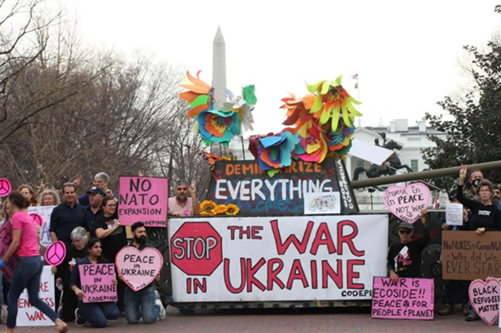
For these reasons and more, I endorse the Code Pink
demands that Russia withdraw its troops from Ukraine and the United States and
its allies pull back NATO forces from its presence in Eastern Europe. In
addition, diplomatic efforts should ensue to replace NATO with an organization
that can provide security for Europe and the Global South. The Code Pink
frame gives appropriate recognition to both the immorality of the Russian
action and the context, including NATO expansion and the events in
Ukraine since 2014.
Finally, I want to reintroduce the concept of
“historical memory.” These memories are important for people and they are
legitimate ways to think about what needs to change. The historical memory for
many Russians probably includes the 27 million of their ancestors killed during
World War II largely from invading German armies crossing through Ukraine. I
assume that if I were a Russian such a memory would affect how I
think about the world. I know from experience how deeply the Holocaust still
affects Jewish people even today.
So peace activists will continue to debate root causes
of this senseless war and what to do about it. But for now as Cold Pink and
others demand: Stop the War, Withdraw Russian Troops From Ukraine, Reverse the
Extension of NATO.
********************************************************************************************************************************************************************************
Saturday, March 5, 2022
LIES AND FOREIGN
POLICY: AN OLD STORY
This is an old story. As Professor John Mearsheimer has pointed out,
governments, often democracies, lie to convince their citizens that war is
justified. As many have pointed out, lies have been perpetrated on all sides
about the Ukraine war.
Part of the job of peace activists is to
interrogate all the narratives, seek truth, and stand up for basic principles:
no war, no interventions overt and covert, and justice for all people.
And it is a testament to the potential
wisdom of people that governments feel they must lie to achieve their goals.
July 25, 2003
Harry Targ
On August 2, 1964, North Vietnamese armed motor boats
attacked two U.S. naval vessels off the coast of North Vietnam. The
administration of Lyndon Johnson defined the attacks as an unprovoked act of
North Vietnamese aggression.
Two days later it was announced that another attack on
U.S. ships in international waters had occurred and the U.S. responded with air
attacks on North Vietnamese targets. President Johnson then took a resolution
he had already prepared to the Congress of the United States. The so-called
Gulf of Tonkin resolution declared that the Congress authorizes the president
to do what he deemed necessary to defend U.S. national security in Southeast
Asia. Only two Senators voted "no." Over the next three years the U.S.
sent 500,000 troops to Vietnam to carry out a massive air and ground war in
both the South and North of the country.
Within a year of the so-called Gulf of Tonkin
incidents, evidence began to appear indicating that the August 2 attack was
provoked. The two U.S. naval vessels were in North Vietnamese coastal waters
orchestrating acts of sabotage in the Northern part of Vietnam. More serious,
evidence pointed to the inescapable conclusion that the second attack on August
4 never occurred.
President Johnson's lies to the American people about
the Gulf of Tonkin contributed to the devastating decisions to escalate a U.S.
war in Vietnam that cost 57,000 U.S. troop deaths and upwards of three million
Vietnamese deaths.
Forty years later, George W. Bush and his key aides
put together a package of lies about Iraq- imports of uranium from Niger,
purchases of aluminum rods which supposedly could be used for constructing
nuclear weapons, development of biological and chemical weapons, and
connections between Saddam Hussein and Osama Bin Laden.
As the Vietnamese and Iraqi cases show, foreign
policies built on lies can lead to imperial wars, huge expenditures on the
military, economic crises at home, and military casualties abroad.
The American people must insist that their leaders
tell the truth about the U.S. role in the world.
************************************************************************************************************************************************************
From Covert Action:
Peace Movement Needs to Demand Dismantling
of NATO
Harry Targ
April 28, 2022
[Source: greatgameindia.com]
NATO went from fighting socialism to
enforcing global empire
It looks a lot like a return to the past. Founded in
1949 to defend against the “Soviet threat,” the NATO alliance is facing a
return to mechanized warfare, a huge increase in defense spending, and
potentially a new Iron Curtain falling across Europe. After struggling to find
a new post-Cold War role, countering terrorism following the September 11
attacks on the United States in 2001 and a humiliating withdrawal from
Afghanistan in 2021, NATO is back encroaching on its original nemesis.[1]
U.S. Plans for the Establishment of Global
Hegemony: 1945-47
During World War II an “unnatural alliance” was
created between the United States, Great Britain, and the former Soviet Union.
What brought the three countries together—the emerging imperial giant (the
United States), the declining capitalist power (Great Britain), and the first
socialist state (the Soviet Union)—was the shared need to defeat fascism in
Europe. Rhetorically, the high point of collaboration was reflected in the
agreements made at the Yalta Conference, in February 1945, three months before
the German armies were defeated.
At Yalta, the great powers made decisions to
facilitate democratization of former Nazi regimes in Eastern Europe, a
“temporary” division of Germany for occupation purposes, and a schedule of
future Soviet participation in the ongoing war against Japan. Leaders of the
three states returned to their respective countries celebrating the “spirit of
Yalta,” what would be a post-war world order in which they would work through
the new United Nations system to modulate conflict in the world.
Big Three leaders pose for photo outside historic
Yalta conference. [Source: history.com]
Within two years, after conflicts over Iran with the
Soviet Union, the Greek Civil War, the replacement of wartime President
Franklin Roosevelt with Harry Truman, and growing challenges to corporate rule
in the United States by militant labor, Truman declared in March 1947 that the
United States and its allies were going to be engaged in a long-term struggle
against the forces of “International Communism.” The post-war vision of
cooperation was reframed as a struggle of the “free world” against “tyranny.” It
was really a struggle between two kinds of political/economic orders: one
socialist, another capitalist.
[Source: apprend.io]
The Economic Foundations of a New World
Order
In addition to Truman’s ideological crusade, his
administration launched an economic program to rebuild parts of Europe,
particularly what would become West Germany, as capitalist bastions against the
ongoing popularity of Communist parties throughout the region. Along with the
significant program of reconstructing capitalism in Europe and linking it by
trade, investment, finance and debt to the United States, the U.S. with its new
allies constructed a military alliance that would be ready to fight the Cold
War against International Communism.
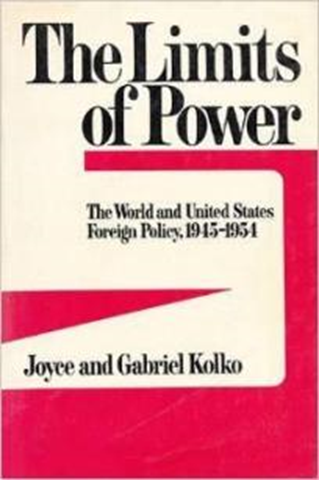
For Joyce and Gabriel Kolko (The Limits of Power,
1972) and other revisionists, the expansion of socialism constituted a global
threat to capital accumulation. With the end of the Second World War, there
were widespread fears that the decline in wartime demand for U.S. products
would bring economic stagnation and a return to the depression of the 1930s.
[Source: goodreads.com]
The Marshall Plan, lauded as a humanitarian program
for the rebuilding of war-torn Europe, was at its base a program to increase
demand and secure markets for U.S. products. With the specter of an
international communist threat, military spending, another source of demand,
would likewise help retain customers, including the U.S. government itself. The
idea of empire, which William Appleman Williams so stressed (The Tragedy
of American Diplomacy, 1959), was underscored by the materiality of
capitalist dynamics.
[Source: thecoldwarexperience.weebly.com]
The Marshall Plan inspired European integration of
states that were major recipients of Marshall Plan funds. The first significant
economic organization, The European Coal and Steel Community, became operational
in 1952. Its membership included France, West Germany, Italy, Belgium, the
Netherlands, and Luxembourg. It encouraged the production and trade of core
resources such as coal, steel and iron. In 1957, the purview of the ECSC was
expanded with the creation of the European Economic Community (EEC) and the
European Atomic Energy Community (Euratom).
Other, overlapping European institutions were created
during the 1950s and beyond involving the original six and additional
countries. In May 1960 seven European nations, not in the EEC, formed the
European Free Trade Association to foster trade and economic integration. (In
1973, three countries including Great Britain joined the EEC).
Finally in 1992, after the collapse of the Soviet
Union, the Maastricht Treaty established the European Union (EU) which, by
2019, had 27 member countries (nine from the former Soviet bloc) with a GDP of
16.4 trillion euros (the EU currency), constituting 15% of world trade. In
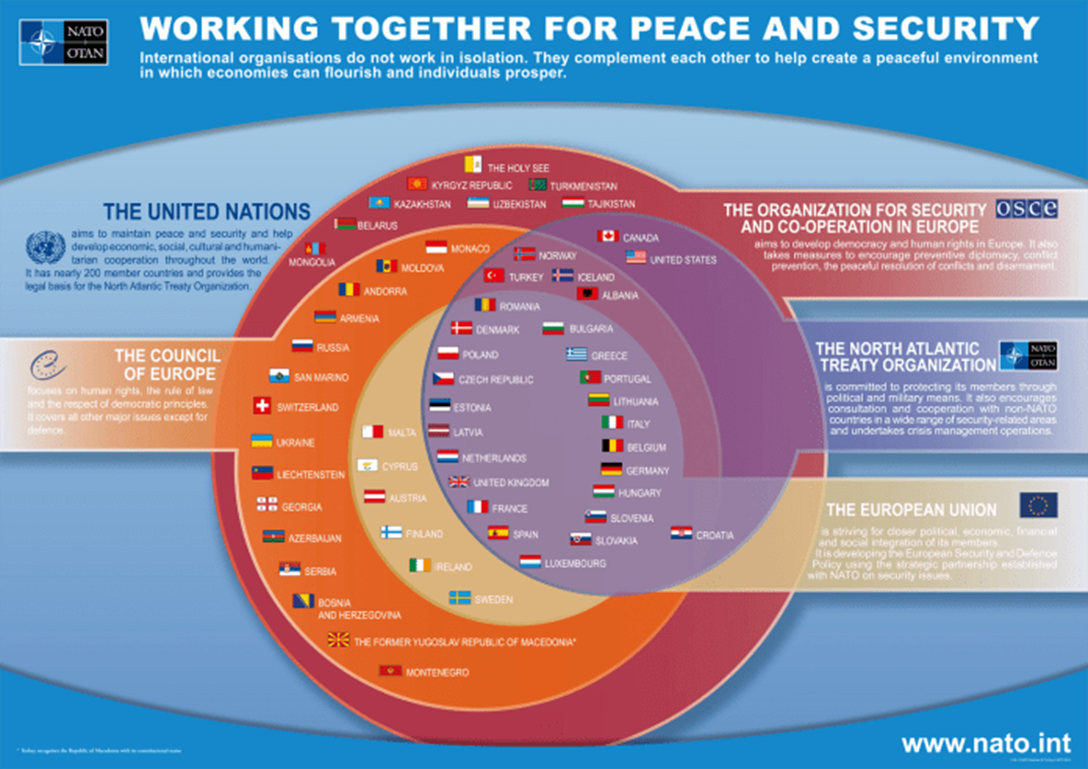
addition, European nations are embedded in a network of regional and
international organizations that deal with trade, finance, indebtedness,
security and human rights. (See the diagram below.)
[Source: twitter.com]
The reigning scholarly study of these efforts in the
1960s and beyond, integration theory, postulated that the greater the
cross-national interactions of European countries the lesser the likelihood of
war among them. Studies were carried out designed to discover how and why
integration seemed to be working in Europe but less so in troubled locations,
such as on the African continent.
But from another vantage point “regional integration”
inspired by and connected to the United States political economy can be seen as
a near complete fruition of the vision of U.S. and capitalist hegemony
initiated in those crucial early years after World War ll. The
21st century policy program of the United States and most of Europe has
been to establish on a global basis a capitalist economic model.
Ideologically, the presupposition is that this model
is historically exceptional and therefore must resist threats to its survival
and growth. The so-called communist threat of the 1940s is the “authoritarian”
threat of the current century. And to the extent that capitalist hegemony is
not achievable by consent, it might need to be instituted by force.
While world history is more complicated than this
narrative suggests, there is enough plausibility to it to justify fears,
particularly when the military instrument—NATO—expanded eastward. From this
point of view, NATO itself may not be the only threat to countries in Europe
and Asia. But the use of it as a part of global expansion of economic and
political institutions, coupled with the ideological expression of American
exceptionalism, could create fear and aggression.
NATO As the Military Arm of a Drive for a
Hegemonic Global Political Economy
Representatives of Western European countries met in
Brussels in 1948 to establish a program of common defense and one year later
with the addition of the United States and Canada, the North Atlantic Treaty
Organization (NATO) was formed. The new NATO charter, inspired largely by a
prior Western Hemisphere alliance, the Rio Pact (1947), proclaimed that “an
armed attack against one or more of them…shall be considered an attack against
them all” which would lead to an appropriate response.
Image from first NATO summit. [Source: nato.int]
The Charter called for cooperation and military
preparedness among the 12 signatories. After the Soviet Union detonated its
first atomic bomb and the Korean War started, NATO pushed ahead with the
development of a common military command structure with General Eisenhower as
the first “Supreme Allied Commander.”
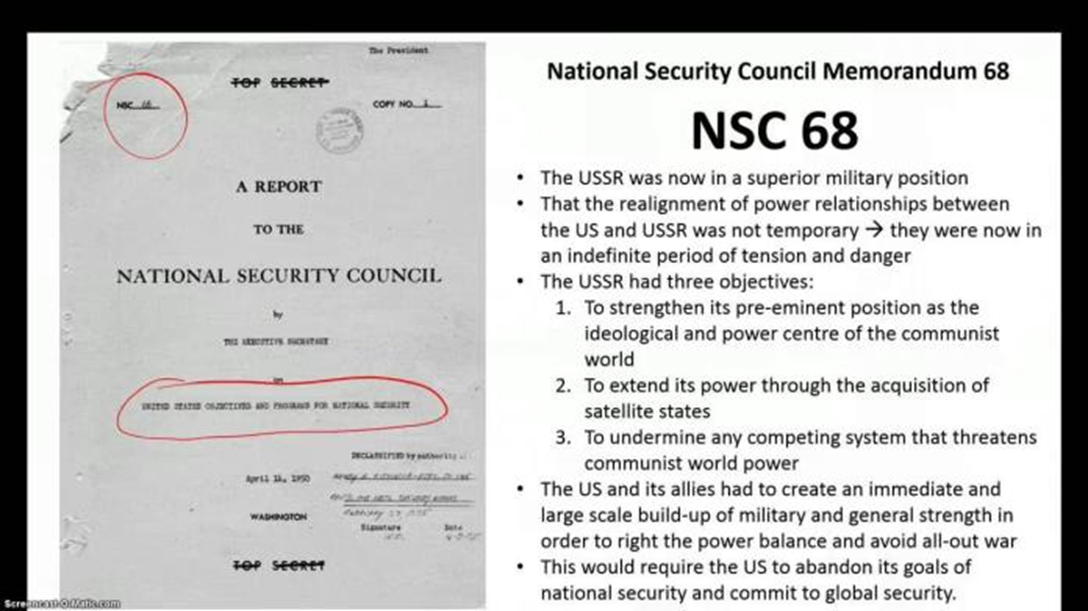
After the founding of NATO and its establishment as a
military arm of the West, the Truman administration adopted the policy
recommendations in National Security Council Document 68 (NSC 68) in 1950 which
declared that military spending for the indefinite future would be the number
one priority of every presidential administration.
[Source: youtube.com]
As Western European economies reconstructed, Marshall
Plan aid programs were shut down and military assistance to Europe was
launched. Greece and Turkey joined NATO in 1952 and, fueling the flames of the
Cold War, West Germany was admitted to NATO in 1955. (This stimulated the
Soviet Union to construct its own alliance system, the Warsaw Pact, with
countries from Eastern Europe.)
During the Cold War, NATO continued as the only
unified Western military command structure against the “Soviet threat.” While
forces and funds only represented a portion of the U.S. global military
presence, the alliance constituted a “trip wire” signifying to the Soviets that
any attack on targets in Western Europe would set off World War III. Thus, NATO
provided the deterrent threat of “massive retaliation” in the face of a
first-strike attack.
With the collapse of the former Warsaw Pact regimes
between 1989 and 1991, the tearing down of the symbolic Berlin Wall in 1989
and, finally, the collapse of the Soviet Union itself in 1991, the outspoken
purpose for maintaining a NATO alliance presumably had passed. However, this
was not to be.
In the next 20 years after the Soviet collapse,
membership in the alliance doubled. New members included most of the former
Warsaw Pact countries. The functions and activities of NATO were redefined.
NATO programs included air surveillance during the crises accompanying the Gulf
War and the disintegration of the former Yugoslavia.
In 1995, NATO sent 60,000 troops to Bosnia and in 1999
it carried out brutal bombing campaigns in Serbia with 38,000 sorties. NATO
forces became part of the U.S.-led military coalition that launched the war on
Afghanistan in 2001. In 2011 a massive NATO air war on Libya played a critical
role in the overthrow of the Gaddafi regime.
Conference in Belgrade, Yugoslavia, March 2019,
exposes NATO’s bombing of Yugoslav children. [Source: workers.org]
An official history of NATO described the changes in
its mission: “In 1991 as in 1949, NATO was to be the foundation stone for a
larger, pan-European security architecture.” The post-Cold War mission of NATO
combines “military might, diplomacy, and post-conflict stabilization.”
The NATO history boldly concludes that the alliance
was founded on defense in the 1950s and détente with the Soviet Union in the
1960s. With the collapse of Communism in the 1990s, it became a “tool for the
stabilization of Eastern Europe and Central Asia through incorporation of new
Partners and Allies.” The 21st century vision of NATO has expanded
further: “extending peace through the strategic projection of security.” This
new mission, the history said, was forced upon NATO because of the failure of
nation-states and extremism.
NATO and Ukraine Today
Reviewing this brief history of NATO, observers can
reasonably draw different conclusions about NATO’s role in the world than from
those who celebrate its world role. First, NATO’s mission to defend Europe from
aggression against “International Communism” was completed with the “fall of
Communism.” Second, the alliance was regional, that is pertaining to Europe and
North America, and now it is global. Third, NATO was about security and
defense. Now it is about global transformation.
Fourth, with the U.S. as NATO’s biggest supporter in
terms of troops, supplies and budget (22-25%), NATO is an instrument of United
States foreign policy. Fifth, as a creation of Europe and North America, it has
become an enforcer of the interests of member countries against, what Vijay
Prashad calls, the “darker nations” of Asia, Africa and the Middle East. Sixth,
NATO has become the 21st century military instrumentality of global
imperialism. And, finally, there is growing evidence that larger and larger portions
of the world’s people have begun to stand up against NATO.
In the context of this complex history, Russia
launched its invasion of Ukraine on February 24, 2022, following eight years of
war in Eastern Ukraine. After four weeks thousands of Ukrainians have been
killed and more than four million have fled their cities and towns. The
President of Ukraine, spokespersons from some NATO countries, and some U.S.
politicians have called for a “no-fly zone” over Ukraine which would escalate
the war to a near-nuclear war situation. In addition, NATO countries, and
particularly the United States, have dramatically increased military
expenditures. Impactful economic sanctions have been leveled against Russia,
and economic instabilities are beginning to affect Europe and the United
States. In addition, vital work around combating climate change has been
stalled and important pieces of legislation to fulfil social needs have been
eliminated from legislative consideration.
What Needs to Be Done?
To quote a tired but true slogan, “war is not the
answer.” The Russian invasion of Ukraine threatens the lives and property of
Ukrainians, the lives of Russian soldiers and protesters, raises fears of an
escalation of war throughout Europe, and raises the danger of nuclear war.
“We” need to support “back-channel negotiations”
in process as occurred during the Cuban missile crisis, demands that Russia
stop the violence and withdraw its military forces from Ukraine, diplomacy at
the United Nations, and summit meetings of diplomats from Russia, Ukraine and
Europe. And conversations on the agenda should include forbidding Ukraine from
joining NATO, establishing regional autonomy for Ukraine citizens who want it,
pulling back NATO bases from Eastern European states, and/or abolishing NATO
itself because the reason for its creation in the first place, defending
against the Soviet Union, no longer exists.
The “we” at this moment could be a resurgent
international peace movement, taking inspiration from peace activists in Russia
and around the world. As horrible as this moment is, it is potentially a
“teachable moment,” a moment when peace becomes part of the global progressive
agenda again and people all around the world can begin to examine existing
international institutions such as NATO.
[Source: blogger.googleusercontent.com]
And while we react with shock and condemnation of the
Russian invasion of Ukraine, whatever the complicated and understandable
motivations, we need to be familiar with the historic context of the very
dangerous warfare that we are living through now.
As James Goldgeier wrote more than 20 years ago on a
Brookings Institution web page: “The dean of America’s Russia experts,
George F. Kennan, had called the expansion of NATO into Central Europe ‘the
most fateful error of American policy in the entire post-Cold War era.’ Kennan,
the architect of America’s post-World War II strategy of containment of the
Soviet Union, believed, as did most other Russia experts in the United States,
that expanding NATO would damage beyond repair U.S. efforts to transform Russia
from enemy to partner.”[2]
Sabine Siebold and Robin Emmott, “Russia may not stop
with Ukraine—NATO looks to its weakest link,” Reuters, March 21,
2022. ↑
James Goldgeier, Brookings Institution, “The U.S.
Decision to Enlarge NATO: How, When, Why, and What Next?“ June 1, 1999. ↑
***************************************************************************************************************************************************************************
Saturday, May 14, 2022
ON GRADUATED
RECIPROCATION IN TENSION REDUCTION (GRIT)
Harry Targ
Secretary of State Anthony Blinken endorses
negotiations between contending nations in Africa, the Democratic Republic of
Congo and Rwanda August 9, 2022
And the Ukraine?
“The United States is doing everything it can to
support the very important African-led mediation efforts, in particular the
processes that are being led by Kenya and Angola, to bring peace, security and
stability to the eastern Congo. We are not only following this very closely and
carefully, we’re engaged in it,” he said. (Jean-Yves Kamale “Blinken calls
for end to Congo violence, backs negotiations” Associated Press, August 9,
2022.)
"Defense Secretary Lloyd Austin spoke with Russian defense minister Sergey Shoygu on Friday, marking
the first time the two have spoken since before Moscow’s invasion of Ukraine
began." (The Hill, May 13,2022).
As a Marxist teaching Peace Studies I always made
light of sections of my course and text that dealt with bargaining and
negotiation.
However, reflecting on the war in Ukraine and the
seething tensions and competing arguments (even among us on the left) I was
drawn to this bargaining and negotiation literature I long since forgot. Why?
Because I do believe the first priority of the peace movement should be to
organize around stopping the killing. We can put off for now debates over the
role of NATO, great power chauvinism, self-determination of Ukrainians
including those in the Donbas region, and the role or not of neo-Nazi's. In my
opinion the first priority is how to get the killing to stop, hopefully coupled
with a withdrawal of Russian troops from Ukraine.
So I recalled the writings and research of a social
psychologist, Charles Osgood, who developed his strategy of Graduated
Reciprocation in Tension Reduction or GRIT. He claimed it worked during the
Cuban Missile Crisis and others have claimed that it has worked in other
conflict situations such as US/Iranian negotiations. https://savinghumans.wordpress.com/2014/05/21/building-a-spiral-of-trust-through-grit/
GRIT’s basic point is to get one side, in this case
US/NATO/Ukraine, to make some serious but not risky unilateral moves inviting
the other side to reciprocate. (And that is where peace movement activism and
demands come in.) And such de-escalatory moves should be continued but not to
endanger the security of the initiating party. (And the conversation between
Secretary of Defense Lloyd Austin and Russian Defense Ministery Sergey Shoygu
may be a start).
Hopefully, Osgood would have suggested, the Russians
would eventually stop the killing, perhaps order troops in place, and/or pull
back some troops. One critical goal would be to get a number of nations
to send representatives to negotiate a ceasefire and further tension-reduction.
In this case the Minsk Accords might be a starting place.
GRIT may not work, but in my opinion it is worth a
try. And if one looks at the GRIT strategy for tension-reduction US policy is
now doing just the opposite; that is the US is escalating by word and deed more
threats, more demands, more arms, and more calls for expanding the scope of the
conflict.
So, while social psychology is not political economy
or realpolitik, it might help end the killing. And we all agree that is the
first priority for the Ukrainians and is vital for reducing, rather than
increasing, the threat of global nuclear war.
http://psychology.iresearchnet.com/social-psychology/antisocial-behavior/grit-tension-reduction-strategy/
********************************************************************************
Monday, May 16, 2022
Diplomacy not War:
Relevant to Stopping the Ukraine War?
WHERE SHOULD THE PEACE MOVEMENT STAND?
IMPERIALISM, WAR, AND/OR DIPLOMACY
(Originally
posted August 2, 2015)
Harry Targ
“Not every conflict was averted, but the world avoided
nuclear catastrophe, and we created the time and the space to win the Cold War
without firing a shot at the Soviets…. Now, when I ran for president eight
years ago as a candidate who had opposed the decision to go to war in Iraq, I
said that America didn’t just have to end that war. We had to end the mindset
that got us there in the first place. It was a mindset characterized by a
preference for military action over diplomacy, a mindset that put a premium on
unilateral U.S. action over the painstaking work of building international
consensus, a mindset that exaggerated threats beyond what the intelligence
supported.” (Barack Obama, “Full text: Obama gives a speech about the Iran
nuclear deal,” The Washington Post, August 5, 2015).
The peace movement has often been faced with a
dilemma. Should it channel its energies in opposition to imperialism, including
economic expansion and covert operations, or should it mobilize against war, or
both. The problem was reflected in President Obama’s August 5, 2015 speech
defending the anti-nuclear proliferation agreement with Iran. On the
one hand he defended diplomacy as the first tool of a nation’s foreign policy
and on the other hand his defense included the argument that through diplomacy
the United States “won” the Cold War, and thereby defeated a bloc of states
that opposed capitalist expansion. The implication of his argument was that
pursuing imperialism remained basic to United States foreign policy but
achieving it through peace was better than through war.
The speech was presented at American University 52
years after President Kennedy called for peaceful competition with the former
Soviet Union. In June, 1963, nine months after the Cuban Missile Crisis, which
nearly led to nuclear war, and weeks after Soviet leader Nikita Khrushchev’s
call for “peaceful coexistence,” President Kennedy responded by urging the use
of diplomacy rather than war in the ongoing conflict with the Soviet
Union.
A small but growing number of scholars and activists
at that time had begun to articulate the view that the threat of nuclear war,
growing U.S. involvement in Southeast Asia, and repeated covert interventions
in Guatemala, Iran, Cuba, and the Congo, had to do with U.S. imperialism. The
dilemma for the peace movement in 1963 then as it is in 2015 is how to respond
to United States imperialism at the same time as supporting the use of
diplomacy to forestall wars.
In the context of political discourse in 2015,
dominated by “neoconservative” and “humanitarian interventionist” factions of
the foreign policy elite, the danger of war always exists. Therefore, any
foreign policy initiative that reduces the possibility of war and arguments
about its necessity must be supported. The agreement with Iran supported by
virtually every country except Israel constitutes an effort to satisfy the
interests of Iran and the international community and without the shedding of
blood and creating the danger of escalation to global war.
Neoconservatives, celebrants of war, have had a long
and growing presence in the machinery of United States foreign policy. James
Forrestal, the first Secretary of Defense in the Truman Administration, was a
leading advocate for developing a militaristic response to the Soviet Union in
the years after World War II. As historian Andrew Bacevich pointed out,
Forrestal was one of the Truman administrators who sought to create a
“permanent war economy.” He was, in Bacevich’s terms, a founding member of the post-World
War II “semi-warriors.”
Subsequent to the initiation of the imperial response
to the “Soviet threat”--the Marshall Plan, NATO, wars in Korea and Vietnam, the
arms race--other semi-warriors continued the crusade. These included the Dulles
brothers (John and Alan), Air Force General Curtis LeMay, and prominent Kennedy
advisors including McGeorge Bundy and Walter Rostow, architect of the
“noncommunist path to development,” in Vietnam.
Key semi-warriors of our own day, Donald Rumsfeld,
Dick Cheney, Elliott Abrams, Robert Kagan, and others who formed the Project
for a New American Century (PNAC) in the 1990s, gained their first experience
in the administrations of Richard Nixon and Ronald Reagan. The PNAC view of how
the United States should participate in world affairs is to use military
superiority to achieve foreign policy goals. The key failure of Clinton foreign
policy, they claimed, was his refusal to use force to transform the world. For
starters, he should have overthrown Saddam Hussein in Iraq.
The neoconservative policy recommendations prevailed
during the eight years of the George Walker Bush administration. International
organizations were belittled, allies were ignored, arms control agreements with
Russia were rescinded and discourse on the future prioritized planning for the
next war. And concretely the United States launched long, bloody, immoral wars
in Iraq and Afghanistan.
Humanitarian interventionists, more liberals than
conservatives, argued that the United States should use force, but more
selectively, to achieve various goals. These goals included interventions that
allegedly defended the quest for human rights. Advocates of humanitarian
interventionism argued that the United States must use all means available,
military and diplomatic, to maximize interests and values. And force need not
be the first or only instrument of policy.
But in the end the humanitarian interventionists
encouraged bombing Serbia, intervening in a civil war in Libya, funding rebels
perpetuating war in Syria, expanding military training and a U.S. presence in
Africa, and funding opposition elements against the government in Venezuela. In
addition, with advice from humanitarian interventionists, the United States
increased the use of drones to target enemies of U.S. interests in East Asia,
the Persian Gulf, and the Middle East.
Neoconservatives and humanitarian interventionists
(and in earlier times anti-communists) have led the charge for war-making in
the United States since World War II. Between the end of the war and the 1990s,
10 million people died in wars in which the United States had a presence.
Hundreds of thousands of young men and women serving in the armed forces of the
United States have died or been permanently scarred by U.S. wars. And the
physical landscape of Southeast Asia, the Persian Gulf, Central America, and
the Middle East has been devastated by war. And in the United States, foreign
policy elites, politicians, and think tank experts still advocate violence to
address international problems.
Therefore, in the context of a huge arms industry and
global economic and political interests, any presidential initiative that uses
diplomacy rather than force, declares its opposition to unilateral action, and
challenges the war mindset deserves the support of the peace movement. Given
the long and painful United States war system, the battle to secure the
agreement between the P5 plus 1 nuclear agreement with Iran is worthy of
support.
The Russian invasion of Ukraine is deplorable and the
issues between all contending parties are more intractable today than the
negotiations with Iran referred to above. However, Russia’s engaging in
violence and destruction, and the United States and NATO supplying
arms to Ukraine, can only lead to more death, hunger, and the danger of
escalation to nuclear war.
****************************************************************************
Tuesday, May 24, 2022
CONNECTING FOREIGN
POLICY TO DOMESTIC NEEDS
Harry Targ
As the tragedy of the Russian invasion and the
devastation of Ukraine unfold, the war machines (policymakers, arms
manufacturers, educators, media propagandists) of various countries-Russian,
NATO alliance partners, and the US-ramp up their calls for more war. These
advocates for more violence, more nuclear threats, and more great power
chauvinisms increasingly take center stage. Rumors of “back channel”
negotiations are demeaned. Feelers for negotiation articulated by key leaders
are ignored. And hints of negotiations and compromises and
concessions are ridiculed. Finally, any suggestions that China, an
“authoritarian state” could play a role in deescalating the crisis are
condemned.
And, in the midst of the escalating tensions and
finally the Russian invasion of Ukraine, the significant Biden program of
substantial social, economic, and environmental changes has been allowed to
flounder and die. Now Congress and the Administration eagerly legislate
more money for the military and more money for our beleaguered Ukrainian
ally (the latest over $40 billion) and increasingly remind the population that
China, the real enemy, is lurking in the global background. Biden’s efforts
this week to resuscitate an Asian trade bloc and warnings about the US
commitment to defend Taiwan are the most recent examples. Health care, debt
relief for students, shifts to a Green Jobs Agenda, tax reform, raising the
minimum wage all need to be put off for another day.
Last year the New Poor Peoples Campaign showed in an
informative flyer how money projected for the military could be used for human
needs.
https://ips-dc.org/wp-content/uploads/2021/12/PPC-BBB-fact-sheet.pdf
And elsewhere the NPPC pointed out that:
“Since Vietnam, the United States has waged an ongoing
war against diffuse enemies, siphoning massive resources away from social
needs. Out of every dollar in federal discretionary spending, 53 cents [go]
towards the military, with just 15 cents on anti-poverty programs.”
Many of us remember the dramatic policies proposed,
some implemented, of the Great Society. And twenty-five years earlier, during
World War and before “the Great Society,” Henry Wallace, spoke of the the
prospect of creating the “Century of the Common Man,” the absence of war,
social and economic justice, and freedom. President Roosevelt called for a “New
Economic Bill of Rights,” in 1944 embodying economic security and justice for
all, and even Harry Truman advocated for a national health care system.
And what happened every time, the 1940s, the 1960s,
the 1990s, and now-threats of war, demands for preparations for war, escalating
military expenditures. The tragedy of how war and the mythology of its
inevitability is vividly reflected in the defeat of the Great Society programs.
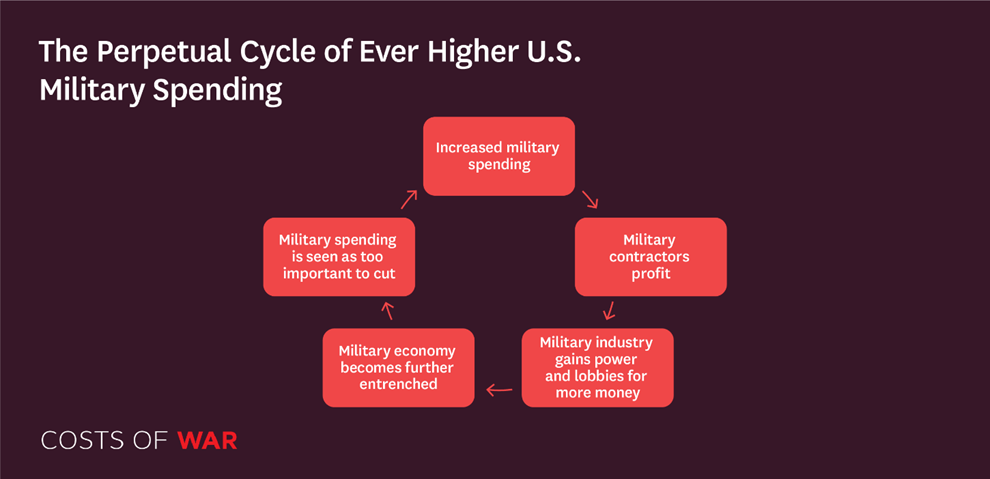
In sum, since the establishment of the permanent war
economy in the 1940s millions of proclaimed “enemies” have been killed and
seriously injured, mostly in the Global South. Permanent physical and
psychological damage has been done to U.S soldiers, predominantly poor and
minorities as they too are victims of war.
In addition, military spending has distorted national priorities and invested
U.S. financial resources in expenditures that do not create as many jobs as
investments in construction, education, or healthcare. And, as Andrew Bacevich,
Seymour Melman and others have called it, “the permanent war economy” has
created a culture that celebrates violence, objectifies killing, dehumanizes
enemies, and exalts super-patriotism through television, music, video games,
and educational institutions.
There is no doubt that there is an inextricable
connection between war-making abroad and human suffering at home. Now is the
time for peace and justice movements to act on these connections.
********************************************************************************************************************
Wednesday, June 1, 2022
The United States
Escalates War in the Heartland of Europe By Sending Advanced Rockets: Makes
Diplomacy More Difficult
Harry Targ
President Biden on Tuesday confirmed that his
administration is sending medium-range advanced
rocket systems to Ukraine, responding to a top request
from Ukrainian officials who say the weapons are
necessary to curb the advance of Russian forces in the east. (Rachel Pannett, John Hudson,
“Biden confirms U.S. is sending advanced rocket systems to
Ukraine”. Washington Post, June 1, 2022)
“America’s goal is straightforward: We want to
see a democratic, independent, sovereign and prosperous Ukraine with the means
to deter and defend itself against further aggression.” President Joe
Biden.
https://www.nytimes.com/2022/05/31/opinion/biden-ukraine-strategy.html
“Adversaries around the globe are becoming more
sophisticated. To protect soldiers, citizens and infrastructure, our customers
require the most advanced tactical missile capabilities. The Lockheed Martin
High Mobility Artillery Rocket System is a strategic capability, improving
homeland and important asset defense while reducing overall mission
costs”(HIMARS: Protecting our soldiers with combat proven reliability)
\https://www.lockheedmartin.com/en-us/products/high-mobility-artillery-rocket-system.html#:~:text=High%20Mobility%20Artillery%20Rocket%20System,Lockheed%20Martin
Opposing Imperialism and War at the Same
Time
The peace movement has often been faced with a
dilemma. Should it channel its energies in opposition to imperialism, including
economic expansion and covert operations, or should it mobilize against war, or
both. The problem was reflected in President Obama’s August 5, 2015 speech
defending the anti-nuclear proliferation agreement with Iran. On the
one hand he defended diplomacy as the first tool of a nation’s foreign policy
and on the other hand his defense included the argument that through diplomacy
the United States “won” the Cold War, and thereby defeated a bloc of states
that opposed capitalist expansion. The implication of his argument was that
pursuing imperialism remained basic to United States foreign policy but
achieving it through peace was better than through war.
The speech was presented at American University 52
years after President Kennedy called for peaceful competition with the former
Soviet Union. In June, 1963, nine months after the Cuban Missile Crisis, which
nearly led to nuclear war, and weeks after Soviet leader Nikita Khrushchev’s
call for “peaceful coexistence,” President Kennedy responded by urging the use
of diplomacy rather than war in the ongoing conflict with the Soviet
Union.
A small but growing number of scholars and activists
in the early 1960s had begun to articulate the view that the threat of nuclear
war, growing U.S. involvement in Southeast Asia, and repeated covert
interventions in Guatemala, Iran, Cuba, and the Congo, had to do with U.S.
imperialism. The dilemma for the peace movement in 1963 then as it is in 2022
is how to respond to United States imperialism at the same time as supporting
the use of diplomacy to forestall wars.
The Two Strands of Imperial Thought:
Neoconservatism and Humanitarian Interventionism Lead to the Same Policies
Despite differences in political discourse since the
collapse of the Soviet Union in 1991, “neoconservative” and “humanitarian
interventionist” factions of the foreign policy elite, have continued to
advocate policies that have retained war as a central tool of US global goals.
(This tool, of course, is a centerpiece of pressure from the arms industry).
Therefore, any foreign policy initiative that reduces the possibility of war
and arguments about its necessity should be supported by the peace movement. In
2015, the agreement with Iran endorsed by most countries except Israel
constituted an effort to satisfy the interests of Iran and the international
community without the shedding of blood and creating the danger of escalation
to global war.
Neoconservatives, celebrants of war, have had a long
and growing presence in the machinery of United States foreign policy. James
Forrestal, the first Secretary of Defense in the Truman Administration, was a
leading advocate for developing a militaristic response to the Soviet Union in
the years after World War II. As historian Andrew Bacevich pointed out,
Forrestal was one of the Truman administrators who sought to create a
“permanent war economy.” He was, in Bacevich’s terms, a founding member of the post-World
War II “semi-warriors”.
Subsequent to the initiation of the imperial response
to the “Soviet threat” --the Marshall Plan, NATO, wars in Korea and Vietnam,
the arms race--other semi-warriors continued the crusade. These included the
Dulles brothers (John and Alan), Air Force General Curtis LeMay, and prominent
Kennedy advisors including McGeorge Bundy and Walter Rostow, architect of the
“noncommunist path to development,” in Vietnam.
Later, key semi-warriors such as Donald Rumsfeld, Dick
Cheney, Elliott Abrams, Robert Kagan, and others formed the Project for a New
American Century (PNAC) in the 1990s. They had gained their first experience in
the administrations of Richard Nixon and Ronald Reagan. The PNAC view of how
the United States should participate in world affairs is to use military
superiority to achieve foreign policy goals. The key failure of Clinton foreign
policy, they claimed, was his refusal to use force to transform the world. For
starters, he should have overthrown Saddam Hussein in Iraq.
The neoconservative policy recommendations prevailed
during the eight years of the George Walker Bush administration. International
organizations were belittled, allies were ignored, arms control agreements with
Russia were rescinded and discourse on the future prioritized planning for the
next war. And concretely the United States launched long, bloody, immoral wars
in Iraq and Afghanistan.
Humanitarian interventionists, more liberals than
conservatives, argued that the United States should use force, but more
selectively than proposed by the neoconservatives, to achieve varied goals.
Their goals included interventions that allegedly defended the quest for human
rights. Although, advocates of humanitarian interventionism argued that the
United States must use all means available, military and diplomatic, to
maximize interests and values, force need not be the first or only instrument
of policy.
But in the end the humanitarian interventionists
encouraged bombing Serbia, intervening in a civil war in Libya, funding rebels
perpetuating war in Syria, expanding military training and a U.S. presence in
Africa, and funding opposition elements against the government in Venezuela. In
addition, with advice from humanitarian interventionists, the United States
increased the use of drones to target enemies of U.S. interests in East Asia,
the Persian Gulf, and the Middle East.
In the United States both neoconservatives and
humanitarian interventionists have led the charge for war-making since World
War II. Between the end of that war and the 1990s, 10 million people died in
wars in which the United States had a presence. Hundreds of thousands of young
men and women serving in the armed forces of the United States have died or
been permanently scarred by U.S. wars. And the physical landscapes of Southeast
Asia, the Persian Gulf, Central America, and the Middle East have been devastated
by war. And in the United States, foreign policy elites, politicians, and think
tank experts still advocate violence to address international problems.
And the War in Ukraine Today
Charles Osgood, a social psychologist, developed his
strategy of Graduated Reciprocation in Tension Reduction or GRIT in the 1960s.
He claimed it worked during the Cuban Missile Crisis and others have claimed
that it has worked in other conflict situations such as US/Iranian
negotiations. https://savinghumans.wordpress.com/2014/05/21/building-a-spiral-of-trust-through-grit/
GRIT’s basic point is to get one side, in this case
US/NATO/Ukraine, to make some serious but not risky unilateral moves inviting
the other side to reciprocate. (And that is where peace movement activism and
pressure might come in.) And such de-escalatory moves should be continued but
not to endanger the security of the initiating party. (And the recent
conversation between Secretary of Defense Lloyd Austin and Russian Defense
Minister Sergey Shoygu was one example which has apparently not been
continued).
The GRIT strategy would suggest that the Russians
might eventually stop the killing, perhaps order troops in place, and/or pull
back some troops. One critical goal would be to get a number of nations
to send representatives to negotiate a ceasefire and further tension-reduction.
In this case the Minsk Accords might be a starting place.
GRIT may not work but is worth a try. And if one looks
at the GRIT strategy for tension-reduction US policy is now doing just the
opposite; that is the US is escalating by word and deed including more threats,
more demands, more arms, and more calls for expanding the scope of the
conflict.
And it is in this context that the announcement by
President Biden that the United States is sending medium-range advanced
rocket systems to Ukraine is a move in the wrong direction. If it is true, as
Biden’s New York Times editorial claims, that he wants negotiation to
end the war in Ukraine he is carrying out policies that are the direct opposite
to a de-escalatory strategy suggested by Osgood and others. And President
Biden has put the humanitarian interventionist gloss on the escalatory policy
by declaring that the US goal is to support a “democratic,
independent, sovereign and prosperous Ukraine.”
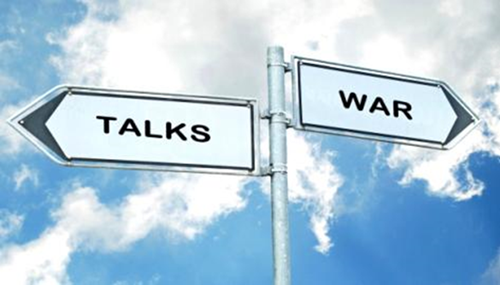
So, while social psychology is not political economy
or realpolitik, it might help end the killing. And for the peace movement
stopping the killing and reducing the threat of global nuclear war means
prioritizing “talks not war,”
http://psychology.iresearchnet.com/social-psychology/antisocial-behavior/grit-tension-reduction-strategy/
In sum, the Russian invasion of Ukraine is deplorable
and the issues between all contending parties are more intractable today than
the negotiations with Iran referred to above. And yesterday’s announcement of
the reported US transfer of the new round of weapons to Ukraine has deepened
the conflict beyond the Russian invasion of February 25. Russia’s engaging in
violence and destruction, and the United States and NATO supplying
arms to Ukraine, can only lead to more death, hunger, and the danger of
escalation to nuclear war.
Therefore, in the context of a huge arms industry and
global economic and political interests, any presidential initiative that uses
diplomacy rather than force, declares its opposition to unilateral action, and
challenges the war mindset deserves the support of the peace movement. And any
military escalation should be opposed.
https://tribune-diplomatique-internationale.com/mouvement_pour_la_paixdissolution_de_lotan/
https://covertactionmagazine.com/2022/04/28/peace-movement-needs-to-demand-dismantling-of-nato/#comments
**************************************************************************************************************************************************************************
The NATO Summit
Closes With New Commitments to Increase the Militarization of Europe (and the
World)
Harry Targ
Friday, July 1, 2022
Monday of the week of the long-advertised summit of
the North Atlantic Treaty Organization, the organization’s Secretary-General
Jens Stoltenberg announced that it would increase “high-readiness military
forces from 40,000 to over 300,000.” https://truthout.org/articles/nato-will-increase-ranks-of-high-readiness-forces-by-650-percent/
Subsequently, leaders of NATO countries met in Madrid
from June 29-30 and made key decisions to advance the organization and
militarism in Europe and around the world. According to a NATO document the
30-nation military alliance identified “Russia as the most significant and
direct threat to Allied security” and referred to “China for the first
time,”and included “other challenges like terrorism, cyber and hybrid.” Perhaps
most troubling from a peace point of view was the document’s announcement that
deterrence and defense would be enhanced by “more troops and more
pre-positioned equipment an weapon stockpiles in the east of the Alliance,
enhancing NATO’s eight multinational battlegroups…”
NATO plans included recommitments of each member
country to provide 2 percent of their GDP to the organization’s budget and
invitations to new members, Sweden and Finland. NATO documents refer to the
Russian threat and “China’s growing influence and assertiveness.” For the first
time other attendees included representatives from
Australia, New Zealand, Japan, and the Republic of Korea presumably in regard
to the China “threat.” In addition, the NATO press release referred to a
recommitment “to the fight against terrorism and addressed NATO’s response to
threats and challenges from the Middle East, North Africa, and the Sahel.” And
finally, the NATO partners made long term financial commitments to addressing
the climate crisis.
https://www.nato.int/cps/en/natohq/news_196144.htm
At the closing press conference, the NATO Secretary
General indicated that “we face the most serious security situation in
decades.” Peace forces can agree with this conclusion but for different
reasons. For example, the NATO summit made decisions to:
-Increase the militarization of Central Europe
-Once again increase the membership of the
organization
-Define Russia as the number one enemy of
international security
-Allude to China as an additional threat to world
security
-Globalize the conflict in Europe
-Once again fuel the arms race
-Make permanent the war in Ukraine
-And despite promises to the contrary, to sweep the
mortal threat of climate disaster under the rug.
(Just as an aside, NATO in the spring, 1955 decided to
admit the then Federal Republic of Germany into membership. One week later the former
Soviet Union created the Warsaw Pact, a ‘security” organization that mirrored
NATO. Six years later, the United States and the Soviet Union almost went to
nuclear war over the then divided Germany. In other words, NATO’s expansion
over 60 years ago escalated tensions and the danger of nuclear war between the
two great powers).
On NATO’s “strategic concept” see:
https://www.nato.int/nato_static_fl2014/assets/pdf/2022/6/pdf/290622-strategic-concept.pdf
*****************************************************************************************************************************************************************************
BUILDING A PEACE
AND JUSTICE MOVEMENT IN THE NEW AGE OF EMPIRE: 2003 to 2022
By Harry Targ
Thursday, September 22, 2022
(Revised from an April 16, 2003 essay)
The Peace Movement Said “No” to the Iraq
War in 2003
In the aftermath of the February 15, 2003, massive worldwide mobilization
against US war in Iraq, activists aptly borrowed the metaphor of the “two
superpowers” from New York Times reporter Patrick Tyler. One
superpower was United States imperialism and the other, the power of
the people.
While the two-superpower thesis remains appropriate
today, the peace movement needs to develop its content and ground the
contesting powers in their material realities today. First, it needs to clarify
the connections between US capitalism, global conquest, militarism, and visions
of empire. Second, it needs to discern whether individual imperial superpowers
are homogeneous or riddled with factional disagreements that can be used for
its purposes. For example, in the US case, analyses should discover where multinational
corporations and international financiers stand, whether the oil and/or
military industries are driving the doctrine of preemption, and which, if any,
sectors of the ruling class regard unilateralism, globalism, and militarism as
a threat to global trade, production, investment and speculation. Third, the
peace movement must analyze the role and presence of multiple super-powers in
collaboration with each other (or unilaterally in the Russia case today) who
together or singly seek to dominate other nations and peoples.
As to the anti-imperial superpower, the peace movement should understand it to
consist of smaller and poorer nations, masses of workers all across the face of
the globe, and representatives of a large range of religious, labor, women's,
environmental and other groups from civil society. Most nations are part of the
bloc because of the momentous mass mobilizations of their citizens to say no to
war. It was extraordinary to see poor and vulnerable countries such as
Cameroons or Angola, and traditional subordinates of the United States, Chile
and Mexico, reject US pressure to support the war on Iraq in the United Nations
Security Council in 2003.
Most importantly, the second superpower was represented by what in 2003 was
perhaps the largest global protest in human history. With the launching of the
Iraq war in March 2003 the steadfast opposition grew in size and militancy.
In the United States in 2003 protests occurred in hundreds of cities and towns;
city councils in over 160 cities passed resolutions against war; and every
church denomination but the Southern Baptists said "no" to war. It is
true that when war started the "rally round the flag" phenomena
kicked in: 70 percent of the people supported President Bush's action. However,
just before the war started about half of the US people supported giving the
weapons inspectors more time to do their job. Furthermore, support for the war
was more likely among those who believed that there was a connection between
Iraq and the 9/11 terrorist attacks on US targets. Party differences were stark
in reference to war: Republicans supported the Bush war on Iraq about 20 to 30
percent more than Democrats.
Finally, people were scared. They were scared of
terrorism, of job loss, of economic depression, of devalued pensions. Some
worried about being arrested for conduct defined as criminal by the Patriot
Act. In fact, then (as now) we lived in a culture that promoted fear.
What was done to nourish and expand the movement for peace and justice during
the Iraq War (and what can be done today)? A consensus emerged in the peace
movement in 2003 that over several months, perhaps years, grassroots
organizing-networking across neighborhoods, churches, union locals, and civic
groups-was central. In the US one-third to 40 percent of the population
probably supported war in 2003 and the Bush foreign policy agenda. Perhaps
one-third were inalterably opposed. This left another third undecided,
confused, or marginally supportive of the war on Iraq.
The target of grassroots work was bringing the
undecided people into the peace and justice camp. Perhaps, it was thought, what
would drive them into the antiwar camp would be fiscal crises at state and
local levels, economic stagnation and job loss, the dismantling of the meager
health care system, the continued marginalization of public schools, and
crumbling infrastructure all around nation. People were reminded of the fact
that while economic crisis grows by the days and weeks, the administration increased
defense spending to a record $400 billion in 2004 (and over $800 billion today)
while state and federal taxes on the rich were cut.
***************************************************************************************
Monday,
October 3, 2022
END THE WAR:
DIPLOMACY NOT BOMBS
On September 15, 2022, Peace
Activists Hit the Streets from DC to San Francisco Urging Ceasefire
in Ukraine
On February 24, 2022, Russia launched a massive
invasion of Ukraine. The Ukrainians responded and their response was fueled by
billions of dollars of US and European military equipment and private armies.
Thousands of Russian and Ukrainian soldiers have died, and millions
of Ukrainians have fled the war. The leaders of Russia, the United States, and
even Ukraine talk of the possible use of nuclear weapons. Negotiations between
competing parties have broken down.
Sectors of the peace movement in the United States
have demanded that all sides participate in negotiations not war. Pacifists in
Ukraine, presumably a small minority, have urged an end to the fighting and
larger numbers of Russians have protested their country’s invasion of Ukraine.
Protestors on September 15 in the US rallied for all
sides to stop sending more arms and fighting and begin serious negotiations to
end the violence. For example, in Milwaukee
“antiwar activists, including a county supervisor,
took their peace flags and "Diplomacy, Not War" signs to the campus
of conservative Marquette University, where they passed out hundreds of flyers
with QR codes for students to email their Congress members for a ceasefire.
Organizer Jim Carpenter, co-chair (with this author) of the foreign policy team
of Progressive Democrats of America, told skeptics who want a fight to the last
Ukrainian, ‘Are you more concerned about saving lives or saving territory’?"
(Marcy Winograd, “Peace Activists Hit the Streets From DC to San Francisco
Urging Ceasefire in Ukraine,” Common Dreams, September 20, 2022. https://www.commondreams.org/views/2022/09/20/peace-activists-hit-streets-dc-san-francisco-urging-ceasefire-ukraine)
In the face of increased probabilities of nuclear war,
the peace movement needs to build a worldwide movement of historic proportions,
comparable or greater than in 2003. The task would be to stop the escalation of
war in the Ukraine and its spread to Asia, Africa, and Latin America. This will
take grassroots organizing, building global solidarity, and mobilizing for
peoples' power in the United Nations. This may be our last chance to build a
peaceful and just world.
Particularly, mass mobilization could be animated by
the vision of vibrant international institutions that could represent the
"peoples’” interests. The United Nations, usually a reflection of the
distribution of power in the world, can be made to represent the people of the
world. Particularly, the UN General Assembly, where all nations have only one
vote, can be made viable as it was in the 1960s and 1970s when the U.S. and the
Soviet Union were competing for the "hearts and minds" of the newly
independent nations.
Also the peace movement should direct its solidarity
to the Group of 77, the movement of non-aligned nations that seeks social and
economic development in a world at peace. During various periods in its
history, the Group of 77 has stood up against the forces of global capitalism.
The peace movement should stand with the Group of 77 today.
In the end, the metaphor of the two superpowers, economic ruling classes,
bureaucratic elites, and generals in powerful countries versus their opponents,
the people, still make sense. The only hope for humankind is the mobilization
of peace movements, the second superpower, to demand an end to war. And for the
most part, while displaying solidarity with peace movements everywhere, peace
movements in individual countries must target the complicity of their own
nations in the making of war.
**********************************************************************************************************************
With Escalating
Tensions Between the United States and China While Serving as a Co-Belligerent
in Ukraine, the Time is Ripe For the Revitalization of the Peace Movement
Harry Targ
Wednesday, December 21, 2022
So Why Isn’t That Happening Right Now? And What Can Be Done?
What Can Be Done to Change That?
The history of the peace movement is replete
with successes and many failures. Peace movement solidarity has been intimately
connected to anti-racist, pro-labor, women, and environmental struggles for
decades. When Dr. King and Mohammed Ali connected the evils of Vietnam with
racism and poverty at home, proponents of peace and social and
economic justice gained in strength.
Today the movement is dispersed because peace
activists are appropriately struggling to defend what remains of
democracy, women’s’ right to choose, gun control, medical care for all, and
other critical issues.
Meanwhile the multidimensional character of war
continues. War and terrorism on the world stage persists including the
systematic use of hybrid war techniques to starve populations in states defined
as enemies, the spread of new high technological instruments of slaughter,
economic sanctions against governments defined as enemies of “democracy,” the
danger of the return to big power conflict, and continuing increases in
military spending. But, what we might call “the war system” is not only about peace
but about economic justice, saving the environment, and ending racism and
sexism as well.
Therefore, it is useful to step back and analyze
“the time of day” on a worldwide basis as to global class forces and their
ideologies, contemporary techniques of empire and their consequences for the
lives of billions, individual global crises; and to assess the fundamental
structures of President Biden’s stances on war, peace, and foreign policy in
general.
The Ruling Class Agenda for the United States
Role in the World
From a Washington
Post editorial, May 21, 2016:
“Hardly a day goes by without evidence that the
liberal international order of the past seven decades is being
eroded. China and Russia are attempting to fashion a world in their
own illiberal image… no matter who takes the Oval Office, it will demand
courage and difficult decisions to save the liberal international order. As a
new report from the Center for a New American Security points out,
this order is worth saving, and it is worth reminding ourselves why: It
generated unprecedented global prosperity, lifting billions of people out of
poverty; democratic government, once rare, spread to more than 100 nations; and
for seven decades there has been no cataclysmic war among the great powers. No
wonder U.S. engagement with the world enjoyed a bipartisan consensus.”
The Washington Post editorial of 2016 quoted
above still clearly articulates the dominant view envisioned by U.S. foreign
policy elites: about global political economy, militarism, and ideology.
First, it is inspired by the necessity of
21st century capitalism to defend neoliberal globalization: government for
the rich, austerity for the many, and deregulation of trade, investment, and
speculation.
Second, the Post vision of a New World Order
is built upon a reconstituted United States military and economic hegemony that
has been a central feature of policymaking at least since the end of World War
II even though time after time it has suffered setbacks.
In addition, despite recent setbacks, grassroots mass
mobilizations against neoliberal globalization and austerity policies have
risen everywhere, including in the United States. However,
The Washington Post speaks to efforts to reassemble the same
constellation of political forces, military resources, and concentrated wealth,
that, if anything, are greater than at any time since the establishment of the
US “permanent war economy” after the last World War.
Historian, Michael Stanley, in an essay entitled “‘We
are Not Denmark’: Hillary Clinton and Liberal American Exceptionalism,” (Common
Dreams, February 26, 2016) pointed to the ideological glue that has been used
by foreign policy elites, liberal and conservative, to justify the pursuit of
neoliberal globalization and militarism; that is the reintroduction of the old
idea of American Exceptionalism. The Biden administration conceptualization of
this ideology is presented as the struggle between “democracy versus
authoritarianism.”
American Exceptionalism presumes the world has little
to offer the United States. The only difference between Democrats and
Republicans on foreign policy is whether the exceptionalism still exists and
must be maintained or has dissipated requiring the need to “make America great
again.” Leaders of both parties, however, support the national security state,
high military expenditures, and a global presence—military, economic,
political, and cultural.
Techniques of Empire Today
Although the imperial agenda, and the
ideological precepts justifying it, has remained the same for two hundred years
the techniques of empire have changed as growing resistance at home and abroad
and new technologies dictate. Changes in warfare, other violence, and imperial
expansion include the following:
-Wars are internal much more than international
and casualties are overwhelmingly civilian rather than military.
-The global presence of some form of the United
States military is ubiquitous-between 700-and 1,000 military bases, in anywhere
from 40 to 120 countries
- U.S. military operations have been privatized.
It is estimated that ninety percent of such work is being done by 110
contractors.
- “Unmanned Aerial Vehicles” have been used to
kill alleged enemies everywhere.
[Source: wilayah.info]
-U.S. agencies, such as the CIA, have been
engaged in the increased use of assassinations and efforts to undermine
governments. So-called “non-government organizations” fund dissident groups in
countries the United States seeks to destabilize.
-So-called “humanitarian assistance” is used to
support United States policies in the Middle East, Africa, and Latin America.
-In sum, the United States increasingly has used
economic tools—economic blockades, trade sanctions, covert financing of pro-US
politicians in other countries, and condemnations by some international
organizations to undermine, starve, and ultimately, it is hoped, to entice
people to overthrow their governments. These techniques, often labeled “hybrid
war,” are being used against Venezuela, Cuba, Nicaragua, Iran, and some thirty
other countries.
Imperial “Trouble Spots”: 2022: NATO/Ukraine and
a New Cold War
In the last week of June, 2022, three months after the
Russian invasion of Ukraine starting the recent and ongoing war, the
long-advertised NATO summit opened. Before the meeting the
organization’s Secretary-General Jens Stoltenberg announced that it would
increase NATO’s “high-readiness military forces from 40,000 to over 300,000,”
an increase of troop levels by 650 percent over the past.
NATO director Jens Stoltenberg advocated for more NATO
funding at NATO summit. [Source: foreignpolicy.com]
Subsequent to the announcement, leaders of NATO
countries met in Madrid from June 29-30 and made key decisions to advance the
organization and militarism in Europe and around the world. According to a NATO
document the 30-nation military alliance identified “Russia as the most
significant and direct threat to Allied security” and referred to “China for
the first time,” and included “other challenges like terrorism, cyber and
hybrid.”
Perhaps most troubling from a peace point of view was
the document’s announcement that deterrence and defense would be enhanced by
“more troops and more pre-positioned equipment and weapon stockpiles in the
east of the Alliance, enhancing NATO’s eight multinational battlegroups…”
Diplomacy was not discussed.
NATO plans included recommitments of each member
country to provide 2 percent of their GDP to the organization’s budget and
invitations to new members, Sweden and Finland. NATO documents refer to the
Russian threat and “China’s growing influence and assertiveness.”
For the first time other attendees
included representatives from Australia, New Zealand, Japan, and the
Republic of Korea presumably in regard to the China “threat.” In addition, the
NATO press release referred to a recommitment “to the fight against terrorism
and addressed NATO’s response to threats and challenges from the Middle East,
North Africa, and the Sahel.” And finally, the NATO partners made long term
financial commitments to addressing the climate crisis.
At the closing press conference, the NATO Secretary
General indicated that “we face the most serious security situation in
decades.” Subsequent to the NATO Summit the war in Ukraine, on all sides,
escalated.
The Asian Pivot
In 2011, U.S. spokespersons announced that the country
would shift resources and attention to Asia from the Middle East, an area with
demanding security and economic interests. Although U.S./Chinese dialogue
continues the United States has criticized China’s repositioning of what it
regards as its possessions in the South China Sea and threatens any Chinese
actions in relation to Taiwan.. The United States has expanded military
relations with Vietnam, reestablished military bases in the Philippines, and has
generally avoided criticizing efforts by ruling Japanese politicians to revise
their constitution to allow for a full-scale remilitarization. The United
States has threatened North Korea over their military maneuvers and has
bolstered the South Korean military. Dee Knight has described recent
Biden Administration policy proclamations concerning China.
U.S. Defense Secretary Lloyd Austin III bumps elbows with Vietnam’s Defense
Minister Phan Van Giang in Hanoi, July 29, 2021. [Source: thediplomat.com]
And corporations engaged in military production
and research universities have used the China threat as a justification for
increased military spending, research and development, cyber-security and a
whole panoply of tools to fight twenty-first century wars.
The Middle East
Most American politicians express their belief that
the U.S. must maintain a special relationship with the state of Israel. One of
the few active mobilizations for peace today is the worldwide campaign to
demand governments, corporations, and other institutions boycott, and divest
holdings in what is regarded as an apartheid state, Israel, which oppresses its
Arab population and those living in the Occupied Territories. The campaign is
so effective that along with national politicians, governors and state legislatures
have taken stands against the BDS campaign. Israel continues to expand its
occupation of Palestinian land, repress Palestinians within Israel, and is
currently not distributing the covid-19 vaccine to Palestinian people, while
other Israel citizens are inoculated.
Next to the historic U.S. ties to Israel, Syria,
Libya, Yemen and other countries have been torn apart by civil war fueled by
western, primarily U.S. intervention, continuing U.S. support of Saudi Arabian
militarism, and the fractionalization of states in the region. The Trump
administration increased the threat of war with Iran. President
Biden, open to returning to the Nuclear Treaty with Iran from which Trump
withdrew, has achieved little success in reducing tensions with Iran.
The Saudi Arabian war on Yemen with U.S. support
continues and Biden visited Saudi Arabia to secure increasing production of
oil, in demand since the onset of the war in Ukraine.
Protest outside White House against Saudi bombing of
Yemen. [Source: bbc.com]
Africa
Nick Turse has described the growing U.S. military
presence on the African continent. A special command structure, AFRICOM, was
established in 2008 to oversee U.S. security interests on the continent.
Initially, Turse reported, the Pentagon claimed that it had one larger base,
Camp Lemonier in Djibouti. But enterprising researchers discovered that the
U.S. military had a dense network of “cooperative security outposts,” bases and
other sites of military presence, at least 60 across the continent, in 34 countries.
The U.S. has defense attaches in 38 countries.
Turse and colleagues reported on data indicating that
the United States has been engaged in secret military training of personnel in
many countries, what they called ‘a shadowy network of U.S. programs that every
year provides instruction and assistance to approximately 200,000 foreign
soldiers, police, and other personnel.” (Douglas Gillison, Nick
Turse, Moiz Syed, “How the U.S. Trains Killers Worldwide,” Portside,
July 13, 2016). In addition, as Richard Dunn reported, on April 27,
Congress overwhelmingly passed the “Countering Malign Russian Activities in
Africa Act” warning of the need for greater US military presence and support of
African nations against a “Russian threat.” In December 2022, President Biden
hosted African leaders to announce modest “development” assistance and to warn
of China’s exploitative intentions on the African continent.
Map of U.S. Special Forces operations in Africa.
[Source: theintercept.com]
Latin America
The influence of the United States in the Western
Hemisphere has weakened since the onset of the Bolivarian Revolution in the
early part of the 21st century. Also Latin Americans oppose the
long-standing efforts of the US to isolate Cuba. However, during the
Trump Administration Obama era “soft power” approaches toward Cuba
were reversed. Trump initiated 243 new economic sanctions against the island.
Biden has not lifted most of them. Cuba solidarity activists estimate, the
economic blockade of Cuba is more severe now than any time since its initiation
in 1960.
June 6-10, 2022, the United States orchestrated a
“Summit of the Americas,” excluding invitations for Cuba, Venezuela, and
Nicaragua. Several Hemisphere nations refused to participate in the meetings in
protest. Mexico and other countries in the region have called for
the revitalizing of regional economic and political organizations without
United States participation and interference. In the United Nations General
Assembly all Latin American countries and virtually all countries in the Global
South vote annually to condemn the US blockade of Cuba. While governments in
Colombia, Bolivia, and elsewhere have emerged to resume the “Pink Tide,” coups
in Peru and Argentina suggest that the right in Latin America (and the United
States) are attempting to push back against it.
[Source: mronline.org]
The Idea of the National Security State
[Source: twitter.com]
The contradiction that still needs an explanation is
the fact that for the most part the American people oppose wars and
intervention. This is particularly so in the twenty-first century when so much
pain and suffering has been caused by wars in Iraq and Afghanistan.
The answer can be found in a variety of explanations
of United States imperialism including what Mike Lofgren has called the
“deep state.” Lofgren defined the “deep state” as “… a hybrid
association of elements of government and parts of top-level finance and
industry that is effectively able to govern the United States without reference
to the consent of the governed as expressed through the formal political
process.” (Mike Lofgren, “Anatomy of the ‘Deep State’: Hiding in Plain
Sight,” Online University of the Left, February 23, 2014).
Power to make critical decisions reside not in the
superstructure of the political process; the place were competitive games are
played for all to see, but in powerful institutions embedded in society that
can make decisions without requiring popular approval. In the end these
institutions have involved the United States in death and destruction all
across the globe.
And Military Spending Continues
("The spending on contractors continues today at
the same rapid clip, accounting for more than half of
average Pentagon spending each year. And with Congress poised to approve
a $778 billion one-year spending
package… Democrats are slashing the Build Back Better bill from $3.5 trillion
to $1.75 trillion over ten years. Meanwhile, Pentagon contractors have received
$3.4 trillion over the past decade." (Lindsay
Koshgarian, "U.S. Military Contracts Totaled $3.4
Trillion Over 10 Years,” Institute for Policy Studies, October 28, 2021).
And with the war in Ukraine, U.S. military
spending in 2022 has exceeded $800 billion dollars. As Raytheon
Technologies CEO Greg Hayes said: “Everything that’s being shipped
into Ukraine today, of course, is coming out of stockpiles, either at DoD [the
Department of Defense] or from our NATO allies, and that’s all great news.
Eventually we’ll have to replenish it and we will see a benefit to the business
over the next coming years.” (William Hartung, “How Pentagon Contractors Are Cashing
in on the Ukraine Crisis,” Quincy Institute, April 17, 2022). In December,
2022, Congress authorized military expenditures of $858 billion (not counting
authorizations to agencies that are really engaging in military activities).
So Where Does the Peace Movement Go From
Here?
Analyses of what is wrong are easier to develop than
thinking through ways to respond. This essay opened with a dilemma, a dispersed
peace movement locally and nationally. It then argued that the foreign policy
elites have had a hegemonic vision of the role of the United States in the
world yesterday, today, and tomorrow. And these elites and institutions of
the national security state have at their disposal 21st century military
technologies to maintain their power in the world.
But a revitalized peace movement can respond to the
complexities of “the time of day”. Approaches the peace movement can take in
the near term include the following:
1.Articulate a theory, a conceptual scheme, that
foregrounds two main elements. First, this “theory” should make crystal
clear that there are fundamental interconnections between the economic system
of capitalism, militarism, and the ideology of American exceptionalism. The
peace movement might work on single issues and aspects of the war problem as
circumstances dictate at particular times, but in the main such movements must
unabashedly show how economics, politics, ideology, and the war system are
interconnected and to end war and militarism, all of the elements
must be seen together.
One way to articulate these connections graphically is
to think about a diamond shaped figure. At the base is an economic system, at
this point-in-time finance capitalism and the exploitation of workers. Above
the base at the two side points are militarism on one side and racism, sexism,
and American exceptionalism on the other. At the top add destruction of nature.
Conceptualizing the war problem in this way we begin to see the connections
between the 21st century state of capitalism as a global system and war,
racism, sexism, ideology, and environmental destruction.
Second, this “theory” should encourage a shift in
thinking about international relations as an issue of the relations among
powerful states to a way of thinking that conceptualizes economics and
militarism as a “North/South” problem.
Theorists like V. J. Prashad have argued that “older”
models of international relations have overemphasized big power conflict at the
expense of understanding how the countries of the Global North have exploited,
invaded, and transformed the economic and political life of what Prashad has
called “The Darker Nations.” To some extend Eurocentric models of international
relations have limited the peace movements’ understanding that the object of
wars and competition have largely been about countries and peoples of the
Global South. (For a useful comparison of a G7 versus BRICS view of the world
see https://fb.watch/ebp1ie-34t/)
Vijay Prashad [Source: wikipedia.org]
2.Use the theory or schema to develop an educational
program that begins with efforts to understand the fundamentals of the war
system, that is connecting economics, to class, race, gender, ideology, and the
environment. Relate the specific issue at hand: Israel/Palestine, Ukraine,
undermining regimes in Latin America for example, to the diamond.
3.Participate in grassroots organizing in solidarity
with others, linking issues to the war/peace paradigm. Particular attention
should be given to articulating the connections between domestic issues and the
war system.
4.Engage in global solidarity. The analysis above has
emphasized the forces of global hegemony, or imperialism. Introduce to peace
and justice struggles ideas about “North/South connections. That is, the deep
structure of international relations for hundreds of years has been primarily
about violence and exploitation of peoples of the Global South by nations,
particularly from Europe and North America, in the Global North. For the vast
majority of humankind economic inequality, starvation, disastrous climate
change and a host of interrelated problems take precedence over conflicts in
Europe. As V J Prashad has pointed out “war is a crime” and war includes
structural as well as direct violence. https://youtu.be/Lg9c0jv6wTA
The tasks of a 21st century peace movement are
not different from those of the past. They involve education, organization, and
agitation. With the growth of worldwide resistance to neoliberal globalization,
austerity, racism, sexism, and destruction of nature, it seems natural
to incorporate concerns for peace and the right to national and personal
self-determination to the budding radical movements of our day.
( An earlier version of this paper appeared as “US
Foreign Policy, International Relations, and Militarism Today”
103-116, Contested Terrains: Elections, War &Peace, Labor, Dialogue
and Initiative,2022, Changemaker Publications).
********************************************************************************************************************
FOREIGN POLICY:
THE ELEPHANT IN THE ROOM (A timely update from a 2017 post
which appeared in The Rag Blog)
Harry Targ
Wednesday, December 21, 2022
An Empire in Relative Decline
United States global hegemony continues to be
challenged. As the beneficiary of war-driven industrial growth and the
development of a military-industrial complex unparalleled in world history, the
United States was in a position in 1945 to construct a post-war international
political and economic order based on huge banks and corporations. The United
States created the international financial and trading system, imposed the
dollar as the global currency, built military alliances to challenge the
Socialist Bloc, and used its massive military might and capacity for economic
penetration to infiltrate, subvert, and dominate most of the economic and
political regimes across the globe.
The United States always faced resistance and was by
virtue of its economic system and ideology drawn into perpetual wars, leading
to trillions of dollars in military spending, the loss of hundreds of thousands
of American lives, and the deaths of literally millions of people, mostly
people of color, to maintain its empire.
As was the case of prior empires, the United States
empire is weakening. There is now the possibility of a multipolar world
emerging with challenges to traditional hegemony coming from China, India,
Russia, and the larger less developed countries such as Brazil, Argentina,
South Africa, South Korea, and Thailand. By the 1970s, even traditional allies
in Europe and Japan had become economic competitors of the United States.
The United States throughout this period of change has
remained the overwhelming military power, however, spending more on defense
than the next seven countries combined. It remains the world’s economic giant
even though growth in domestic product between 1980 and 2000 has been a third
of its GDP growth from 1960 to 1980. Confronted with economic stagnation and
declining profit rates the United States economy began in the 1970s to
transition from a vibrant industrial base to financial speculation and the globalization
of production.
The latest phase of capitalism, the era of neoliberal
globalization, required massive shifts of surplus value from workers to bankers
and the top 200 hundred corporations which by the 1980s controlled about
one-third of all production. The instruments of consciousness, a handful of
media conglomerates, have consolidated their control of most of what people
read, see, hear, and learn about the world.
A policy centerpiece of the new era, roughly spanning
the rise to power of Ronald Reagan to today, including the eight years of the
Obama Administration, has been a massive shift of wealth from the many to the
few. A series of graphs published by the Economic Policy Institute in December,
2016 showed that productivity, profits, and economic concentration had risen
while real wages have declined, inequality increased, gaps between the earnings
of people of color and women and white men grew, and persistent poverty
remained for twenty percent of the US population (https://www.epi.org/publication/inequality-2021-ssa-data/ for
2021 data on economic inequality). The austerity policies, the centerpiece of
neoliberalism, spread all across the globe. That is what globalization has been
about.
Contrary to the shifts toward a transnational
capitalist system and the concentration of wealth and power on a global level,
the decline of U.S power, relative to other nation-states in the twenty-first
century, has increased. China’s economy and scientific/technological
base have expanded dramatically. The wars in Afghanistan, Iraq, and the
spreading violence throughout the Middle East have overwhelmed US efforts to
control events. Russia, Iran, China, and even weaker nations in the United Nations
Security Council have begun to challenge US power and authority. Mass movements
increasingly mobilize against regimes supported by the United States virtually
everywhere (including mass mobilizations within the U.S. as well).
However, most U.S. politicians still articulate the
mantra of “the United States as the indispensable nation.” The articulation of
American Exceptionalism represents an effort to maintain a global hegemony that
no longer exists and a rationale to justify the massive
military-industrial complex which fuels much of the United States economy.
(For more data on military bases see https://www.davidvine.net/bases.html)
Imperial Decline and Domestic Politics
The narrative above is of necessity brief and
oversimplified but provides a backdrop for reflecting on the substantial shifts
in American politics. The argument here is that foreign policy and
international political economy are “the elephants in the room” as we reflect
on the outcomes of recent elections. It does not replace other explanations or
“causes” of election results but supplements them.
First, the pursuit of austerity policies, particularly
in other countries (the cornerstone of neoliberal globalization) has been a
central feature of international economics since the late 1970s. From the
establishment of the debt system in the Global South, to “shock therapy” in
countries as varied as Bolivia and the former Socialist Bloc, to European bank
demands on Greece, Spain, Portugal, and Ireland, to Reaganomics and the
promotion of Clinton’s “market democracies,” and the Obama era Trans-Pacific
Partnership, the wealth of the world has been shifting from the poor and
working classes to the rich.
Second, to promote neoliberal globalization, the
United States has constructed by far the world’s largest war machine. With
growing opposition to U.S. militarism around the world, policy has shifted in
recent years from “boots on the ground,” (although there still are many), to
special ops, private contractors, drones, cyberwar, spying, and “quiet coups,”
such as in Brazil and Venezuela, to achieve neoliberal advances.

One group of foreign policy insiders, the humanitarian interventionists, has
lobbied for varied forms of intervention to promote “human rights,
democratization, and markets.” 2016 candidate Hillary Clinton and a host of
“deep state” insiders advocated for support of the military coup in Honduras, a
NATO coalition effort to topple the regime in Libya, the expansion of troops in
Afghanistan, even stronger support of Israel, funding and training
anti-government rebels in Syria and the overthrow of the elected government of
Ukraine. Secretary of State, Hillary Clinton was a major advocate for
humanitarian interventionist policies in the Obama administration.

Humanitarian interventionists have joined forces with
“neoconservatives” in the new century to advocate policies that, they believe,
would reverse the declining relative power of the United States. This coalition
of foreign policy influentials has promoted a New Cold War against China and
Russia and an Asian pivot to challenge an emerging multipolar world. The
growing turmoil in the Middle East and the new rising powers in Eurasia also
provide rationale for qualitative increases in military spending, enormous
increases in research and development of new military technologies, and the
reintroduction of ideologies that were current during the last century about
mortal enemies and the inevitability of war.
In sum, the “elephant in the room” for the peace
movement pertaining to US politics must include building opposition to an
activist United States economic/political/military role in the world and the
long history of United States imperialism.
Finally, it must be articulated that to the extent
that economics affects domestic politics the neoliberal global agenda that has
been enshrined in United States international economic policy since the 1970s,
coupled with humanitarian interventionism, has had much to do with rising
austerity, growing disparities of wealth and power, wage and income stagnation,
and declining social safety nets at home. As millions of Americans struggle to
survive poverty, inadequate access to healthcare, homelessness, a variety of
environmental disasters it is time to reinsert visions of a
non-interventionist, anti-militaristic foreign policy into our progressive
political agenda.
How Should the Peace Movement Respond to
the Elephant in the Room?
“Somehow this madness must cease. We must stop now. I
speak for those whose land is being laid waste, whose homes are being
destroyed, whose culture is being subverted. I speak for the poor of America
who are paying the double price of smashed hopes at home and death and
corruption in Vietnam. I speak as a citizen of the world, for the world as it
stands aghast at the path we have taken” (Dr. Martin Luther King, Jr.,
April 4, 1967)
This year, the Science and Security Board of the
Bulletin of the Atomic Scientists moves the hands of the Doomsday Clock
forward, largely (though not exclusively) because of the mounting dangers of
the war in Ukraine. The Clock now stands at 90 seconds to midnight—the closest
to global catastrophe it has ever been (2023 Doomsday Clock Announcement,
January 24, 2023).
The Peace Movement has been engaged in a variety of
separate but interconnected tasks. It may be useful to identify them, see how
they are interrelated, and think about ways in which it and other social
justice campaigns can more effectively work together in the coming period.
Peace Movement tasks should include the
following:
1.Oppose war. In 2022 the war in Ukraine has captured
the attention of activists everywhere. Attention also has been paid on other
wars, such as in Yemen and Palestine. Peace researchers have often referred to
the historic need to end “direct violence”; that is killing. That task remains
preeminent.
2.Reconceptualize “war” as a problem not only of
killing and dying in war but also as a problem of hunger, inequality,
environmental spoilation, and powerlessness in a world of power, control, and
oppression. Peace researchers have called this “structural violence.”
Theorists/activists like Vijay Prashad have argued that the problem of “war,”
both direct and structural is more about the divide in resources and power
between the countries of the Global North (the traditional imperial powers in
Europe and North America) and the vast majority of humankind living in Asia,
Africa, the Middle East and Latin America. For Prashad, the war problem is
about hundreds of years of exploitation, occupation, military assault,
sanctions, and the threat and destruction of the resources and environment of
the Global South. From this point of view, the peace movement task is to engage
in solidarity with those struggling for their liberation from domination and
control.

3.Oppose militarism. Historically
peace movements have identified an inextricable connection between growing
militarism and war and further a connection between military spending and
concentrated wealth in selected military corporations. From this point of view
as the old slogan suggests: “war is a racket.” And that "racket” can be
seen as directly reallocating societal resources from fulfilling human needs to
the construction of more and more weapons. Some theorists referred to the
history of United States foreign policy, at least since World War II, as one of
creating a “permanent war economy.”

4.Oppose the use of war to achieve pernicious goals domestically. This
perspective sees war preparation as tied to efforts to create solidarity at
home, to the detriment of domestic social groups seeking significant social
change. For example, as World War II ended, the labor movement
sought significant policy changes to improve the rights and conditions of
American workers. During the late 1940s, workers were demanding more rights to
form unions, national health care, pension systems, and in some unions and
communities an end to racism. The emergence of “the Soviet threat” served to
stimulate nationalism, a rekindling of the vision of American exceptionalism,
and increased repression against those pursuing worker rights and racial
justice. In short, the war system, has served to reallocate societal resources
and create a virulent nationalism which supports the interests of the wealthy
and powerful. The war system, in this sense, is a status quo system. And to
justify the war system an increasingly concentrated media institutionalizes
narratives justifying war and imperialism.

5.Educate, agitate, and organize around these
four major tasks. The questions that peace movements need to address include:
a.How to theorize about the interconnections between
these four points? How do we develop a compelling narrative that targeted
audiences find compelling for them? Young people, people of color, men,
women, gays and lesbians?
b.How to network with other peace and social justice
organizations?
c.And for now what kind of programs-education, street
heat, networking, organizing- should the peace movement engage in to
address the four key elements raised above.
*************************************************************************************************************
Imperial
Decline and the Threat of a New Cold War With China: Revisiting
a Book Review in the Context of Rising Tensions
Harry Targ
February 20, 2023
Alfred McCoy, In the Shadows of the American
Century: The Rise and Decline of US Global Power, Haymarket Books,
2017.
Researchers affiliated with the Bulletin of the Atomic Scientists who
regularly assess the danger of nuclear war declared that the probability of
nuclear war has increased over the last year. Using their “doomsday clock” as a
metaphor the dial was recently moved to 100 seconds to midnight; midnight
signifying the onset of nuclear war. The scientists believe that the danger of
nuclear destruction and devastating climate disaster is greater now than at any
time since the early 1980s.
The context for this grim prediction is well-reflected
in a 2017 book by University of Wisconsin historian Alfred
McCoy, In the Shadows of the American Century. The author
describes the twentieth century emergence of the US as the global hegemonic
power based upon economic superiority and overwhelming military power. However,
this economic and military dominance is being challenged today.
Perhaps the most critical challenge to the American
empire, he suggests, is the rise of China, particularly as an economic
successor to US control of the global political economy: Chinese domestic
development, Chinese trade and investment with countries on every continent,
and an Asian financial and trading system that challenges the historic US
presence in the region. In economic terms the global system is changing from
unipolarity to multipolarity.
In response to this decline McCoy suggests that the
United States has embarked on a program to expand militarily programs around
the globe and in outer space including preparing for cyber space war,
occupying space, developing biometrics to identify potential enemies,
increasing drone warfare capabilities, and the creation of a whole panoply of
weapons that exceed the imagination of science fiction. In sum, therefore, the
new militarism is designed to forestall and overcome declining empire.
This book is a must read for the peace movement
because it indicates the dangerous world in which we live, the emergence of a
New Cold War with China, and the increased probability of global destruction.
It suggests that peace activists must continue to oppose militarism and develop
a public discourse that celebrates the emergence of a multi-polar world, a
world in which more countries can participate in global policy-making. The
alternative could be, as the atomic scientists warn, a nuclear apocalypse.
Saturday, July 22,
2023
Washington's New Cold War: a book review
Harry Targ
Socialism and Democracy
A Book Review:
John Bellamy Foster, John Ross, and Deborah Veneziale, with an
introduction by Vijay Prashad, Washington’s New Cold War: A Socialist
Perspective, Monthly Review Press, 2023, 99 pp.
The authors of this volume describe in vivid detail the role
United States militarism is playing in leading the world down the path to
nuclear and environmental destruction. Vijay Prashad, in his brief introduction
reports on a conversation he had in 2003 with a US State Department spokesman
who reported that US policy is based on “short-term pain and long-term gain.”
In sum, Prashad says, the spokesperson was suggesting that the United States
was prepared to inflict pain and suffering on victims in other nations and
among the working class in the United States in exchange for the long-term
revitalization of US hegemony abroad and at home. Prashad reports that this
comment was made at the outset of the war in Iraq and two years after the US
attacked Afghanistan.
Then John Ross, in a lengthy and comprehensive essay describes
the “increasing international military aggression” of the United
States characteristic of the recent past. He points out that before Ukraine, US
military action primarily targeted poor and/or non-nuclear countries such as
Panama, Iraq, Serbia, Afghanistan, and Libya. Now, Ross warns, the US is
engaged in a war against Russia, a nuclear state.
He describes compellingly the thirty-year escalation of US
involvement in Ukraine; the expansion of NATO, participation in the Maidan
coup, the funding and training of the Ukrainian military, the dismissal of the
provisions of the Minsk Accords, and the transferring billions of dollars to
Ukraine to fight the Russian armies. He suggests that the Ukraine model is
being used against China, by escalating tensions over Taiwan. The author
concludes that the Ukraine War and the provocations toward confrontation with
China are manifestations of the US project of
reestablishing hegemony in a world in which China and the rest of
the Global South are seen as challenges to US economic and political dominance.
To use Ross’s words the US;
“ relative economic position has weakened tremendously,
but its military power is great. Therefore, it attempts to move issues to the
military terrain, which explains its escalating military aggression and why
this is a permanent trend.”
And he warns us: “This means that humanity
has entered a very dangerous period. (21-22).
In the second essay, Deborah Veneziale examines the domestic
actors in the United States that are leading the way down a war path. She
interrogates for 2023 what has been called the “military/industrial complex.”
She demonstrates how once competing factions of the foreign policy elite have
come together to advocate a policy of return to US global hegemony,
particularly targeting China as the bulwark of opposition to the project.
Essentially, she suggests that the controversial document prepared by former defense
official Paul Wolfowitz in 1992 calling for the US “to maintain a permanent
unipolar position” has been embraced by all major parties to the foreign
policy-making process. Second, these elites have decided that China is the main
enemy. And third, she describes “the merging of belligerent foreign policy
elites” which include influential think tanks, military contractors, big tech
corporations, and elite decision-makers circulating from military corporations
to governments and back to the corporations again. As she writes:
“The military-industrial complex, composed of generals,
politicians, tech companies, and private military contractors, is pursuing a
massive expansion of U.S. military capacity. Today, nearly all in Washington
use China as well as Russia as their pretext for this build up” (54).
Finally, John Bellamy Foster raises the specter of the
inextricable connections between the danger of nuclear war and environmental
collapse. He uses E. P. Thompson’s 1980s discussion of “exterminisms” to link
the danger of nuclear war with the danger of “nuclear winter.” In other words,
the escalating tensions described in the other essays could lead along with
death and destruction by nuclear war to a radical elimination of the viability
of the planet due to fire, smoke, dramatic declines in the earth’s temperature,
and the end to the capacity of survivors to redevelop agriculture. We, he
claims, are playing with the dangers of the two “exterminisms,” killing of
people and the destruction of the planet. And, ultimately these potential life
destroying crises, the New Cold War, have their roots in the logic of
capitalism.
After summarizing some of the science that has led to the
confirmation of the likelihood of a “nuclear winter” coming from nuclear war,
Foster described the dangerous shift in US military policy from a strategy of
deterrence (“counter value” or “counter city”), with the former Soviet Union,
to a “counterforce” strategy.
The earlier nuclear strategy of the United States and the Soviet
Union, MAD, or mutually assured destruction, was based on the proposition that
the US (and the former Soviet Union) would maintain enough nuclear capacity to
survive a first strike from their enemy and respond in kind. This second-strike
capacity would insure that neither side would strike first, knowing that their
own society would be destroyed.
In the Reagan period US military doctrine shifted to
a “counterforce” strategy, that is billions of dollars are being invested in
developing the capacity to destroy a potential enemy’s second strike capacity,
by hitting their military targets first. This counterforce strategy, most
theorists have argued, makes nuclear war more likely. Some of this fear might
have been behind the Russian assault on Ukraine.
In sum the authors portray a contemporary reality that includes
the US drive to recreate global hegemony in a more multipolar world and
dramatically escalated tensions among nations with nuclear weapons. US policy
is rationalized by white supremacist ideology. Finally, enormous profits are
derived from dramatically increased military spending.
The small size of the volume, the richness of the data, and the
enormity of the warnings make this an important volume for use in classrooms
and study groups.
While accessible for discussion, shortcomings remain:
1.The volume does not address or evaluate the intentions of key
adversary actors. Particularly, not enough attention is given to the fact that
Russia did invade Ukraine, in a sense precipitating the global crisis the
authors address.
2.The authors give insufficient attention to contradictions:
disagreements within the US foreign policy elite (such as among the so-called
“realists” and the influential role of the Quincy Institute as an example),
debates among the military, the role (insufficient though it is) of the
so-called Squad in Congress, and perhaps most importantly the US and the global
peace movement.
3.The authors do not address adequately “what is to be done.”
Foster’s compelling linkage of the “exterminisms” of nuclear war and nuclear
winter could/should be a centerpiece of peace and environmental movements
coming together more effectively. And surely, now, in the midst of the
so-called deficit debate the connections between growing economic immiseration,
rising healthcare costs, homelessness, and, on the other hand military
spending, close to a trillion dollars, should be the basis for rebuilding a
unified mass-based movement that sees the connections between United States
foreign and domestic policy