Saturday, April 23, 2022

THE CUBA/UNITED STATES STORY: 1959-1962

 Harry Targ

The Biden administration, however, is ignoring the most important lesson of the missile crisis: all lines of communication—political, military and diplomatic—must be kept open at all times, particularly in the nuclear age. The missile crisis ended without a formal agreement, but less than a year later the two sides signed a formal agreement to ensure safe and quick communications between Washington and Moscow. (Melvin Goodman, "Lessons From the Cuban Missile Crisis" Counterpunch, October 7, 2022.)


THE BAY OF PIGS TO THE MISSILE CRISIS: Part 1

The 60 year anniversary of the Cuban Missile Crisis is approaching. In an introduction to the presentation of new documents on the crisis the National Security Archives warned  that “the combination of nuclear weapons and human fallibility will eventually result in nuclear destruction if these weapons are not abolished” (www.gwu.edu/~nsarchiv/). The historical record shows that the decisions leading to the crisis which almost brought nuclear war have been repeated over and over again since the early 1960s. Many fear that the brutal Russian war on Ukraine and the US/NATO response could escalate to the point of nuclear war.

Particularly, the Kennedy Administration pursued numerous policies to forestall revolutionary ferment in the Western Hemisphere. These included covert military action, economic assistance, and nuclear confrontation with the Soviet Union. The following blog essays address these policies. They are adapted from my book on United States foreign policy during the Cold War (Strategy of an Empire in Decline: Cold War II. 1986 available as a pdf at https://heartlandradical.blogspot.com/2022/03/strategy-of-empire-in-decline.html

The United States Invades Cuba

Before Fidel Castro’s 26th of July Movement seized power in Cuba in January, 1959, the United States had long controlled the island nation ninety miles from its shores. The country was ruled by dictator, Fulgencio Batista, a close ally of the United States, who, through repression and corruption, generated large-scale opposition in the countryside and the cities. In 1958 the State Department urged Batista to turn control over to a caretaker government, to forestall the victory of Fidel Castro, Che Guevara, and Camillo Cienfuegos, and their growing guerrilla armies, who were on the verge of overthrowing the dictator. Batista rejected the pressure to flee. His U.S. backed armies and police were defeated. The revolutionaries were victorious.

Before the revolution, United States investors controlled 80 percent of Cuba’s utilities, 90 percent of its mines, 90 percent of its cattle ranches, its three oil refineries, half its railroads, and 40 percent of its sugar. In a land rich with human and natural resources and a modern infrastructure and a tourist sector second to none in the Hemisphere, 600,000 Cubans were unemployed, more than half the population lived in slums, and one-half the population had no access to electricity. Forty percent of the Cuban population was illiterate, most Cubans spent much of their income on rent, and among wealthy Cubans, 1.5 percent of landowners owned 46 percent of the land.
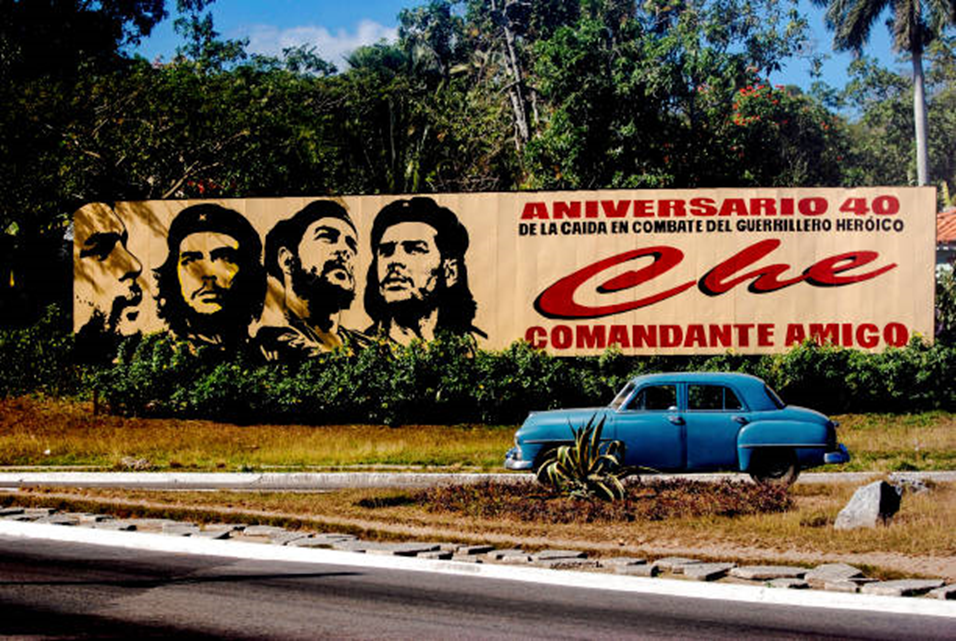


When the Castro-led revolutionaries assumed office, they began to develop a series of policies to alleviate the worst features of Cuban poverty. The revolutionary government invested in housing, schools, and public works. Salaries were raised, electrical rates were cut, rents were reduced by half. On a visit to the United States in April, 1959, Castro, who had proposed a large-scale assistance program for the Western Hemisphere to the Eisenhower Administration, was ignored by the President.

Returning from a hostile visit to Washington, Castro announced a redistributive program of agrarian reform that generated opposition from conservative Cuban and American landowners. These policies involved transfers of land to the Cuban people from the huge estates owned by the wealthy. The Eisenhower administration responded by reducing the quantity of United States purchases of Cuban sugar. Cuba then nationalized the industry.

In February, 1960 Cuba signed trade agreements with the Soviet Union. The Soviets agreed to exchange their oil for sugar no longer purchased by the U.S.  When the U.S. owned oil refineries refused to refine the Soviet oil, the Cuban government nationalized them.

In July, 1960, the U.S. cut all sugar purchases. Over the next several months the Cuban government nationalized U.S. owned corporations and banks on the island. Therefore, between the spring of 1960 and January 1961 U.S. and Cuban economic ties came to a halt and the island nation had established formal diplomatic relations with the Soviet Union. Shortly before Eisenhower left office, the break was made symbolically complete with the U.S. termination of formal diplomatic relations with Cuba.

As U.S./Cuban economic and diplomatic tensions were escalating, President Eisenhower made a decision that in the future would lead the world to the brink of nuclear war. In March, 1960, he ordered the Central Intelligence Agency to create a Cuban exile force that would invade the island and depose Fidel Castro. Even the State Department knew at that time that Castro was enormously popular.

In April, 1961, the newly elected President Kennedy was presented with an invasion plan by the CIA. The agency claimed that the right-wing Cubans would be greeted as heroes when they landed at the Bay of Pigs. After the Castro regime was overthrown, all private assets would be returned, and a Batista-like government would be reestablished.

The Bay of Pigs invasion, April 17-19, 1961, was launched by fifteen hundred Cuban exiles. It was an immediate failure: 500 invaders were killed and the rest captured. No uprising against the revolutionary government occurred. Kennedy was criticized in the United States for not providing sufficient air support to protect the invading army. The critics ignored the fact that the revolutionary government had the support of workers and peasants who would fight to defend it.


After the invasion attempt failed, President Kennedy warned of the danger of the “menace of external Communist intervention and domination in Cuba.” He saw a need to respond to Communism, whether in Cuba or South Vietnam. In the face of perceived Communist danger to the Western Hemisphere he reserved the right to intervene as needed. The lesson he drew from the Bay of Pigs was the need for escalated adventurism, not caution.


THE CUBA STORY: THE BAY OF PIGS TO THE MISSILE CRISIS: Part 2

Harry Targ

“I have called on all the people of the hemisphere to join in a new Alliance for Progress - Alianza para Progreso - a vast cooperative effort, unparalleled in magnitude and nobility of purpose, to satisfy the basic needs of the American people for homes, work and land, health and schools - techo, trabajo y tierra, salud y escuela….

To achieve this goal political freedom must accompany material progress. Our Alliance for Progress is an alliance of free governments-and it must work to eliminate tyranny from a hemisphere in which it has no rightful place. Therefore let us express our special friendship to the people of Cuba and the Dominican Republic-and the hope they will soon rejoin the society of free men, uniting with us in our common effort” (Address by President Kennedy at a White House reception for Latin American diplomats and members of Congress, March 13, 1961).

“Those who make peaceful revolution impossible will make violent revolution inevitable” (Address by President Kennedy to diplomats one year after his Alliance for Progress speech. March 13, 1962).

The Alliance for Progress as a “Non-Communist” Path to Development


The Kennedy Administration initiated a policy of foreign assistance in Latin America to complement the United States’ historic use of military force in the region. The President’s economic program was announced in the aftermath of long-standing complaints from Latin American dictators and some elected leaders that the United States had supported European recovery, the celebrated Marshall Plan of the 1940s, but ignored the Western Hemisphere. Most importantly, the Kennedy Administration and anti-Communist friends in the Hemisphere became increasingly concerned about the enthusiasm the Cuban revolution was generating in the region.

In the midst of what was presented to the public as the “threat of Communism” in Latin America, Kennedy presented his “Alliance for Progress” aid package to diplomats and Congressmen on March 3, 1961 (about one month before JFK authorized the Bay of Pigs invasion).

The Alliance, the President promised, would provide public and private assistance equivalent to $20 billion to Latin American countries over a ten-year period. The plan projected annual growth rates in Latin America of 2.5 percent and would lead to the alleviation of malnutrition, poor housing and health, single-crop economies, and iniquitous landholding patterns (all campaigns underway in revolutionary Cuba).

Loans were contingent upon the recipient governments, and their political and economic elites, carrying out basic land reform, establishing progressive taxation, creating social welfare programs, and expanding citizenship and opportunities for political participation.

However, the effect of the Alliance, even before Kennedy’s death, was negative. Problems of poverty, declining growth rates, inflation, lower prices for export commodities, and the maintenance of autocratic and corrupt governments persisted. The reality of the Alliance and most other aid programs was that they were predicated on stabilizing those corrupt ruling classes that had been the source of underdevelopment in the first place.

The connections between the Alliance program and the interests of United States capital were clear. For example, a section of the Foreign Assistance Act of 1962 authorized the president to cut off aid to any nation which nationalized or placed “excessive” taxes on U.S. corporations or which terminated contacts with U.S. firms. The act also emphasized monetary stability and the kinds of austerity programs common to U.S. and International Monetary Fund aid, requiring nations receiving aid to reduce public services and to maintain low wage rates to entice foreign investment. Further, Alliance funds were often to be used to serve the interests of foreign capital; for example building roads, harbors, and transportation facilities to speed up the movement of locally produced but foreign-owned goods to international markets.

Finally, the symbolism of the Alliance proclamation by President Kennedy was designed to promote the idea that U.S. resources, in collaboration with reformism in Latin America, would create societies that met the needs of the people and encouraged their political participation. The Alliance was presented as a response to Fidel Castro, a “non-Communist manifesto” for development.

The record of poverty and military rule throughout the Hemisphere suggested that there was no correspondence between symbol and reality. Kennedy, in a moment of unusual frankness, was reported to have said that the United States preferred liberal regimes in Latin America, but if they could not be maintained, it would much prefer a right-wing dictatorship to a leftist regime. After Kennedy’s death, Thomas Mann, Assistant Secretary of State for Inter-American Affairs, in the Johnson Administration, told reporters that U.S. policy in the Western Hemisphere was not about economic development or democratization but fighting Communism and protecting U.S. economic interests.


In reality, the frankness about the motivations behind U.S. policy expressed by Kennedy after the Alliance speech and Thomas Mann after Kennedy’s death clearly showed that the bottom line in terms of U.S. policy remained support for international capital. The Castros of this world, the Kennedy Administration believed (as has every administration since), had to be crushed at all costs. What remained significant over the next sixty years was that the Cuban revolution could not be defeated.

As the next essay in this series suggests, the Kennedy Administration, having failed to overthrow Cuban socialism at the Bay of Pigs, nor diminish its luster in the region through the economic bribery of the Alliance for Progress program, was willing to go to the brink of nuclear war, the Cuban Missile crisis, to combat socialism in the Western Hemisphere.


THE CUBA STORY: THE BAY OF PIGS TO THE MISSILE CRISIS: Part 3

"In the missile crisis the Kennedys played their dangerous game skillfully….But all their skill would have been to no avail if in the end Khrushchev had preferred his prestige, as they preferred theirs, to the danger of a world war. In this respect we are all indebted to Khrushchev." (I.F. Stone, “What If Khrushchev Hadn’t Backed Down?” in In a Time of Torment, Vintage, 1967).

The Kennedy Administration Goes to the Brink of Nuclear War

The period between the failed Bay of Pigs invasion, the announcement of the Alliance of Progress economic assistance program, and the Cuban Missile Crisis was one of escalating hostilities. Fidel Castro declared Cuba a Socialist state. The United States pressured members of the Organization of American States (OAS) to expel Cuba. The CIA began campaigns to assassinate the Cuban leader and President Kennedy initiated the complete economic blockade that exists until today. (During the Trump Administration over 240 new sanctions were imposed on Cuba to starve the population into submission. Despite campaign promises the current Biden Administration has not lifted these sanctions, even though the former Obama Administration in which Biden served had made substantial efforts to open economic and political relations).  In addition, Castro warned that the U.S. was continuing to plan for another invasion. The Soviet Union began providing more economic and military support to the Cubans, including anti-aircraft missiles and jet aircraft.

In October, 1962, U.S. spy planes sighted the construction of Soviet surface-to-air missile installations and the presence of Soviet medium-range bombers on Cuban soil. These sightings were made after Republican leaders had begun to attack Kennedy for allowing a Soviet military presence on the island. Kennedy had warned the Soviets in September not to install “offensive” military capabilities in Cuba. Photos indicated that the Soviets had also begun to build ground-to-ground missile installations on the island, which Kennedy defined as “offensive” and a threat to national security.

After securing the photographs Kennedy assembled a special team of advisors, known as EXCOM, to discuss various responses the United States might make. He excluded any strategy that prioritized taking the issue to the United Nations for resolution.

After much deliberation EXCOM focused on two policy responses: a strategic air strike against Soviet targets in Cuba or a blockade of incoming Soviet ships coupled with threats of further action if the Soviet missiles were not withdrawn. Both options had a high probability of escalating to nuclear war if the Soviet Union refused to back down.


High drama, much of it televised, followed the initiation of a naval blockade of Soviet ships heading across the Atlantic to Cuba. Fortunately, the leader of the Soviet Union, Nikita Khrushchev, sent notes to the President that led to a tacit agreement between the two leaders whereby Soviet missiles would be withdrawn from Cuba and the United States would promise not to invade Cuba to overthrow the Castro government. In addition, the President indicated that obsolete U.S. missiles in Turkey would be disassembled over time.

Most scholars argue that the missile crisis constituted Kennedy’s finest hour as statesman and diplomat. They agree with the administration view that the missiles constituted a threat to U.S. security, despite Secretary of Defense Robert McNamara’s claim in EXCOM meetings that the missiles did not change the strategic balance between the United States and the Soviet Union. Most of these scholars have agreed that the symbolic value of the installation of Soviet missiles could have had grave consequences for U.S. “credibility.”

Given the importance of the missiles, leading social scientists have written that the Kennedy team carefully considered a multitude of policy responses. EXCOM did not ignore competing analyses, as had been done in the decisional process prior to the Bay of Pigs. The blockade policy that was adopted, experts believe, constituted a rational application of force that it was hoped would lead to de-escalation of tensions. All observers agreed that the United States and the Soviet Union had gone to the brink of nuclear war. Even the President estimated that there was a fifty percent probability of full-scale nuclear war.

In the end the Soviets withdrew their missiles. Analysts said the Soviet Union suffered a propaganda defeat for putting the missiles on Cuban soil in the first place and then withdrawing them after U.S. threats. Khrushchev was criticized by the Chinese government and within a year he was ousted from leadership in the Soviet Union.

In the light of this U.S. “victory,” Kennedy has been defined as courageous and rational. The real meaning of the Cuban Missile Crisis, however, is different, even sixty years after the event. The crisis actually suggests that the United States quest to maintain and enhance its empire would lead it to go to any extreme, even nuclear war, to defend the interests of capitalism. To avoid serious losses, whether symbolic or material, for capitalism, any policy was justified.

Further, in terms of U.S. politics, Kennedy was calculating the effects of the missiles on the chances for his party to retain control of Congress in 1962. A second “defeat” over Cuba (the Bay of Pigs was the first) would have heightened the opposition’s criticisms of his foreign policy.

Finally, in personal terms, Kennedy was driven by the need to establish a public image as courageous and powerful in confronting the Soviets. Khrushchev had spoken harshly to him at a summit meeting in Vienna in 1961 and Castro had been victorious at the Bay of Pigs. The President’s own “credibility” had been damaged and a show of force in October, 1962, was necessary for his career.

Because of imperialism, politics, and personal political fortunes, the world almost went to nuclear war sixty years ago. As I.F. Stone suggested shortly after the crisis, nuclear war was avoided because the Soviet Union chose to withdraw from the tense conflict rather than to engage in it further.

National Security Archives files referred to earlier suggest, “the historical record shows that the decisions leading to the crisis which almost brought nuclear war have been repeated over and over again since the early 1960s” ( www.gwu.edu/~nsarchiv/). The danger of the unabashed and irresponsible use of force and the legitimation of the idea that diplomacy can be conducted using nuclear weapons and other devastating weapons systems still represents a threat to human survival.

These comments were adapted from Harry Targ, Strategy of an Empire in Decline: Cold War II, 1986. It is the third essay in a series on “The Cuba Story” available at www.heartlandradical.blogspot.com. Recent escalation of tensions and war in Eastern Europe reminded the author of sixty years ago when the world almost went to nuclear war.


Monday, April 18, 2022

A PEOPLE'S HISTORY OF THE GLOBAL SOUTH: THE STRUGGLE CONTINUES

 Harry Targ

(As the debates around the war on Ukraine have evolved, one new feature stands out. It has to do with the very conception of international relations. As an international relations scholar I have always seen the world from an East/West perspective (during the Cold War), or a struggle among the big powers (bipolarity versus multipolarity), or United States imperialism versus everyone else. These views have led to discourses on colonialism, neo-colonialism, world wars, deterrence, arms races all featuring the behavior, policies, and consequences of actions by nations of the Global North and their institutions. If wars and interventions occurred in countries of the Global South those countries were merely victims in the narrative.

Exposure to the writings of V. J. Prashad, described below and the quote from Philbrick, suggest that scholars and activists might need to reconceptualize how they see the world; shifting from a “big power” or “polarity” lens to examining the behaviors, attitudes, policies of the vast majority of humankind who have been left out of much scholarly and activist discourse. If we reconceptualize our view of the world, the horrors of the Ukraine War may have been a “teachable moment.” Harry Targ, April 18, 2022)


("We live in a bubble, here in the U.S. and Europe, where we think the very stark moral and geopolitical stakes, and framework of what we’re seeing unfolding, is a universal cause,” Barry Pavel, a senior vice president at the Atlantic Council, told me. “Actually, most of the governments of the world are not with us.”
(
 Ian Prasad Philbrick, The ‘Messy Middle,’ The New York Times, April 18, 2022).


**********************************************************************************

Originally posted on February 15, 2011

I am teaching a course this semester on United States relations with the Caribbean and Central America. I use the course to explore the historic patterns of United States foreign policy from the industrial revolution to the present. I open the course with reference to Greg Grandin’s thesis that U.S. conduct in the Western Hemisphere has served as a template or experiment for its global role as an imperial power.

The course also examines the rise of dependent capitalist regimes in the region but most importantly resistance to the Colossus of the North. Course discussion includes assessments of revolution in Haiti, Cuba, Chile, Nicaragua, and El Salvador and how the United States sought to forestall them and undermine their successes.

This time I chose as the first text a book that reframes world history from a “bottom-up” perspective. I am using Vijay Prashad’s book, The Darker Nations: A People’s History of the Third World, which presents a view of twentieth century world history that gives voice to the peoples of Asia, Africa, and Latin America. It turns out that the Prashad book has become extraordinarily timely (I make no claims about whether my students agree or not) in that it describes in historical and theoretical terms the rise of what we used to call “The Third World,” or what he calls “The Darker Nations” beginning with the era of global colonial empire. It identifies leaders, nations, movements, organizations such as the Non-Aligned Movement (NAM), policies, successes and failures. Although it was published in 2007, it leads the reader to reflect on the burgeoning mass movements today in the Middle East, suggesting pitfalls and possible strengths in terms of global progressive social change.


The Rise of the Third World: An Historical Project


Prashad’s book identifies three periods of the history of the Darker Nations that he identifies in chapters as “Quest,” “Pitfalls,” and “Assassinations.” In each period there are dominant actors--individuals and nations, visions, policies, and patterns of interaction with rich and powerful countries.

The chapter Prashad called “Quest” summarizes the coming together of anti-colonial movements and the successive victories that occurred against the European colonial powers that occupied much of the world’s land mass from the mid-nineteenth century until the end of World War II. “Quest” begins with an interesting discussion of the meeting of the new League Against Imperialism held in Brussels in 1927. It is there that the Third World project is formulated. It is a project inspired by Communists, Socialists, and Nationalists who abhorred colonialism and sought to build a global movement to overthrow it.

In subsequent chapters Prashad traces the development and institutionalization of the movement, from anti-colonial struggle to independence to the drive to establish a Third World bloc that would stand between western capitalism and Soviet socialism. The early leaders of this movement were the leaders of independence in their own countries: such figures as Jawaharlal Nehru (India); Ahmed Sukarno (Indonesia); Marshall Tito (Yugoslavia); and Gamal Abdel Nasser (Egypt). These and other leaders, representing countries from Asia, Africa, Latin America, and the Middle East, had diverse political ideologies but all supported political sovereignty and economic development. In general, their vision was a Social Democratic one.

For a time, given the East/West competition the Third World Project had some influence on debate and policy primarily through the United Nations. The Third World Project advocated for a New International Economic Order (NIEO), designed to regulate and control unbridled global capitalism. As the Socialist bloc deconstructed the advocacy for the NIEO declined.

Prashad discusses a second “stage” of the Third World Project that surfaced in the 1970s and beyond. The movement of Darker Nations becomes compromised by the rise of political elitism, bureaucratization, the demobilization of masses of people, the crushing of left forces, the rise of particular institutions such as the military that challenge grassroots politics, and the failure to bring rural agricultural reforms to the process of modernization. Perhaps most important to the Prashad narrative is the growing debt crisis, the incorporation of many Darker Nations into the grip of the International Monetary Fund and the World Bank, and the rise of a new generation of post colonial elites who did not share the passion, vision, or experience of their predecessors.

The third part of Prashad’s book, loosely covering the 1980s to the present, he calls “Assassinations.” It describes, through case studies, the continuation of the deformations of the Third World Project described above. The “neo-liberal” policy agenda embraced by many leaders reduced the role of states in shaping their own economies, deregulated and downsized public institutions, opened economies to foreign investors, and shifted from production for domestic consumption to export-based economies. Gaps between rich and poor grew and as a result political institutions, particularly armies and police, became more repressive. However, a few regimes experienced economic growth, the so-called “Asian Tigers” for example. Others, Saudi Arabia being a prime example, supported and fostered on a global basis religious fundamentalism and ethnic hostilities to debase and virtually eliminate the unity embedded in the original vision of the Third World Project.

The Project of the Darker Nations Today

What we have witnessed over the last twenty days perhaps constitutes what Prashad might regard as a new stage in the development of the Third World Project.

First, the Middle East revolution, if we wish to call it that for shorthand reasons, can be seen as a direct reaction to the profound global economic crisis that has been brought on by neo-liberal globalization.

Second, it clearly is motivated by goals similar to those NAM endorsed in the 1950s, that is some kind of New International Economic Order.

Third, the movements seem to be largely secular, perhaps reflecting a rejection of the counter-revolutionary programs of Third World elites who promoted division and reaction to further their own interests.

Fourth, the movements appear to incorporate vast numbers of young people, men and women, workers and small business people, intellectuals and artists, as well as those who identify with their religious traditions.

Fifth, the labor movement and the growing percentages of unemployed and underemployed workers have been playing a passionate and committed role in the struggles. The estimated forty percent of the world’s population in the so-called “informal sector” have a stake in revolutionary change as do workers in transportation, electronics, construction, and manufacturing.

Sixth, this revolution is a non-violent revolution. “Revolutionaries” are saying no or enough, and are doing so in such numbers that the institutions of government and the economy can not continue to operate. This culls up memories of the Gandhi struggles against the British empire and the civil rights movement in the U.S. South.

Seventh, this is an electronic revolution. As a result of the computer age time and space as factors confounding communicating and organizing have been eliminated. Cell phones and social networks do not make revolutions but they facilitate the kind of organizing that historically was more tedious and problematic. And, the new technology insures that revolutionary ferment in one part of the world can be connected to revolutionary ferment elsewhere. In a certain sense, now all youth can be participants, not just observers.

In a recent interview Prashad summarized some of these elements of the ongoing struggles:

The Arab revolt that we now witness is something akin to a “1968” for the Arab World. Sixty per cent of the Arab population is under 30 (70 per cent in Egypt). Their slogans are about dignity and employment. The resource curse brought wealth to a small population of their societies, but little economic development. Social development came to some parts of the Arab world….The educated lower-middle-class and middle-class youth have not been able to find jobs. The concatenations of humiliations revolts these young people: no job, no respect from an authoritarian state, and then to top it off the general malaise of being a second-class citizen on the world stage…was overwhelming. The chants on the streets are about this combination of dignity, justice, and jobs. (MRZINE. Monthly Review.org, February 4, 2011)

Some of the Differences From Before

Comparing the period of the Third World Project with today suggests some differences and similarities. As Prashad and other historians of the Third World make clear, the rise of the non-aligned movement gained some influence because of the Cold War contest between the Soviet Union and the United States. Now the world consists of a variety of new powers, some from the original movement (such as India, China, Egypt, and Brazil) whose economic, political, and military capabilities are challenging the traditional power structures of international relations. Also, global capitalism is in profound crisis and the causes of the revolutionary ferment as well as its escalation are intimately connected with the Middle East revolutions.

Today the danger of escalating state violence and repression remains significant. Global capitalism is in crisis. Some third world regimes are still driven by fundamentalisms of one sort or another. And, finally, key decision makers in centers of global power seem committed still to archaic ideologies, for example suggesting that Islamic fundamentalism will take over revolutions, democracy is dangerous, and that the one “democracy” in the Middle East, Israel, will be further threatened by the movements in the region.

In addition, the Egyptian revolution, while exciting and inspirational suffers from some of the same weaknesses Prashad described at the dawn of the Third World Project. Looking back fifty years, the leaders, and the various participating sectors of the mass movement, had not articulated a systematic and compelling ideology, beyond the programmatic demands of the NIEO.

Several countries in the forefront of the NAM were military regimes. Placards of Nasser were prominently displayed in Liberation Square last week. Nasser was a military leader of the “Free Colonels” movement that overthrew King Farouk in 1952. The same “revolutionary” military created a Hasni Mubarak many years later. While the military in Egypt today may act in ways that curry the favor of the protestors, it must be clear that military institutions are driven by their own interests, not the interests of the people.

So the mass mobilization of the last twenty days that is so exciting, inspiring hope for the world, is fraught with danger. The people now must struggle to articulate, advocate for, and institutionalize a program of humane socialism in every country where they are victorious. The task of progressives in the Global North is to support the new project and to link its causes and visions to the struggles that are experienced everywhere.


And finally if we add a 2022 deduction to those listed above we might, quoting Philbrick realize that we live in a bubble, here in the U.S. and Europe, where we think the very stark moral and geopolitical stakes, and framework of what we’re seeing unfolding, is a universal cause.”


Saturday, April 16, 2022

US IMPERIALISM IN LATIN AMERICA CONTINUES: BUT LATIN AMERICANS CONTINUE TO SAY “NO”

 Harry Targ

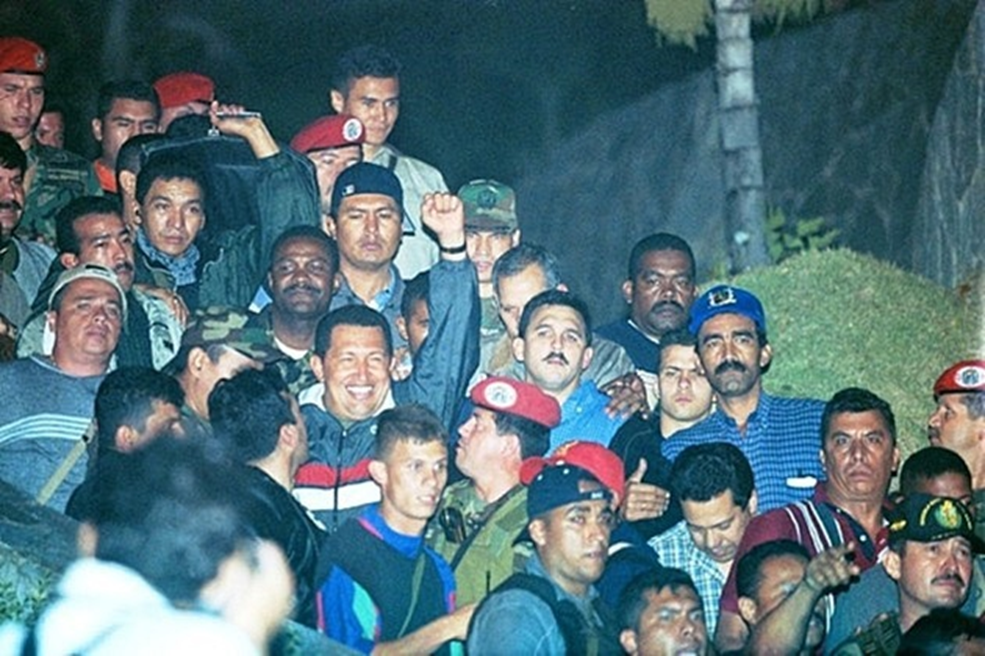
(Twenty years ago, April 11, 2002, sectors of the Venezuela military, in conjunction with support from the United States, launched a coup to oust former President Hugo Chavez from power in Venezuela. But, as the image below suggests, the vast majority of the people said “no” to the coup and they and most of the military released Chavez. Subsequently, before his death from natural causes, Chavez inspired a “Pink Tide” to create alternative economic and political institutions to challenge US hegemony in the Western Hemisphere. While the road has been rocky, the spirit of Chavez survives with the recent elections of progressives in Bolivia, Chile, Peru, Argentina, Nicaragua, Honduras, Mexico, and the Cuban Revolution remains a beacon of hope for the Global South).


A Brief History

As Greg Grandin argues in “Empire’s Workshop,” the rise of the United States as a global empire begins in the Western Hemisphere. For example, the Spanish/Cuban/American war provided the occasion for the United States to develop a two-ocean navy, fulfilling Assistant Secretary of the Navy Theodore Roosevelt’s dreams. After interfering in the Cuban Revolution in 1898 defeating Spain, the United States attacked the Spanish outpost in the Philippines, thus becoming a global power. Latin American interventionism throughout the Western Hemisphere, sending troops into Central American and Caribbean countries thirty times between the 1890s and 1933, (including a Marine occupation of Haiti from 1915 until 1934), “tested” what would become after World War II a pattern of covert interventions and wars in Asia, Africa, and the Middle East.

The Western Hemisphere was colonized by Spain, Portugal, Great Britain, and France from the fifteenth to the twentieth centuries. The main source of accumulated wealth that funded the rise of capitalism as a world system came from raw material and slave labor in the Western Hemisphere: gold, silver, sugar, coffee, tea, cocoa, and later oil. What Marx called the stage of “primitive accumulation,” was a period in world history governed by land grabs, mass slaughter of indigenous peoples, expropriation of natural resources, and the capture, transport, and enslavement of millions of African people. Conquest, land occupation, and dispossession was coupled with the institutionalization of a Church that would convince the survivors of this stage of capitalism’s development that all was “God’s plan.”

Imperial expansion generated resistance throughout this history.  In the nineteenth century countries and peoples achieved their formal independence from colonial rule. Simon Bolivar, the nineteenth century leader of resistance, spoke for national sovereignty in Latin America.

But from 1898 until the present, the Western Hemisphere has been shaped by US efforts to replace the traditional colonial powers with neo-colonial regimes. Economic institutions, class systems, militaries, and religious institutions were influenced by United States domination of the region.

In the period of the Cold War, 1945-1991, the United States played the leading role in overthrowing the reformist government of Jacob Arbenz in Guatemala (1954), Salvador Allende in Chile (1973), and gave support to brutal military dictatorships in the 1970s in Brazil, Argentina, Chile, and Uruguay. Also, the United States supported dictatorship in Haiti from 1957 until 1986. The Reagan administration engaged in a decade-long war on Central America in the 1980s.  In 1965 the United States sent thousands of marines to the Dominican Republic to forestall nationalist Juan Bosch from returning to power and in 1989 to overthrow the government of Manuel Noriega in Panama. (This was a prelude to Gulf War I against Iraq).

From 1959 until today the United States has sought through attempted military intervention, economic blockade and cultural intrusion, and international pressures to undermine, weaken, and destroy the Cuban Revolution.

Often during this dark history US policymakers have sought to mask interventionism in the warm glow of economic development. President Kennedy called for an economic development program in Latin America, called the Alliance for Progress and Operation Bootstrap for Puerto Rico. Even the harsh “shock therapy” of neoliberalism imposed on Bolivia in the 1980s was based upon the promise of rapid economic development in that country. 


The Bolivarian Revolution

The 21st century has witnessed a variety of forms of resistance to the drive for global hegemony and the perpetuation of neoliberal globalization. First, the two largest economies in the world, China and India, have experienced economic growth rates well in excess of the industrial capitalist countries. China has developed a global export and investment program in Latin America and Africa that exceeds that of the United States and Europe.

On the Latin American continent, under the leadership and inspiration of former President Hugo Chavez, Venezuela launched the latest round of state resistance to the colossus of the north, with his Bolivarian Revolution. He planted the seeds of socialism at home and encouraged Latin Americans to participate in the construction of financial institutions and economic assistance programs to challenge the traditional hegemony of the International Monetary Fund, the World Bank, and the World Trade Organization.

The Bolivarian Revolution stimulated political change based on varying degrees of grassroots democratization, the construction of workers’ cooperatives, and a shift from neoliberal economic policies to economic populism. A Bolivarian Revolution was being constructed with a growing web of participants: Bolivia, Ecuador, Brazil, Argentina, Uruguay, Nicaragua, El Salvador, and, of course, Cuba.

It was hoped that after the premature death of Chavez in 2013, the Bolivarian Revolution would continue in Venezuela and throughout the region. But the economic ties and political solidarity of progressive regimes, hemisphere regional institutions, and grassroots movements have been challenged by declining oil prices and economic errors; increasing covert intervention in Venezuelan affairs by the United States; a US-encouraged shift to the right by “soft coups” in Brazil, Argentina, Chile, and Ecuador; and a more aggressive United States foreign policy toward Latin America. Governments supportive of Latin American solidarity with Venezuela were temporarily undermined and/or defeated in elections in Honduras, Paraguay, Brazil, Argentina, and attacks in the Trump period (but not reversed by President Biden) escalated against what Trump’s former National Security Advisor John Bolton called “the troika of tyranny;” Venezuela, Nicaragua, and Cuba.  As Vijay Prashad put it: “Far right leaders in the hemisphere (Bolsonaro, Márquez, and Trump) salivate at the prospect of regime change in each of these countries. They want to eviscerate the “pink tide” from the region” (Vijay Prashad, thetricontinental.org, January 20, 2019).

Special Dilemmas Latin Americans Face

Historically all Western Hemisphere countries have been shaped and distorted in their economies, polities, and cultures by colonialism and neo-colonialism. They have also been shaped by their long histories of resistance to outside forces seeking to develop imperial hegemony. Latin American history is both a history of oppression, exploitation, and violence, and confrontation with mass movements of various kinds. The Bolivarian Revolution of the twenty-first century is the most recent exemplar of grassroots resistance against neo-colonial domination. Armed with this historical understanding several historical realities bear on the current threats to the Venezuelan government.

First, every country, with the exception of Cuba, experiences deep class divisions. Workers, peasants, the new precariat, people of color, youth, and women face off against very wealthy financiers, entrepreneurs, and industrialists, often with family ties, as well as corporate ties, with the United States. Whether one is trying to understand the soft coup in Brazil, the instability in Nicaragua, or the deep divisions in Venezuela, class struggle is a central feature of whatever conflicts are occurring.

Second, United States policy in the administrations of both political parties is fundamentally driven by opposition to the full independence of Latin America. US policy throughout the new century has been inalterably opposed to the Bolivarian Revolution. Consequently, a centerpiece of United States policy is to support by whatever means the wealthy classes in each country.

Third, as a byproduct of the colonial and neo-colonial stages in the region, local ruling classes and their North American allies have supported the creation of sizable militaries. Consequently, in political and economic life, the military remains a key actor in each country in the region. Most often, the military serves the interests of the wealthy class (or is part of it), and works overtly or covertly to resist democracy, majority rule, and the grassroots. Consequently, each progressive government in the region has had to figure out how to relate to the military. In the case of Chile, President Allende assumed the military would stay neutral in growing political disputes among competing class forces. But the Nixon Administration was able to identify and work with generals who ultimately carried out a military coup against the popular elected socialist government of Chile. So far in the Venezuelan case, the military seems to be siding with the government. Chavez himself was a military officer.

Fourth, given the rise of grassroots movements, the Bolivarian Revolution in Venezuela began to support “dual power,” particularly at the local level. Along with political institutions that traditionally were controlled by the rich and powerful, new local institutions of popular power were created. The establishment of popular power has been a key feature of many governments ever since the Cuban Revolution. Popular power, to varying degrees, is replicated in economic institutions, in culture, and in community life such that in Venezuela and elsewhere workers and peasants see their own empowerment as tied to the survival of revolutionary governments. In short, defense of the Maduro government, depends on the continuing support of the grassroots and the military.

Fifth, the governments of the Bolivarian Revolution face many obstacles. Small but powerful capitalist classes is one. Persistent United States covert operations and military bases throughout the region is another. And, perhaps most importantly, given the hundreds of years of colonial and neo-colonial rule, Latin American economies remain distorted by over-reliance on small numbers of raw materials and, as a result of pressure from international financial institutions, on export of selected products such as agricultural crops. In other words, historically Latin American economies have been distorted by the pressure on them to create one-crop economies to serve the interests of powerful capitalist countries, not diversified economies to serve the people.

Finally, and more speculatively, United States policy toward the region from time to time is affected by the exigencies of domestic politics. For example, each US administration has given undue attention to rightwing pressures from powerful counter-revolutionary Cubans, mostly in Florida. Foreign policy often is a byproduct of domestic politics.

Where do Progressives Stand

First, and foremost, progressives should prioritize an understanding of imperialism, colonialism, neocolonialism, and the role of Latin American as the “laboratory” for testing United States interventionist foreign policies. This means that critics of US imperialism can be most effective by avoiding “purity tests” when contemplating political activism around US foreign policy. That is, the main task should be opposing US intervention in the affairs of other countries not judging their institutions and policies. One cannot forget the connections between current patterns of policy toward Venezuela, with the rhetoric, the threats, the claims, and US policies toward Guatemala, Haiti, the Dominican Republic, Cuba, Brazil, Argentina, Chile, Nicaragua, El Salvador, Panama, and in the new century, Bolivia, Venezuela, Paraguay, Brazil, and Argentina.

Second, progressives need to show solidarity with grassroots movements in the region, support human rights, oppose military interventions, and demand the closure of the myriad of United States military bases in the region and end training military personnel from the region. (When citizens raise concerns about other countries interfering in the US political system, it is hypocritical for the United States to interfere in the political and economic lives of other countries in Latin America.).

Finally, progressives must oppose all United States foreign policies that are designed to maintain twenty-first century forms of imperialism in the Western Hemisphere. Support for progressive candidates for public office should require that they oppose economic blockades, punishing austerity programs imposed by international financial institutions, the maintenance of US ties with ruling classes in the region; essentially all forms of interference in the economic and political life of the region. And, as progressives correctly proclaim about domestic life, their candidates should be in solidarity with the poor, oppressed, and marginalized people of the Western Hemisphere. Progressives cannot with integrity support the “99 percent” in the United States against the “1 percent” without giving similar support for the vast majority of workers, farmers, women, people of color, and indigenous people throughout the hemisphere.

And if it is true that US policy toward Latin America is a laboratory for its policy globally, the same standard should be applied to United States policy globally. 

The time has come for the articulation of a comprehensive stand against United States imperialism in the Western Hemisphere, and around the world.

-A useful history of United States interventionism can be found in Stephen Kinzer, Overthrow: America’s Century of Regime Change from Hawaii to Iraq, Henry Holt, 2006.

-On the anniversary of the Venezuelan coup attempt see:

https://peoplesdispatch.org/2022/04/16/venezuela-commemorates-20th-anniversary-of-the-failed-coup-against-hugo-chavez/#


Tuesday, April 12, 2022

REVISITING MILITARY SPENDING :WAR REENVIGORATES THE MILITARISTS WHILE DOMESTIC NEEDS GET IGNORED

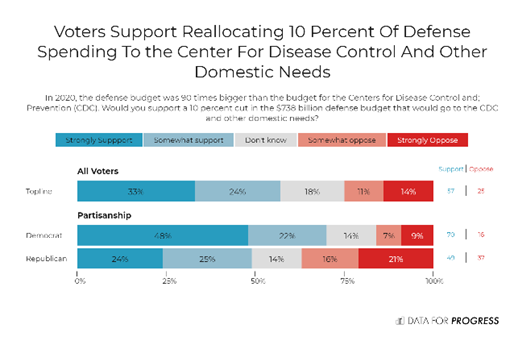
(Although the essay below is old  (2012) and the argument familiar, referring to and updating the ICAN and Frank/Paul studies-see the bold text below-might provide a path to reductions in military spending. In addition the 2020 polling data, see the link below, suggests that Americans prefer “moving the money” from military to domestic needs and Barbara Lee has introduced useful legislation to do just that).

Harry Targ


“From Forrestal’s day to the present, semi-warriors have viewed democratic politics as problematic. Debate means delay. To engage in give-and-take or compromise is to forfeit clarity and suggests a lack of conviction. The effective management of national security requires specialized knowledge, a capacity for clear-eyed analysis and above all an unflinching willingness to make decisions, whatever the cost. With the advent of the semi-war, therefore, national security policy became the preserve of experts, few in number, almost always unelected, habitually operating in secret, persuading themselves that to exclude the public from such matters was to serve the public interest. After all, the people had no demonstrable “need to know.” In a time of perpetual crisis, the anointed role of the citizen was to be pliant, deferential and afraid.” (from a review of a biography of James Forrestal, the first Secretary of Defense by historian Andrew Bacevich in The Nation).

Andrew Bacevich reminds us that a permanent war economy has been part of the political and economic landscape of the United States at least since the end of World War II. The War Resisters League pie chart of total government spending for fiscal year 2013 indicates that 47 percent of all government spending deals with current and past military costs. Despite lower government estimates that mask true military spending, by adding the Social Security Trust Fund to total spending and regarding past military spending-- particularly veteran’s benefits-- as non-military, it is clear that roughly fifty cents of every dollar goes to war, war preparation, covert operations, and military contractors.

In addition “war support” contractors, such as KBR, have made billions of dollars in the twenty-first century from military spending. Top producers of military hardware, Lockheed Martin, Northrop Grumman, and Boeing earned 11, 8, and 5 billion dollars in contracts in 2010 alone. Ostensibly non-military corporations such as BP, FedEx, Dell, Kraft, and Pepsi received hundreds of millions of dollars in defense contracts in 2010. Virtually every big corporation is to some degree on the Department of Defense payroll.

A recent data-based report, “Don’t Bank on the Bomb,” prepared by the International Campaign to Abolish Nuclear Weapons (ICAN) identified “…more than 300 banks, insurance companies, pension funds and asset managers from 30 countries that invest significantly in 20 major nuclear weapons producers.” The report examined in detail financial connections to 20 major nuclear weapons companies. These 20 included US producers of nuclear weapons components such as Bechtel, Boeing, GenCorp, General Dynamics, Honeywell, and Northrop Grumman. US financial institutions investing in the nuclear weapons producers included Abrams Bison Investments, AIG, American National Insurance Company, Fidelity, Franklin Templeton, JP Morgan Chase, New York Life, and Prudential Financial.

Because of the economic crisis which began in 2007, debate about military spending has increased. In 2010 Congressmen Barney Frank and Ron Paul initiated a study addressing needed cuts. The report prepared for them in 2010, “Debt, Deficits, and Defense,” called for across the board reductions in spending-procurement, research and development, personnel, operations and maintenance, and infrastructure--of $960 billion over the next decade. The report noted that over the last decade 65 percent of federal discretionary spending went to the military.
(For a July, 2021 legislative proposal for cutting military spending see Congresswoman Barbara Lee’s press release below.*)

President Obama last January proposed more modest spending cuts of $480 billion over the next decade (reductions in projected increases not existing funding). He coupled announcement about future spending with a firm statement that the world must realize that the United States remains committed to maintaining its military superiority. The President indicated that spending reductions in the future will be tied to greater use of “special operations,” drones, and shifting existent forces from Europe to Asia.

The magnitude of military spending represents what Bacevich referred to as the permanent war economy articulated and defended by the “semi-warriors” dominating U.S. foreign policy in each administration since World War II. These semi-warriors gained influence after the Truman Administration accepted recommendations in National Security Document Number 68 (1950), which recommended that defense spending should always have priority over all other government spending. NSC 5412, approved by President Eisenhower, gave legitimacy to covert operations around the world allowing any president to “plausibly deny” any connections with such operations. Subsequently virtually each president proclaimed a doctrine--Eisenhower for the Middle East, Carter for the Persian Gulf, Reagan to rollback “the evil empire,” Clinton for “humanitarian interventions” and Bush for “preemptory attacks”-- justifying more and more military spending.

The Obama administration, through speeches and actions has constructed what might be called “the Obama Doctrine.” First, as the last remaining superpower and the beacon of hope for the world, the United States once again reserves the right and responsibility to intervene militarily to enhance human rights around the world. Second, U.S. humanitarian military interventions will be carried out from time to time with our friends. Third, new technologies such as drones will allow these interventions to occur without “boots on the ground.” They will be cheaper in financial and human cost (mostly for American troops). Finally, assassinations and covert killings have made it clear that the Obama Doctrine overrides recognized judicial proceedings and the sanctity of human life.

Since the establishment of the permanent war economy in the 1940s millions of proclaimed “enemies” have been killed and seriously injured, mostly in the Global South. Permanent physical and psychological damage has been done to U.S soldiers, predominantly poor and minorities as they too are victims of war. In addition, military spending has distorted national priorities and invested U.S. financial resources in expenditures that do not create as many jobs as investments in construction, education, or healthcare. And the permanent war economy has created a culture that celebrates violence, objectifies killing, dehumanizes enemies, and exalts super-patriotism through television, music, video games, and educational institutions.

These issues need to be more vigorously related to those raised by the grassroots campaigns that have sprung up to defend worker’s and women’s rights, oppose growing income and wealth inequality, and defense of working people’s homes from foreclosures. A long time ago in reference to the massive U.S. war in Southeast Asia and desperate needs of workers at home Dr. Martin Luther King described the fundamental connections that peace activists and all progressives must pursue: “I speak of the poor of America who are paying the double price of smashed hopes at home, and death and corruption in Vietnam.”

**************************************************************************

Polling data from 2020 suggests that a majority of the American people prefer reallocating military spending for domestic purposes.


https://www.dataforprogress.org/blog/2020/7/20/cut-the-pentagons-budget

*********************************************************************


*CONGRESSWOMAN BARBARA LEE INTRODUCES LEGISLATION TO CUT $350 BILLION FROM PENTAGON BUDGET

June 16, 2021

Washington, D.C. – Congresswoman Barbara Lee (CA-13) recently introduced legislation detailing up to $350 billion in cuts to the Defense budget. Congresswoman Lee released the following statement:

“As we continue to fight a pandemic and economic crisis that has pushed millions into poverty, it’s clearer than ever that a bloated defense budget does not meet our national security needs. Instead of wasting billions of dollars on forever wars around the globe, we should be investing in housing, education, food assistance, clean water for our communities, as well as work to strengthen our diplomatic ties. 

“Over the past two decades, the United States has designated approximately $6.4 trillion toward military operations. For this year alone, the Pentagon’s budget totaled $740.5 billion, which proved to be ineffective in addressing the true national security threats we face today, including an unprecedented public health crisis and economic crisis.  

“Analysis shows that we can significantly reduce our defense spending without sacrificing our national security or reducing the support for our service members. As Co-chair of the Defense Spending Reduction Caucus, I’m leading this effort to redefine our nation’s priorities and work toward a more peaceful and prosperous world.”  

This legislation's proposals include: 

·         Cutting private service contracting by 15% to save $26 billion 

·         Eliminating Space Force to save $15.2 billion 

·         Cutting unnecessary, obsolete, and excessive weapons systems to save $57.9 billion 

The Bookshelf

CHALLENGING LATE CAPITALISM by Harry R. Targ

Challenging Late Capitalism